Blog

  • Finally: Bras That Fit a 40-48 Band With a Small Cup (We Found Them)

    Finally: Bras That Fit a 40-48 Band With a Small Cup (We Found Them)

    Every bra in every store you have ever walked into began as one sample, sewn to fit one fit model, in one core size somewhere near the middle of the chart. That sample gets approved in a showroom, and then a technician grades it: the pattern is scaled up and down in fixed steps until it covers the whole size run. I sat through enough fit sessions in my magazine years to tell you the part nobody says out loud. The grade doesn’t just widen the band as the sizes climb. It inflates the cup at the same time, automatically, because the pattern math assumes that a bigger torso always comes with a proportionally bigger bust.

    That assumption is the entire reason you can’t find your size. Bodies don’t scale like patterns. Plenty of women carry their width in the ribcage, the back, the shoulders, the belly, and not in the breast. Some were built that way from the start. Some arrived there through menopause, weight change, breastfeeding, or reduction surgery. The industry’s grading table has no row for any of them, so the woman who measures a wide band and a shallow cup walks into a fitting room and gets told, with a straight face, that her size doesn’t exist. It exists. Her body is standing right there. What doesn’t exist is the inventory.

    And the inventory doesn’t exist because of a spreadsheet, not a conspiracy. Every band and cup combination a brand cuts is its own SKU, its own fabric commitment, its own slice of a retail buyer’s open-to-buy budget. The combinations at the corners of the size grid sell the slowest, so when a line gets rationalized, the corners die first. The proof is brutal: the one modern brand I know of that built a dedicated big-band-small-cup collection, Understance, has permanently closed. When you search this problem, you get a Reddit fitting forum, a couple of brand collection pages, and nothing editorial. That’s the hole this article fills.

    One honesty note before the list, because I don’t fake try-ons. I haven’t wear-tested these across a size run I don’t wear. What I did was pull the official size charts and the live stock on every pick below, because in this category the standard failure is a brand that claims the range on its chart and then quietly never cuts the small cups past a certain band. Every bra in this table was verified in the range it claims, on a real product page, this season. Where a pick has a flaw, I name it.

    A B Cup on a 46 Band Is Not a Small Breast
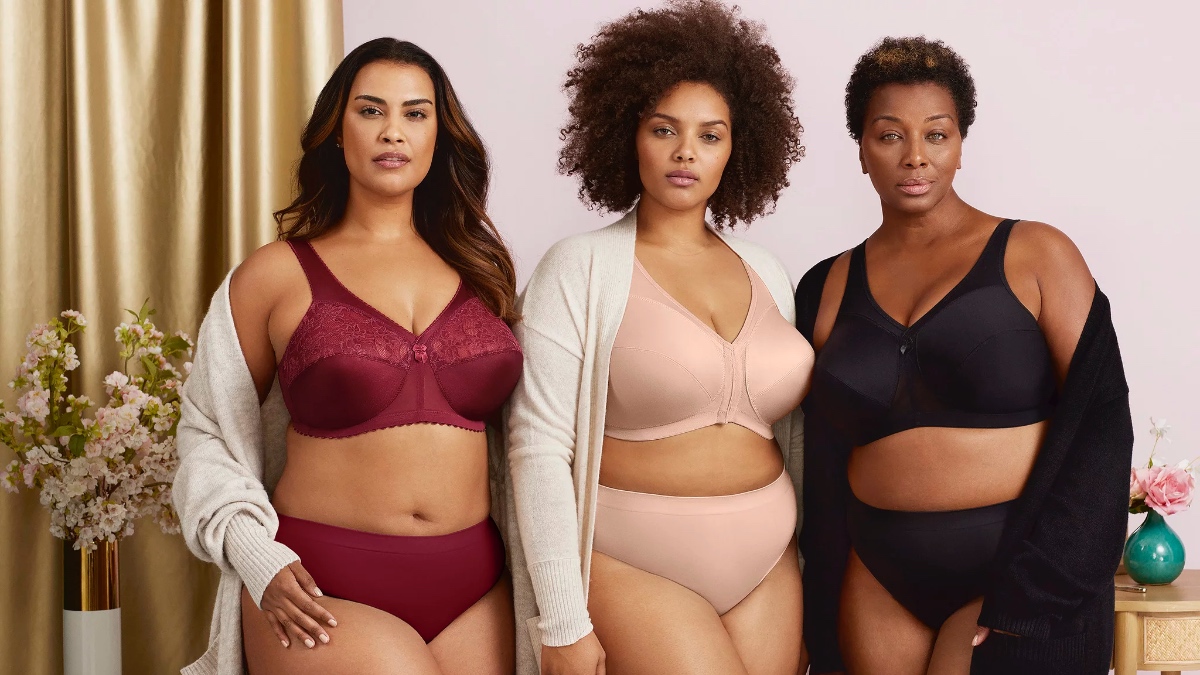
    A B Cup on a 46 Band Is Not a Small Breast

    Get one piece of mechanics straight, because it fixes both your shopping and your self-talk. A cup letter is not an amount of breast. It’s a ratio: the difference between your bust measurement and your band measurement. The same letter holds more actual volume every time the band steps up, which means a B cup on a wide band contains noticeably more tissue than the same letter on a narrow one. You are not a mislabeled teenager’s size. You’re a normal proportion the grading table refuses to cut.

    This also explains why the usual advice fails. “Just wear a bralette” collapses because most bralettes are alpha-sized and the largest letter usually maps to a band in the low forties at best, cut for a fuller bust besides. “Just take the cup that’s on the rack” fails worse: a deeper cup on your correct band gapes at the top, the neckline bows away from your chest, and the straps slide because the cup isn’t loaded. The fix is never more cup. It’s a brand that actually grades a shallow cup onto a long band, and there are fewer of those than there should be. Here’s who still does it.

    The Bras, Compared
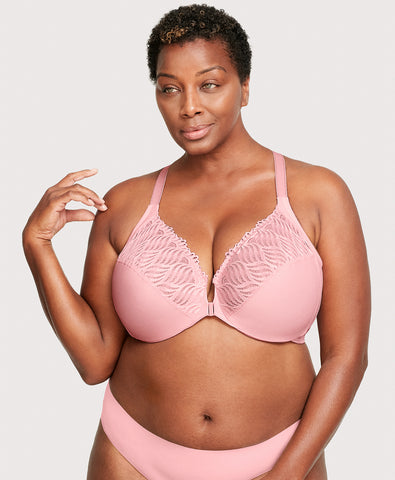
    The Bras, Compared

    Bra Band range Cup floor Why it works
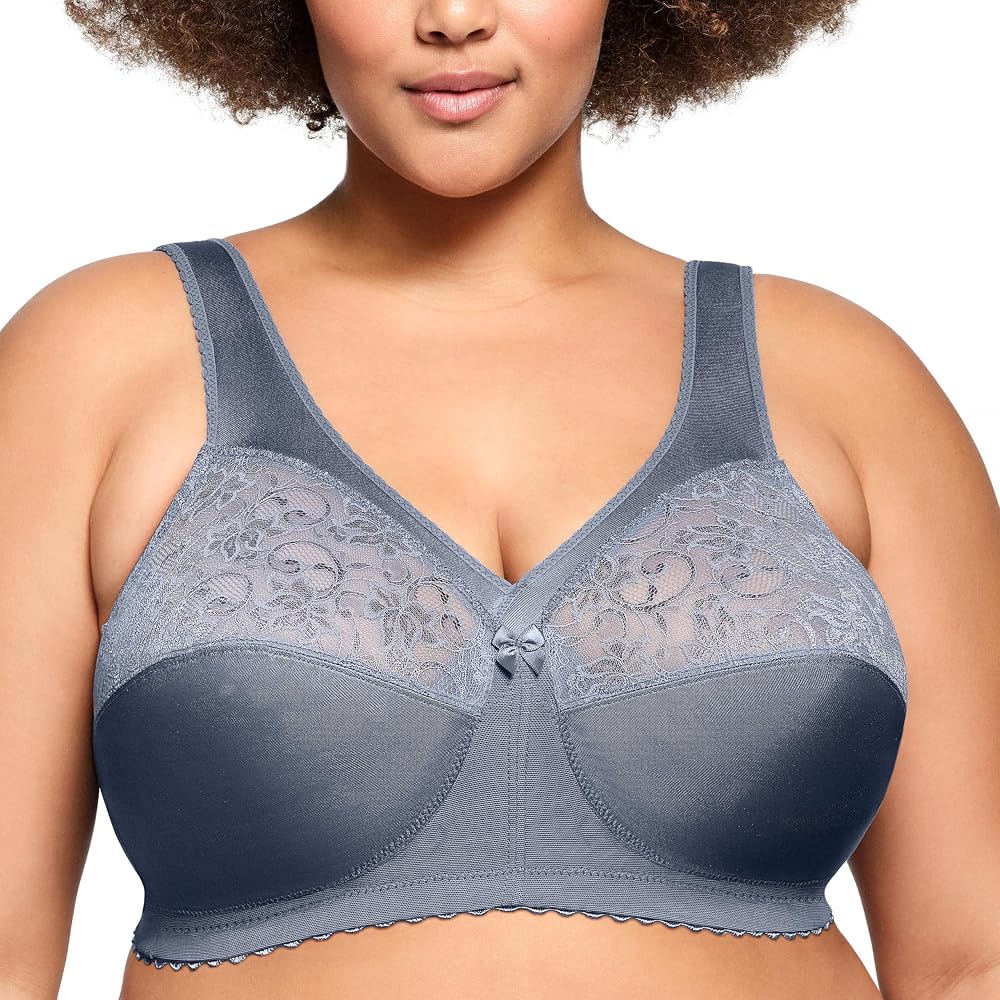
    Glamorise MagicLift Original (1000) 36-56 B, stocked to the last band Crisscross inner-bust band lifts without a wire; the rare grading table with a full corner
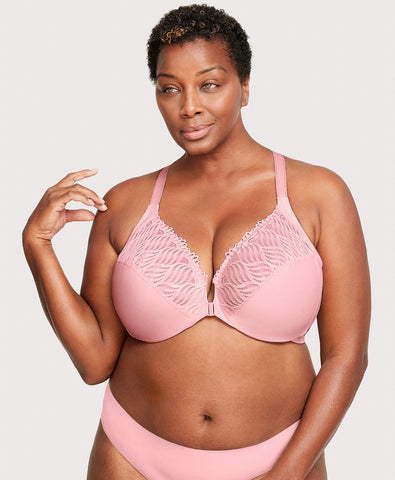
    Glamorise MagicLift Front-Closure Posture Back (1265) 36-58 B, verified through 58B Front hooks that add rows as sizes climb, crisscross posture back, widest band run here
    Leading Lady Brigitte Full Coverage (5042) Through 48 A (48A verified at Target) True A cups on plus bands; light molded padding stops the shallow-cup gape under tees
    Leading Lady Serena (514) 38-58 Multi-size B/C/D cup Cotton wireless racerback; the stretch cup absorbs the shallow fit instead of gaping
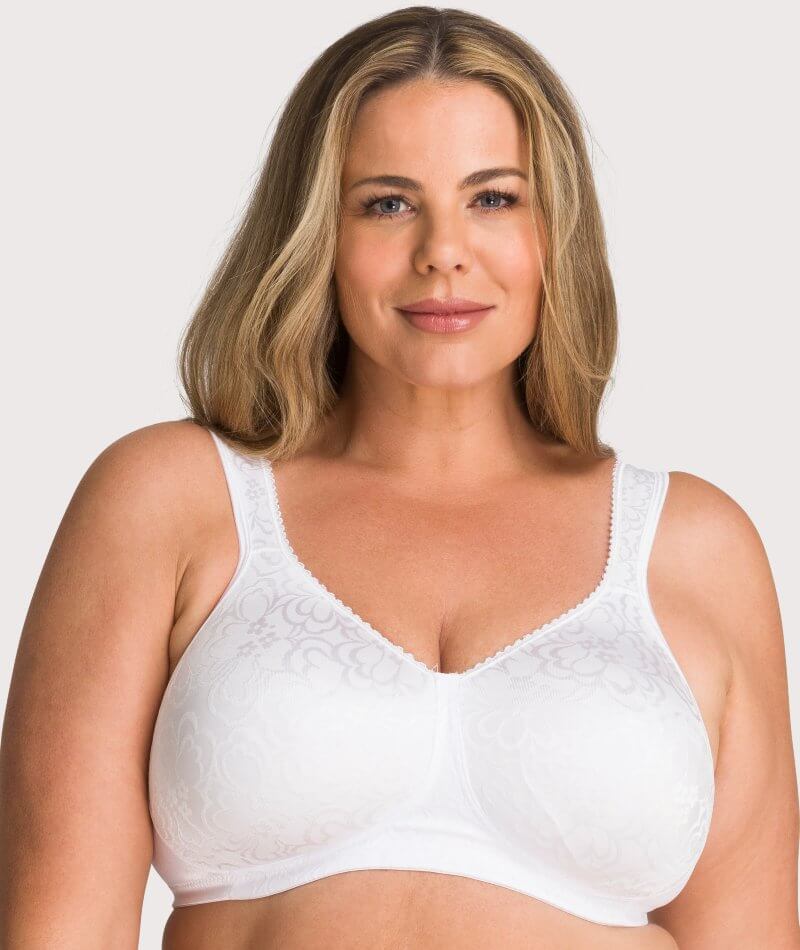
    Playtex 18 Hour Ultimate Shoulder Comfort (4693) 36-50+ (46B, 48B verified) B Cushioned wide straps, department-store availability, decades of pattern refinement
    Playtex 18 Hour Seamless ComfortFlex (4395) 46B verified on Amazon B Smooth knit version of the same block for anyone who hates seamed cups
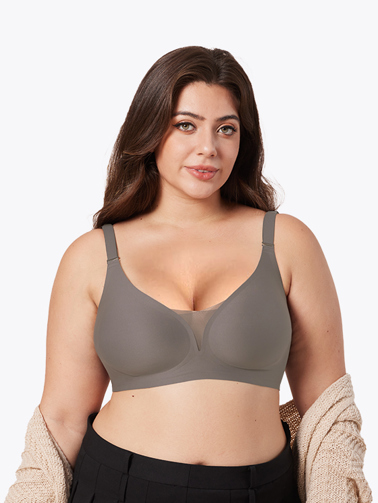
    DELIMIRA Posture Front Closure Wireless Plus bands (46B verified) B Amazon-native brand that grades B cups across the plus range; easy returns for fit roulette
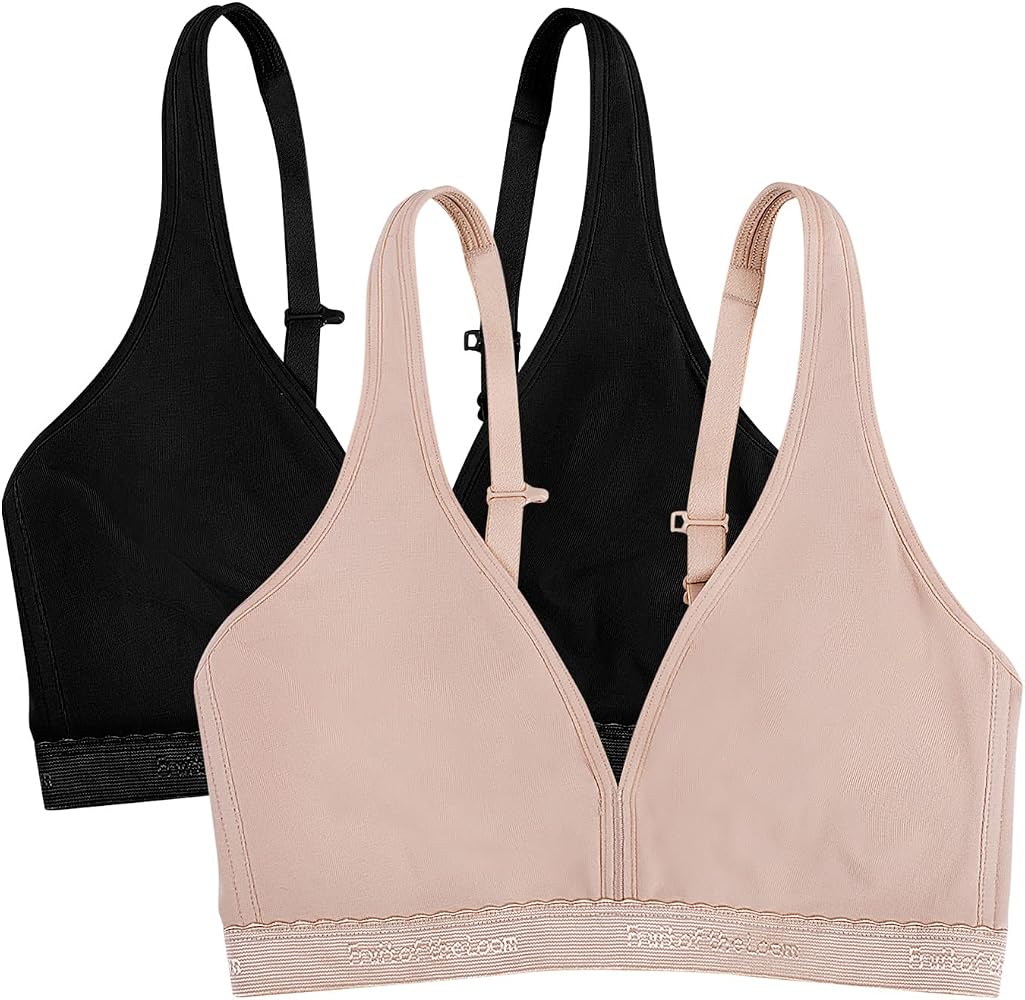
    Fruit of the Loom Beyond Soft Front Closure (96014) 34-48, band-only sizing None; unlined stretch cotton No cup grading to fail you; the honest bralette answer at a wide band, in a multipack

    Glamorise: The Only Grading Table With a Full Corner
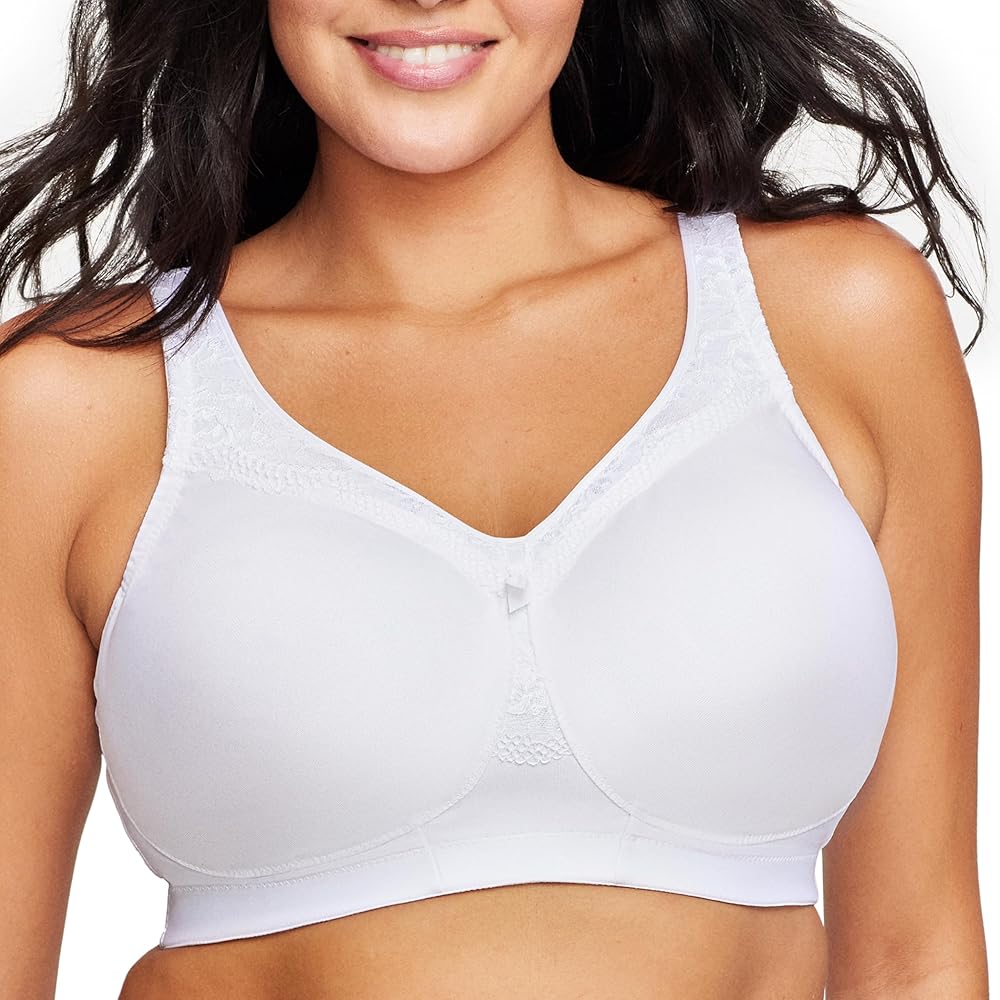
    Glamorise: The Only Grading Table With a Full Corner
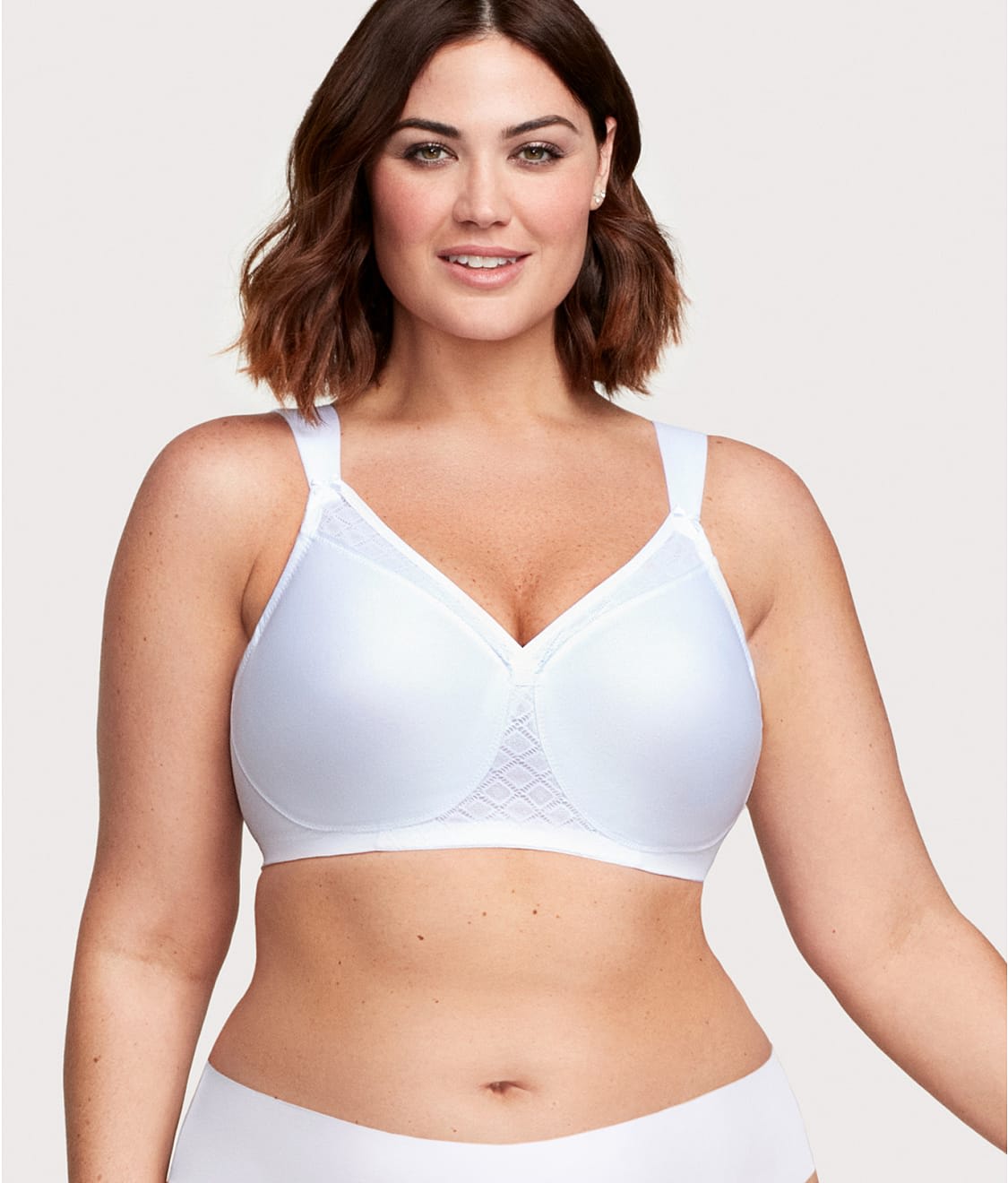
    Glamorise MagicLift wire-free bra

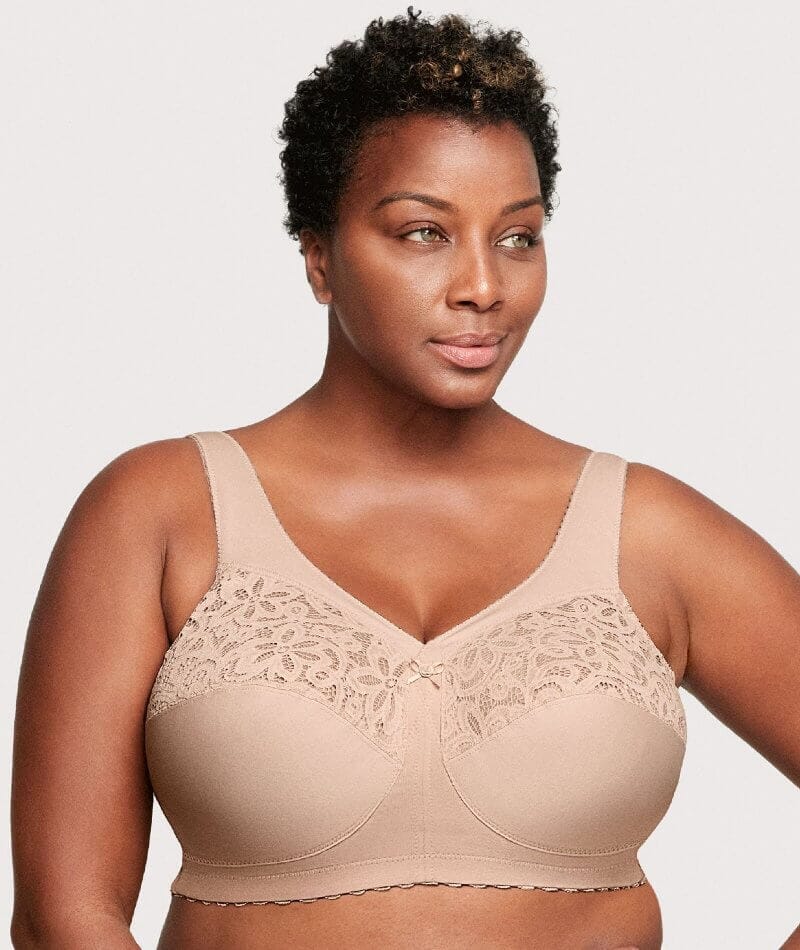
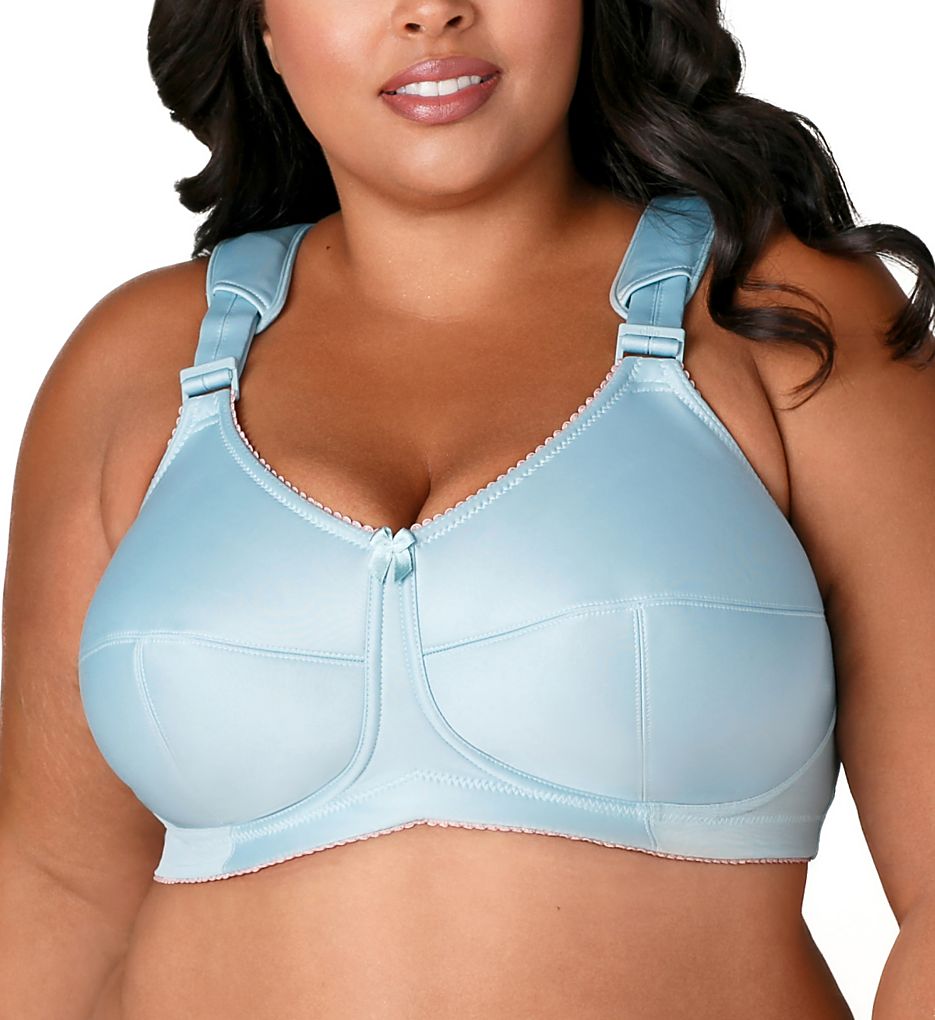
    Glamorise has been cutting wire-free support bras in New York since the twenties, and their size architecture is the industry exception that proves my opening point. Most brands drop the small cups the moment the band leaves straight sizes. Glamorise grades its B cup all the way out: the MagicLift Original’s own product FAQ lists 46B and 48B as plainly as any middle-of-the-chart size, and the cups keep pace to the end of the band run. The support mechanism matters for this body, too. Instead of a wire, there’s a cushioned band that crisscrosses under and over the bust, so the lift comes from the frame of the bra rather than from cup volume you don’t have. Wide padded straps and a hook-and-eye that adds rows as sizes climb finish the job.

    Two caveats, because I promised them. The classic MagicLift carries a lace overlay on the cup, so if lace against the neckline is a dealbreaker, this isn’t your style, and the two-piece seamed cups read classic rather than sleek under a thin tee. The front-closure Posture Back version answers a different brief: hooks in front for anyone with shoulder mobility issues, a crisscrossed stretch panel across the back that genuinely pulls the shoulders back, and the widest band run in this entire roundup, with the B cup verified to the very last band on the chart. The brand’s own FAQ admits the seamed cups give a slightly pointed silhouette, which I appreciate as disclosure. List prices sit at $59 and $62 respectively, and Glamorise discounts so constantly that paying list is a rounding error.

    Leading Lady: The Brand That Names the Problem
    Leading Lady: The Brand That Names the Problem
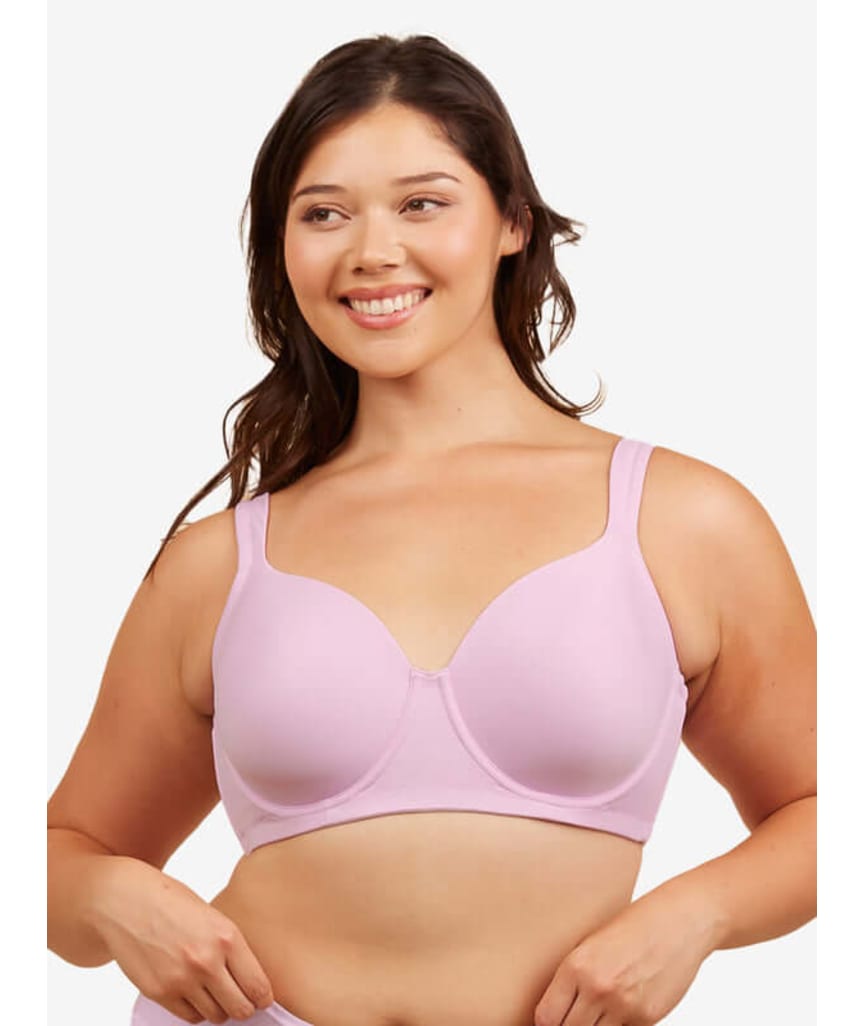
    Leading Lady Brigitte wire-free bra

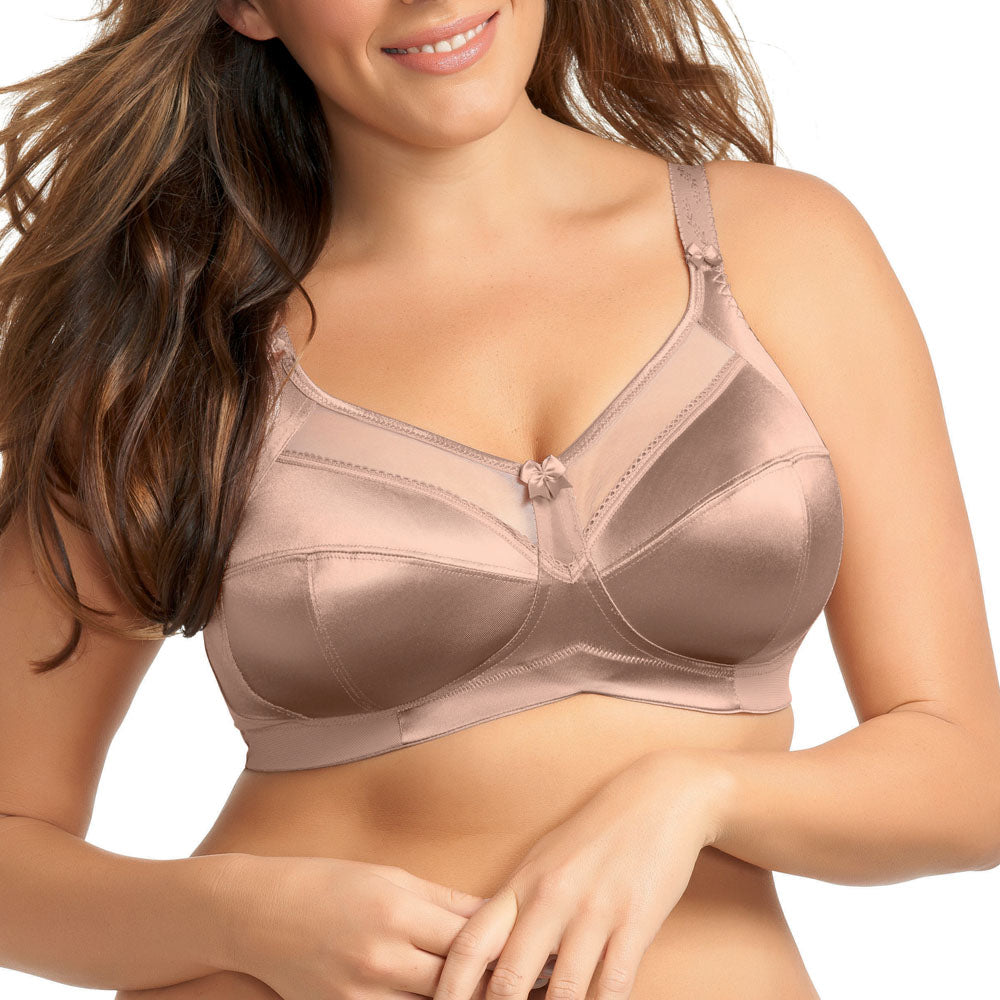
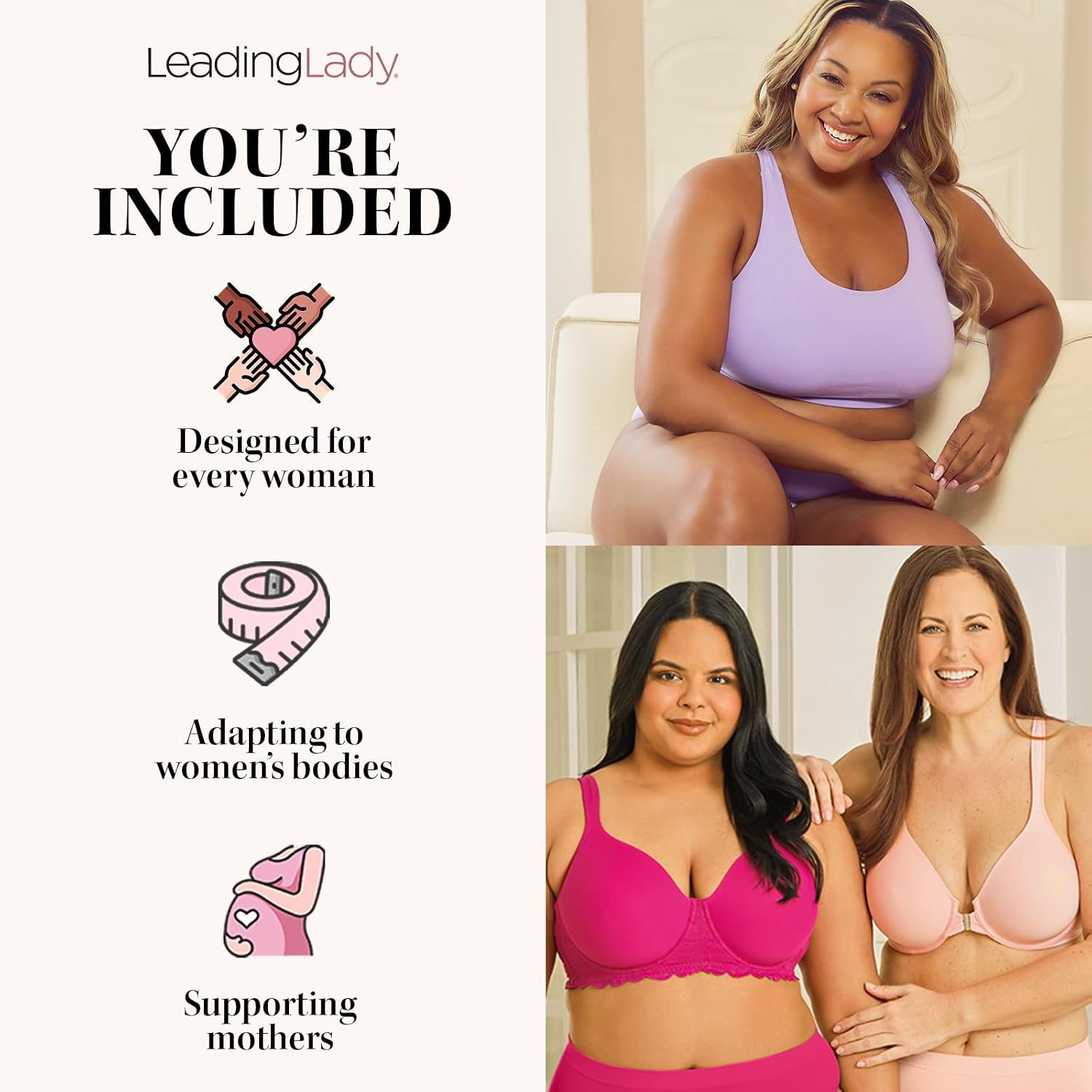
    Leading Lady is the only company I found that treats this fit as a merchandising category instead of an accident. Their site navigation has a section literally called Large Band Small Cup, filed under hard-to-find sizes, and the collection behind it is real: filtering their wireless range to a 46 band with a B cup returns dozens of styles, not the two sad leftovers you’d expect. They’re also the only maker on this list cutting a true A cup on plus bands. The Brigitte Full Coverage is the pick there, a lightly padded wireless t-shirt bra whose thin molded cup does quiet, important work: foam holds its own shape, so a slightly shallow fit doesn’t announce itself by collapsing or gaping the way an unlined seamed cup would. I verified the deepest A-cup size sitting on Target’s site, which tells you the distribution is mainstream, not specialty-boutique.

    The other Leading Lady style worth your cart is the Serena, a cotton wireless racerback that solves the problem from a different angle: multi-size stretch cups. One cup piece covers the B-through-D range, and because the fabric is almost all cotton with just enough spandex to recover, the cup conforms downward to a shallow bust instead of standing empty. It runs to bands most brands have never cut, costs $35 before the brand’s frequent sitewide codes, and works as a sleep bra, a lounge bra, and a light-impact gym bra in one. The honest limit: multi-size cups mean gentle shaping, not lift. This is the comfort workhorse, not the under-a-silk-blouse bra.

    The Everywhere Tier: Playtex 18 Hour
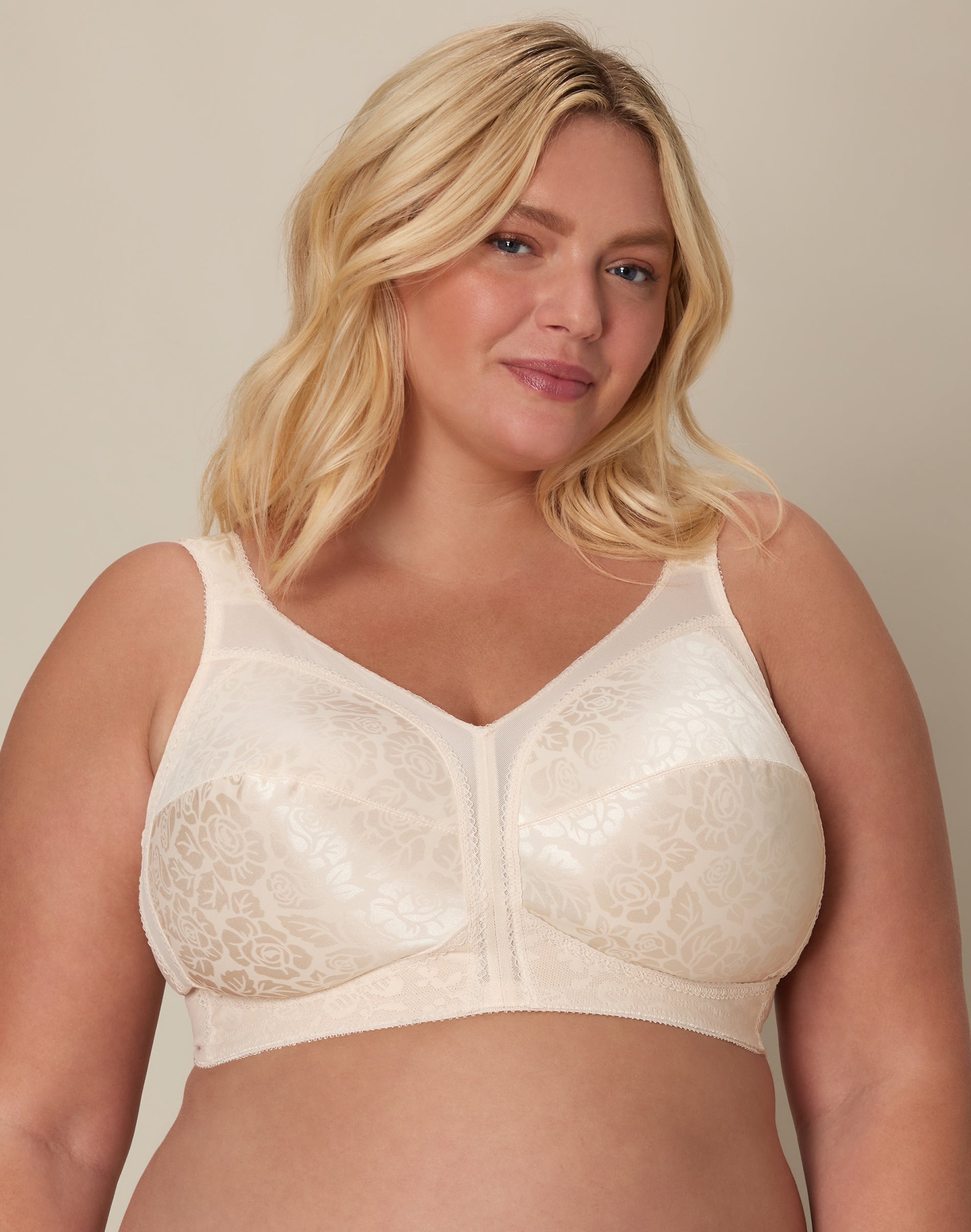
    The Everywhere Tier: Playtex 18 Hour
    Playtex 18 Hour Ultimate Lift bra

    If you want to solve this at a department store this weekend instead of waiting on a shipping window, the answer has been hanging on the same rack since your grandmother’s era, and I mean that as a compliment. The Playtex 18 Hour block is one of the most-refined wireless patterns in American retail, and unlike almost every newer competitor, it still gets cut in B cups on wide bands: I verified both of the deep-band B sizes this article exists for sitting in stock at a regional department chain, with Amazon, Kohl’s, Macy’s and the rest carrying the family. The Ultimate Shoulder Comfort version is the one to grab for this fit, because its selling point is exactly where a shallow-cup wearer hurts: wide, cushioned straps that don’t dig when the band, not the cup, is doing all the work.

    Its sibling solves the texture complaint. The Seamless ComfortFlex takes the same engineering and swaps the seamed cups for a smooth knit, and Amazon stocks it in the wide-band B sizes this article exists for. Neither Playtex will win a lingerie editorial; both will be on your body five days a week. Street prices run well under either Glamorise, especially in multipacks, which makes this the tier where you buy two and stop rationing laundry days around one bra.

    The Amazon-Native Fix: DELIMIRA
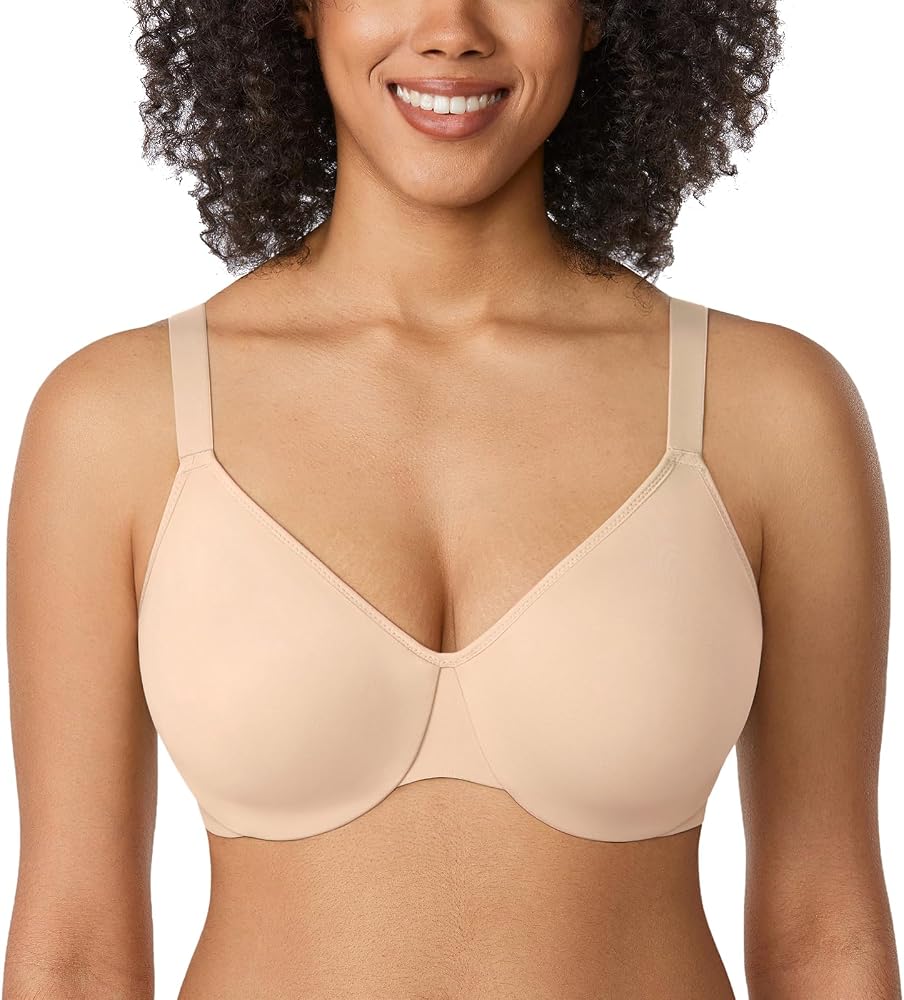
    DELIMIRA minimizer bra

    DELIMIRA is the brand the fitting forums keep surfacing for this exact intersection, and it’s a genuinely interesting animal: an Amazon-native label that decided the underserved plus-size chest was its whole business, grading from a B cup up through the deep letters instead of starting at a D like most full-figure lines. The style I verified in the range is their posture front-closure wireless, a seamless back-smoothing design with front hooks, sitting in stock in a 46B as I wrote this. They also cut unlined underwire minimizers and full-coverage styles if you actually want a wire, which almost nobody else offers a wide-band B wearer at any price.

    Buy it the smart way: through Amazon with free returns, in two candidate sizes if you’re between measurements. An imported label’s grading always drifts a little from the American blocks, and the reviews on any given DELIMIRA listing disagree about whether it runs snug in the band. With a return window, that’s an afternoon of fit testing at home, which is more than any mall in America currently offers this size.

    When the Cup Letter Stops Mattering
    Fruit of the Loom wire-free cotton bra

    There’s a whole category that routes around the grading problem instead of solving it: bras sized by band alone, with unlined stretch cups that fit whatever sits in front of them. This is what people mean when they say a bralette works, except most bralettes stop at a band far too short for this article. The one that doesn’t is Fruit of the Loom’s Beyond Soft front-closure cotton bra, cut in band-only sizing to a 48, unlined, with a front hook-and-eye and nothing inside the cup to gape, pucker, or stand empty. It’s sold in multipacks at Walmart for less than a single bra costs anywhere else on this page. It will not lift anything, and it isn’t trying to. As the weekend bra, the work-from-home bra, and the first thing you order while you fit-test the structured picks, it’s exactly right.

    One more name belongs in this conversation with an asterisk: ThirdLove. Their size grid runs B-cup collections through a 46 band, and they’re the only maker here offering half-cup sizes, which is a real gift when a shallow bust leaves you permanently between letters. The asterisks are the band ceiling, which stops short of the deepest sizes in this article, the direct-only distribution, and a price around $74 for the flagship t-shirt bra before promotions. If your band sits at the lower end of this article’s range and you want the most polished cup of the bunch, take their fit quiz. If you’re at the upper end, the picks above serve you and ThirdLove doesn’t yet.

    Sister Sizing Down, Explained Correctly

    Now the technique that unlocks every rack this article can’t fix, because most explanations of it are wrong in a way that specifically hurts you. Sister sizes are bra sizes that hold the same cup volume on different bands. The rule runs on a diagonal: step the band down one size and the cup letter goes up one, and the actual space inside the cup hasn’t changed at all. Step the band up, the letter drops. The letter changed because the ratio changed, not the breast.

    Here’s why that matters when your calculated size doesn’t exist. You order the sister size one band down, which does exist far more often, and you recover the lost band length with a hook-on extender, a flat little strip of extra hook-and-eye rows that costs pocket change. The cup fits exactly as your true size would have, and the band circles back to your real measurement. A multipack of band extenders in every hook width belongs in your drawer permanently. It’s the single cheapest fix in this entire category.

    Your measured size Sister size down (same cup volume) What to add
    48A 46B Band extender to restore length
    46A 44B Band extender to restore length
    44A 42B Band extender to restore length
    48B 46C Band extender to restore length

    And the move to refuse, the one the department-store fitter will offer you with total confidence: taking your correct band in whatever deeper cup happens to be on the rack. That is not sister sizing. That’s a bigger cup, full stop, and it buys you the gaping neckline, the sliding straps, and the wrinkled cup under knits that probably sent you searching for this article in the first place. If the cup is too deep, no band adjustment will ever fix it. Volume is the one thing you can’t alter out.

    What Goes in the Cart for a 46 Band and a Shallow Cup

    So here’s the order I’d actually place, and I’ll be as specific as I’d be for a friend. Start with the Glamorise MagicLift Original in your measured size as the structured everyday anchor; it’s the pick I’d trust most to arrive fitting the way the chart promised, and at its usual sale price of about $41 it’s not a gamble. Add the Fruit of the Loom front-close multipack in your band number the same day, so something comfortable arrives fast while you fit-test. If you measure into A cups, the Leading Lady Brigitte is the only molded t-shirt cup being cut for you at a mainstream retailer, and it’s worth the $44 before codes. Toss the extender multipack in the cart no matter what you order, because the sister-size trick will eventually rescue you on some rack this article never covered. Your size was never missing from your body. It was missing from a spreadsheet, and now you know exactly whose spreadsheet still has the row. The links are above.
  • Gym Leggings That Actually Stay Up Over an Apron Belly: Picks by Size, From the Reviews That Matter

    Gym Leggings That Actually Stay Up Over an Apron Belly: Picks by Size, From the Reviews That Matter

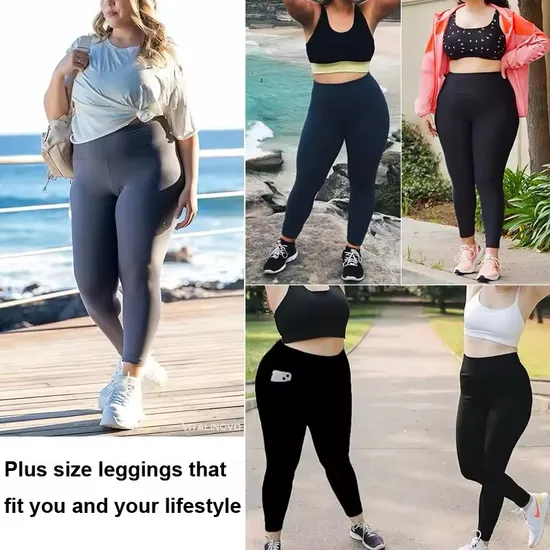
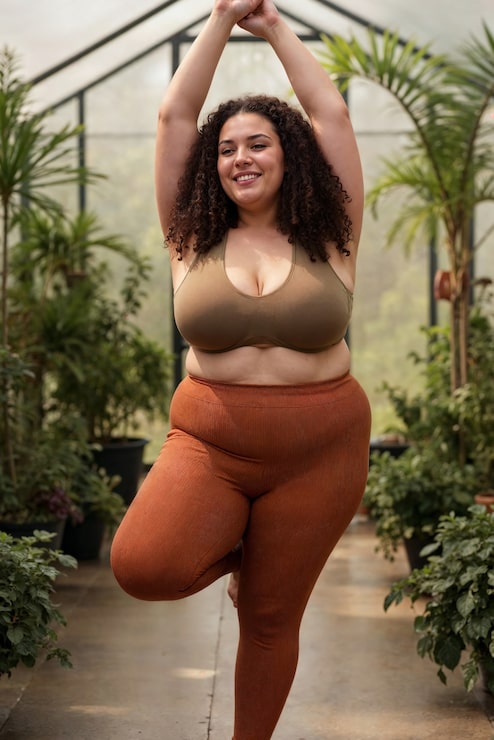
    It happens on the treadmill first, usually around the second incline interval. The waistband that felt fine in the locker room starts its slow crawl, folding over itself where your belly pushes against it, until you’re doing that two-thumb hitch between strides that everyone at the gym pretends not to see. By the time you hit the mat work, you’re not thinking about form. You’re managing a garment. Women with an apron belly describe this exact loop in fitness forums over and over, and the answers they get are usually a shrug and a link to an Amazon search page.

    Here’s the part nobody tells you: the roll-down is not your body failing the leggings. It’s the leggings failing a predictable engineering problem. An apron belly is soft tissue that sits over the waistline and moves when you move. A waistband parked on top of that tissue is sitting on a slope, and elastic under tension always migrates toward the narrowest point. If the band doesn’t clear the apron entirely and anchor above it, at the natural waist, it will roll. Every time. No amount of sizing down and suffering changes the physics. What changes it is construction: band width, band height, layering, and something for the band to grip.

    Before we go further, the disclosure I owe you: I haven’t taken every pair on this list through a workout, and I’m not going to stage a fake sweat test to sound authoritative. What I bring instead is the skill set from eight years as a department store retail buyer, which is mostly the unglamorous ability to read thousands of customer reviews fast and find the pattern. For this piece I filtered specifically for verified buyers who mention an apron belly, a hanging stomach, a c-section shelf, or plus sizing, and I read what they said about one thing only: does the waistband stay up. Everything below is their testimony, organized by someone who used to decide which of these garments got a purchase order.

    What Actually Keeps a Band Up, According to the People Wearing One

    The Gym People high waisted tummy control leggings waistband

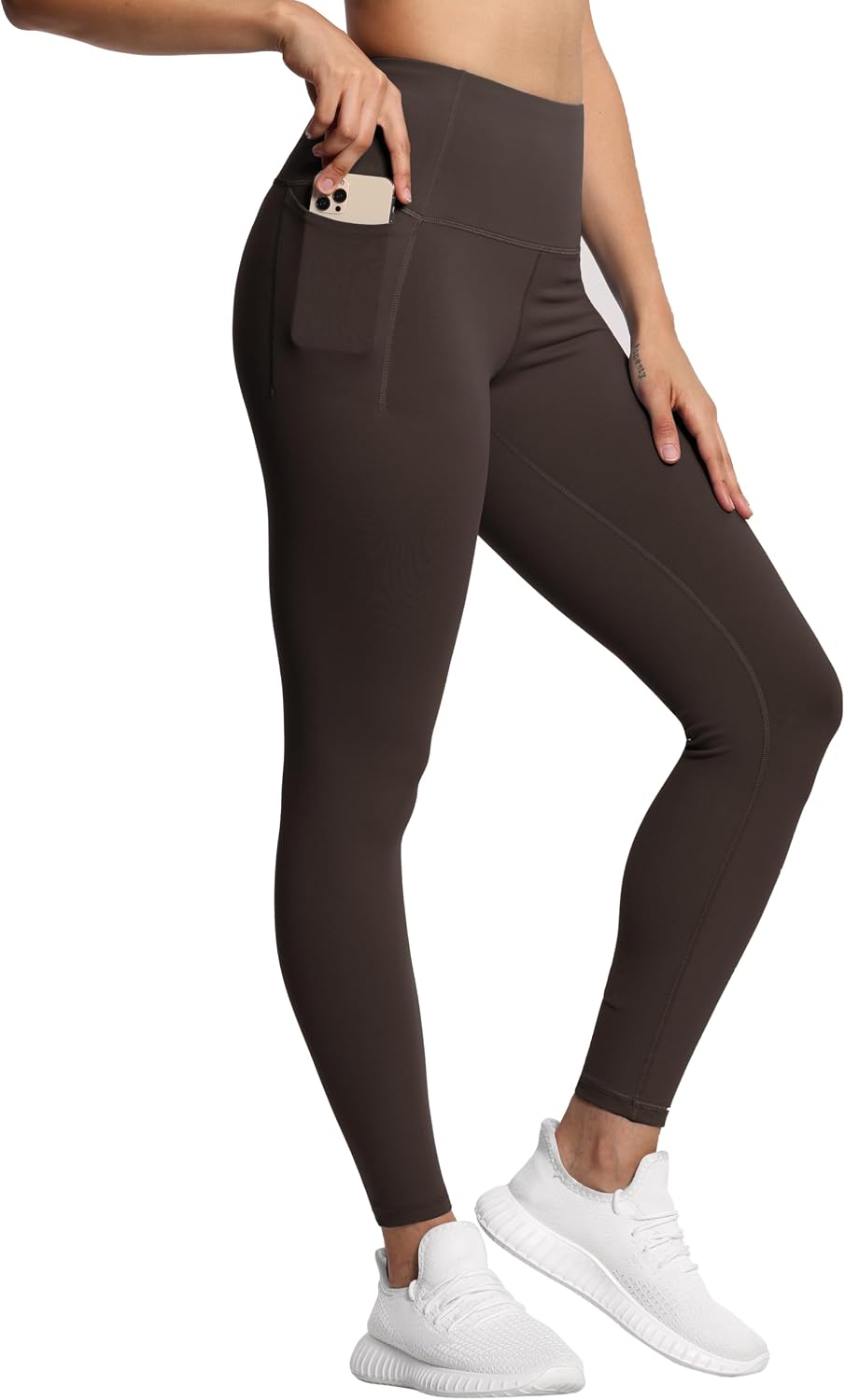
    Across every brand’s review section, the same construction features keep getting credited when apron-belly buyers say a pair stayed put. A wide band beats a narrow one, because width distributes the pressure instead of creating a single fold line. A double-layer or triple-layer band beats a single layer, because the fold needs to bend more fabric to get started. An interior drawstring beats no drawstring, and reviewers say it works best when it’s anchored mid-band rather than at the top edge. And rise is everything: the band has to reach your natural waist, above the apron, where the body narrows and gives the elastic somewhere to settle. “Tummy control” on a product page, by the way, is marketing for “the front panel is doubled.” It says nothing about roll-down. Read the band, not the label.

    The reverse pattern shows up just as consistently. When a pair fails an apron-belly reviewer, the story is almost always one of three things: she sized down hoping tighter would mean more secure, and the extra tension made the band roll faster; the rise stopped mid-belly, right on the slope; or the elastic died in the dryer. Keep those three failure modes in mind and half the negative reviews on any listing start explaining themselves.

    The Field, Side by Side

    The Field, Side by Side

    Legging Price Sizes Waistband style What apron-belly reviewers report
    The Gym People Tummy Control Leggings $27.99 typical, sale dips near $20 XS-3XL (some styles 4XL) Thick wide elastic band, covers the navel 69,000+ ratings; “high waist doesn’t roll down like other brands”; extra elastic “keeps them up way better than much more expensive Fabletics”; short-torso buyers report fold-over
    IUGA High Waist Yoga Pants $24-29 XS-XXXL High wide band with tummy panel “Waistband stays up, doesn’t roll”; band holds tension after repeated washes where cheaper pairs quit; thick-waisted buyers say fit stays put without a drawstring
    Baleaf High Waisted Leggings $30-36 XS-3XL High band with interior drawstring Drawstring gets the credit for no roll-down; waistbands reported unstretched after years of wear; some 1X buyers size up to 3X for comfort
    Old Navy High-Waisted PowerSoft Pocket Leggings $39.99 full price, frequent sales XS-4X Wide soft high band, light compression 4.7 stars on ~2,900 reviews for a sibling style; “supportive high waist,” survived a sweaty hour without slipping; comfort-first buyers happiest, heavy-compression seekers less so
    Halara UltraSculpt Leggings $34.95-44.95; plus versions reported ~$20 higher XS-3X (plus line 1X-3X) Triple-layer band with powernet core, no-roll design Apron-belly try-ons on social run positive; stay-put band praised in reviews; plus-size buyers flag the price gap between straight and plus versions of the same pant
    Spanx Booty Boost Active Leggings ~$98 XS-3X Double-layer contoured high band “Zero time wasted on faffing with the waistband” mid-workout; tummy smoothing praised; the complaint is price, not performance
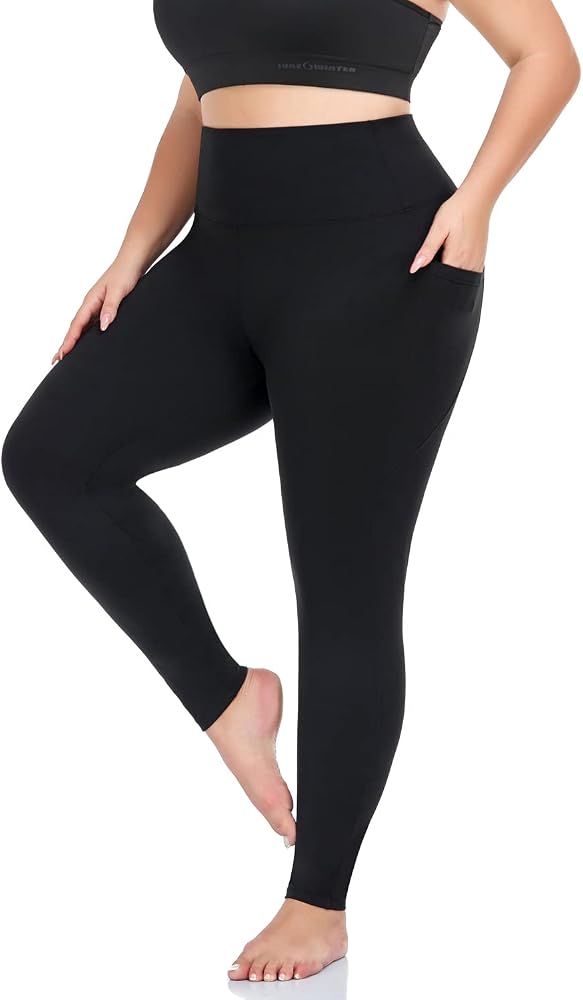
    Superfit Hero SuperHold Pocket Leggings $98 L-7X High compression stay-put band, 8-15mmHg fabric “The only pants with a high enough waist that my belly doesn’t work its way out when I move”; “no rolling, slipping, or see-through moments”; 86% five-star across 544 reviews

    Up to About a Size 20: The Amazon Workhorses Earn Their Numbers

    Up to About a Size 20: The Amazon Workhorses Earn Their Numbers
    IUGA high waist workout leggings with pockets

    If the straight-size ceiling still covers you, the two listings with the deepest review pools are where I’d start, and it isn’t close. The Gym People’s tummy control pair has one of the largest rating counts of any legging on Amazon, and when you filter the plus-size reviews the phrase that keeps repeating is some version of “stays up.” One buyer compared them directly against her Fabletics pairs costing three times as much and said the cheaper band held better. That kind of unprompted cross-brand testimony is the most useful sentence a review can contain, because nobody’s paying her to say it.

    The pattern isn’t spotless, and I’d rather you hear it from me than from your own returns process. The recurring Gym People complaint among bigger-bellied buyers is fold-over on shorter torsos: the band is tall, and if your natural waist sits low, the top edge has nowhere to go and creases forward. That’s not a roll-down, but it’s an annoyance. If you’re short-waisted, this is the pair to buy in the capri or lower-rise cut, or to skip for the IUGA below.

    IUGA’s high waist yoga pants read like the same garment from a parallel factory, and functionally they almost are: same price bracket, same pocket layout, same wide band. The difference in the review data is durability language. IUGA buyers keep mentioning that the waistband still holds after months of washing, where other budget bands go slack, and heavier-set reviewers specifically note the band stays in place without a drawstring. The honest downside: the fabric is softer and thinner than The Gym People’s thick compression knit, so if you want to feel held in, TGP wins. If you want to forget you’re wearing them, IUGA wins. Buy whichever failure you’d rather live with.

    Baleaf is the quiet third option almost nobody writes about, and it has the one feature the other two skip: an interior drawstring. For an apron belly, a drawstring is not a gimmick. It’s a mechanical backstop that stops the band from migrating even when the elastic alone would lose the fight. Reviewers credit it by name, and several report their waistbands haven’t stretched out after years of regular gym use. Runs slim through the leg for some buyers, so read the size chart against your own measurements rather than your usual letter.

    Sizes 20 to 24: Where the Mall Brands Still Show Up

    Sizes 20 to 24: Where the Mall Brands Still Show Up
    Old Navy PowerSoft leggings in plus size

    This is the range where the Amazon size charts start lying to you and the dedicated plus construction begins to matter. Old Navy’s High-Waisted PowerSoft pocket leggings are the value play of the entire article. The size run goes to 4X, the price is routinely discounted below its already reasonable list, and the review pattern is remarkably clean: soft fabric, supportive high waist, no slipping through a full sweaty workout. What PowerSoft is not is compressive. The band stays up through softness and height rather than grip, which suits walking, strength training, and the elliptical better than burpees. If your workout involves a lot of getting up and down off the floor, the apron pushes on a soft band more than the reviews from treadmill users would suggest.

    Halara’s UltraSculpt line is the most interesting construction in the group: a triple-layer waistband with a powernet core, which is shapewear architecture bolted onto an activewear pant. The apron-belly try-on content on social media is genuinely positive, and the brand’s stay-put band claims are backed up in customer reviews rather than just ad copy. Two things stop me from a full endorsement. First, the plus line stops at 3X, which is not the inclusivity the marketing implies. Second, one plus-size reviewer documented that the plus version of the same legging cost about twenty dollars more than the straight-size version. She called it a fat tax, and based on my years sitting in pricing meetings, I can’t tell you she’s wrong. The garment is good. The pricing structure deserves the side-eye.

    Then there’s Spanx Booty Boost Active, which costs roughly what you’d pay for three pairs of the Amazon options. The reviews are excellent, including on the exact metric this article cares about: testers describe starting a workout and never touching the waistband again. The double-layer contoured band is real engineering and it behaves. My buyer’s brain still struggles with the math. The Booty Boost tops out at 3X, same as Halara, so the premium isn’t buying you range. It’s buying fabric quality, brand, and a band that performs about as well as the Superfit Hero band below performs for the same money with twice the size run. If someone’s gifting them, accept happily. If it’s your card, keep reading.

    Size 26 and Up: One Brand Showed Up, So Let’s Talk About It

    Size 26 and Up: One Brand Showed Up, So Let's Talk About It
    Superfit Hero SuperHold leggings on a plus size model

    Above a 4X, the field empties out embarrassingly fast. The mall brands are gone, the Amazon listings technically stretch but stop cutting for a body’s actual proportions, and what’s left is essentially one company that treats extended sizing as the product rather than the afterthought: Superfit Hero. The SuperHold Pocket Leggings run from L to 7X, and the top of that chart fits a waist measurement most activewear brands have never graded a pattern for. This is the only pair on this list designed from scratch around the assumption that the wearer might have an apron belly, rather than accommodating one by accident.

    The review pool is small next to the Amazon giants, but it’s the most on-topic data set I found anywhere in this research. These buyers talk about lipedema, compression tolerance, post-surgical bellies, and long days on their feet, and the roll-down verdict is nearly unanimous. The single most useful quote in this entire article comes from a SuperHold reviewer: the only pants with a waist high enough that her belly doesn’t work its way out when she moves. That’s the whole product brief for this category, written by a customer. The fabric carries a genuine light-compression rating, the band is engineered not to slip or roll, and the flat seams are placed to avoid chafing where an apron creates skin contact.

    The catch is the same number Spanx asks for, from a small business instead of a conglomerate. I won’t pretend that’s casual money for gym clothes. I’ll just give you the buyer’s framing: cost per wear. The review data on budget leggings shows elastic failure as the most common death, usually within a year of heavy rotation. SuperHold reviewers report their pairs outlasting that cycle, the company offers free returns and exchanges through its checkout protection if the fit misses, and if you’re above the size where Old Navy stops, your alternative isn’t a cheaper legging. It’s another year of hiking a failing waistband between sets. Priced against that, it’s the most defensible expensive purchase in this piece.

    Read the One-Star Reviews Before You Buy Any of These

    A habit from my buying days that I want to hand you: skip the five-star reviews entirely and read the angriest ones, because that’s where the sizing truth lives. On every listing above, the roll-down complaints cluster around buyers who bought their aspirational size or trusted a letter instead of the measurements. Elastic under extra tension rolls sooner, not later. Measure your waist at the narrowest point above the apron, buy the size whose chart contains that number, and if you land between sizes, go up. Every apron-belly reviewer who mentioned sizing up reported better hold, not worse. The band stays because it sits where it was cut to sit.

    Second habit: protect the elastic you paid for. Across all seven brands, reviews that describe a good band going bad almost always mention the dryer somewhere in the story. Heat is what kills spandex, and a dead band rolls no matter how clever the construction was on day one. Cold wash, hang dry, and the review data says even the budget pairs hold their waistbands for years. That’s free performance nobody markets, because it doesn’t sell replacement pairs.

    The Short List for Your Next Leg Day

    If your size is on the straight chart: The Gym People for compression, IUGA for softness, Baleaf if you want the drawstring insurance. All three cost about the same, so pick by feel, not price. Worth it.

    Between sizes 20 and 24: Old Navy PowerSoft for low-impact days and the best cost per pair, Halara UltraSculpt when you want the shapewear-grade band and can stomach the plus markup. Worth it, with eyes open.

    Spanx Booty Boost Active: excellent pant, wrong math. Wait for sale, or let someone gift it.

    Above a 4X: Superfit Hero SuperHold, full stop, because it’s the only one built for the job at your size and the reviews from bodies like yours say it does that job. Worth it at $98, because the alternative isn’t cheaper. It’s a waistband you fight through every workout, and you already know what that costs.

  • Terra & Sky Review: What Thousands of Walmart Shoppers Say About the Plus Size Brand

    Terra & Sky Review: What Thousands of Walmart Shoppers Say About the Plus Size Brand

    Last winter, in a Walmart on Chicago’s northwest side, I watched a woman drop three identical pairs of plus size jeans into her cart without checking a tag, a price, or her phone. That’s repeat-purchase behavior, the kind brands spend millions trying to manufacture. The jean she was buying has thousands of customer ratings on Walmart’s site and zero editorial reviews anywhere on the internet. Not one. Fashion media has tested the $98 jean, the $148 jean, and every direct-to-consumer denim startup with a founder story, while the jean plus size women actually buy in the largest numbers gets ignored completely. That’s a coverage gap, and honestly, it’s a snob problem. So let’s give Terra & Sky the review it never got.

    One thing before we start, because I don’t do fake testing content: I haven’t bought this line and I’m not going to pretend I have. What I can do is what I did for eight years as a retail buyer for a Midwest department store chain: read review data at volume, read fabric labels, and read price architecture. When 2,800 people rate a single jean and thousands more rate the tees, jeggings, and dresses around it, the patterns in that data are more useful than any one blogger’s try-on. This review is a synthesis of what those buyers keep saying, filtered through someone who used to sit in line reviews deciding which of these garments got made.

    The Verdict, Up Front

    Terra & Sky is a legitimately good budget basics brand with two real weaknesses: generous, inconsistent sizing and fabric specs that occasionally get quietly downgraded. The Straight High Rise Jeans at $22.98 are the anchor product and the best argument for the brand. The ten-dollar tees rate higher than tees costing four times as much. The Tummy Control Jeggings are the cautionary tale. Buy the denim a size down, buy the knits true to size, air-dry anything you want to keep, and skip anything where the recent reviews mention the words “they changed it.”

    What Terra & Sky Actually Is

    Terra & Sky is Walmart’s private plus size label, launched in spring 2018 as part of the company’s big apparel overhaul that also produced Time and Tru for straight sizes, Wonder Nation for kids, and George for men. It replaced the old Faded Glory and White Stag era of Walmart plus. The range has stretched since launch, and the ceiling is the story: the denim now runs to a 34W, a size most dedicated plus brands either stop short of or quietly exile to online-only. Terra & Sky puts it on a physical rack in thousands of stores. For a lot of women, this is not the budget option. It’s the only option within driving distance that they can try on before buying.

    The price architecture is tight: almost nothing in the line crosses $35, with tees near the floor of it, denim in the low twenties, and dresses topping out just under the ceiling. Hold that against the dedicated plus brands, where a single pair of full-price jeans costs more than an entire Terra & Sky outfit, and sometimes two of them. You could build a whole capsule wardrobe here for the price of one premium pair.

    A note on what the line doesn’t cover: this is tops, bottoms, dresses, activewear, and outerwear. Bras and underwear at Walmart live under other labels, so if you came looking for an intimates review, this brand isn’t where Walmart plays that game.

    The Hero Products, by the Numbers

    Product Price Rating Review volume
    Straight High Rise Jeans, 14W-34W $22.98 4.4 2,800+
    Core Denim Skinny Jeans, 16W-28W $22.98 4.4 2,229
    Crewneck Tee, 0X-5X $9.98 4.7 508
    Flare Leggings 2-Pack, 0X-5X $29.98 4.7 722
    Capri Leggings 2-Pack, 0X-5X $12.98 4.3 963
    Tummy Control Jeggings $15.87 3.8 1,143
    Flutter Sleeve Tiered Midi Dress, 0X-5X $26.98 4.3 192

    Prices and counts move around on Walmart.com, so treat these as the shape of the data rather than gospel. The shape is what matters anyway. Here’s how to read it.

    The Straight High Rise Jean: The Reason This Brand Deserves a Review

    Terra and Sky straight high rise jeans

    A high average across a few dozen reviews is easy to prop up. An average across thousands can’t hide anything: every sizing miss, every torn seam, every “not like the last pair” lands in the math, and the straight high rise jean still holds its 4.4. In buyer terms, that’s a replenishment core: a style that survives reorder after reorder because the return rate stays low enough to justify the shelf space. Walmart doesn’t keep a plus size style in continuous production for years out of sentiment.

    The praise pattern across those reviews is consistent: soft, moveable denim, a high waist that doesn’t gap when you sit or bend, and a fit that holds through the hips without pinching. Multiple reviewers report zero shrinkage even through hot-water washes, which tracks with the fiber content (more on that below).

    The complaint pattern is just as consistent, and you should take it seriously: this jean runs generous and relaxes further with wear. One reviewer laid a tape across the waistband of her usual size and watched it give up two easy inches to gentle pulling. Others describe jeans that fit in the fitting room and were sliding down an hour later. The size-down advice shows up over and over in the review text. That’s not a defect exactly; it’s a design choice. Comfort-stretch denim at this price trades recovery for softness. But it means your first pair is a calibration exercise.

    The Core Skinny: Same Story, Tapered

    Terra and Sky skinny jeans

    The Core Denim Skinny carries a matching score at similar volume, and the review patterns mirror the straight leg: comfortable rise, good color, nice taper at the ankle, with the same generous-waist warnings. There’s also a high rise skinny with a comfort waistband for a dollar more if you’d rather have elastic doing the work. When two sister styles at this volume rate identically, that tells you the fit block (the base pattern the factory cuts from) is solid. Brands with a broken fit block show scattered ratings across styles. Terra & Sky’s denim ratings cluster, which is quiet evidence of a pattern room that got the plus fit right.

    The $9.98 Basics: The Best Value in the Line

    Terra and Sky crewneck tee

    The Crewneck Tee holds a 4.7 across hundreds of reviews, and the Scoop Neck Rib Tee, the Scoop Neck Ribbed Tank, and the Faux Button Front Tank all cluster within a tenth or two of it. Scores like that on basic tees are rare for any brand at any price; plenty of $38 tees from mall brands can’t hold anything close. Reviewers repeatedly note the tees survive washing without shrinking. At two for the price of a fancy coffee order, this is where I’d tell a friend to start with the brand: worst case, you’re out ten dollars and you’ve learned your Terra & Sky knit size for future orders.

    The Leggings Split

    Terra and Sky leggings

    Interesting divergence here. The Flare Leggings 2-Pack outrates the Capri Leggings 2-Pack by a wide margin, even though the capri pack costs less than half as much per pair. When the cheaper item in the same category rates lower at higher volume, the review text usually explains why, and here it points at thinner fabric on the budget pack. You get what the spec sheet paid for. The flares are the better buy if you want leggings that read as pants; the capris are fine as under-dress and around-the-house layers if you go in expecting $6.49 fabric.

    The Tummy Control Jeggings: A Masterclass in Why You Read Recent Reviews First

    Terra and Sky tummy control jeggings

    The Tummy Control Jeggings carry the weakest score in the table above, and the review timeline tells you exactly what happened. Older reviews praise a soft, stretchy jegging that was, in the words of many, a steal at the price. Newer reviews describe a different garment: thicker, dress-pant-like material, baggier, bulkier, not what they reordered. Longtime buyers say so directly: the design and material changed, and they wouldn’t recommend the new version.

    As a former buyer, I recognize this pattern instantly, because I’ve sat in the meetings where it happens. It’s called cost engineering: the listing, the photos, and the accumulated review equity stay, while the fabric spec underneath gets renegotiated to hit a margin target. Shoppers assume they’re buying the product the first several hundred reviews describe. They’re not. It’s the single most important thing to understand about private-label shopping at any big-box retailer, and it’s why my standing advice for this entire brand is: sort reviews by newest, read the last three months, and only then decide. A 3.8 with a happy history and an angry present is worse than a flat 3.8.

    The Tiered Dresses: TikTok’s Favorite Walmart Secret

    Terra and Sky tiered flutter sleeve dress

    The Flutter Sleeve Tiered Midi Dress is the style you’ve seen if the algorithm has ever shown you a Walmart try-on haul. The tiered and peasant midi silhouettes are the brand’s social media engine: rayon-blend, empire-waisted, pockets included, frequently marked down into the teens. Its score in the table above is respectable for a dress; dresses rate harder than basics because fit expectations are higher and a midi hits everyone at a different point. The buyer consensus in the review text favors the shape (forgiving through the middle, real pockets) with the usual lightweight-rayon caveats: it wrinkles, and it wants a gentle wash cycle. At this price, that’s a fair trade.

    How the Sizing Runs, According to the People Who Bought It

    Aggregating the fit commentary across the denim and knits, the consensus looks like this:

    • Jeans: run generous. When in doubt, size down. This is the most repeated advice across thousands of reviews. The stretch denim relaxes with body heat and wear, so a pair that feels snug at 9 a.m. is comfortable by noon and loose by dinner.
    • Jeggings: split verdict. Some reviewers found them a full size big, others true to size, and the multipack listings collect both camps. The safest play if you’re between sizes is down for jeggings, true for leggings.
    • Knit tops and tees: true to size, cut roomy. The tee reviews rarely argue about fit, which at 500+ reviews is itself a data point.
    • Dresses: true to size with a forgiving cut. Empire waists and tiers hide a multitude of sizing sins, which is partly why the dress ratings hold up.

    Two structural notes. First, dual sizing: the knits run on the X system while most of the denim runs on W sizes, and the brand’s 2X doesn’t map perfectly onto its 20W across every style. Check the size chart on each listing rather than assuming your size carries over from the last item. Second, an industry reality worth knowing: high-volume private labels typically spread production across multiple factories, and different runs of the same style can fit slightly differently. That’s the most likely explanation for why one reviewer’s “true to size” and another’s “huge” can both be honest. It’s not you. It’s the supply chain.

    What the Fabric Labels Tell You

    Fiber content is the closest thing a shopper gets to reading a brand’s mind, so here’s what the labels say. The denim leans on a cotton-polyester blend with only a whisper of spandex, about 2% in the core jean, and the pull-on styles run more cotton-heavy still. Translation from buyer-speak: high polyester with modest spandex gives you softness and initial stretch at low cost, but mediocre recovery. That’s the fiber-level explanation for the single most common complaint in the whole review corpus, jeans that grow through the day. Premium stretch denim solves this with engineered elastane systems. Those systems cost money, and this is a $22.98 jean. The brand spent its budget on cotton content and fit instead, which for the price is the right call.

    On durability, the review data sorts the line into clear tiers. The denim and the cotton tees hold up: repeated reports of no shrinkage, color that survives washing. The fashion knits are the weak flank: wide-leg knit pants drew pilling complaints within two or three washes, and a chenille sweater drew shrink-and-distort complaints after laundering. None of this is surprising at the price point, but it changes how you should shop the brand: buy the woven and cotton-jersey pieces with confidence, treat the fuzzy and drapey specialty knits as one-season items, and air-dry anything you care about.

    One more practical advantage that reviews rarely spell out: Walmart’s return infrastructure. Apparel comes with a 90-day return window and free in-store returns at more than 4,000 locations, no return-shipping fee, no restocking charge. Compare that with online-only plus brands where a failed fit means repackaging, label printing, and waiting on a refund. When sizing is the brand’s known weakness, a frictionless return policy is not a footnote. It’s half the value proposition.

    Who Terra & Sky Is For, and Who Should Skip It

    Buy it if: you want everyday basics and workhorse denim at the absolute floor of the price market; you wear the top of the size range and are tired of brands that pretend you don’t exist; your weight fluctuates and $23 recalibration beats $80 recalibration; you want to try on plus size clothing in an actual store instead of gambling on shipping; or you’re building a work-from-home or errands wardrobe where cost per wear is the metric that matters. A jean at this price worn weekly for a year works out to well under a dollar a wear. That math is the brand’s whole thesis, and it holds.

    Skip it if: you want denim with real structure and recovery that snaps back on day two (look at Lane Bryant or Universal Standard and pay accordingly); you need tailoring, occasionwear, or anything with hard construction, because that’s not what this line is; you fall in love with specialty knits and expect them to last years; or you can’t stand recalibrating sizes between styles. And if you’re already at Walmart comparing, the Sofia Jeans line (the Sofia Vergara collaboration) runs a few dollars more with enormous review volume of its own; one plus style carries over 6,800 ratings. Terra & Sky wins on size range and price, Sofia wins on fashion-forward washes. Target’s Ava & Viv plays the same position at a similar price if Target is your store; its review volumes are thinner, which makes the data harder to trust.

    What 2,800 Ratings Buy You at Walmart

    Here’s the thing about Terra & Sky that the fashion press missed while it wasn’t looking: this brand quietly does the two hardest things in plus retail. It puts real size depth, all the way to a 34W, on physical racks, and it holds respectable quality scores at prices no dedicated plus brand can touch. The review data shows exactly where the corners got cut: stretch recovery, specialty knits, and the occasional silent spec change. Those are real flaws and I’ve flagged every one. But a 4.4 average sustained across thousands of denim ratings is not luck, and it’s not low standards. It’s a fit block that works, sold at a price that respects the fact that most women’s clothing budgets are not editorial fantasy budgets.

    Start with a $9.98 tee to learn your knit size. Then take the straight high rise jean into a fitting room in your usual size and one size down, and buy the smaller pair. Read the newest reviews before adding anything else to the cart. Worth it at $23. The basics too. Wait on the jeggings.

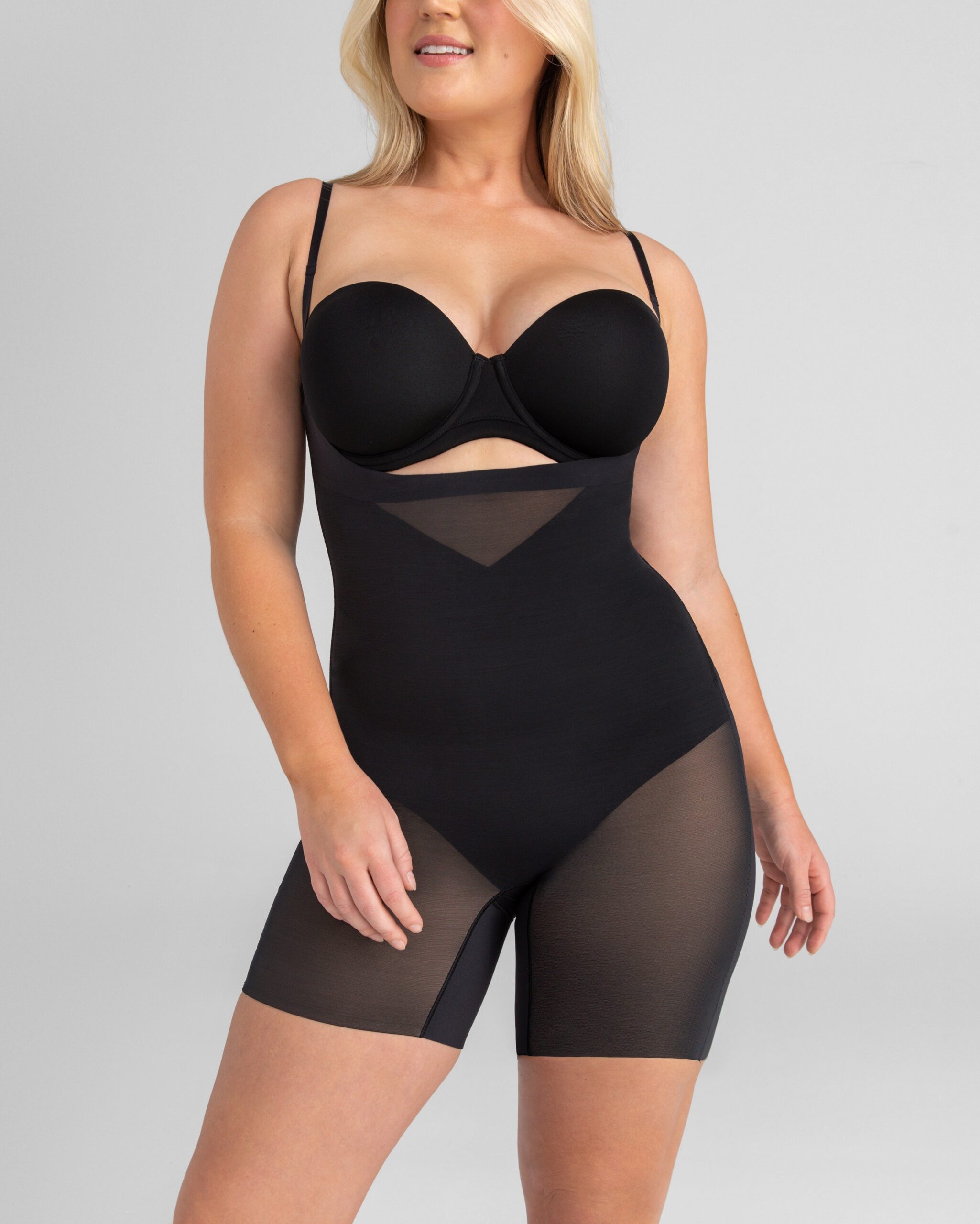
  • Shapewear That Actually Comes in 4X, 5X and 6X: Where to Find It and How Each Brand Runs

    Shapewear That Actually Comes in 4X, 5X and 6X: Where to Find It and How Each Brand Runs

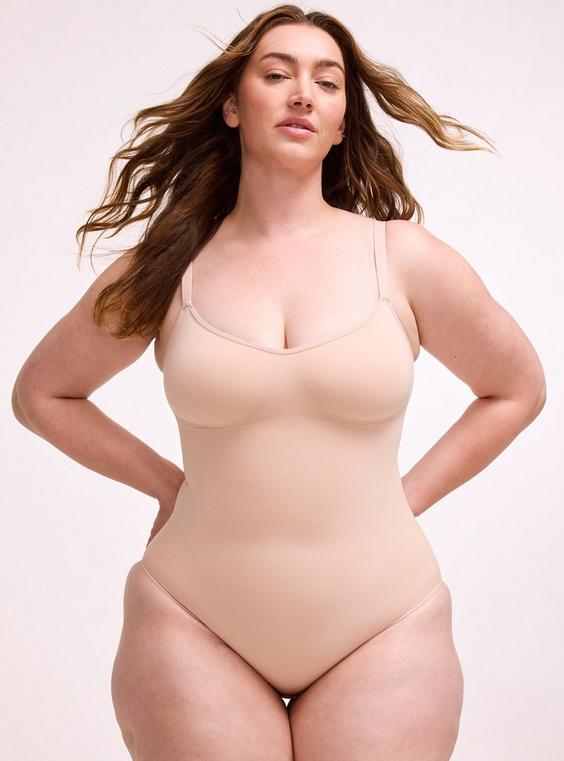
    Pull up the size guide on almost any shapewear brand’s site and time how fast the chart quits on you. Spanx makes it to 3X and stops – that’s not me being catty, it’s their own education page: “All our plus-size shapewear is available up to 3X.” Honeylove runs XS through 3X. Half the “inclusive” Amazon brands print 5XL on the tag and then map it to a US 22 in the fine print. Meanwhile r/PlusSizeFashion runs some version of “where can I find shapewear in larger sizes?” every few weeks, the thread fills up with the same five comments, and no publication had sat down and mapped what actually exists past 3X. So I did.

    One thing up front, because CGJ doesn’t do fake try-ons: I’m a 16 on top and an 18 on the bottom depending on the cut, which means the industry mostly lets me shop in peace. I’m not going to pretend I wore a 6X brief around Crown Heights for a week. This is research, done the unglamorous way: brand size charts read line by line, live product pages pulled the week this was written, and buyer consensus from the communities that actually wear these sizes. Where the record is thin, I say so.

    The Short Answer: Who Actually Sells Shapewear Past 3X

    Six brands genuinely go above a 3X right now, and two more claim to while their own charts say otherwise. Here’s everything I found, in one table. Every size in it comes from the brand’s published chart, not a press release.

    Brand Top size on the chart The fine print How buyers say it runs
    Torrid 6X (US 30) 6X = 60-64″ waist, 72-76″ hips per Torrid’s chart; smoothing styles run the full range True to chart; Level 1 is light smoothing, not sculpt
    Cacique (Lane Bryant) 34/36 Collection runs 10/12 through 34/36 across three compression levels Deepest style selection past 4X of any brand here
    Catherines 6X (38/40) Fit guide covers 0X-6X; their 6X maps to a 38/40, a different number than anyone else’s 6X Catalog-generous cuts via Roaman’s and house brands
    Yitty 6X Every style runs XS-6X; 6X is cut for a bust around 60″ Strong runs-small consensus; size up at least one
    Rago Up to 15X/58 on some styles Old-school girdle sizing; extra-firm 6207 runs 5X/40 to 8X/46, the 6210 goes to 14X and beyond Brand’s own guidance: go up 1-2 sizes on firm styles
    Skims 4X (some styles 4X/5X) Shapewear runs XXS-4X; jump-size styles reach 4X/5X, some bras hit 5X “Very inconsistent” by its own subreddit’s account
    SHAPERX “4XL/5XL” Their own chart maps 4XL/5XL to a US 22-24 Label inflation; shop the measurements, not the letters
    Shapermint 4XL 4XL = US 24, hips 56-58″ max on the core shaper short ($48) Smoothing more than sculpting, per Wirecutter’s testing

    And the two you can stop checking: Spanx caps out at 3X in its own words, and Honeylove runs XS through 3X, full stop. Both make good garments up to that line. Neither makes yours if you’re past it.

    A 6X Is Not a 6X: Read the Tape Measure, Not the Letter

    The single most useful thing this article can tell you: the X system is not a standard. It’s shorthand, and every brand draws the line somewhere different. Three examples from the charts above, side by side:

    • Torrid’s 6X is a US 30 – 60 to 64 inches at the waist.
    • Rago’s 6X is labeled 6X/42, which in girdle-world convention pairs the X with a waist measurement in the low 40s. That’s a garment Torrid would call roughly a 2X. Same letter, wildly different body.
    • SHAPERX’s “5XL” is, per its own size chart, a US 22-24. Torrid’s 4X starts at a 26. So Amazon’s biggest label is smaller than the specialty market’s second-smallest extended size.

    This is why “does it come in my size” is the wrong question and “does it come in my inches” is the right one. Grab a soft tape, measure your natural waist, the widest point of your hip, and your rise if you’re buying shorts. Write those three numbers on a sticky note and shop against them like the size names don’t exist. Because functionally, they don’t.

    Torrid: The Full Range to 6X, Honest About Its Compression

    Torrid Curve shapewear on a plus size model

    Torrid’s shapewear lives inside its intimates line and runs the brand’s complete size scale – L through 6X, which in Torrid’s grading means up to a US 30 with hips cut to 76 inches. That last number matters. A lot of brands technically grade up but keep straight-size proportions, so the waist grows while the seat and belly stay stingy. Torrid’s chart adds roughly six inches of hip per two sizes at the top of the range, which is how actual bodies grade.

    The catalog is smoothing-first: high-rise briefs, ultra-high-waist shorts, panty-style pieces like the Microfiber High-Rise 360° Smoothing Brief, which runs to 6X and whose reviews keep repeating one phrase in different words: it doesn’t roll down. That’s the recurring praise, and for anyone who has spent a wedding reception yanking at a waistband, it’s the praise that counts.

    Set your expectations on compression, though. On the Level 1 Smoothing Ultra-High Waist Short, one reviewer put it flatly: “Not shapewear.” She’s not wrong about what Level 1 is – it’s a smoothing layer, a slip short with opinions, not a foundation garment. Torrid’s lane is comfortable, correctly proportioned smoothing at true extended sizes. If you want serious hold, keep reading – that lives further down this page.

    Cacique at Lane Bryant: The Deepest Bench Past 4X

    Cacique shapewear from Lane Bryant

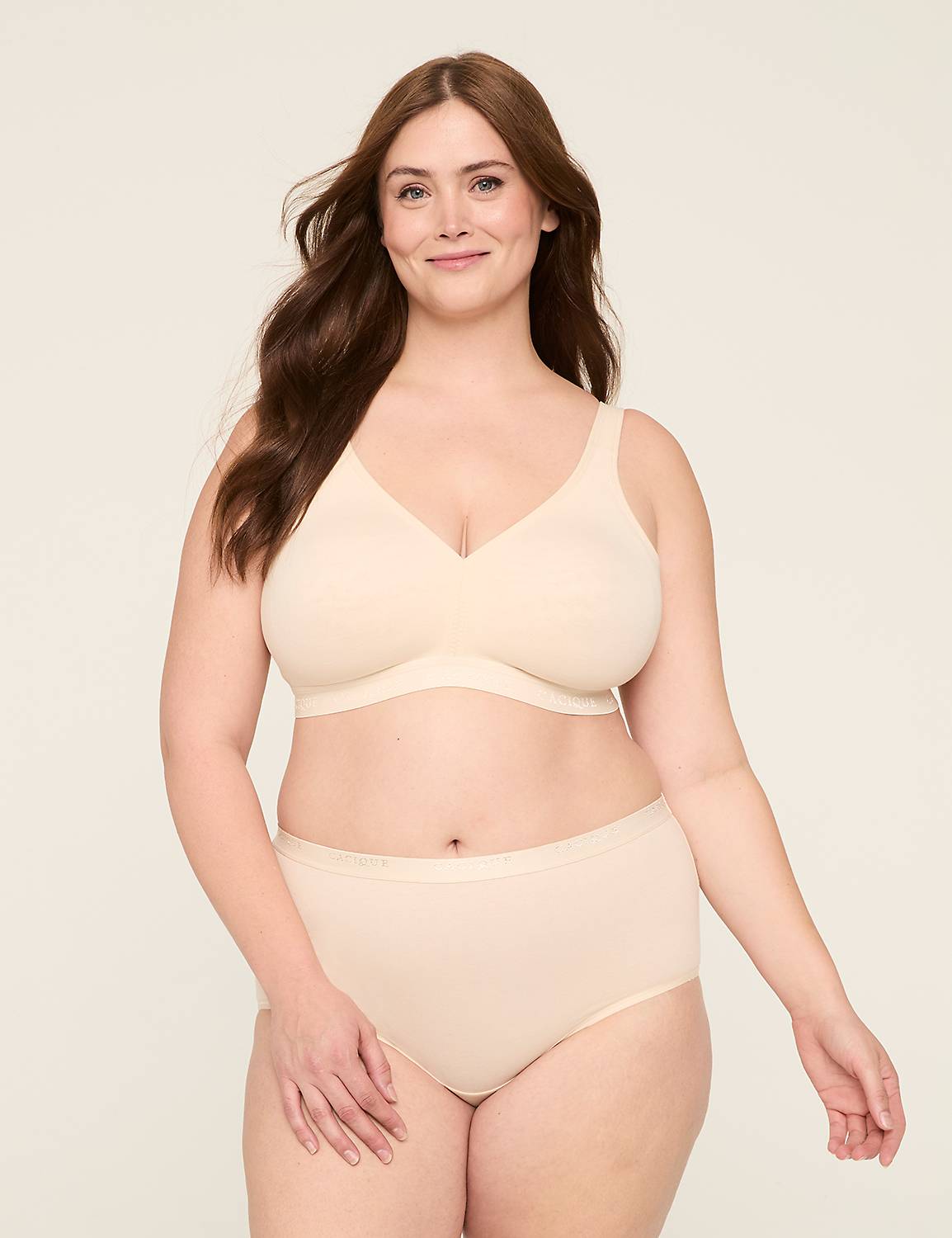
    If Torrid wins on range, Cacique wins on selection. Lane Bryant’s shapewear line runs 10/12 through 34/36 across the entire collection, and it’s organized by a three-level compression system that actually means something: Level 1 light smoothing, Level 2 medium shaping, Level 3 firm contouring. No other brand on this list offers this many silhouettes at the top of the range – briefs, camis, slips, slip shorts, open-bust bodysuits, thigh shapers, even a full unitard.

    Prices, from the live collection page: the Medium Shaping Totally Smooth Ultra High-Waist Brief lists at $26.50, the Level 3 Contouring High-Waist Brief at $55.50, the Firm Contouring Open-Bust Bodysuit at $79.50, and the Medium Shaping Totally Smooth Unitard at $89.95. Here’s the shopping intel: Lane Bryant discounts intimates constantly, and at the time of writing the entire shapewear page was sitting at half off. Almost nobody should pay Cacique list price. Wait a week; the sale comes back.

    One honest caveat. The collection copy promises 10/12 through 34/36, but on any given day some styles show thinner size availability – top sizes sell through, and restocks lag. Check the size dropdown on the specific style before you fall in love. That’s not a Cacique-only problem, but with a bench this deep it stings more here.

    Catherines and Woman Within: The Catalog Heavyweights

    Catherines plus size shapewear

    Catherines fits 0X through 6X, and its 6X maps to a 38/40 – a bigger number than anyone else’s 6X on this list. The shapewear assortment leans on house and sister brands, including Roaman’s full-body shapewear, and the whole operation carries decades of catalog-fit DNA: generous cuts, longer rises, less vanity in the grading. It’s not where you go for a seamless sculpting bodysuit that photographs like a second skin. It’s where you go when other brands’ “extended” sizing still isn’t extended enough.

    Woman Within plays the same position – dedicated tummy-control and control-bottom categories at genuine plus proportions – though top sizes vary style to style, so read each product’s chart rather than trusting the category banner. Between these two and Lane Bryant, the old catalog players quietly serve the sizes the venture-backed brands write off.

    Yitty: 6X on Paper, Smaller in the Mail

    Yitty shapewear

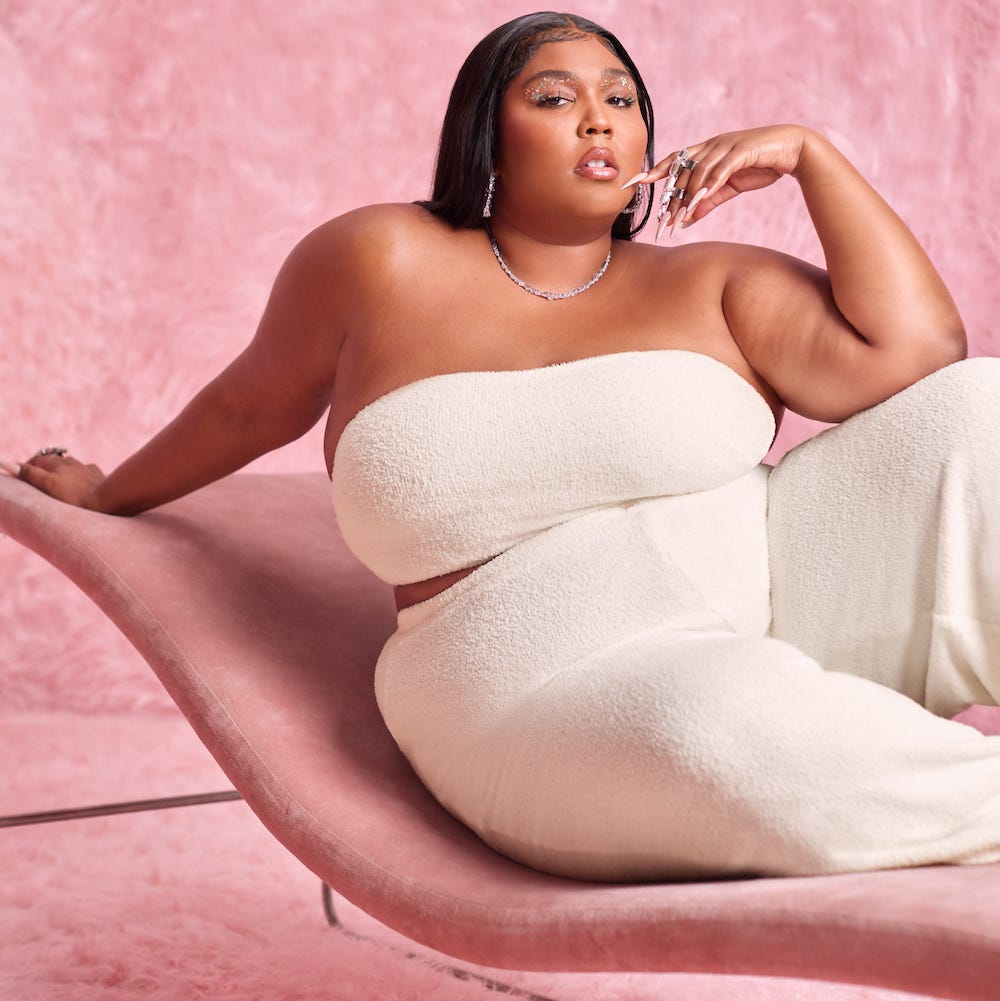
    On paper, Yitty should end this article. Lizzo’s line runs XS through 6X on every style, the 6X is cut for a bust around 60 inches, and the whole brand was pitched as shapewear finally built by someone who wears it. The reality in the plus-size communities is rougher. The runs-small consensus is loud and consistent across r/PlusSize and r/PlusSizeFashion, and the sharpest version came from a shopper in exactly this article’s size range: “Ordered a 4X for a looser fit and that was TIGHT. I sent everything back.” Durability complaints show up too – one buyer reported a piece coming apart after a single wash.

    None of that makes Yitty skippable – the fabric-forward, wear-as-outerwear styling genuinely doesn’t exist elsewhere at a 6X. It makes Yitty a size-up-and-keep-the-receipt brand. Order one size above your chart match, note that it sells through Fabletics with membership pricing attached, and check the return window before the tags come off.

    Rago: The 80-Year-Old Answer Nobody Mentions

    Rago extra firm shapewear

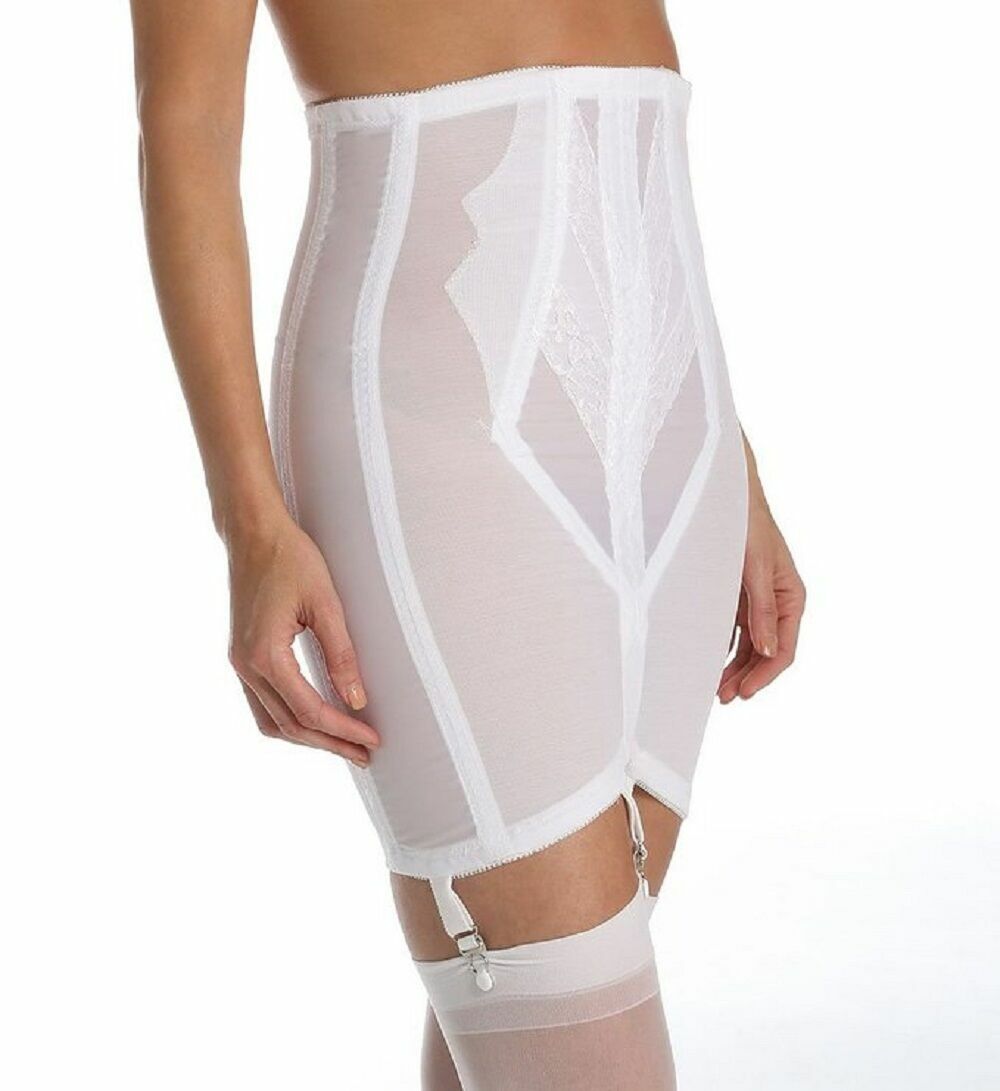
    Here’s the brand every one of those Reddit threads deserves and rarely gets. Rago is an old-school foundation-garment house – boning, side zippers, layered powernet, the whole midcentury toolkit – and it goes bigger than everyone else in this article combined. The high-waisted collection filters on its own site run past 9X/48 and 10X/50 all the way to 15X/58. The Style 6207 extra-firm leg shaper lists 5X/40 through 8X/46, and the Style 6210 high-waist long-leg shaper – stocked at Target, and carried up to 14X at specialty fit retailers – is the rare garment on earth offering genuine extra-firm compression at a 60-inch-plus waist.

    Two things to know before ordering. First, Rago sizes like a girdle maker: the number after the slash tracks the waist measurement, so a 6X/42 is built around a low-40s waist – much smaller than a Torrid 6X. Measure, then match the number, and treat the X as decoration. Second, take the brand’s own fit guidance seriously: on firm and extra-firm styles, Rago tells you to go up one to two sizes from the chart. Powernet with boning does not stretch to forgive an optimistic order the way a seamless knit does. As construction, though, this is the real thing – the difference between a knit that suggests and a foundation garment that holds is the difference between single-layer circular knit and paneled, anchored powernet, and Rago only builds the second kind.

    Skims: 4X Across the Line, 5X If You Catch It

    Skims shapewear in extended sizes

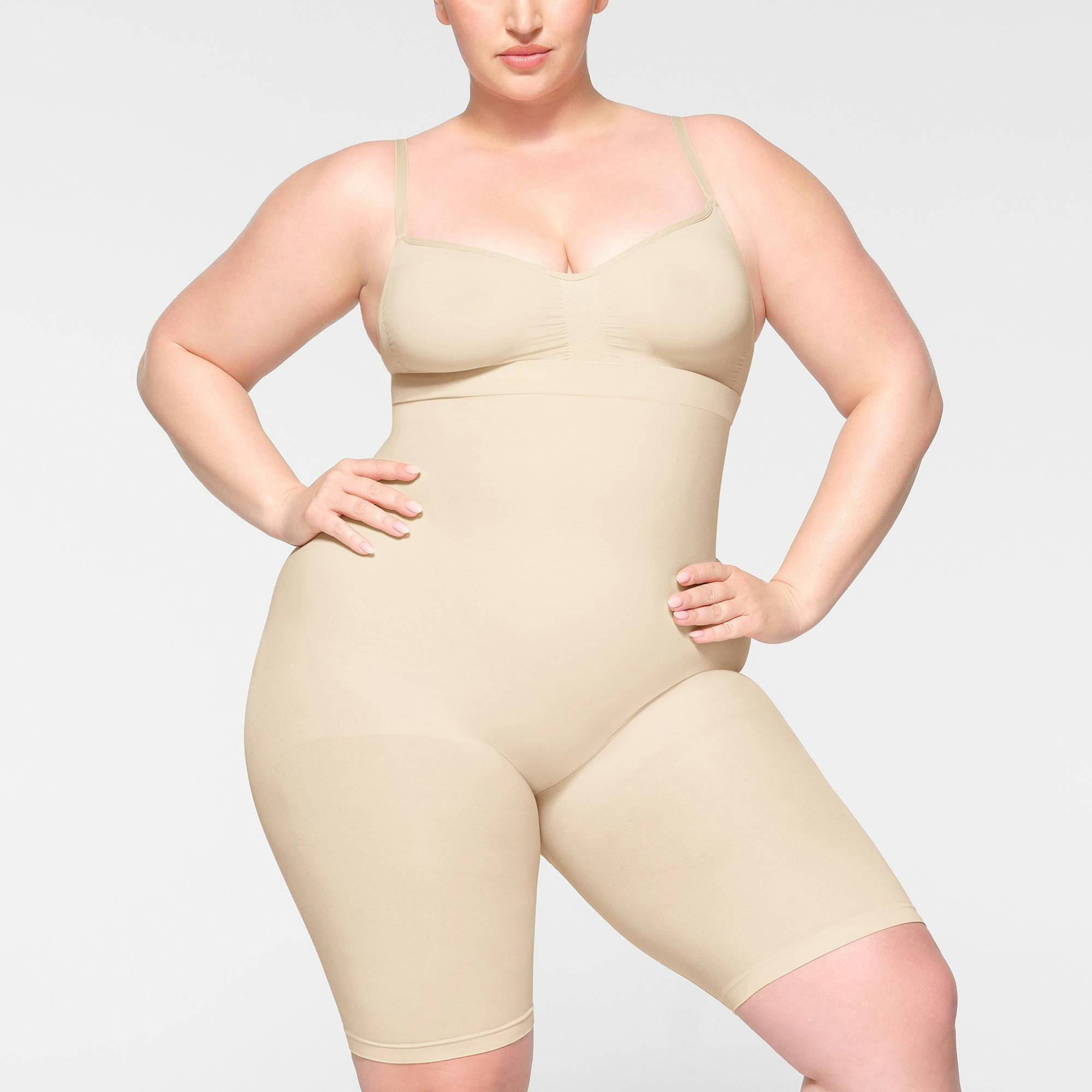
    Skims runs its shapewear XXS through 4X, with jump-sized styles reaching 4X/5X and a handful of bras hitting 5X – which puts it in this article’s range, just barely, and mostly at the 4X line. The fit story is the complication. The brand’s own subreddit describes the sizing as “very inconsistent” – some styles true to size, some demanding a size up, some a size down, depending on the cut. Plus-size buyers frequently size up for torso length as much as width.

    At the top of any brand’s range, that inconsistency costs more, because there’s no bigger size to exchange into when a style runs tight. If Skims is the look you want – and the fabric development is legitimately the best-in-class part – buy from a retailer with painless returns and consider it a fitting, not a purchase, until it’s on your body.

    The Amazon Aisle: FeelinGirl, SHAPERX, and the Label-Inflation Problem

    SHAPERX shapewear bodysuit

    Amazon is where a lot of those Reddit threads end up, and the community affection is real – FeelinGirl in particular gets named with actual enthusiasm (“amazing affordable fajas,” one r/PlusSizeFashion regular wrote, “I live for their bodysuits”), and a size-24 shopper in a separate thread reported her Amazon high-waisted shorts wear comfortably under dresses. Cheap, fast, returnable. There’s a place for that.

    But the Amazon aisle is also where the sizing letters lie hardest. SHAPERX, one of the platform’s biggest shapewear names, tops out at a “4XL/5XL” that its own chart maps to a US 22-24. That’s below where Torrid’s 4X begins. FeelinGirl’s top size shifts from listing to listing, so there’s no single answer to memorize. The rule for the whole aisle: ignore the letter in the title, open the size chart image on the specific listing, and buy against your measured inches. When the chart and the title disagree – and they will – the chart is the one telling the truth.

    How to Choose When You’re Shopping Above a 3X

    Whatever brand you land on, the same six rules keep coming up across the charts, the reviews, and the threads:

    • Buy on inches, never on the size name. Waist at the narrowest point, hip at the widest, rise if it’s a short. Every chart in this article contradicts every other chart. Your tape measure is the only consistent sizing system in the industry.
    • Match the compression level to the actual job. Level 1 and “smoothing” pieces are refined underwear – they kill lines, not inches. If you want visible shaping at a 4X-6X, your real options narrow to Cacique’s Level 3 pieces and Rago. Everything else in that size range is smoothing, whatever the marketing says.
    • Size up on firm compression. Rago says it outright: one to two sizes up on firm and extra-firm styles. The consensus on Yitty says the same thing for different reasons. When in doubt at the top of a range, up.
    • Roll-down usually means too small, not bad design. This one’s straight from the shapewear threads, and it matches everything I know about how knits behave: a waistband rolls when it’s under more tension than the fabric can hold flat. Before blaming the garment, try the next size.
    • Check the construction details that matter at extended sizes. Wider waistbands sit flatter on a soft middle than skinny elastic. A cotton gusset is non-negotiable; an open gusset is a bathroom-logistics decision worth making deliberately. For extra-firm pieces, a side zipper isn’t retro fussiness – it’s how you get in without wrestling.
    • Know the specialty fit retailers. The most useful comment in the r/PlusSizeFashion thread that inspired this article named HerRoom, Bare Necessities, and Breakout Bras as starting points. They stock the extended runs – including Rago’s double-digit X sizes – that brand sites bury or don’t carry at all.

    The Answer to Paste Into the Next Reddit Thread

    Because there will be a next thread. Here’s the condensed version: past a 3X, your real options are Torrid to a 6X for correctly proportioned smoothing, Cacique to a 34/36 for the widest style selection and true firm contouring, Catherines to its extra-generous 38/40 6X, Yitty to 6X if you size up and keep the receipt, and Rago into the double-digit X sizes for actual foundation-garment compression nobody else builds. Skims gets you to 4X with fit roulette. Amazon gets you convenience and a size chart you must read twice.

    If I were pointing one person at one first purchase, it’s the Cacique Medium Shaping Totally Smooth Ultra High-Waist Brief in her measured size – $26.50 list, routinely half that on sale, from the only collection that treats a 34/36 like a size instead of a favor. The links are above.
  • Sensory-Friendly Bras That Still Support a Big Bust: No Wires, No Lace, No Digging

    Sensory-Friendly Bras That Still Support a Big Bust: No Wires, No Lace, No Digging

    There’s a post that keeps getting rewritten on the bra-fitting forums, and the details barely change from year to year. A woman measures a 36GG. She’s autistic, or she has sensory sensitivities she’s never bothered to put a name on, and the physical facts are the same either way: underwire feels like a splint against her ribs, lace registers as sandpaper, and the seam that crosses the middle of almost every full-bust cup is a low-grade alarm that never shuts off. She’s done the professional fittings. The fitters keep handing her the same engineered underwire styles, because at her size, they tell her, the wire isn’t optional. The comment section fills up with women describing the identical dead end. Everything soft can’t hold them. Everything that can hold them hurts. And somewhere in the thread, someone always says the thing she’s already heard from her mother, her fitter, and at least one ex: you just get used to it.

    You don’t have to get used to it. I want to be precise about why this problem exists, because once you understand what an underwire actually does, you can spot the handful of brands that replaced it with real engineering instead of just deleting it and calling the result a bralette. That distinction, wire removed versus wire replaced, is the entire article.

    Why Wire-Free Usually Means Support-Free

    Why Wire-Free Usually Means Support-Free
    Wire-free full coverage support bra construction

    An underwire does one job: it’s a rigid frame that anchors the bottom of the cup to the band, so the weight of the breast transfers into the band and around your torso instead of hanging off your shoulders. Roughly eighty percent of a bra’s support is supposed to come from the band. The wire is what makes that possible at heavier cup volumes, because soft fabric alone deforms under load. Pull the wire out of a standard pattern and the cup collapses downward, the band rides up in back, and the straps take over the work, which is how you end up with trench marks in your shoulders by lunch.

    So when a brand deletes the wire without redesigning the architecture, you get the classic seamless bralette: fine at a B cup, decorative at anything past a DD. That’s the entire wire-free market most women have met, and it’s why the fitters keep saying the wire is mandatory. It isn’t. It’s just the cheapest way to solve the physics.

    The brands that solved it without the wire all use some version of the same three tricks. One: an internal sling or crisscross panel inside the cup, a second layer of fabric that cradles the breast from below and shunts the load sideways into the band. Two: a taller, wider, denser band, usually a powernet or a heavy-gauge knit with a high elastane content, so there’s enough fabric tension to actually carry weight. Three: wide, cushioned, non-stretch straps that stabilize without digging, because stretchy spaghetti straps under real load are a shoulder injury on layaway. When you’re evaluating any wireless bra above a DD, flip it inside out and look for those three things. If they’re not there, the product page is lying to you.

    What Sensory-Friendly Actually Means, in Construction Terms

    What Sensory-Friendly Actually Means, in Construction Terms

    The sensory half of this brief is its own spec sheet, and it’s worth being blunt about it, because most lingerie copy treats comfort as a mood instead of a set of measurable decisions. If textures genuinely hurt, and for a lot of neurodivergent women they genuinely do, this is what you’re checking for. No wire, obviously. No lace anywhere it touches skin, and ideally not on the garment at all, because lace migrates. Flat or bonded seams instead of raised sewn ridges, especially across the apex of the cup. Covered elastic, meaning the stretchy bits are sandwiched inside fabric rather than sitting bare against your ribcage. Printed care labels instead of sewn-in tags, or tags positioned where you can remove them without opening a seam. And a closure you can live with, which splits people two ways: some want a smooth pullover with no hardware at all, others need a hook-and-eye because pulling a tight band over their head is its own sensory event. Both camps are represented below.

    One honesty note before the list, because I don’t write fake try-on content. I haven’t wear-tested nine bras across a size range I don’t personally wear. What I’ve done is read the construction of each of these the way I read fit samples for six years, pulled the verified size charts from the brands themselves, and cross-checked all of it against what heavy-volume buyer reviews and the fitting communities consistently report. Where a brand has a flaw, I’ll name it. Two of these picks have lace on them, and I’ll tell you exactly where it sits so you can decide, not the brand.

    The Bras, Compared

    The Bras, Compared

    Bra Why it works for sensory needs Size range Where to buy
    Sugar Candy Fuller Bust Everyday Bra Fully seamless knitted body, heat-molded cups, internal U-sling does the wire’s job, pullover with no hardware, no lace anywhere XS-XXL, covering roughly 30-34 F-HH, 36-38 F-H, 40 F-GG, 42 F-G Amazon, specialty bra retailers
    Glamorise MagicLift Cotton Support Bra (1001) Wire-free crisscross inner-bust band replaces the wire, cotton-blend cups, wide cushioned straps; lace overlay on upper cup (see caveat in text) 36B-56J Amazon, Glamorise, JCPenney
    Glamorise MagicLift Seamless Wirefree (1006) The lace-free MagicLift: seamless knit body, same under-and-over support banding, no wire, no trims Full-figure bands into the 50s, cups vary by colorway Amazon
    Soma Embraceable Wireless Unlined Full Coverage Single smooth knit layer, no lace, no lining seams, hidden sling inside the cup, U-back spreads the pull, wide soft straps 32A-44H (includes DDD and G) Soma
    Cacique Cotton Unlined No-Wire Bra Double-layer stretch cotton cups with no padding or lace, wide bottom band, wide adjustable straps, hook-and-eye closure 36B-50H Lane Bryant, Amazon resellers
    Curvy Couture Cotton Luxe Unlined Wireless Breathable cotton against the skin, cushioned bottom band, wide smooth wings; narrow stretch-lace edge at the neckline (see caveat) 36C-46H Amazon, Target
    Knix Revolution Busty Bra Bonded construction instead of sewn seams, smooth matte fabric, no lace, engineered side wings; the Busty version adds cup depth the standard cut lacks Part of Knix’s 99-size wireless range, bands to 48, cups to H Nordstrom, Knix
    Playtex 18 Hour Ultimate Lift Wirefree (4745) No wire, cushioned straps, hook rows that scale with size; sewn cup seams are present, so apex-sensitive buyers should pass 36B-46DDD Walmart, JCPenney, Kohl’s
    Warner’s Easy Does It Wirefree Seamless stretch knit, dig-free covered band, light lining, no lace, no tags that bite Alpha sizing XS-2XL (some styles to 3XL); realistically tops out near DD equivalence Walmart, Kohl’s, Macy’s

    The Direct Answer for the G-and-Up Cup: Sugar Candy

    Sugar Candy fuller bust seamless wire-free bra

    If the woman in that forum post asked me for one order to place tonight, it’s this one. Sugar Candy is the fuller-bust line from Cake, an Australian maternity brand that spent years solving exactly this equation for pregnant and nursing bodies, which are the most seam-intolerant, wire-intolerant bodies in the market. The Everyday bra is a fully seamless knit tube with heat-molded cups and an internal sling, their U-Sling, that mimics what a wire frame does from the inside. No hardware, no lace, no sewn ridge across the apex, nothing to unpick. You pull it over your head and it’s done.

    The construction detail I respect most: the support comes from knitted rib panels of varying density, so the “structure” is engineered into the fabric itself rather than sewn onto it. That’s expensive to do, which is why the price sits around $74 and why almost nobody else does it. The sizing runs alpha, XS through XXL, and it’s built exclusively for F cups and up, so unlike every other alpha-sized bra alive, the fuller bust isn’t an afterthought stretched to fit. A UK 36GG lands inside the range. The honest limits: the silhouette is rounded and casual rather than lifted and separated, and at the largest bands the cup ceiling drops. For lounging, work-from-home, and any day the skin says no, this is the category winner.

    The Size-Range Monster: Glamorise, With One Caveat You Deserve to Hear

    The Size-Range Monster: Glamorise, With One Caveat You Deserve to Hear
    Glamorise MagicLift wire-free support bra

    Glamorise has been building wire-free support bras since before wireless was a marketing word, and nobody, and I mean nobody, touches their size architecture. The MagicLift Cotton Support Bra runs from a 36B to a 56J, and the brand’s wider wireless catalog pushes past even that, into K cups. Read that again if you’ve been told your size doesn’t exist without a wire. The mechanism is a cushioned band that crisscrosses under and over the bust, a fabric suspension bridge doing the wire’s load-bearing job, plus wide padded straps and a hook-and-eye that adds rows as the sizes climb. Buyer data backs the engineering: verified reviewers in J cups on large bands describe it as the rare bra that actually positions them forward instead of to the sides.

    Now the caveat, because the product photos hide it in plain sight: most classic MagicLift styles, including the cotton one, carry a lace overlay on the upper cup. It sits over a lined cup rather than raw against the nipple, and plenty of sensory-sensitive buyers tolerate it fine, but one recent verified reviewer called the material scratchy out of the box, and Glamorise’s own response was that it softens after a couple of washes. If any lace on the garment is disqualifying, and for a lot of you it rightly is, redirect to the MagicLift Seamless Wirefree, style 1006, which delivers the same under-and-over banding in a knit body with no lace and no trims. List price on the cotton style is $60, and Glamorise runs sales so constant that paying full price is basically a rounding error.

    The Smooth Operator: Soma Embraceable

    The Smooth Operator: Soma Embraceable
    Soma Embraceable wireless bra in a smooth knit fabric

    Soma’s Embraceable Wireless Unlined Full Coverage is the bra the gap evidence kept surfacing by name, and having read the spec sheet, I get it. The fabric is a dense nylon-elastane knit, the kind of hand-feel Soma built its whole brand on, with no lace, no padding, and no sewn seam ridges on the body of the cup. The support plumbing is discreet: an added sling inside each cup, a U-shaped back that balances the pull between neckline and band, and wide soft straps that stay put. It reads like a pretty everyday bra, not adaptive equipment, which matters more than the industry admits.

    The catch is reach. Bands stop at 44 and cups at a US H, so this is the pick for the sensory-sensitive DD-through-H woman on a small-to-mid band, not for the far end of the Glamorise range. At $52, with frequent two-for promos, it’s the one I’d send a friend to try in a mall first, because Soma boutiques will fit you without pushing you back onto a wire.

    The Cotton School: Cacique and Curvy Couture

    Cacique cotton wire-free bra from Lane Bryant

    Some skins want cotton and nothing else, and synthetic microfiber, however smooth, feels like a plastic bag. Two builds serve that brief with real cup depth. Cacique’s Cotton Unlined No-Wire is Lane Bryant’s quiet workhorse: double-layer stretch cotton cups with no padding and no lace, a wide bottom band doing the support work, and wide adjustable straps. It runs 36B to 50H, which makes it one of the very few cotton wireless options that follows plus bands into the upper range. The double-layer cup is the trick worth noting, since two light layers contain and smooth without a seam ridge or a foam insert.

    Curvy Couture’s Cotton Luxe Unlined Wireless is the same philosophy with more tailoring: cotton against the skin, a cushioned bottom band, and wide smooth wings across the back, in C through H cups for $49. My one flag, and it’s the same honesty rule as the Glamorise: there’s a narrow band of stretch lace finishing the neckline. It’s the flat, soft variety, not the crunchy scalloped kind, but if your rule is zero lace contact, stay with the Cacique.

    The Bonded-Seam School: Knix

    Knix wireless bra with bonded seams

    Knix approaches the seam problem the way an athleisure engineer would: don’t sew it, weld it. Their Revolution line uses bonded construction, edges fused flat rather than stitched into ridges, on a smooth matte fabric with zero lace. A few years ago that would’ve been irrelevant to this article because the cups stopped shallow, but Knix pushed its wireless range to ninety-nine sizes, with bands to 48 and cups to a US H, and built a dedicated Busty version of the Revolution with the extra cup depth fuller busts actually need. The fitting communities rate the support as real but medium: excellent containment, modest lift, happiest under a 40 band. Pricing sits in the premium tier north of the cotton picks, so treat it as the upgrade buy once you know bonded seams are your texture.

    The Budget Shelf, With Honest Ceilings

    Playtex 18 Hour wire-free bra

    Three names come up constantly in these threads, and each earns a qualified place. The Playtex 18 Hour Ultimate Lift Wirefree is the accessible-anywhere option, on the rack at Walmart deep into the plus bands and up to a DDD cup, with cushioned straps and closure rows that scale up with the size. Its compromise is the very thing some of you can’t have: traditional sewn cup seams, including across the apex. If seams read as neutral to you and lace is the enemy, it’s a fine cheap answer. If seams are the trigger, skip it entirely.

    Warner’s Easy Does It is the opposite trade. It’s genuinely seamless, with a covered dig-free band and a soft stretch knit, but it’s alpha-sized to a 2XL and honestly built for the DD-and-under bust, so it belongs to the reader with a bigger band and a moderate cup rather than the GG crowd. And Coobie, the perennial forum suggestion, deserves its reputation for softness and its reality check on support: even the Full Size version officially fits up to a 42DD, and at G volumes it functions as a sleep and lounge layer, not a bra. Recommend it for the days nothing else is tolerable, not for the workday.

    How to Vet Any Bra Before It Touches Your Skin

    Whatever you order, run the same inspection I’d run on a fit sample. Turn it inside out first thing, because the inside is the surface you live in, and map every seam with your fingertips before your torso has to. Check the fiber content tag while you’re there: high cotton content for breathability, or a dense nylon-elastane knit for smoothness, and be suspicious of anything crunchy that claims to be soft. Look inside the cup for the sling or second layer, because if the cup is a single ply of stretch fabric, it will not hold a G, full stop. Wash it once before the first wear, since sizing chemicals on new fabric are their own texture problem, and that stiff-out-of-the-box feel often halves after one cycle. And buy from somewhere with free returns, then actually use them. Sensory fit can’t be predicted from a product photo, and the brands above all know it, which is why most of them run generous return windows.

    Where the 36GG Clicks Buy

    Back to the woman from the post, because she deserves a straight answer instead of a comment section. Order the Sugar Candy Everyday first, in the alpha size that matches her band and bust measurements, for the days the skin outranks the silhouette. Order the Glamorise MagicLift Cotton second, in a 36J to test against her GG-and-shifting measurements, for the days she needs actual lift under real clothes, with the seamless 1006 as the swap if the lace overlay fails inspection. That’s two bras, two different jobs, and neither one requires getting used to anything. The links are above.
  • Plus Size Return Policies Compared: Who Pays Return Shipping and Who Traps You

    Plus Size Return Policies Compared: Who Pays Return Shipping and Who Traps You

    Here’s a cost nobody prints on the price tag: finding out whether the thing fits. A straight-size shopper orders a medium and gets a medium. I order my usual size from two brands I’ve worn for years and receive two different garments, one cut for my proportions and one cut for a fit model who does not exist. So plus-size shoppers do the only rational thing available. We order the dress in two sizes, keep the winner, and send back the loser. The industry files that under “return problem.” I file it under the fit tax, because a return rate isn’t a character flaw when the sizing is the thing that’s broken.

    And you pay that tax in cash. When a retailer deducts $6.00 or $10.99 from your refund for sending back a dress that didn’t fit the way their own size chart promised, that is not a shipping cost. That’s a surcharge on being sold unpredictable sizing, collected from the exact customers most likely to need the correction. Some retailers eat that cost as the price of doing business with bodies they can’t be bothered to measure consistently. Others have turned the return desk into a profit center, and a few have built policies that quietly convert your refund into money you can only spend with them.

    I spent eight years as a department store buyer, which means I’ve sat in the meetings where return policies get written. I know which fees are defensible logistics and which ones are margin wearing a trench coat. So I pulled the current published return policy of every major retailer a plus-size shopper actually uses, read all of the fine print, and put the whole thing in one table. Nobody had done this. Now it’s done.

    How This Table Was Built, and When

    Every cell below comes from the retailer’s own published return policy page, pulled on July 5, 2026. Policies drift, and fees have a habit of drifting upward, so treat this as a dated snapshot and check the linked policy before a big order.

    Two access notes for honesty’s sake. Torrid’s policy page was blocking automated readers on my pull date, so its terms come from Torrid’s own page as archived the previous November, cross-checked against current third-party guides that report identical terms. Amazon’s help pages were similarly gated, so every Amazon cell is reported from official-page excerpts rather than a live fetch. Everything else was read directly off the live page. Where a retailer’s own pages contradict each other, and two of them do, I flag it in the text and use the stricter number.

    The Master Table: Windows, Fees, and Who Actually Gives Your Money Back

    Plus size shopper preparing an online clothing return package at home

    Retailer Return window Cost to get cash back by mail Cheapest free path Refund type Exchanges
    Torrid 60 days from purchase date $6.00 deducted (free for VIP members, lower 48) In-store, free Original payment (reported) None formal; repurchase fast
    Lane Bryant 45 days from order date (60 with LB Credit Card + Rewards) $7.95 deducted In-store, free Original payment in window; merch credit after (in-store only) In-store only
    Eloquii 30 days from SHIP date $10.99 deducted (label or Return Bar) Free only as a FullBeauty e-gift card; exchanges free Original payment minus fee, or e-gift card Free by mail, no fee
    Universal Standard 30 days from ship date $8.95 per order by mail; $4.50 at a Return Bar Free only as store credit Original payment minus fee, or free credit Free; your size is not held
    Kiyonna 30 days from purchase (15 for bridal) $16.00 unless return protection was bought at checkout None; self-shipping still costs you Original payment; optional credit with 15% bonus First exchange ships back free
    City Chic (US) 30 days from purchase date $7.95 deducted Happy Returns drop-off, free Original payment None online
    Amazon apparel 30 days from delivery Free on “Free returns” badge items; $1 at UPS if a closer free option exists (reported) Kohl’s / Whole Foods / Amazon Fresh drop-off Original payment Size/color exchange on eligible items
    Walmart 90 days (marketplace sellers: 30) Free In-store, free Original payment In-store within window
    Target 90 days; 365 days on owned brands with receipt; +30 with Circle Card Free In-store, Drive Up, or mail, all free Original payment Same windows
    Nordstrom No set limit, case by case Free In-store or mail, free Original tender; gift card if no record of sale No formal flow; reorder
    Nordstrom Rack Online: 40 days to original payment, then gift card to day 60, nothing after $9.95 deducted per label In-store at Rack or Nordstrom, free Tiered by day count None
    Old Navy / Gap 30 days from delivery Free In-store (online orders), free Original payment; after 30 days, unpublished Free within window
    Shein 30 days from delivery First return per order free; $7.99 each after that That first return, drop-off or USPS Original payment or Shein wallet Not offered in the policy
    Fashion Nova 30 days from delivery $5.99 label purchase, and you still don’t get cash None STORE CREDIT ONLY None

    Read the third column top to bottom and the pattern is hard to miss. The big-box generalists, the ones that treat plus sizes as one department among forty, return your money for free. The dedicated plus-size specialists, the ones whose entire marketing is that they understand your body, are the ones billing you when their size chart misses. Torrid, Lane Bryant, Eloquii, Universal Standard, Kiyonna, City Chic: every dedicated plus retailer on this table charges for a mailed cash refund. Every mass retailer doesn’t. Sit with that.

    The Final-Sale Traps, Retailer by Retailer

    Torrid store front
    Final sale clearance tag on a plus size clothing rack

    The fee is the visible half of the fit tax. The invisible half is the list of things you were never allowed to return in the first place, and the conditions that let a warehouse refuse the return you thought you’d made. This table is that list.

    Retailer Final sale / non-returnable The buried gotcha
    Torrid Clearance; panties and lingerie sets; tights; earrings; cosmetics; anything washed or worn Footwear can’t go back to stores, mail only; pay with Klarna, Apple Pay, or Google Pay and the free in-store option disappears too
    Lane Bryant Anything marked final sale, in store or online Miss the window and your in-store return refunds as merchandise credit at the item’s LOWEST promotional price, not what you paid
    Eloquii Final sale items Return a final-sale item anyway and it is donated to charity: no refund, and they don’t send it back. The returns page also says 30 days while its own exchanges page says 60; assume 30
    Universal Standard Final sale (most of the sale section); gift cards The mail fee is per order, per day: return two items from one order on different days and you pay it twice. Hangtag off means the Return Bar can’t take it
    Kiyonna Shapewear; the final-sale collection A $25 “worn condition” deduction for pet hair, deodorant marks, or makeup transfer; late returns lose 15% and come back as credit
    City Chic Items priced $20 and under are automatically final sale Their own two policy articles disagree on the threshold ($20 vs $16.99); the parent company has publicly floated exiting the US market
    Amazon apparel Items flagged non-returnable on the listing Third-party sellers ride their own rules: on a changed-my-mind return the seller can deduct the label cost from your refund (reported, effective Feb 2026)
    Walmart Nothing apparel-specific published Marketplace apparel gets 30 days, not 90; marketplace apparel over $300 gets 14; marketplace sellers may take up to a 20% restocking fee
    Target Nothing for regular apparel; designer collab drops run about two weeks The famous owned-brand year requires the receipt, and the Circle Card bonus days don’t stack on top of it
    Nordstrom Special-occasion dresses must come back with the return tag intact No record of sale means any refund granted goes to a gift card at the CURRENT price, which after markdowns is not the price you paid
    Nordstrom Rack Worn, altered, or tagless items refused Day 61 is a wall: past it the policy offers nothing at all, and Rack does no exchanges, period
    Old Navy / Gap Final sale and “Encore Market” resale items; masks Swim needs the hygiene liner intact and Old Navy swim and maternity are mail-only; “unwashed and unworn… will not be accepted” is the exact refusal language; what happens after the window is no longer published anywhere
    Shein Bodysuits, lingerie, underwear, jewelry, accessories, cosmetics, clearance Warehouse inspection can shrink your refund for “lost value” or zero it entirely, and their judgment is final
    Fashion Nova Bodysuits, swim, undergarments, beauty, party wear, and every item whose price ends in .48 or .98 The final-sale label is hidden in the price digits themselves; miss it and the item can’t be returned even for their store credit

    The Four Tiers, and How to Shop Each One

    Lane Bryant store front

    Once you’ve stared at both tables long enough, the fourteen policies collapse into four tiers, and each tier has a correct shopping strategy. Not a preference. A strategy. Because the whole point of knowing the policy before you click is that it changes what you’re allowed to be uncertain about.

    Tier one is the free-return tier: Target, Walmart, Nordstrom, Old Navy, and badge-eligible Amazon. Here, ordering two sizes is genuinely free, so this is where you experiment. New silhouette you’ve never tried, a brand whose size chart you don’t trust yet, denim, anything structured. The gamble costs you nothing but the repack.

    Tier two is the fee tier: Torrid, Lane Bryant, and City Chic, where a mailed return runs six to eight dollars but a free escape hatch exists. If you live near a Torrid store or a Lane Bryant, the fee tier behaves like the free tier and you can order multiples with a clear conscience. If the nearest store is an hour away, the fee is real, so consolidate: one big order, one return shipment, one fee spread across everything you sent back.

    Tier three is the credit-or-pay tier: Eloquii, Universal Standard, and Kiyonna, where the free path exists but pays out in their money instead of yours. This tier rewards loyalty and punishes tourists. If you already know you’ll reorder from Universal Standard, the free store-credit return is a fine deal and their quality makes the round trip worth it. If you’re trying a brand once to see what the fuss is about, price the exit before you enter.

    Tier four is the trap tier: Fashion Nova outright, Shein past your first free return, Nordstrom Rack past its cliff, and any final-sale rack anywhere. Here you buy only sure things: exact repurchases, brands whose fit you’ve already proven on your own body, and prices low enough that a miss becomes a donation bag entry instead of a grievance.

    Where a Plus-Size Shopper Can Actually Try Things On at Home

    Old Navy store front
    Plus size woman trying on clothing from an online order at home

    The single most shopper-friendly clause on this entire spreadsheet belongs to Target, and almost nobody uses it on clothes. Target’s owned brands return for a full year with a receipt, and its plus lines are owned brands. That means Ava & Viv and Universal Thread pieces are the lowest-stakes plus-size purchases in America: order three sizes of the same jean, keep one, and return the others on your schedule, free, for months. The policy article doesn’t name the brands, so the mapping runs through Target’s own corporate brand list, but the clause is published and I’ve watched it honored at the service desk.

    Walmart’s window is a quarter of a year on anything it sells directly, which covers Terra & Sky and the rest of its house plus lines, returnable free at any register. The one thing to check is the seller name on the listing, because marketplace items on Walmart’s site follow shorter, seller-set rules, and the difference is invisible until you look. Same discipline applies on Amazon: the badge is the policy. If the listing shows “Free returns” next to the price, size-gamble freely; if it doesn’t, or the seller is a third party, read that seller’s terms before you order two of anything.

    Then there’s Nordstrom, which publishes no time limit at all and handles everything case by case, free either direction. That’s the policy that lets you order a special-occasion dress in two sizes without a knot in your stomach, and it’s a named reason plus shoppers give for paying Nordstrom prices in the first place. Two honest caveats: the goodwill is discretionary and abusing it gets people flagged, and none of it transfers to Nordstrom Rack, which is a different and much colder animal wearing the same last name. Old Navy rounds out the safe list: the window is short but returns are free both ways, which for basics at that price is all you need.

    Where You Buy Only Sure Things

    Fashion Nova is the worst policy on this table and it isn’t close. A standard return there gets you store credit, full stop; your cash comes back only if the item arrived damaged, defective, or wrong. You pay for the return label on top. If you bought with Afterpay or Klarna, the installments keep billing on schedule while you hold a gift card. And the final-sale flag is encoded in the price itself, in those .48 and .98 endings, where no reasonable person would look for it.

    This is also the company the FTC fined in 2020 for handing out gift cards instead of refunds on unshipped orders, so the instinct is documented. Order from Fashion Nova the way you’d order a custom item: only when you’re certain, only at prices you can walk away from.

    Shein is more defensible than its reputation on the first pass, since your first return per order is free and refunds go back to your card. The trap is everything after: each additional return from that order costs $7.99, the non-returnable list quietly swallows bodysuits and accessories, and the warehouse reserves the right to decide your item lost value and shave the refund. Make your Shein return one consolidated shipment, photograph everything before it goes in the bag, and never assume the clearance section is returnable, because it isn’t.

    Kiyonna deserves a gentler version of the same advice. The clothes have a real following and the first exchange ships back free, but a cash-refund return costs $16.00 unless you bought their return protection at checkout, and the worn-condition deduction is aggressive enough that a cat owner should pack the return in a clean-room. Know your Kiyonna size cold before you order, and if you’re between sizes, use the exchange, not the return. Eloquii’s workwear is still some of the best cut in plus, and their free mail exchange is genuinely useful when you’re one size off, but shop it knowing the cash-back fee is the highest of any dedicated plus brand on this table and the clock starts the day the box ships, not the day it reaches you.

    Store Credit Is Not a Refund

    Shein package prepared for return

    Let me say the quiet part with numbers around it. When a return pays out in store credit, the retailer has converted your refund into a liability that costs them almost nothing and guarantees your next purchase. Credit you’ll genuinely spend is a mild inconvenience. Credit at a store you were sampling is money you’ve lost politely. That’s the real difference between Universal Standard’s free-credit option, which is fair because their repeat customers actually repeat, and Fashion Nova’s mandatory version, which assumes your loyalty without asking. Eloquii’s free path sits in between: the e-gift card spends across the whole FullBeauty family of brands, which softens it, provided any of those brands were on your list. Kiyonna is the only one on the table that pays you to take credit, adding fifteen percent to the balance, and if you already love the brand that’s the rare sweetener worth taking.

    Memberships Change the Math

    Target store front exterior

    Three loyalty programs on this table functionally abolish the fit tax for members, and if you shop these stores more than twice a year they’re worth the sign-up on returns alone. Torrid’s VIP membership makes mailed returns free in the lower 48, which turns the strictest-feeling specialist policy into one of the friendliest. Lane Bryant extends its window to 60 days for Rewards members paying with the store card, though I’d never tell anyone to open a credit card for a return window, so weigh that one against your own wallet habits. Target’s Circle Card adds a month to standard returns. And Universal Standard’s Fit Liberty program is the only policy in this article that acknowledges bodies change: on eligible pieces, if your size shifts within a year, they exchange for the new size free, well past the normal window. Nobody else on this table even attempts that.

    Check the Last Two Digits Before You Fall in Love

    Woman reviewing an online clothing checkout screen on her phone

    The fit tax survives on the fact that nobody reads the returns page until the dress is already wrong. So flip the order. Before checkout, three checks that take under a minute: the price ending, because at Fashion Nova those two digits are a final-sale sentence; the seller name, because “sold by” a marketplace third party rewrites the policy on Walmart, Amazon, Target, and even Nordstrom listings; and the words “final sale” anywhere near the size selector, because at four of these retailers that phrase means the money is gone the moment you pay. Then screenshot the policy page with the date visible. Policies changed under my feet twice while I was researching this article, both times in the retailer’s favor, and your screenshot is the receipt that wins the customer service argument.

    Buy your experiments where returns are free. Buy only sure things where they aren’t. And any retailer that charges you to fix their size chart should have to earn it in the quality of the clothes, every single time.

    Free returns or sure things. Nothing in between.

  • How to Pee in Shapewear Without Getting Undressed: Every Method, Honestly Ranked

    How to Pee in Shapewear Without Getting Undressed: Every Method, Honestly Ranked

    The line for the single stall at a Buckhead wedding reception is four women deep, and the one at the back, in the emerald jumpsuit, is doing math she did not study for. The jumpsuit has to come all the way off. Under the jumpsuit is a firm-compression short that took a full production number to get on at home, with her sister holding the waistband like a rodeo hand. The DJ just announced the bouquet toss. She has been holding it since the salad course, and the wait is running about forty minutes door to door.

    Every woman who has worn real shapewear to a long event has been her, or has handed her a clutch through a stall door. And when she gets home and types “how to pee in shapewear” into her phone at midnight, what comes back is Reddit threads, TikToks, and brand FAQ pages that swear their own product solved it. Nobody neutral has sat down and ranked the actual methods. So that’s what this is: every technique real women report using, compiled from wedding forums and buyer reviews and the brands’ own design pages, ranked from best to worst. I’ll tell you up front that I have personally field-tested more of these than I planned to, including one christening where I learned what a hand dryer can and cannot do for a compression short. We’ll get there.

    One honesty note before the ranking, because this site doesn’t do fake authority: I’m a lifestyle writer, not a pelvic floor therapist, and the evidence base here is design facts plus the collected testimony of a great many brides, bridesmaids, and women at galas who typed up what happened to them. Where a method fails people regularly, I say so.

    Method 1: The Open Gusset, Used With Two Hands and a Practice Run

    Spanx OnCore shapewear with open gusset design

    This is the winner, with an asterisk the size of a reception hall. Most major shapewear brands now build an overlapping opening into the crotch of their shorts and bodysuits. Spanx calls the double-layer version on its firmest line a gusset opening; every garment in the OnCore range has one. Skims sells its Seamless Sculpt shorts and bodysuits with the open gusset named right on the label. Honeylove builds a bathroom-friendly cotton gusset into its thigh-length styles. The panels lie flat and closed while you’re wearing them, which is why half the women who own these garments discover the opening by accident and post “so am I supposed to pee through this hole?” on The Knot.

    Yes. You are. Here is the technique the forum veterans converge on, and it is remarkably consistent across threads: sit all the way down first. Use both hands to separate the overlapping panels, and spread them wide, out toward your thighs, not just apart. Then reposition the whole garment forward or back until the opening is actually centered where it needs to be, because it usually isn’t on the first try. Lean slightly forward. Start gently, like you’re testing the water pressure in a hotel shower, and keep one hand holding the fabric out of the way for the duration.

    When it fails: when the opening is too small, when the compression is strong enough to snap the panels back mid-event, and when you skip the rehearsal. Kim Kardashian herself, a woman who sells shapewear, has said the split in her old Spanx wasn’t big enough to pee through. Brides on The Knot report asking their seamstress to widen the slit, which tells you the factory opening does not fit every body. And a big skirt takes both your hands hostage, which is exactly when this method needs both of them.

    Verdict: the best method in existence, but only for women who practice at home first, in just the shapewear, before adding the dress. Untrained, it produces exactly the mess you’re imagining.

    The Open-Gusset Shopping List

    The Open-Gusset Shopping List
    Skims sculpting shapewear shorts

    If you’re buying shapewear for an event and you know a bathroom trip is inevitable, which it is, buy the opening on purpose instead of discovering whether you have one in the stall. Here’s what the major brands actually offer, with the gusset design named honestly.

    Brand Product Gusset type Sizes
    Spanx SPANXsculpt OnCore High-Waisted Mid-Thigh Short Double-layer open gusset, no snaps; whole OnCore line has it XS-3X
    Spanx SPANXshape Invisible Mid-Thigh Short (the renamed Thinstincts 2.0) Easy-open double gusset, lighter compression than OnCore XS-3X
    Skims Seamless Sculpt Mid Thigh Short Overlapping open gusset; look for “open gusset” in the product name XXS-4X, runs small, buyers size up
    Skims Seamless Sculpt Mid Thigh Bodysuit with Open Gusset Open gusset on a full bodysuit, no snaps to refasten XXS-4X
    Honeylove SuperPower Short Bathroom-friendly cotton gusset on thigh-length styles XS-3X, select styles run higher
    Shapermint All Day Every Day Scoop Neck Bodysuit Closed gusset with two rows of snaps, hook-and-eye style S-4XL
    Popilush Full Confidence Open-Gusset Body Shaper Open gusset on this style; most Popilush bodysuits use a cotton-lined snap closure instead Varies by style, check each chart

    Notice what the sizes column just told you: the two brands with the roomiest open-gusset size runs stop at 4X, and the firmest gusseted line on the market stops at 3X. If you wear above that, your options narrow to snap closures and the methods further down this list, which is its own quiet unfairness, and a big part of why the full-strip method refuses to die.

    Method 2: The Funnel, for Women Who Want a Guarantee

    pStyle female urination device

    This is the method that sounds unhinged when a bridesmaid first suggests it in a group chat and then quietly wins the whole thread. Female urination devices are little funnels, and wedding forum veterans genuinely recommend them, not as a joke. There are two relevant designs. The peeLUX was invented specifically for shapewear: it slots into the gusset opening you already have, holds the fabric apart so the panels can’t creep back, and keeps drips off the garment entirely. You press the handle back while seated, go, done. The pStyle is the general-purpose version, a rigid plastic channel you can use through pulled-aside fabric while standing or hovering, then draw forward to wick away the last drops. It’s the one hikers and festival women swear by, it’s sturdy enough to work one-handed, and the whole device class runs about $12 to $30, which is the cheapest insurance in this entire article.

    When it fails: logistics, not physics. You have to carry it into the stall, in an evening clutch that’s already holding lipstick, a phone, and someone’s vows. You have to rinse or wipe it afterward, which is a fine thing at home and a diplomatic exercise at a shared sink in front of the groom’s aunt. And it does not fix a garment with zero give; the funnel needs an opening or a pull-aside to work through.

    Verdict: the upgrade that turns a decent gusset into a reliable one. If the event is long, the dress is complicated, or you simply do not trust your aim, and honestly, the aim data from the forums says most of us shouldn’t, this is the difference between a technique and a system.

    Method 3: Snaps and Hooks, the Bra-Clasp-You-Cannot-See

    Honeylove shapewear bodysuit with hook closure

    Bodysuit shapewear that doesn’t use an open gusset usually closes at the crotch the way a bra closes at the back: rows of hooks and eyes, or snaps. Shapermint’s bodysuits put two rows of snaps down there; Popilush uses a cotton-lined snap closure on most of its bodysuit styles. The going technique from the brands themselves: undo everything, go, then refasten starting from the front hook and working backward, using your fingers to guide the two edges together.

    When it fails: on the refastening, every single time. You are reclosing a clasp you cannot see, under a dress you’re holding with your chin, with hands you just washed and a garment whose whole job is tension, which means the two edges are actively pulling away from each other while you fumble. Buyer reviews split right down the middle between “very easy to unhook and rehook” and “not the easiest to maneuver,” and I’d gently suggest the difference between those two reviewers is the length of their arms and the strength of the compression, not the product.

    Verdict: better than a sealed crotch, slower than an open gusset. Fine for a dinner out. For a wedding, practice the reclose blind, at home, until you can do it without swearing loud enough for the next stall to hear.

    Method 4: The Pull-Aside, the Move Everyone Tries First

    The instinct move: hook a thumb into the crotch panel, haul it to one side, pin it against your inner thigh, and go. Even the shapewear brands describe this one in their own bathroom guides, so it’s officially sanctioned, and with a light smoothing short and a wide crotch panel it genuinely works.

    When it fails: compression. Popilush’s own guide admits that tight, high-compression pieces are harder to pull aside and adjust, and the forum record is blunter: firm-control fabric treats your thumb as a temporary inconvenience and migrates back toward center mid-stream. A narrow panel gives you almost no margin. The failure mode is not abstract, it is pee on the one garment you cannot rinse and rewear, at hour two of a six-hour event. This is the christening I mentioned. The hand dryer did its best. Marcus still brings it up.

    Verdict: acceptable for light-compression, wide-gusset shorts and absolutely nothing firmer. The industry’s own written advice is that if there’s no built-in opening, rolling the garment down is the safer, cleaner move, and when the people selling the product are telling you their fabric will win the tug-of-war, believe them.

    Method 5: The Full Strip, Slow and Undefeated

    Peel the shapewear down to your knees, or all the way off if a jumpsuit demands it, go in peace, and then perform the re-shimmy. On The Knot, plenty of brides skip the gusset debate entirely and buy smoothing shorts with no opening at all, on the theory that a method that always works beats a method that mostly works. They are not wrong. This is the only entry on this list with a zero percent mess rate.

    What it costs you is everything else. Time, first: budget five minutes a visit, which across a reception adds up to most of a cocktail hour spent in a stall. Effort, second: rolling firm compression back up a body that has been dancing is a fundamentally different sport than rolling it up a body fresh out of the shower, and every woman reading this just nodded. Logistics, third: a jumpsuit or a big gown means bare shoulders in a public stall and a hemline negotiating with the floor. Brides have one good tool here, the Bridal Buddy, an underskirt that bags the whole dress up out of the way so both hands are free for the shapewear part of the problem.

    Verdict: the honest default. If you strip, choose shapewear one notch less fierce than you think you need, because the version of you getting it back on is tired, warm, and slightly annoyed at the version of you who bought it.

    Method 6: Holding It, Ranked Last on Purpose

    It has to be on the list because women confess to it constantly. There is a bride on The Knot who reports drinking freely and simply not peeing from the moment the dress went on until after the reception, and every wedding-shapewear thread has a sister post from someone planning to cut off water at noon so the problem never arises.

    Please don’t do either. As a method it fails in every direction at once: the discomfort compounds through the toasts, your bladder keeps score in ways your body will discuss with you later, and the dehydration version trades one problem for a headache, a dry mouth for the vows, and wilting before golden hour photos. The hydration science for long events is boring and unanimous: steady, moderate sips across the day beat chugging and stopping, and cutting fluids doesn’t even reliably reduce the urge, because your body responds to sudden overcorrection by getting thirstier. The one timing trick that does hold up is simpler: make the bathroom your very last stop before the shapewear goes on, so you start the event on an empty tank with a full glass.

    Verdict: not a method. A dare, issued by your outfit, that your kidneys did not agree to.

    Practice in Your Own Bathroom Before You Trust a Ballroom Stall

    Here’s the whole article in one honest paragraph. Buy the opening on purpose: an open-gusset short or bodysuit in your actual size, sized up where the brand runs small. Rehearse at home, shapewear only, seated, both hands, until the spread-and-center move is boring. Add the dress and rehearse once more. If you want the guarantee, put a funnel in your bag and stop thinking about it. And if your size or your garment rules out the gusset entirely, take the full strip without shame, pick a compression level your future self can pull back up, and build five extra minutes into every bathroom trip like the grown woman you are.

    I was a school counselor for eight years, and the reception-bathroom version of me is apparently still on duty, because I have now talked two separate women through the two-hands gusset technique from the far side of a stall door. Both times it worked. Neither of them had practiced. Be better than all three of us: run the drill at home this week, while the stakes are a bath mat and not a borrowed gown. That single boring rehearsal is the difference between this being a crisis and being a thing you did in ninety seconds while the line outside assumed you were fixing your lipstick.

  • Torrid vs Lane Bryant vs Eloquii Sizing: The Conversion Chart That Should Exist

    Torrid vs Lane Bryant vs Eloquii Sizing: The Conversion Chart That Should Exist

    The first time I ordered from Torrid, I clicked into a moto jacket I’d been circling for a week, saw “2” on the size tag, decided it had to be a misprint or a straight-size listing that had wandered into the plus section, and very nearly closed the tab. It was neither. That tag was cut for my body – the same body that answers to a completely different number at Lane Bryant, another at Eloquii, and a letter at Universal Standard. All of them hang in my closet right now. All of them fit. Nobody tells you that at checkout, and no store hands you the phrasebook for its private sizing dialect.

    Here’s the part that actually annoys me as an editor: the question “what’s a Torrid 2 at Lane Bryant” gets asked constantly, and the best answers on the entire internet are a Reddit comment and a blog post from 2015. So we built the chart that should exist. Every number below comes from the brands’ own published size charts, pulled and dated this week, not from folklore. Where a brand hides its chart or its numbers contradict the common wisdom, I say so, because that gap between what brands publish and what shoppers believe is exactly where your money goes to die.

    The Conversion Chart, Built From the Brands’ Own Numbers

    Find your row by your tape measurements, not by whatever size you wear somewhere else. Bust is measured at the fullest point, waist at the natural waist. Every cell is what that brand’s published chart assigns to those measurements.

    Your measurements Torrid Lane Bryant Eloquii Universal Standard Ava & Viv (Target) Old Navy Plus
    Bust 38-40
    Waist 32-34
    00 10/12 (M/L) 10/12* XS (10-12) – –
    Bust 40-42
    Waist 34-36
    0 12/14 12* XS/S – –
    Bust 42-44
    Waist 36-38
    1 14/16 (1X) 14 S (14-16) X (14W) –
    Bust 44-46
    Waist 38-40
    1 16/18 14/16 S 1X (16W) 1X (16)
    Bust 46-48
    Waist 40-42
    2 18/20 (2X) 16/18 M (18-20) 1X (18W) 1X (18)
    Bust 48-50
    Waist 42-44
    2 20/22 18/20 M 2X (20W) 2X (20)
    Bust 50-52
    Waist 44-46
    3 22/24 (3X) 20/22 L (22-24) 2X (22W) 2X (22)
    Bust 52-54
    Waist 46-48
    3 24/26 22/24 L 3X (24W) 3X (24)
    Bust 54-56
    Waist 48-50
    none** 26/28 24/26 L/XL 3X (26W) 3X (26)
    Bust 56-58
    Waist 50-52
    4 28 26 XL (26) 4X (28W) 4X (28)
    Bust 58-61
    Waist 52-55
    5*** 30/32 28 XL (28) 4X (30W) 4X (30)
    Bust 62-65
    Waist 56-59
    5 34 30 2XL (30) – –
    Bust 66-70
    Waist 60-64
    6 38/40 (7X) 32 2XL/3XL – –

    *Eloquii’s 10 and 12 exist only in its 11 Honoré line, per its own chart. **Torrid’s published chart has no size between its 3 (bust tops out at 54″) and its 4 (bust starts at 56″). That two-inch no-man’s-land is real and it’s in their own table. ***Torrid’s 5 starts at a 60″ bust, so the bottom of this band has no exact Torrid home either.

    And because letter sizes are where conversions really go wrong, here’s what the same “1X” means at each store, straight from their charts:

    Store What their chart says “1X” means
    Lane Bryant 14/16
    Torrid 14/16
    Universal Standard Maps to their S, a 14-16
    Old Navy 16/18
    Ava & Viv (Target) 16W/18W
    Terra & Sky (Walmart) 16W/18W, per label listings

    Same letter, up to two sizes of daylight. If you shop by the X, you’re gambling.

    How to Actually Use This Thing

    First, measure yourself this month, not from memory. A soft tape measure costs less than the return shipping you’ll pay guessing. Bust at the fullest point wearing the bra you’d wear with the garment, waist where you crease when you bend sideways, hip at the fullest part with your feet together. Those three numbers move between brands with you. The size on the tag doesn’t.

    Second, pick the column that matches what you’re buying. For tops and dresses, follow your bust row and let the waist ride; Lane Bryant’s own chart says that when bust and waist point to two different sizes, order by bust. For bottoms, waist and hip rule, and bust is irrelevant. Most of these brands publish separate bottoms charts with the same waist and hip numbers as their master chart, so the rows above hold.

    Third, respect the ranges. Lane Bryant grades in tidy two-inch steps from the bottom of its chart to the top, which makes it the most predictable ruler in the business. Torrid and Eloquii hold that discipline through the middle of their ranges and then start taking bigger leaps near the top. That’s why a conversion that’s dead accurate mid-chart drifts by a full size at the upper end. The chart above accounts for it; a decade-old blog post doesn’t.

    Same Number on the Tag, Different Body Underneath

    This is the table I actually want screenshotted, because it shows the disagreement instead of hiding it. Below, one size tag per row, and the bust each brand’s published chart assigns to it. Reading across a row tells you whether a brand cuts that number bigger or smaller than its neighbors. The three tables are split up so they read on a phone.

    Bust, in inches, by size tag:

    Tag Torrid Lane Bryant Eloquii Universal Standard Ava & Viv Old Navy Plus
    14 42-44 42 43-45 43-45 42.5-44.5 –
    16 44-46 44 45-47 45-47 44.5-46.5 44.5
    18 46-48 46 47-49 47-49 46.5-48.5 46
    20 48-50 48 49-51 49-51 48.5-50.5 48
    22 50-52 50 51-53 51-53 50.5-52.5 50.5
    24 52-54 52 53-55 53-55 52.5-54.5 53
    26 56-58 54 56-58 56-58 54.5-56.5 55.5
    28 60-64 56 59-61 59-61 56.5-58.5 58
    30 66-70 58 62-65 62-65 58.5-60.5 60.5
    32 – 60 66-69 66-69 – –

    Natural waist, in inches, by size tag:

    Tag Torrid Lane Bryant Eloquii Universal Standard Ava & Viv Old Navy Plus
    14 36-38 36 37-39 37-39 37-39 –
    16 38-40 38 39-41 39-41 39-41 36.5
    18 40-42 40 41-43 41-43 41-43 38
    20 42-44 42 43-45 43-45 43-45.5 40
    22 44-46 44 45-47 45-47 45.5-47.5 42.5
    24 46-48 46 47-49 47-49 47.5-50 45
    26 50-52 48 50-52 50-52 50-52 47.5
    28 54-58 50 53-55 53-55 52-54.5 50
    30 60-64 52 56-59 56-59 54.5-56.5 52.5
    32 – 54 60-63 60-63 – –

    Hip, in inches, by size tag (heads up: Lane Bryant and Torrid measure “low hip,” Eloquii, Universal Standard and Target measure the fullest hip, so read this one directionally):

    Tag Torrid Lane Bryant Eloquii Universal Standard Ava & Viv Old Navy Plus
    14 46-48 44.5 46-48 46-48 46.5-48.5 –
    16 48-50 46.5 48-50 48-50 48.5-50.5 48
    18 50-52 48.5 50-52 50-52 50.5-52.5 49.5
    20 52-54 50.5 52-54 52-54 52.5-54.5 51.5
    22 54-56 52.5 54-56 54-56 54.5-56.6 54
    24 56-58 54.5 56-58 56-58 56.6-58.5 56.5
    26 60-64 56.5 59-61 59-61 58.5-60.5 59
    28 66-70 58.5 62-64 62-64 60.5-62.5 61.5
    30 72-76 60.5 65-68 65-68 62.5-64.5 64
    32 – 62.5 70-73 70-73 – –

    Sit with the 28 row for a second. Lane Bryant and Torrid disagree by a full eight inches of bust on that one number. Lower down the chart, these brands mostly agree within an inch or two and the folklore conversions work fine. Up top, the charts diverge hard, and that’s the territory where “I’m always the same size” costs you two return labels a month. If you take one thing from this article, take that.

    Torrid: The 00-6 System, Decoded and Fact-Checked

    Torrid plus size clothing

    Torrid’s numbers are just US sizes with the math pre-done: each digit on their tag covers two neighboring regular sizes, and the master table up top spells out every pairing. The one everyone actually asks about: a Torrid 2 is an 18/20. Which means the Reddit shorthand that’s been carrying the entire conversion economy for years holds up against Torrid’s own chart. Vindication for that one anonymous commenter.

    Where the folklore falls apart is at the top. Past the mid-range, Torrid quietly stops pairing sizes and starts cutting each number enormous, so the same tag sits two or three sizes bigger there than it would at Lane Bryant. Their chart also has a genuine hole near the top: a two-inch stretch of bust that no Torrid size claims at all, marked in the footnote under the master table. That gap explains a decade of “this one cuts me in half but the next one falls off” reviews. None of it is a manufacturing accident; it’s printed in their own table.

    In their denim, the two-sizes-per-number thing is also why the same Bombshell skinny can fit two friends a full size apart. When I’m buying Torrid, I’m a 1 on top and a 2 on the bottom, and I always check whether I’m the top or bottom half of the number’s range before ordering anything cut slim through the hip.

    One more thing you should know: Torrid currently hides its size chart behind a bot-verification wall, so you can’t even Google your way to it. The numbers above come from an archived copy of Torrid’s own chart page, details in the methodology below.

    Lane Bryant: The Straight Ruler Everyone Else Bends Around

    Lane Bryant plus size clothing

    Lane Bryant is the metronome of this comparison: every size adds exactly two inches everywhere, all the way up, and the letter mapping is clean. It’s the only brand here whose chart runs to a 40, and the only one where “size up one” means the same thing at the bottom of the range and the top. If you know your Lane Bryant size, you can navigate every other column in this article. That predictability is worth actual money; returns to a Lane Bryant store are also free, per their own size chart page, which quietly makes them the lowest-risk fit gamble in the group.

    The catch is the hip. At any given bust, Lane Bryant’s chart assumes a noticeably straighter hip than Eloquii’s or Universal Standard’s; their default block is simply drafted for a straighter figure. They know it, too, which is why their Curvy jeans chart exists: same waist, three more inches of hip, per their own table. If Lane Bryant pants fit your waist and pull at your seat, you’re not between sizes, you’re in the wrong block; the Curvy fit in their Boost denim is the chart-correct fix, in your usual number.

    Eloquii: Runs a Size Generous, and Their Chart Admits It

    Eloquii plus size dress

    Eloquii prints every size roughly an inch and a half roomier than Lane Bryant’s same number, and that’s not vanity sizing gossip; it’s right there in their published chart. It matches the long-running buyer consensus that Eloquii runs generous. In practice: if Lane Bryant calls you a 16, Eloquii’s 14 will often do, especially in their structured wovens. I learned that on my own bust, and now I buy the smaller number in anything tailored, including the Kady fit pant, which is the piece I’d use to calibrate your Eloquii size before buying anything else there.

    Credit where due: Eloquii is the only brand in this table that publishes a biceps measurement per size, which matters enormously if sleeves are your recurring fit failure, and their chart runs deeper than most in select styles. Two quirks to know. First, their grading changes gear near the top: tidy two-inch steps through the middle, then wider jumps, so conversions that work mid-chart drift at the upper end. The master table absorbs that for you. Second, their own international conversion table prints a “25” where a 24 should be. It’s a typo on their page as published, and I mention it so you don’t try to order one.

    Universal Standard: Different Labels, Familiar Numbers

    Universal Standard plus size clothing

    Universal Standard’s letter system reads like a riddle until you see the trick: they’ve re-centered the alphabet around the actual average American body, so an 18-20 wears the M. From there the ladder is perfectly regular – each letter up or down moves you two sizes – and the full run covers as much of the size spectrum as Lane Bryant’s, which nobody else here manages. The master table up top matches every letter to its numbers, so I won’t recite the alphabet at you.

    Here’s the finding that surprised me at my desk: Universal Standard’s bust, waist and hip numbers are identical to Eloquii’s, digit for digit, through the entire shared range. Same measurements at every size, same gear change near the top. Universal Standard’s chart is Eloquii’s chart wearing different labels. So if you know your Eloquii number, you already know your Universal Standard letter: find your row in the master table and read across. Their denim runs on the same chart, which makes the Seine high rise jean a safe first order, and their Fit Liberty program will exchange it free for a year if your size shifts, per the standing offer on their site. It’s the least punishing size-guessing environment in this article.

    The Big-Box Anchors: Old Navy, Ava & Viv, Terra & Sky

    Ava and Viv plus size clothing at Target

    These three matter because they’re where the largest number of plus-size shoppers actually buy, and their charts pull some quiet tricks. Old Navy starts its letters a full size later than Lane Bryant does and stops its published plus chart earlier than the dedicated brands do. Its waists also run trim for the tag, a few inches leaner than Eloquii’s at the same number. If Old Navy bottoms keep failing you at the waistband while the hip fits, that gap is why. When their cut works for you, the High-Waisted Wow jean in plus is the cheapest way in this article to put a chart row on your actual body and learn your band.

    Target’s Ava & Viv publishes a real chart, and it’s a decent one, with one trap: the same letter starts a full size later at Target than it does at Lane Bryant, and Ava & Viv’s waist numbers sit close to Eloquii’s roomier ones, so the line runs bigger than the tag suggests if you’re calibrated to Lane Bryant. Their chart even contains its own typo (a hip printed as 56.6 where the pattern says 56.5), which I point out with affection, as someone whose job is apparently reading size charts so you don’t have to. Fit-test the brand cheaply with a pair of Ava & Viv high rise straight jeans before trusting it for anything occasion-wear.

    Walmart’s Terra & Sky is the honesty test of this whole exercise, so here’s the honest answer: Walmart does not publish an open measurement chart for the brand anywhere we could verify. The chart exists only as an image buried inside individual product pages, unlinkable and invisible to search. What Walmart’s own listings do confirm is the label mapping in the 1X table above, plus a range that starts at a 14W and runs deep. Buyer reviews on Walmart’s own product pages lean toward “runs big, size down,” but I can’t check that against a published spec because there isn’t one. For anything forgiving, like the Terra & Sky pull-on jeggings, the stretch will cover the ambiguity. For anything structured, open the size chart image on that exact listing before you buy, because the brand-level answer genuinely does not exist. If a Walmart merchandiser is reading this: publish the chart. I’ll link it.

    Where Every Number in This Article Comes From

    All charts were pulled and transcribed on July 3, 2026, from each brand’s own published size guide: Lane Bryant’s size chart page, Eloquii’s size chart page, Universal Standard’s size and body measurement chart (which they publish as an image on their size guide page; we transcribed it cell by cell), Old Navy’s women’s plus tops and outerwear chart, and Target’s Ava & Viv chart fragment. Two disclosures. Torrid’s chart page currently blocks visitors behind a bot-verification wall, so Torrid’s numbers come from an Internet Archive capture of Torrid’s own global size chart page from last August, cross-checked against the rows of the live page that Google still indexes, which match. Terra & Sky, as covered above, has no published chart to cite. One comparability note: Lane Bryant and Torrid spec a “low hip” while the others spec the fullest hip, so cross-brand hip comparisons are directional rather than exact. Nothing in the tables above is interpolated, averaged or guessed; where a brand publishes a range, the range is reproduced as printed, typos included. When a brand revises a chart, the numbers here get re-pulled and the date above changes.

    The Number That Travels Is the One in Inches

    Five stores gave my one body five different names this week. The names are marketing; the tape measurements are mine, and they unlocked every chart in this article without a single guess. So do the ten-minute version of what I did: measure bust, waist and hip, write the three numbers in your notes app under “sizes,” and screenshot the conversion table at the top of this page next to them. Then spend your first calibrated order somewhere cheap and stretchy to confirm the row before you trust it with a $150 coat. And if your two calibration sizes disagree, believe the tape over the tag; the tape has no seasonal margin targets. Universal Standard’s Barely-There slip shorts run $48 and follow the same chart as everything else they cut, which makes them a low-stakes way to test your letter. The link’s right there.

  • Dressing an Apron Belly in Summer: 9 Outfit Formulas That Beat the Heat Without Layers

    Dressing an Apron Belly in Summer: 9 Outfit Formulas That Beat the Heat Without Layers

    Every trick that makes dressing an apron belly comfortable in October turns hostile in July. The long cardigan that used to skim over everything is now a wearable sauna. The compression layer that anchored a waistband becomes a sweat trap with a grudge. The structured denim that held its shape all fall is suddenly a hot, rigid band parked exactly where soft tissue folds and skin needs air. Summer doesn’t just remove options. It takes away the entire architecture most of us built our comfort on, and it does it during the exact months when clothes touch skin the most.

    The forums where women actually talk about this are full of the same July panic, asked a hundred different ways: what do I wear when it’s ninety degrees and I can’t layer? The answers that keep rising to the top of those threads aren’t tricks. They’re construction choices. Waistbands that sit above the apron instead of across it. Wovens that hold their own shape instead of knits that report yours. Smocking instead of rigid elastic. A bike short doing quiet foundation work under everything. That’s a coherent styling system, and nobody has bothered to write it down properly, so let’s do that.

    One thing before the formulas. This is not a piece about making a belly disappear, because that’s not a styling goal, it’s a shame spiral with a shopping list attached. An apron belly is a normal way for a body to carry weight, after children, after weight changes, after surgery, or just because that’s how you’re built. The goal here is heat management, chafe management, and clothes that stay where you put them. Comfort first. Everything else follows.

    The Two Rules Doing All the Work

    The Two Rules Doing All the Work

    Almost every formula below runs on the same two principles, so I’ll say them once. First: waistband placement is everything. A band that sits mid-belly is sitting on a slope, and elastic on a slope migrates, digs, and folds. You want the waist either well above the apron, at the narrowest part of your torso, or you want no waistband at all, which is why dresses dominate this list. Second: in heat, fabric does the job that layers used to do. Linen and cotton gauze are structured enough to stand slightly away from the body, so they create airflow and their own silhouette at the same time. Thin single-knit jersey does the opposite, which is why the sundress that looked so promising on the hanger clings by noon. Buy the fabric, not the print.

    Start Where the Forums All End Up: A Tiered Maxi Over Bike Shorts

    Start Where the Forums All End Up: A Tiered Maxi Over Bike Shorts
    Tiered maxi dress in plus size for summer

    If the plus-size internet has a unanimous summer answer, this is it. A tiered maxi dress with a shirred or defined high waist, worn over a soft bike short, solves four problems in one outfit: no waistband on the belly, air moving under the skirt, zero thigh chafe, and full coverage the moment you sit down on a hot bench. The tiers matter more than they look like they should. Each seam adds volume that holds the skirt away from the body, so the fabric keeps its own shape instead of settling against yours. Torrid’s Festi tiered maxi is the strongest current version of the silhouette, with the shirred waist sitting high and the tiers starting immediately below it, and Lane Bryant’s sleeveless tiered maxi runs the same idea deep into extended sizing. Under it, the community favorite foundation is a smooth knit short, and Old Navy’s PowerSoft plus bike short in the longer inseam is the workhorse: brushed, wicking, and cut with a rise that actually clears the apron.

    Bike Shorts Are Underwear Now, So Buy Them Like It

    Bike Shorts Are Underwear Now, So Buy Them Like It

    Before the next eight formulas, the foundation piece they all lean on deserves its own section, because it’s the piece that makes every dress on this list wearable in real life, and the construction details are where women get burned. What you want under a summer dress is not shapewear. Compression is a winter luxury and a July mistake. You want a lightweight knit with enough spandex to stay put, a waistband wide enough not to fold, and a rise that ends above the apron rather than bisecting it. Cotton-heavy blends breathe better; slick poly blends dry faster after real sweat. Torrid’s Signature Waist bike short takes the cotton lane with a thick two-inch band that refuses to roll, and Lane Bryant’s LIVI Signature Stretch short takes the athletic lane. Own both. Rotate by weather.

    Let the Waistline Sit Where the Body Narrows

    Empire waist summer dress in plus size

    The empire and smocked-bodice dress family works on pure geometry: the seam lands under the bust, at the narrowest point of the torso, and everything below it is released fabric. There is no negotiation between garment and belly because they never meet under tension. Reddit threads about apron-belly dressing recommend this cut constantly, usually with the note that it’s the first thing that made summer dresses feel easy again. The Amazon smocked-bodice category is genuinely good here, which I don’t say about Amazon dresses lightly. Brands like ANRABESS and MEROKEETY have turned the smocked empire maxi into a repeatable formula: elasticized shirring through the chest and upper back for fit, rayon crepe or gauze below for drape, sizing that runs well into plus on most listings. Check the fabric line before you buy. Rayon and cotton drape and breathe. A polyester version of the same dress is a greenhouse.

    A Smocked Maxi Skirt Does What Rigid Waistbands Can’t

    A Smocked Maxi Skirt Does What Rigid Waistbands Can't
    Smocked waist maxi skirt in plus size

    Skirts come with a warning label for this body type: a stiff waistband on a maxi skirt recreates the exact mid-belly pressure line we’re trying to retire. The fix is smocking, those rows of parallel elastic channels that stretch and recover as a panel instead of a single band. Smocking distributes pressure across several inches of torso, flexes when you sit, and doesn’t carve a line into soft tissue on the way. Worn high, at or above the navel, a smocked-waist tiered maxi skirt gives you the dress formula in two pieces, which means you can run a breezy woven tank over it and let the hem of the top float free at the smocked panel. The tuck-or-no-tuck debate resolves itself here: don’t tuck, let the top end just past the waistband, and the proportion sorts itself out.

    Linen Wide-Legs, Cut High and Worn Loose

    Plus size linen wide leg pants outfit

    Pants are the hardest category for an apron belly and summer makes them harder, so let me be specific about the only construction that reliably works: a high elasticized rise that clears the apron entirely, a wide straight leg that falls from the hip without tracing anything, and a linen-heavy woven that stands slightly off the skin. Old Navy’s high-waisted linen-blend wide-legs are the best value execution of this spec in the country right now, and the review pool agrees loudly. The linen-rayon blend matters: linen brings the airflow and the structure, rayon kills the burlap stiffness and most of the wrinkle anxiety. Wear them with a relaxed woven shirt that ends mid-hip, unbuttoned over a tank if you want air on your arms. The pull-on waist means no fly, no button pressing into the belly when you sit, no hardware at all.

    Challis Is the Trouser That Thinks It’s a Skirt

    One step dressier than linen sits challis, and Torrid is the plus retailer that has committed to it hardest. Challis is a plain-weave rayon, fluid and cool, with more movement than linen and less wrinkle. It drapes like a skirt while still being pants, which makes it the answer to every summer event where you want to be comfortable and still look like you made decisions. Torrid’s pull-on wide-leg challis pant has the high elasticized rise and the flat front the formula requires, and because the fabric has real weight for how cool it wears, the leg swings instead of clinging. The styling move is contrast: something with a little structure on top, a crisp poplin shell or a boxy cropped button-up that ends at the high waistband, so the outfit has one architectural element and one liquid one.

    Double-Layer Gauze Is the Fabric Doing the Work

    Double gauze summer dress in plus size

    Cotton gauze is the most underrated summer textile in the plus market. It’s a loose open weave, usually crinkled, often doubled, which sounds like more fabric but behaves like less: the two airy layers trap almost nothing, skim without clinging, and the crinkle texture means it never sits flat against skin. A gauze pullover dress is about as close as clothing gets to wearing shade. Target’s Universal Thread cotton maxi pullover sundress is the one to grab: double-layered woven cotton, a smocked upper so the fit lives at the chest, pockets, and a price that makes owning two colors reasonable. Torrid’s washable gauze pieces in the Festi line run the same fabric logic with more design detail. Gauze also solves the sweat-visibility problem no one likes saying out loud: the texture and the double layer keep damp fabric from announcing itself the way flat jersey does.

    The Knit Dress Exception: Fit and Flare, Never Bodycon

    I spent this whole piece warning you off clingy knits, so here’s the caveat that keeps it honest. A knit dress works over an apron belly when the pattern is doing structural work: a fitted bodice through the bust, a seam at the natural waist, and a skirt that flares immediately from that seam. The flare is the whole mechanism. It releases the fabric before it reaches the belly, so the knit’s stretch fits the top of you and the skirt’s geometry handles the rest. Torrid’s Super Soft skater dress family is the reliable version, in a knit thick enough to hold the flare open. Over bike shorts, this is the errands-to-dinner dress that survives a car seat, a restaurant booth, and a heat index without one adjustment. What you’re avoiding is the unstructured T-shirt-dress-in-thin-jersey, which has no waist seam and no flare and therefore no plan.

    One Zipper-Free Decision: The Wide-Leg Jumpsuit

    Plus size wide leg jumpsuit for summer

    A jumpsuit sounds counterintuitive until you look at where a good one puts its structure: fitted or smocked through the bust and upper back, then a straight uninterrupted fall of fabric from the high waist down. No waistband, no tucking, no separates to negotiate with each other at the belly. The Amazon brand ANRABESS has quietly become the default here, and their wide-leg linen-blend jumpsuit is the shape to buy: sleeveless, V-neck, smocked back panel for stretch, wide legs that read as a maxi skirt in motion. Editorial reviewers and flight attendants have both adopted it for the same reason, which is that it looks assembled while feeling like sleepwear. The honest flaws: the rayon-heavy fabric wrinkles across the front lap when you sit for a long stretch, and jumpsuit bathroom logistics remain jumpsuit bathroom logistics. Worth it anyway on the days you want exactly one decision.

    The Skort Grew Up While Nobody Was Watching

    Plus size skort summer outfit

    The last formula is the one readers push back on until they try it. The current generation of athletic skorts is a genuinely smart apron-belly garment: a built-in stretch short handles chafe and coverage, a flat wide waistband sits high without digging, and the skirt layer floats over the front of the short so nothing is outlining anything. Old Navy’s StretchTech plus skort is the version built in an actual plus block rather than a graded-up straight size, in a quick-drying four-way stretch woven with UV protection baked in. Pair it with a longline tee or a sleeveless tunic that ends at the top of the thigh and you have the theme-park outfit, the long-walk outfit, the humid-errands outfit. It’s the only formula on this list engineered to be sweated through on purpose, and summer usually demands at least one of those.

    The Nine Formulas, Shopped

    Formula Anchor piece Retailer Snapshot price Sizes
    Tiered maxi + bike short Festi Tiered Maxi Dress Torrid $70-90 list, promo-driven 10-30
    The foundation under all of them PowerSoft Plus Biker Short, 8-inch / LIVI Signature Stretch Old Navy / Lane Bryant $25-35 / $39.95 list, frequent halving to 4X / 10-40
    Empire smocked-bodice dress ANRABESS or MEROKEETY smocked maxi Amazon $35-50 to 5XL on most listings
    Smocked tiered maxi skirt YURIONA boho tiered skirt Amazon $30-40 XS-5XL
    High-rise linen wide-legs High-Waisted Linen-Blend Wide-Leg Pants Old Navy $39.99 full price XS-4X
    Challis trousers Pull-On Wide-Leg Challis Pant Torrid $50-70 list, promo-driven 10-30
    Double-layer gauze dress Universal Thread Cotton Maxi Pullover Sundress Target ~$35 XS-4X
    Fit-and-flare knit dress Super Soft Skater Dress Torrid $50-70 list, promo-driven 10-30
    Wide-leg jumpsuit ANRABESS wide-leg linen-blend jumpsuit Amazon $35-50 to XX-Large, some to 5XL
    Athletic skort High-Waisted StretchTech Plus Skort Old Navy ~$37 list, frequent sales plus 1X-4X

    Prices are snapshots from my research date and every retailer on this list runs constant promotions, so treat the numbers as a ceiling, not a quote. Torrid in particular almost never expects you to pay full list; wait for the site-wide percentage-off cycle that reliably comes around.

    The Belly Stays. The Suffering Doesn’t Have To.

    Read back through the nine formulas and notice what they have in common: not one of them asks your body to change, compress, or apologize. They ask the clothes to be built correctly. Waists that land where the torso narrows. Wovens that carry their own shape. Smocking instead of tourniquets. A bike short doing the quiet work a slip did for our grandmothers. That’s the entire discipline, and once you can read a product page for those construction details, you stop needing articles like this one, which is the outcome I’d actually call a win. The heat is coming either way. This summer it can find you in double gauze with air moving around your legs, comfortable enough to forget what you’re wearing, which was always the point of getting dressed.

  • Where to Buy Bras in Band Sizes 48 to 56: Every Brand Checked

    Where to Buy Bras in Band Sizes 48 to 56: Every Brand Checked

    Try this experiment when you have a spare minute and your blood pressure is low. Type “50 band bra” into a search engine and look at what comes back. A retailer page for a size that turns out to be sold out. A Reddit thread from four years ago where the top answer is a dead link. And, reliably, one blog post, a decade old now, that promises a list of brands for “full figures” and then quietly stops before your size begins, as if the tape measure ends there. That post has ranked all these years because nobody has bothered to replace it.

    I find that genuinely embarrassing for my industry. Bra content is one of the most crowded categories in fashion publishing. There are ten thousand articles about which T-shirt bra some editor in a 34B thinks is life-changing, and not one current, checked table of who actually manufactures a 52 band and in which cups. The women who need that table get marketing copy instead, and marketing copy lies by omission. A brand will put “inclusive sizing” in forty-point type and hide the fact that the inclusivity ends two sizes before you.

    So I did the unglamorous thing. I went brand by brand and opened the size selector on the actual product pages, the dropdown where a company can’t fib, because either your size is in the menu or it isn’t. What follows is what’s really stocked across the extended band range this article’s title names, checked in early July 2026. I’ll say up front that I’m not the customer here; I hover around a 38 band depending on the cut. This piece exists because the checking is the value, and the checking has to be done on selectors, not press releases.

    How This Was Checked, and What Counts

    The rules I used: a brand earns a row only if I could see the extended band in a live size menu or in the brand’s own published size range, not in a roundup quoting a roundup. Where a brand’s marketing claims one ceiling and its live selector shows another, I report both and tell you which one I’d trust. Where a size is technically listed but reads as chronically unavailable, that gets flagged too, because a bra you can never actually add to cart is a rumor, not a size range.

    One more note on how bra math works at this end of the rack, because it shapes everything below. Band and cup availability are two different fights. Plenty of brands will sell you a big band in a shallow cup, which serves the woman with a wide ribcage and a smaller bust, and abandons the woman who needs that same band with a deep cup. The table therefore records the cup range at the top bands specifically, not the brand’s best-case cup range at a mid band, which is the exact sleight of hand most size charts pull.

    The Table: Every Brand, Checked

    All verification dates are early July 2026. Styles change seasonally; the selectors are the truth on any given day.

    Brand Bands stocked Cup range at top bands Styles Where
    Glamorise 36 to 58 (posture-back style); most MagicLift styles to 56 B through K, even at 56 and 58 on the front-closure posture bra Wireless, front-closure, minimizer, sports, T-shirt Glamorise direct, Amazon, Walmart, Kohl’s
    Leading Lady To 56 on select styles (dedicated 42+ band shop; filter shows 58 but treat it as decorative) A through H, plus forgiving multi-size cups (B/C/D etc.) Front-closure comfort, wireless T-shirt, posture, sleep/leisure, nursing Leading Lady direct, Amazon
    Just My Size (Hanes) 40 to 56 via 1X-6X wirefree line; numbered styles to 54DD C to DDD (that’s the chart’s whole cup universe) Wirefree pullover, front-close, satin stretch Walmart, Amazon
    Comfort Choice 38 to 54 on live selectors; brand family claims bands to 58 B to G on the style I checked; claims run higher Front-close wireless, posture, cotton full coverage Woman Within, Catherines, Roaman’s, Amazon
    Elila 34 to 54, the brand’s stated full range A through O, style-dependent (seamless line stops at a 50 band, L cup) Softcup, underwire, longline, sports, jacquard Specialty bra shops, Bare Necessities, HerRoom, Amazon
    Cacique (Lane Bryant) 32 to 54 per LB’s own copy; assortment thins fast past 50 B to K at mid bands; far narrower at the top Full coverage, wireless, front-close, T-shirt, sports Lane Bryant stores and online
    Torrid To 54 by the brand’s announced Curve expansion; many styles still cap at 50 To DDD/H on most; brand claims more I, J, K than before Curve 360 smoothing back, wirefree, T-shirt, lounge Torrid stores and online
    Playtex 18 Hour To 54 on hero styles; no 56 exists anywhere I could find To DD/DDD at the top bands 18 Hour wirefree family, front-close variants Walmart, Amazon, Kohl’s
    Goddess US 34 to 52 per the official size guide To US O (UK K) at mid bands; check per style at 50-52 Keira banded underwire, soft cup, sports Bare Necessities, HerRoom, Nordstrom, Amazon
    Elomi 32 to 48, hard ceiling To US O, and genuinely deep cups do exist at 48 Full cup underwire, wireless, swim Nordstrom, Bare Necessities, Amazon
    HSIA 32 to 50 Core B to I; to K on selected styles Unlined underwire, minimizer, wireless, strapless Amazon, HSIA direct
    DELIMIRA To 50, with 52 appearing on select listings B to K claimed; deep cups thin out at the top Minimizer, front-close posture, seamless wireless Amazon

    Past 54: The Short List That Actually Exists

    Glamorise MagicLift bra in a 56 band

    Here’s the finding that justifies the whole exercise: once you pass a 54 band, the entire market shrinks to roughly three names, and one of them towers over the others. Glamorise is, on the evidence of its own selectors, the only brand selling the two largest bands made anywhere with a full cup ladder behind them. I pulled up the MagicLift Front-Closure Posture Back bra and counted the menu myself: every cup from B through K, at every band, including the two largest. Not sister-size workarounds. The actual size, in the actual dropdown. The product page even answers the question directly in its FAQ, listing all one hundred twenty combinations like a brand that has nothing to hide, because it doesn’t.

    The construction logic tracks. Glamorise built its reputation on wire-free engineering, an inner-bust band doing the lifting a wire would, crisscrossed back panels doing posture work, and hook counts that increase with size instead of pretending one closure fits all. At this writing the posture-back style sits at $43.40 on sale against a $62 list price, which for the single most size-inclusive bra in America is almost suspiciously reasonable. The MagicLift Original support bra runs the same cup ladder to the second-largest band, one notch below its posture-back sibling, and is often cheaper through mass retailers. If you wear the top of the band range and you only bookmark one brand from this article, it’s this one.

    Leading Lady is the second name, and the one nobody mentions because it markets mostly to the nursing crowd. The site maintains a dedicated hard-to-find-sizes shop, an actual navigation category called 42+ Bands, which alone tells you the brand thinks about this customer as a customer rather than an afterthought. The collection is named for its top band, and the filter checkboxes run past even that, though I’d treat the very last checkbox as decorative until you see it in a cart. Cups run A through H with multi-size stretch cups on the comfort styles, and the large-band-small-cup section deserves special mention because that combination is the single most orphaned size profile in the industry. The Meryl cotton front-closure is the house bestseller, on sale for $35 when I checked, and the whole catalog hovers in the price band where buying two isn’t a moral dilemma.

    The third name is the one on the busiest rack at Walmart. Just My Size, the Hanes plus label, converts its X-size wirefree range to bands that officially reach the top of this article’s range per the brand’s own conversion chart. The fine print matters here: that chart’s cup universe runs C to DDD, full stop, so JMS serves the wide-band, moderate-cup customer and nobody deeper. Within that lane it’s unbeatable on price. The Easy-On Front Close is stocked in numbered sizes to 54DD for about thirteen dollars, and the Pure Comfort wirefree covers the full X range if you take the well-documented runs-small consensus seriously and size up.

    And then there’s Comfort Choice, the house intimates label behind Woman Within, Catherines and Roaman’s, which is where this article earns its “checked” subtitle. The brand family’s banner copy advertises bands to 58 and cups to O. The live product page I audited, a cotton front-close wireless posture bra, offered a band menu that stopped at 54, several sizes short of the claim, with cups B through G. That’s a real and useful range, better than almost anyone at the mall. But it is not the advertised range, and I couldn’t surface the mythical top sizes on the styles I pulled. Verdict: shop Comfort Choice expecting a dependable ceiling exactly where that menu ends, treat anything above it as a pleasant surprise, and don’t build your wardrobe plan around the banner.

    The 52-to-54 Tier: Specialists and Recent Converts

    Elila full coverage softcup bra

    Elila is the specialist’s specialist, a third-generation family operation that designs exclusively for plus sizes and publishes its range without hedging: bands 34 to 54, cups A through O, in words on its own homepage. That cup ceiling is the highest in this article at these bands, which makes Elila the answer for the customer everyone else abandons, the one who needs a deep cup and a big band at the same time. The catch is distribution. Elila sells through independent fitters and specialty shops rather than its own cart, so you’ll buy it through boutiques or the big lingerie retailers online, including the flagship softcup, the style shop owners describe as the one their customers refuse to replace with anything else. Know the per-style fine print: the seamless line stops earlier than the flagship range, so check the selector on each style rather than assuming the brand ceiling applies everywhere.

    Cacique, Lane Bryant’s intimates line, now states a band range reaching 54 with cups B through K on its own category pages, and the fit calculator accepts underbust measurements to match. Two cheers for that. The withheld third cheer: the deep assortment, the part with K cups and the good colorways, lives at the mid bands, and the shelf visibly thins past 50. Dedicated size pages exist for the deep-cup mid sizes; nothing comparable greets you at the top bands. Still, Cacique remains the only option on this list with a national fleet of fitting rooms attached, and for a first proper fitting that’s worth real money. Start with the full coverage underwire, their strongest block, and make the store pull sizes rather than trusting the wall display.

    Torrid announced its band expansion with genuine fanfare, and the brand’s current sizing copy claims bands to 54 with more deep cups than before. On the live site, plenty of styles still cap two sizes below the announcement, which is the polite version of saying the press release shipped before the inventory did. When the extended sizes do appear, they appear on the right product: the Curve 360 smoothing back bra, which earned its cult following honestly. My advice is to treat Torrid as a top-band brand on paper and a check-the-dropdown brand in practice.

    Playtex deserves its row for one reason: ubiquity. The 18 Hour Comfort Strap and its siblings are stocked to a 54 band in DD and DDD cups through mass retail, which makes Playtex the easiest big-band bra in America to physically touch before buying. What Playtex does not make, despite what several roundups imply, is anything past that band, and the cup ladder never climbs the way Glamorise’s does. Note also that a department store’s own Playtex chart may stop well short of the brand’s true range because charts describe assortments, not factories. Buy it where the working-size stock is, which in practice means Walmart’s rack and Amazon’s listings.

    Goddess rounds out this tier from the UK side. The official conversion chart runs US bands 34 to 52 with cups reaching a US O at the mid bands, and the Keira banded underwire is the pattern that built the reputation: a three-section cup with a side panel that fitters recommend by reflex for soft, heavy tissue. Goddess sells through stockists rather than direct, so availability at the top two bands swings by retailer and colorway. Where the band chart ends is honest, though, and for the woman under that ceiling who needs serious cup depth, this and Elila are the grown-up answers.

    The Brands That Stop at 48 or 50, Stated Plainly

    Cacique bra from Lane Bryant in plus size

    Elomi is the internet’s default answer to every full-bust question, and it’s a good brand being recommended to the wrong people half the time. The range stops at a 48 band, cups to a US O, and the ceiling is hard. If you wear that top band, Elomi genuinely delivers deep cups there, and the Cate full cup remains the fitting-room workhorse for exactly that customer. If you wear anything past it, every Elomi recommendation you’ve ever received was someone not listening to your question.

    The Amazon-native brands earn a cautious paragraph. HSIA publishes a range to a 50 band, with core cups in the middle of the alphabet and deeper ones on selected styles, and the value at its price point is real. DELIMIRA claims cups B through K and shows listings at that same ceiling routinely, with the occasional next size up surfacing on minimizer and front-close styles. The caution: marketplace listings mutate, sizes appear and vanish without announcement, and a size present in the dropdown can sit unbuyable for months. Both brands are worth a try below their ceilings and neither is an answer above them.

    The Out-of-Stock Trap, and the Filter Trick

    A pattern you learn to spot after a week of this: the phantom size. A brand lists your band, the reviews mention your band, and every time you visit, your band is out of stock while the mid sizes sit fat and happy in every colorway. That’s not bad luck. Brands cut shallow buys on the extended sizes to test demand, sell through instantly, and reorder slowly or never, so the listing stays up as permanent bait. When you find your size actually in stock at one of the brands above, buy the multiples then. The restock is a coin flip, and every woman in this size range already knows it.

    The efficient way to shop all of this at once is to stop browsing by brand entirely and use a retailer whose filters respect your size. Bare Necessities lets you filter its plus assortment by band well past where the mall stops, and what that filter returns at the top is essentially the cast of this article: Glamorise, Elila, Goddess, Leading Lady. HerRoom runs similar filters. Set the band, set the cup, and let the results tell you who really makes your size this season, because that list will drift as styles cycle even though the brand ceilings above move slowly.

    The Fitting Note Nobody Puts in the Marketing

    Goddess Keira wire-free support bra

    Sister sizing, the standard advice for hard-to-find sizes, gets less useful the further up the band range you go. Trading band for cup assumes the band you’re trading to exists, and past the mid-fifties there’s nowhere left to trade. It also assumes the fit consequences are symmetrical, and they aren’t: on a bigger frame, a too-loose band gives up the roughly ninety percent of support the band is supposed to provide, and no strap-tightening ritual buys it back. If the checked table above says your true size exists, wear your true size. That’s the entire reason the table exists.

    Also, measure before you order, even if you’ve worn the same size for years. Every brand here builds on its own block: Glamorise recommends against sizing up in its posture styles, JMS runs famously small in the pullover shapes, and UK-pattern brands like Goddess cut firmer bands than American mass labels. Ten minutes with a tape measure protects a return window better than any review can.

    Fifty-Six Exists. Now You Have the Receipts.

    The dispiriting version of this article’s conclusion is that after checking every brand with a plausible claim, the market past the mid-fifties bands is one engineering-driven brand, one quiet comfort label, and a Walmart house line. The better version is this: those three are real, in stock, and cheaper than most of the fashion bras that stop three sizes short of you, and a second tier of specialists covers everything to a 54 with cup depth the mall has never once offered. The decade-old post that ranks for your search ends at a 40 band. This one ends where the actual selectors end, and I’ll re-run the check as the assortments move. Start with the Glamorise posture-back if you’re at the top of the range, the Meryl if you want soft cotton and a front closure, Elila if you need the deep cups, and skip anything whose dropdown won’t show you your size today. The links are below.