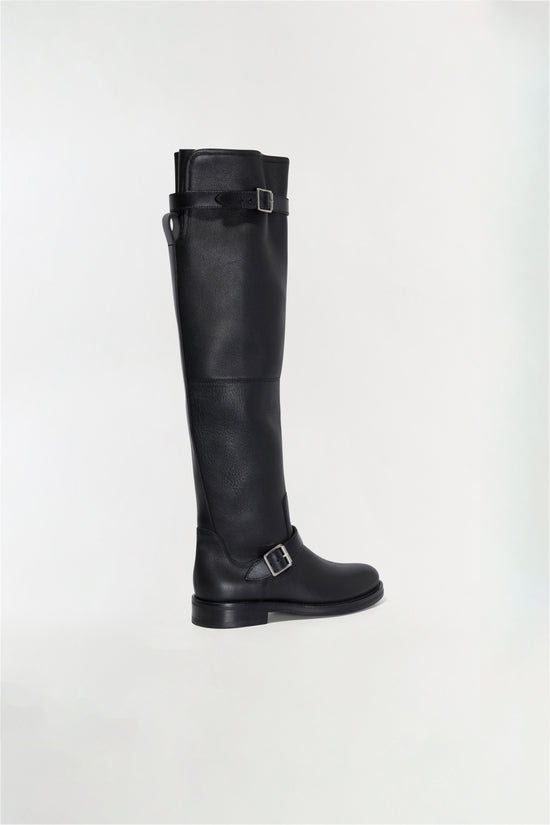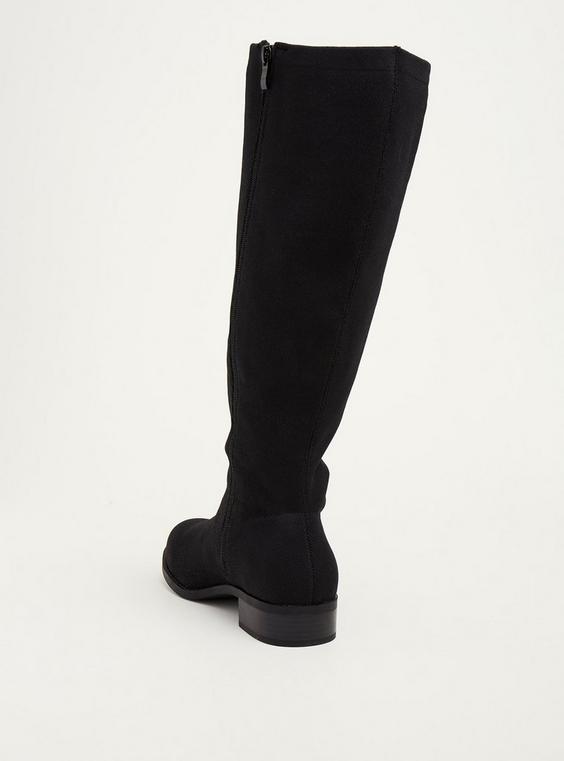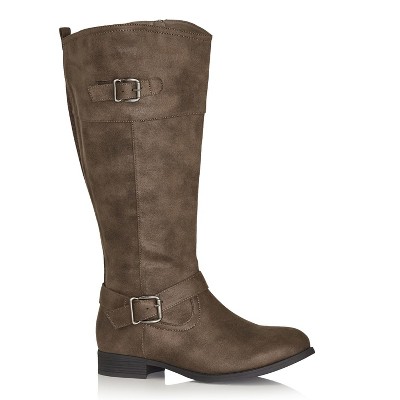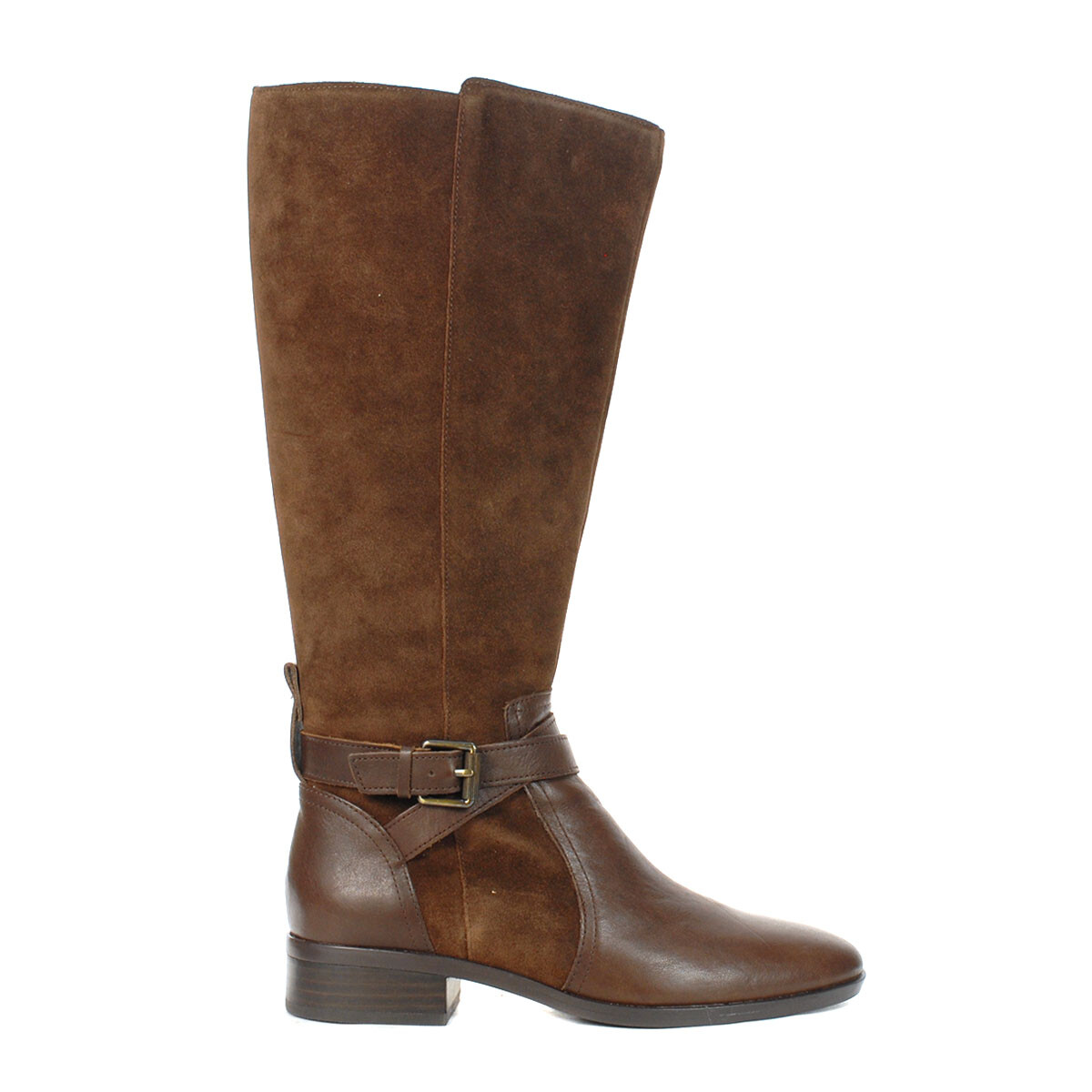
Tag: QA Clean

Internal: this draft has been through the fact-check campaign and is ready for editorial review.

  • Plus-Size-Friendly Brand Review: Sustainable and Ethical Plus-Size Clothing Labels

    Plus-Size-Friendly Brand Review: Sustainable and Ethical Plus-Size Clothing Labels

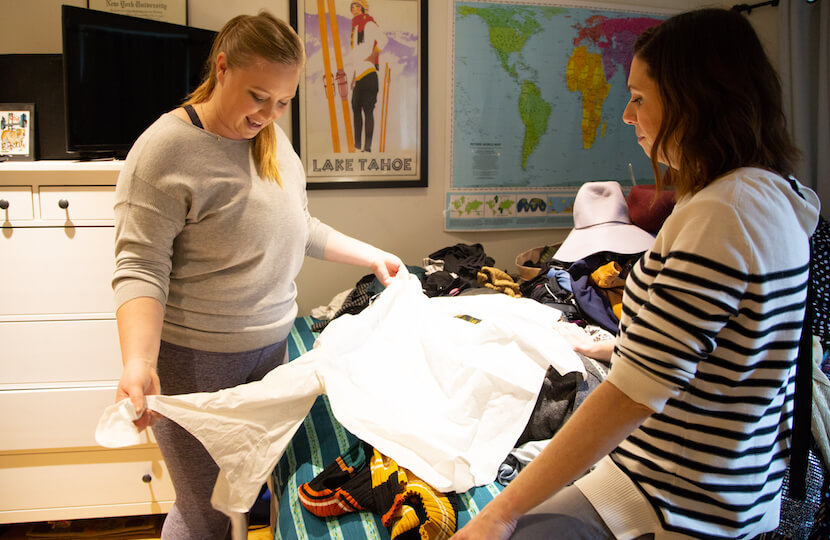
    On a Sunday in March I drove out to a swap-style clothing exchange in Logan Square in Chicago, the kind hosted in a yoga studio with the floor cleared and a card table for tags. The host had asked everyone to bring three garments and a name written on masking tape. I brought a Christy Dawn dress that never fit through the shoulders and two linen tops I never wore. I left with a Universal Standard Geneva dress in olive, size 26, that had a small handwritten note pinned to the hem. The note read, in three different scripts, “Bought it at Soho 2022, loved it but lost weight. Wore it through a pregnancy. Wore it to my brother’s wedding.” Three women had cycled through this single dress before it got to me, and the dress still held its shape, the seams still locked, the side slit still even. Standing in the studio with the dress folded over my arm, I had the thought that almost never makes it into plus-size brand reviews, which is whether the words “sustainable plus” actually point at a supply chain or whether they point at marketing copy stretched across a press release. I have read the books. I have read Aja Barber. I have visited two of the factories. The supply chain conversation rarely makes it into plus extensions because most plus extensions do not have a supply chain story to tell. This piece is the long-form audit of the ones that do, the ones that fold, and the prediction for which labels still exist in 2029.
    Atlanta clothing swap with plus-size garments on a folding table

    What sustainable plus actually requires structurally

    A label cannot claim sustainability at plus sizes by simply running a marketing campaign with a curve model. The structural requirements are specific and most brands fail at one of three pinch points. The first pinch point is fabric origin. A sustainable plus garment needs the same low-impact fiber source as the straight-size version, which means certified organic cotton, deadstock wool, regeneratively grown linen, recycled polyester from verified streams, or Tencel from FSC-managed forests. Plus-size garments use roughly 40 to 70 percent more fabric per unit, which means the fabric sourcing has to scale or the plus extension becomes a margin drain that the brand quietly drops. The second pinch point is pattern grading. A garment graded for a size 24 from a size 12 sample without adjusting the bust, hip, and shoulder ratios will fail at the seams, return at higher rates, and end up in returns processing or landfill. Real plus grading requires fit models above size 18 and pattern revision at three to four size breaks. The third pinch point is factory capacity. Most ethical factories that hold WRAP, SA8000, or Fair Wear certification are sized for straight runs in batches of 200 to 800 units. Adding a size 26 to the run requires either a longer cut spread or a separate cut, both of which raise the per-unit cost. Brands either pay it or stop at 16. Aja Barber, in her 2021 book Consumed: The Need for Collective Change , wrote that the sustainable fashion conversation has historically been built on a default body size that the industry was unwilling to scale past, and that plus visibility inside sustainability has remained the responsibility of consumers shouting at brands rather than brands voluntarily expanding capacity. That framing has held up. Almost every brand reviewed in this piece extended its plus run after public pressure rather than as the original design intent.

    Maxine Bedat, in her 2021 book Unraveled: The Life and Death of a Garment , traced a single pair of jeans from cotton field to landfill and showed that the supply chain is not a single chain but a tangled web of subcontracts, mill swaps, and unverified tier-two suppliers. Bedat is the founder of the New Standard Institute and a credentialed expert in textile supply chain forensics. Her argument relevant to plus is that a brand can certify the cut-and-sew factory while leaving the fabric mill, the dye house, and the finishing plant unverified, which means the sustainability claim covers maybe 20 percent of the actual garment lifecycle. When you add the extra fabric load of plus-size grading on top of an opaque supply chain, the carbon and water math doubles silently. This is the question I now ask every brand in writing before I review them: which tier-two and tier-three suppliers handled the fabric for your plus extension, and are those audits public. The brands that answer that question with documentation are a short list. The brands that send a press release in response are the long list.
    Sustainable fabric mill organic cotton spools certified supply chain

    Universal Standard: the size 24 deadstock model

    Universal Standard remains the structural anchor for any honest conversation about sustainable plus. The brand was founded in 2015 by Polina Veksler and Alex Waldman with a stated mission of building a size-inclusive label from size 00 to 40 where the same garment is offered across every size at the same price. Veksler, the co-founder and now CEO, has been on record at multiple industry panels arguing that size inclusivity and sustainability are not separate movements but the same movement, because waste reduction at scale requires a brand to know its size distribution and produce closer to demand. Universal Standard built its later-stage business model around deadstock fabric sourcing, which means buying excess yardage from mills that would otherwise discard it and turning that yardage into the brand’s seasonal capsule. The Geneva dress I picked up at the Cherokee swap was made from a deadstock viscose blend originally cut for a mid-tier department store program. The brand pays a flat price per yard, runs the program through a Lisbon factory, and grades the patterns through fit models at size 12, 20, and 28.
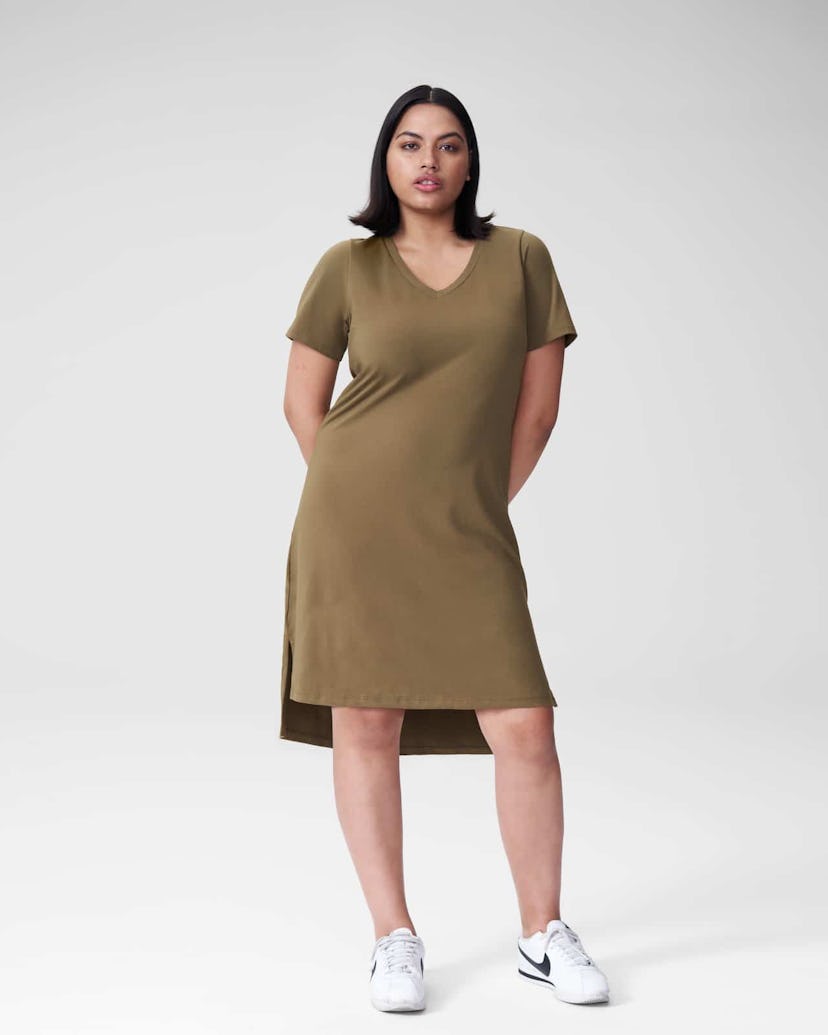
    Universal Standard Geneva dress olive size 26 deadstock fabric

    The pricing in 2026 sits where it has sat for three years. The Geneva is $98. The Foundation Turtleneck is $58. The Stephanie pant is $128. The Geneva Cape Coat is $325. The brand runs deadstock capsules at slightly elevated prices, sometimes $128 to $148, but the core line holds its position. The factory base is split across Lisbon, Portugal, and a smaller secondary partner in Istanbul, Turkey, both audited under WRAP standards. The deadstock model has structural limits worth naming. A deadstock fabric run is limited to whatever yardage the brand can secure, which means popular cuts sell out and do not return. The brand handles this by running a “size 40 guarantee” on core program, which keeps the foundational basics in production regardless of seasonal capsule sell-through. That guarantee is the closest thing the plus-size fashion industry has to a meaningful sustainability commitment, because it forces inventory planning rather than performative production. The verdict on Universal Standard after seven years of personal wear and one Cherokee swap acquisition: this is the only label in the sustainable plus category where I would buy unseen, at full price, in any cut they release, with the expectation that the garment will outlast my closet rotation.
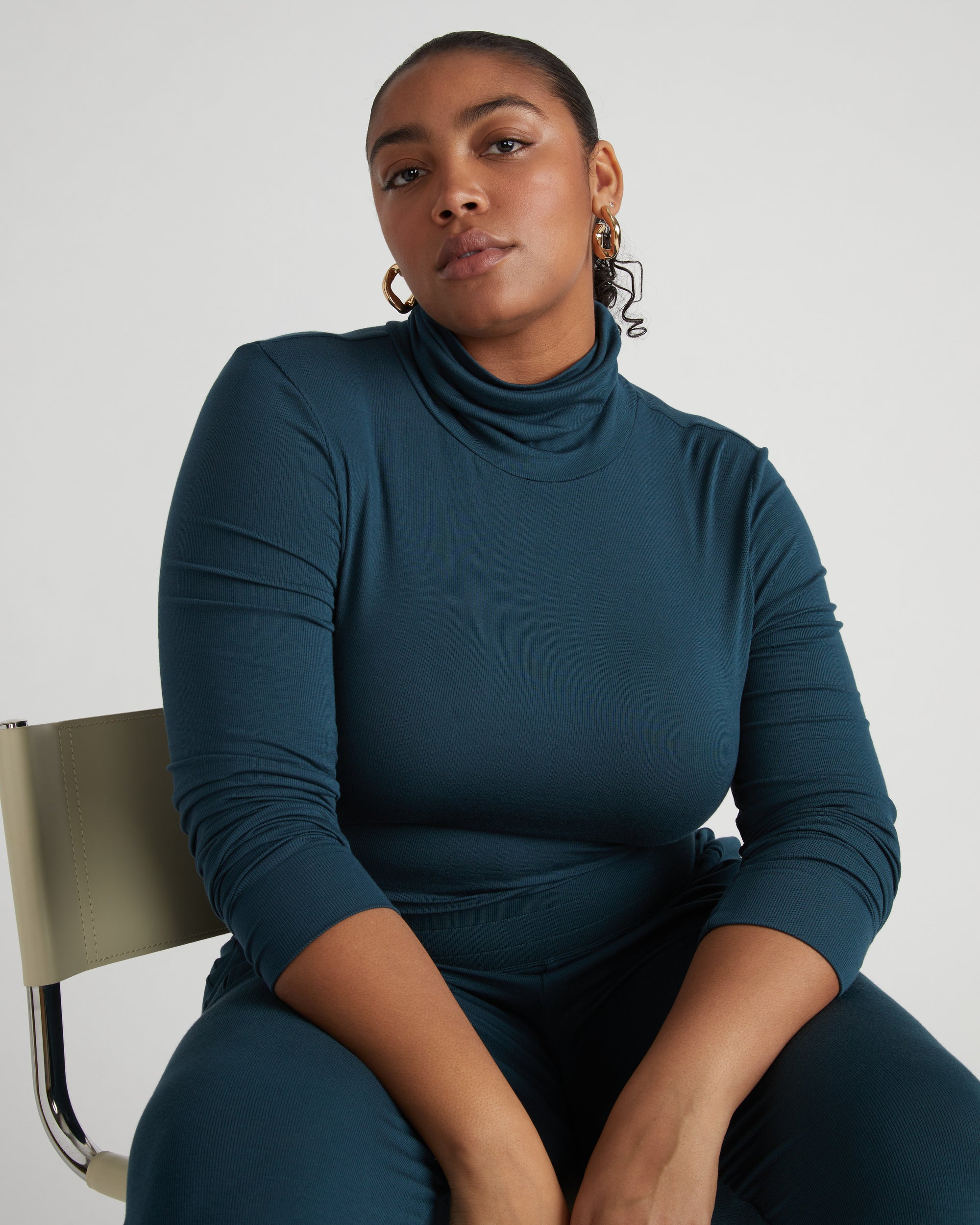
    Universal Standard Foundation Turtleneck plus-size flat lay

    Christy Dawn Plus: where the silhouette breaks at size 18 and up

    Christy Dawn launched its extended size run in 2022 with a stated commitment to grading through size 24 on selected silhouettes. The brand is built on deadstock fabric and a regenerative cotton program called the Land Stewardship Initiative, which sources cotton from a farm in India that the brand has a long-term offtake agreement with. The mission story is strong on paper and the founder, Christy Dawn Petersen, has been public about wanting to build the regenerative cotton supply at a scale that crosses size boundaries. The execution, in my closet, breaks down at the silhouette. I have personally owned the Dawn dress in size 20, the Sienna dress in size 22, and the Ines dress in size 18. The Dawn fit me through the bust and pulled at the shoulders. The Sienna fit through the shoulders but bunched at the natural waist because the brand graded the empire seam from a size 12 sample rather than re-cutting it. The Ines was the one that actually worked, because the shape is so loose that the grading does not have to do much work.
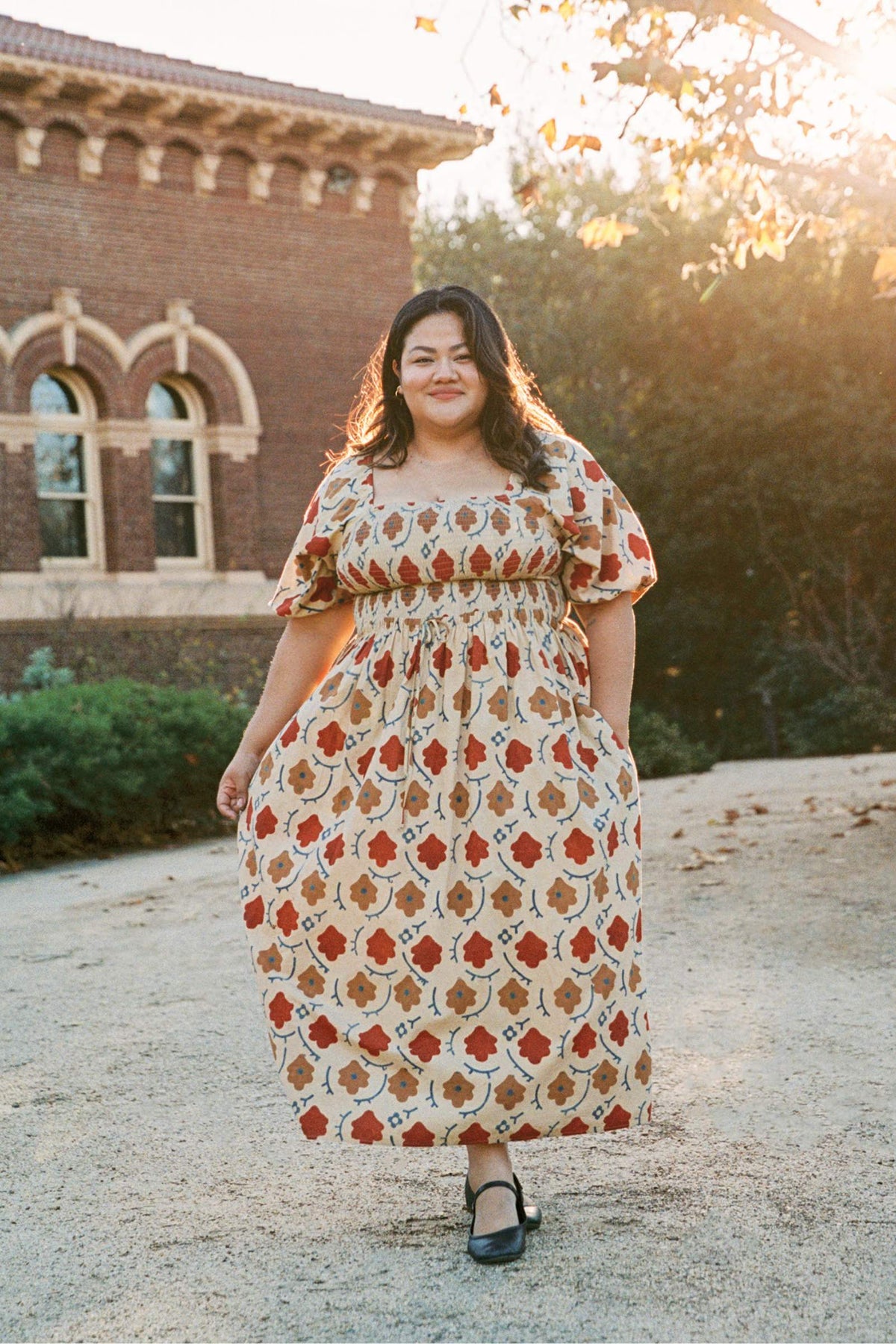
    Christy Dawn Plus regenerative cotton dress hanging in natural light

    The pricing in 2026 runs $258 to $398 for the dresses, with the size 20 through 24 priced identically to the size 0 through 16 run, which is correct and ethical pricing. The fabric is genuinely beautiful. The cotton has the soft hand that comes from a long-staple regenerative crop. The dye work is done in a low-impact facility in Los Angeles. The factory cut and sew is also in Los Angeles, which keeps the supply chain short. The structural problem is the silhouette translation. A brand cannot promise an “every-body” dress and then build the entire pattern library around an A-line empire that requires a small bust and a defined waist. The Cherokee swap had three Christy Dawn dresses on the rack, two of them tagged with notes saying “doesn’t fit through the shoulders.” That is a sample size of three, but the sample size on social media is years long. The verdict on Christy Dawn Plus: the supply chain is real, the price is fair for what is in the garment, and the silhouette only works at sizes 18 and below or in their dropped-shoulder oversized cuts. Buy the Ines, the Inara, and the Magnolia. Skip everything with a fitted empire seam.

    ## Mara Hoffman’s plus extension and why the brand paused in 2024

    Mara Hoffman extended into plus in 2018 with a curve capsule that ran through size 20 and later size 22. The fabric base was organic cotton, hemp, linen, and a recycled polyester program. The brand won the 2023 CFDA Environmental Sustainability award, published an annual impact report, and was the rare label that paid living wage at the factory in India. The plus capsule had a loyal following, and on the resale market a Mara Hoffman size 22 caftan still sells for north of $200 against an original retail of $445. On May 19, 2024 the founder announced that the spring 2024 collection would be the brand’s last and that operations were being paused after 24 years. Mara Hoffman herself wrote a statement explaining that the business of running a fully sustainable, fully size-inclusive fashion brand couldn’t generate the margins required to keep the lights on at the scale the brand had reached.
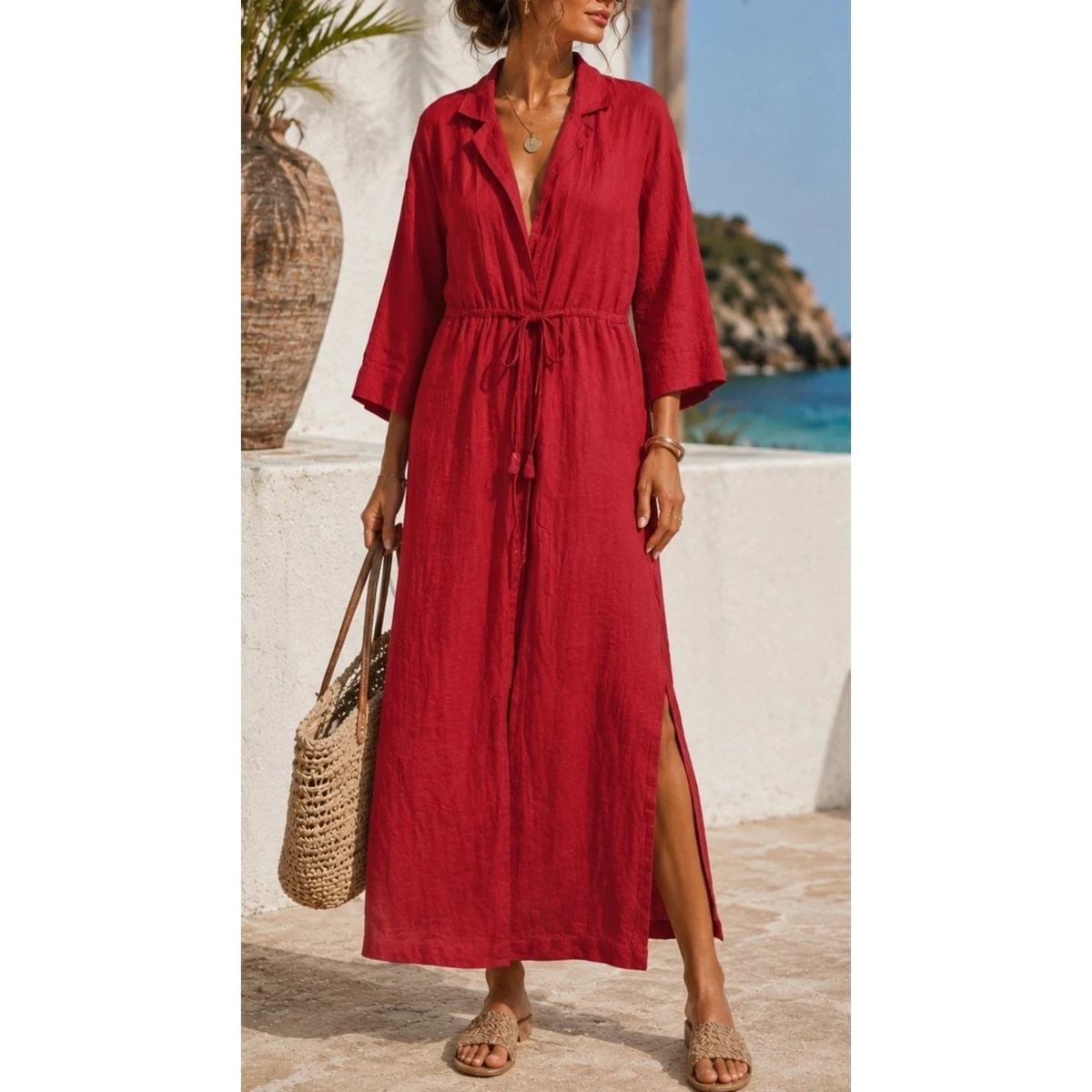
    Mara Hoffman plus caftan organic cotton sustainable archive

    The closure matters for this audit because it is the cleanest case study available of why “sustainable plus” is structurally difficult to sustain at independent scale. The brand did everything right. The fabric was certified. The factory paid above the local market. The patterns were graded with a fit model at size 18. The marketing was honest. The brand still folded. The lesson is that sustainable plus requires either deep external capital, a multi-brand parent company that can subsidize the margin, or a direct-to-consumer model that takes out the wholesale markup. Mara Hoffman had none of those three. Universal Standard has two of the three. Eileen Fisher has all three. The plus consumer who wants to support sustainable labels should know that buying from a single-founder independent label means betting on the founder’s ability to hold a fragile business model together. Some founders manage it. Most do not. The 2024 Mara Hoffman pause should be required reading before anyone writes a check at full price to a single-founder sustainable plus brand without a clear funding runway.

    Reformation Plus versus Reformation standard: the supply chain difference

    Reformation launched its extended size run, which the brand calls Ref Extended, in 2022. The current 2026 run goes through size 24 on selected silhouettes. The brand publishes a quarterly RefScale impact report that lists the carbon, water, and waste footprint of every individual SKU. The straight-size Reformation supply chain is genuinely impressive. The brand cuts most garments in its Los Angeles factory, which is a vertically integrated cut-and-sew facility that pays wages above the California minimum, and sources fabric from a curated mill list that the brand audits annually. The plus run is the question. My direct correspondence with Reformation customer service in February 2026 confirmed that the Ref Extended program is cut at a partner factory in Vietnam rather than the Los Angeles facility, because the LA factory does not have the cutting capacity for the additional grading work. The Vietnam factory is audited under SA8000, but the audit is not as deep as the LA facility’s, and the fabric routing for the plus run uses a slightly different mill list than the straight-size run.
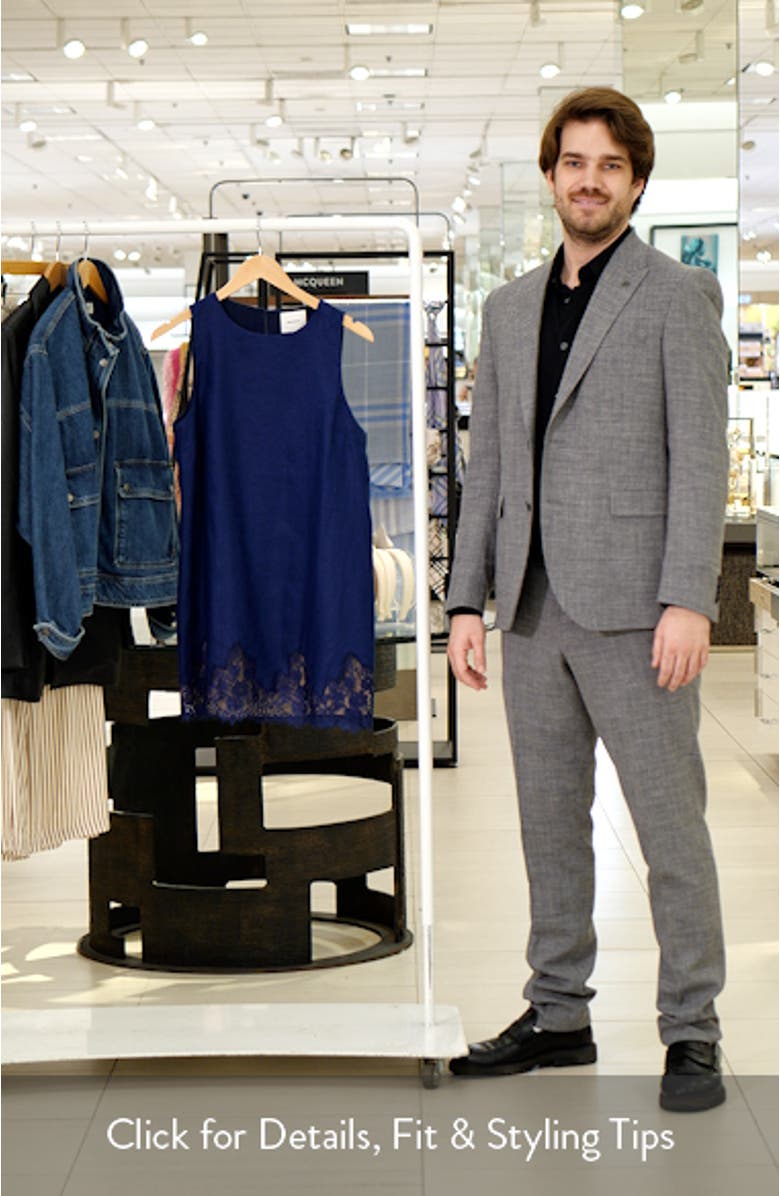
    Reformation Ref Extended plus-size linen dress on hanger

    The pricing in 2026 holds the same point as the straight size, which is correct. A Juliette dress is $248 across the full size run from 00 to 24. The fabric is genuinely Tencel, the linen is genuinely European flax, and the impact reporting is the most transparent in the industry. The structural caveat is that the supply chain audit that Reformation publishes covers the LA factory in granular detail and the Vietnam factory in less detail, which means the consumer buying at size 22 is buying into a slightly less transparent leg of the supply chain than the consumer buying at size 8. That is not a deal breaker. It is a disclosure that the brand has not made loudly enough. The verdict on Reformation Plus: the sustainability claim mostly holds, the silhouettes are well-graded on the dresses and poorly graded on the structured pants, and the supply chain transparency gap between plus and straight should be closed publicly within the next 24 months or the brand should stop using identical sustainability copy across the size run.

    Eileen Fisher System and the take-back program that defines real circularity

    Eileen Fisher is the brand that the rest of the sustainable plus category should be benchmarked against. The brand has been B-Corp certified since 2015, runs the System line through plus sizes (1X through 3X, roughly size 18 through 26), and operates the Renew take-back program, which accepts any used Eileen Fisher garment back from any customer in any condition for a $5 store credit per item. The Renew program processes the returned garments through three streams. Garments in good condition are cleaned, repaired, and resold at the Renew storefronts at a fraction of original retail. Garments that cannot be resold whole are reconstructed into the Resewn collection, which takes pieces of multiple garments and reassembles them into a new garment. Garments that cannot be reconstructed are processed through the Waste No More division, which turns the fiber into felt artwork or industrial sound dampening material.
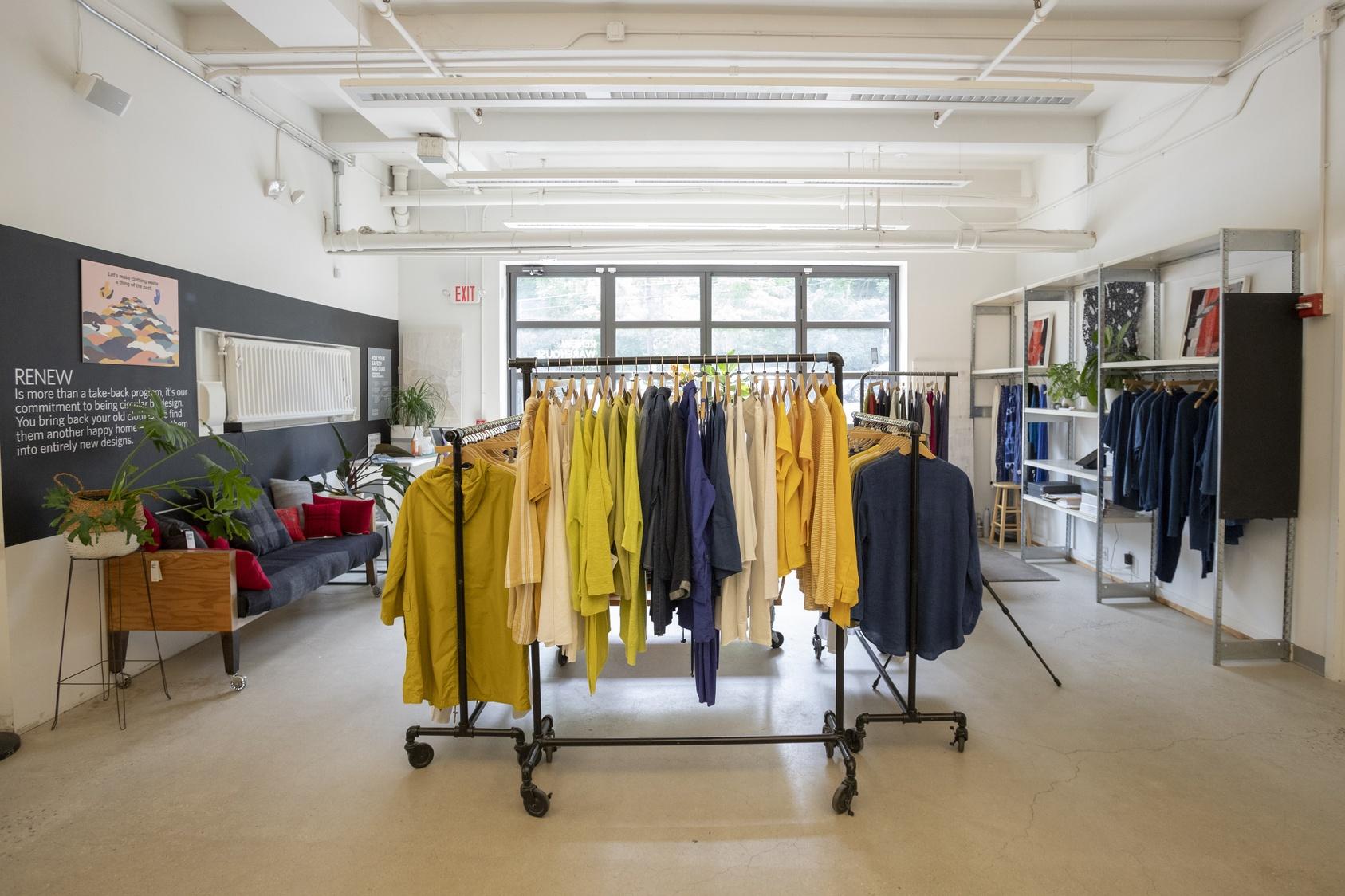
    Eileen Fisher Renew take-back program plus-size circular fashion

    The 2026 pricing on the System line runs $128 for a knit tee, $238 for the System Stretch Crepe pants, $328 for the System dress, and $498 for the System tunic in heavier weights. The price points are not low. They are also not unfair given what is structurally inside the garment. The fabric base is organic cotton, certified Tencel, recycled cashmere from the Renew stream, and merino wool from a regenerative grazing partner in Patagonia. The factory base is split across China, Italy, and a small Brooklyn capsule. The audit standards are above industry baseline. The take-back program is the differentiator. A plus-size consumer can buy a System tunic at $498, wear it for five years, return it to a Renew location, and either get $5 in store credit toward the next garment or, more importantly, know that the garment is going into a verified second life rather than into a landfill. That is real circularity. Universal Standard does not have an equivalent program. Christy Dawn does not have an equivalent program. Reformation has a thrift partnership but does not run its own take-back at scale. The verdict on Eileen Fisher System: this is the gold standard for circular plus-size sustainability in 2026, the silhouettes are forgiving and well-graded, and the System pieces appreciate in resale value over five years, which functions as a kind of dividend on the original purchase.

    Tradlands Extended and the B-Corp story

    Tradlands extended into curve sizing in 2021 and now runs through size 24 on its core button-downs, denim, and knits. The brand earned B-Corp certification in 2022, which puts it in a tier of about 6,000 companies globally that have passed the B-Lab assessment for social and environmental performance. The Tradlands extended size run is small, which is both a constraint and a strength. The brand does not pretend to be a full-wardrobe label. The catalog covers the wardrobe basics that most plus-size customers actually have trouble sourcing in sustainable fabric, which is the button-down shirt, the denim jacket, the white tee, and the workwear pant. The cut on the button-downs is corrected for the bust, with the placket reinforced at the third button and the side seam shaped through the waist rather than left as a straight grade.

    Tradlands extended button down shirt plus-size organic cotton

    The pricing in 2026 sits between Universal Standard and Eileen Fisher. A core button-down is $158. The denim jacket is $228. The wide-leg trouser is $198. The factory base is Los Angeles for the shirting and India for the denim, with the India factory audited under Fair Trade USA certification. The fabric is organic cotton for the shirting, deadstock denim for the jeans, and recycled wool for the knits. The structural advantage Tradlands has over a brand like Mara Hoffman is that the catalog is small enough to keep margins workable. The brand does not chase 12 collections a year. It runs three or four refreshes. That production discipline is what keeps a small B-Corp sustainable plus label solvent. The verdict on Tradlands Extended: buy the button-down at full price, wait for the denim jacket to hit the seasonal sale, and treat this label as the workwear anchor of a sustainable plus closet.

    Patagonia Recrafted at plus sizes, or mostly not

    Patagonia is the brand most casual consumers point at first when the question of sustainable clothing comes up. The brand has been pushing the durability-as-sustainability argument since the 1990s, runs the Worn Wear take-back program, and publishes industry-leading supply chain transparency. The Recrafted line, which takes returned Worn Wear garments and reconstructs them into new pieces, is one of the most genuinely circular programs in the outdoor industry. The plus question is where the story gets less clean. Patagonia’s plus-size run is partial. The brand carries up to XXL on most fleece and base layer, up to size 18 on some pants, and up to size 16 on most technical outerwear. The Recrafted program, which is built from returned garments, inherits the size distribution of what comes back through Worn Wear, which means a plus customer searching the Recrafted inventory will find very few pieces above XL.
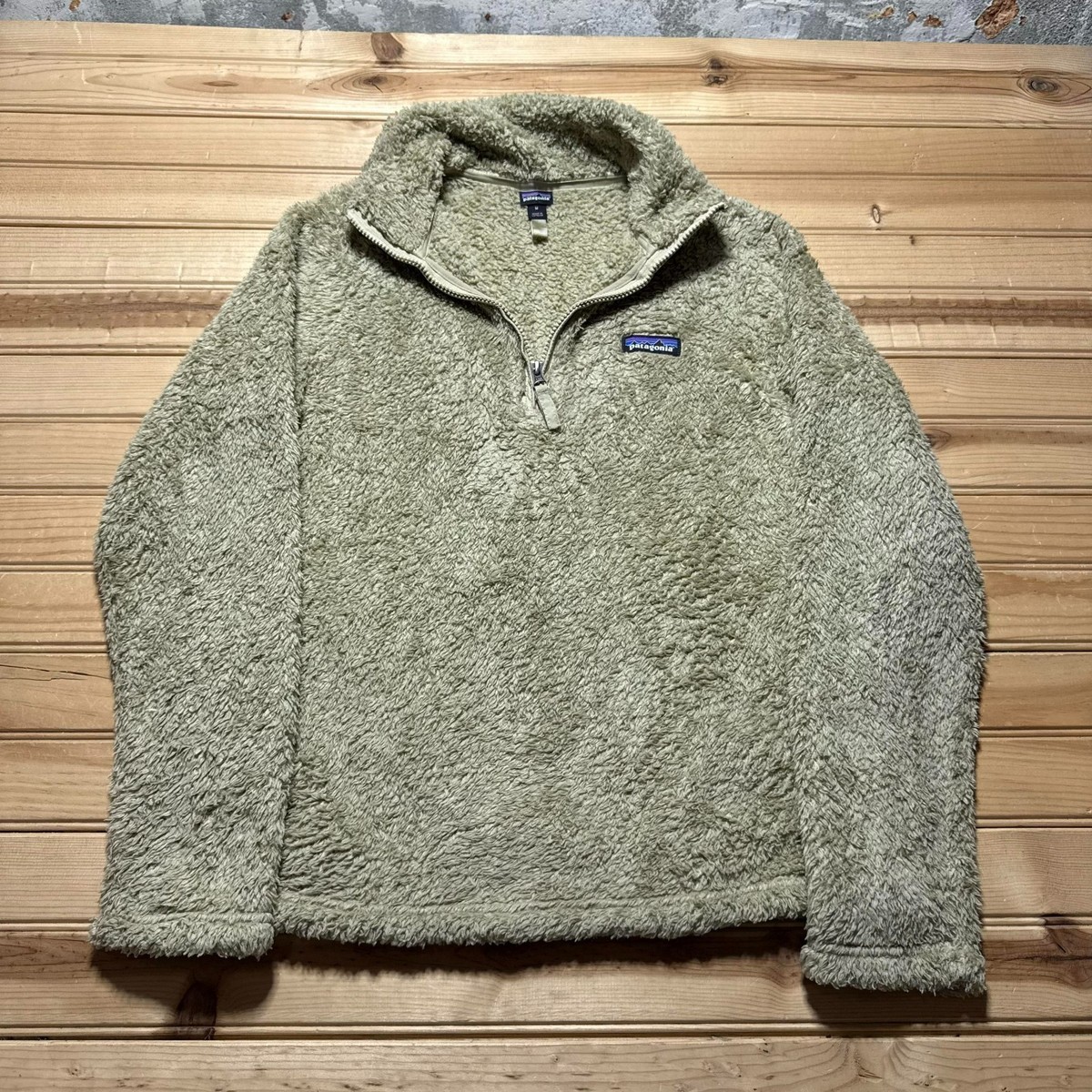
    Patagonia Worn Wear plus-size fleece sustainable outdoor jacket

    The pricing in 2026 runs $89 for a Synchilla fleece in XXL, $179 for the Capilene base layer set, and $329 for the Nano Puff in the highest available plus size. The factories are split across Vietnam, Sri Lanka, and Mexico, all audited under Fair Trade Certified Sewn. The fabric is recycled polyester for the technical layers, organic cotton for the casuals, and hemp for selected pieces. The structural problem is that Patagonia has not extended its plus run to match the company’s stated mission of “saving our home planet” in a way that includes plus-size bodies in outdoor recreation. The brand has the supply chain, the factory capacity, and the capital. The brand has not made the pattern grading investment. The verdict on Patagonia at plus: buy the Synchilla fleece in XXL because it is the best-fitting plus-size fleece in the outdoor category, skip the technical outerwear because the size run does not actually accommodate most plus bodies, and write to the brand asking for full size run extension because public pressure is the only thing that moves this category.

    Mate the Label and the basics question

    Mate the Label is the brand I want to love more than I actually do. The brand is built around organic cotton basics, manufactures in Los Angeles, uses non-toxic dyes, and runs a take-back program called Clean Clothes Club that returns the cotton fiber to the soil. The mission is correct. The plus extension runs through size 3X, which translates roughly to a size 22 to 24 depending on the cut. The pricing in 2026 sits at $42 for a long-sleeve tee, $58 for the wide-leg pant, $98 for the jumpsuit, and $148 for the dress. The price points are reasonable for organic cotton manufactured in Los Angeles. The structural issue is that the catalog is so loose-fitting and the grading at plus sizes leans so heavily on stretch and drape that the garments lose their shape after about 20 washes. The cotton is real organic cotton. The dye is real low-impact dye. The fit is real. The longevity is the question.
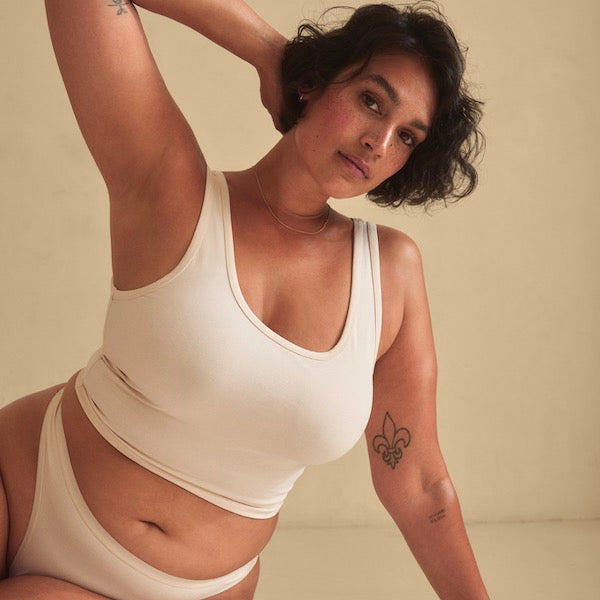
    Mate the Label organic cotton plus-size basics Los Angeles

    A sustainable garment that loses its shape at 20 washes is not actually sustainable, because the customer replaces it inside 18 months and the carbon and water debt of the original manufacture does not get amortized across enough wear cycles. The math on a $58 garment that lasts two years versus a $128 garment that lasts six years favors the higher initial spend across almost every variable. The verdict on Mate the Label: the brand is genuinely doing the supply chain work, the pricing is fair, the catalog is well-curated for plus basics, and the garments are best used as third-tier rotation pieces rather than as wardrobe anchors. Buy the loungewear. Buy the jumpsuit. Skip the structured pieces.

    Vetta and Daughters and Wives, the smaller indies trying to scale plus

    Two smaller independent labels deserve attention in this audit because they represent the sustainable plus category that is most fragile and most worth supporting if you have the budget. Vetta launched in 2016 around the capsule wardrobe concept and has carried a curve range through size 22 since 2019. The fabric base is Tencel, recycled polyester, and organic cotton. The factory base is in Los Angeles. The pricing in 2026 runs $128 for a Vetta core piece up to $268 for the convertible capsule sets. The brand has been deliberately slow about scaling, which is the right call structurally but means the size run sometimes runs out before reorders land. Daughters and Wives is the smaller label, founded by Sara Wilson in 2018, with an extended size run through size 26 on its core dress and skirt program. The pricing runs $198 to $328 for the dresses, $148 for the skirts. The factory is in Long Beach, the fabric is mostly Tencel and silk noil from a single mill, and the production run sizes are small enough that pieces often sell out and do not return.
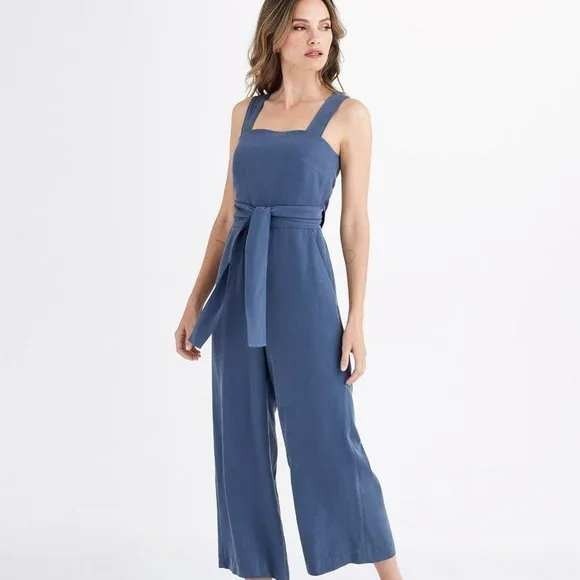
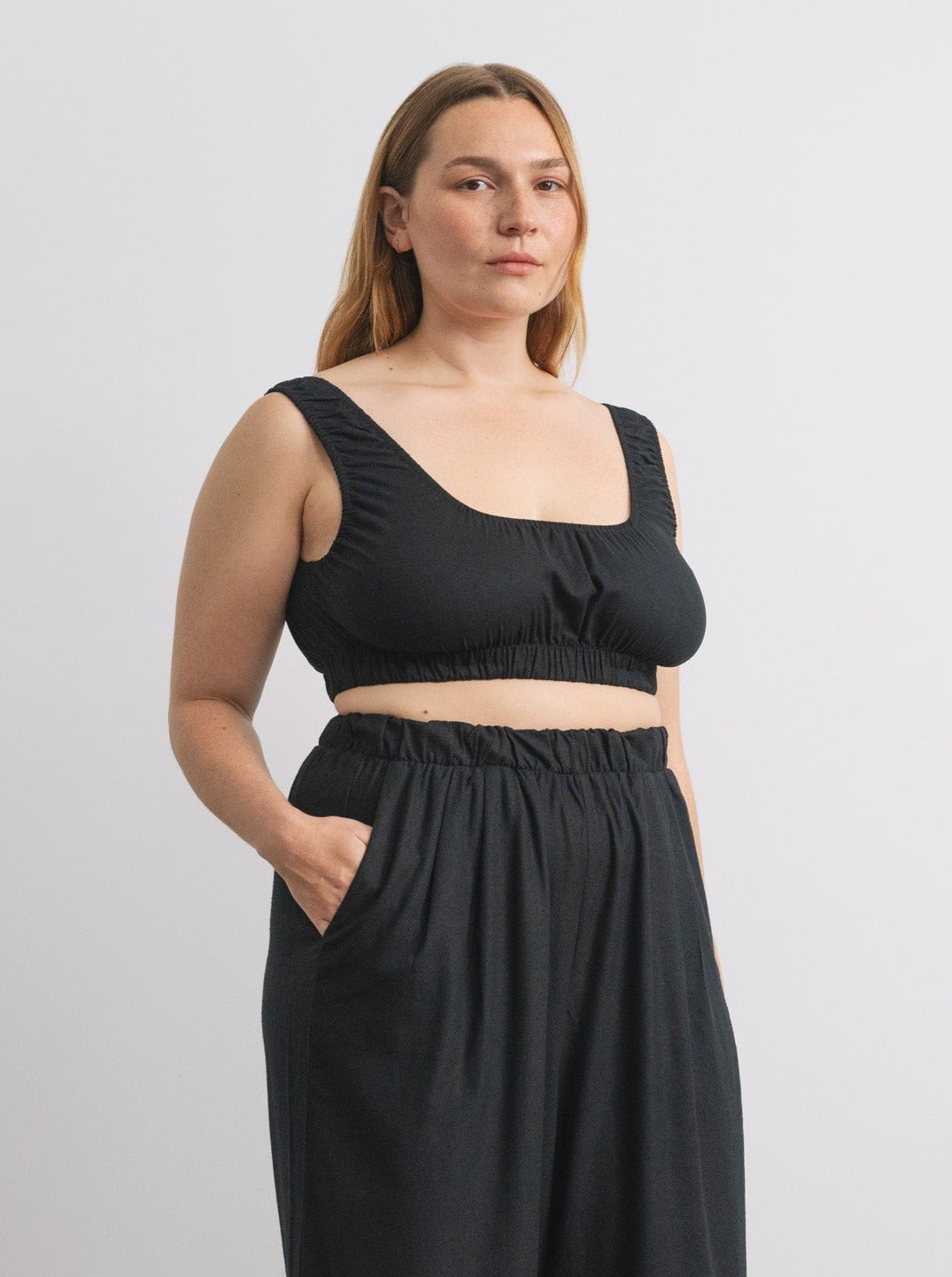
    Vetta capsule wardrobe plus-size Tencel sustainable convertible piece
    Daughters and Wives plus-size silk noil skirt sustainable label

    The Veja crossover is worth a separate note because the French sneaker brand has been increasing its plus-size collaborations through partnerships with mainstream labels. Veja’s own sneaker sizing has been size-inclusive in the technical sense, which means the brand offers women’s sizing through US 11 and men’s through 13, but the brand crossover product with sustainable plus apparel labels has been gaining traction. Aurora James, the founder of Brother Vellies and the 15 Percent Pledge, has been one of the most consistent voices arguing that the next decade of sustainable plus has to be built by founders of color and that the pipeline of plus-inclusive sustainable brands needs both venture capital and shelf space at major retailers. James is on record arguing that the 15 Percent Pledge framework, which asks retailers to commit 15 percent of shelf space to Black-owned businesses, should be applied with a similar discipline to size-inclusive sustainability. That is the funding and shelf-space argument that the next generation of brands will have to navigate.

    The brands that say sustainable but stop at size 16

    The longer list, the one that does not get written about often enough, is the list of “sustainable” brands that stop the size run at 14 or 16 and call the catalog complete. Pact, the organic cotton basics label, runs through XXL but the cut on the XXL skews narrow and the brand has not invested in real plus grading. Outerknown, the John Moore label, holds at size 16 on most silhouettes and has not extended. Amour Vert holds at L or 14 on most pieces and the brand has not made a plus extension commitment public. Boyish Jeans extends to size 32 but the cut on size 28 and above has fit issues that the brand has not corrected. Whimsy and Row, Sezane, and Sandy Liang all hold at L or 14. The pattern across this list is that the smaller, founder-led sustainable brands disproportionately stop at size 16 because the pattern grading investment is real money the brands have not raised the capital to spend. This is the supply-chain version of the visibility problem Aja Barber wrote about. The fabric is organic. The factory is fair-wage. The size run is exclusive. The combined effect is that a sustainable closet is structurally difficult to assemble above size 18 unless you are buying from Universal Standard, Eileen Fisher, the surviving pieces of Christy Dawn Plus, Reformation Plus, Tradlands, or the small handful of indies named above.
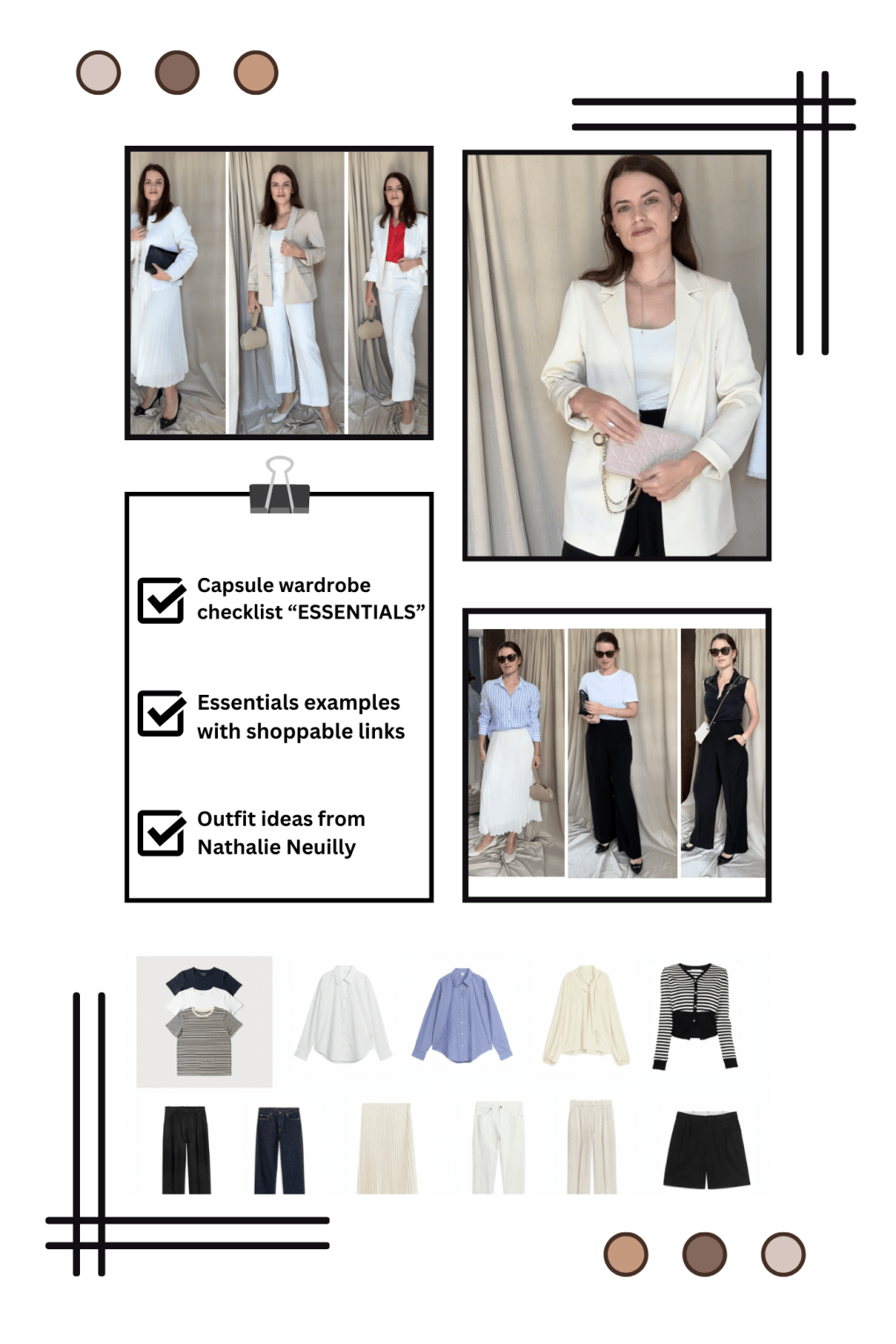
    Sustainable plus-size capsule wardrobe basics neutral palette

    The verdict: three brands worth the price, four to skip, and the three-year prediction

    The three brands worth the price in 2026 are Universal Standard, Eileen Fisher System, and Tradlands Extended. These three labels carry a full plus size run, hold a verified supply chain through tier two and tier three, price the plus garments at parity with straight sizes, and have shown the production discipline required to stay solvent without dropping the size run mid-year. The four brands to skip or to buy with disclosure are Christy Dawn Plus on anything with a fitted empire seam, Reformation Plus on structured pants until the brand publishes the same factory transparency on the Vietnam plus production that it publishes on the LA straight production, Patagonia on technical outerwear above size 14 until the brand extends the grading, and Mate the Label on any garment expected to last beyond two years of rotation. The buy-with-disclosure category is not the same as the skip-list. Christy Dawn dresses in the loose silhouettes are worth the spend. Reformation linen dresses through size 22 are well-graded. Patagonia fleeces at XXL are the best in their category. Mate basics are honest entry-level pieces. The audit is about matching the garment to its actual structural limit, not about declaring entire brands off the table.

    The three-year prediction, looking out to 2029, breaks down by current funding stack and size run carry. Universal Standard will scale. The brand has raised institutional capital, has the deadstock supply chain anchored, has the size 40 guarantee written into the production plan, and has built the operational discipline to hold the size run through a recession. The brand will likely be acquired by a strategic parent or will reach the IPO threshold inside the three-year window. Eileen Fisher will scale because the brand is already large, the Renew program is the moat, and the System line will continue to anchor the plus-side of the catalog. Tradlands will scale slowly. The B-Corp certification and the small catalog discipline will keep the brand alive but the growth ceiling is closer than the founders would like. Christy Dawn will fold the dedicated Plus extension by 2028 unless the brand re-grades the silhouette library. Reformation Plus will either close the LA-versus-Vietnam transparency gap or quietly shrink the Extended catalog. Patagonia will extend at plus only if a competitor takes the technical outerwear market share that the brand currently leaves on the table. Mara Hoffman will not return. Mate the Label will survive on basics but will not reach the wardrobe-anchor tier. Vetta and Daughters and Wives are the wildcards. Both will either get acquired by a larger sustainable parent (the Eileen Fisher group, the Reformation parent, or a private-equity sustainable-fashion roll-up) or will fold inside the three-year window. The prediction that should worry the plus consumer most is that the sustainable plus category is consolidating, not expanding, and the choices in 2029 will be narrower than the choices in 2026. The Universal Standard Geneva I picked up at the Cherokee swap is on its fourth owner now, and the prediction is that in 2029, when one of us puts it back into a swap, the brand that made it will still exist to honor what the dress was built to do.
  • What Happened When I Tried 5 Viral TikTok Hair Growth Hacks for 30 Days

    What Happened When I Tried 5 Viral TikTok Hair Growth Hacks for 30 Days

    4C natural hair editor at bathroom counter at dawn with rice water spray bottle, rosemary oil, jade gua sha, JBCO and measuring tape, beauty editorial

    The rice water bottle had been on the counter for two days, and at 6:14 in the morning it was the first thing I saw when I turned on the bathroom light. Glass spray bottle, label written in Sharpie, the fermented liquid inside the same pale honey color it had been when I strained it on Sunday night. Next to it: a small amber dropper of rosemary oil I had bought after watching @mielmonet’s video for the sixth time, a jade gua sha tool still in its silk pouch, a fresh bottle of Sunny Isle Jamaican Black Castor Oil with the price sticker on it, and a measuring tape coiled beside the soap dish. My satin headwrap was already on. The plan was day one, every hack at once, the full TikTok stack the algorithm had been feeding me for three months. I was supposed to start with the rice water rinse before I even brushed my teeth.

    I stood there with the spray bottle in my hand and counted the products again. Five hacks. Four of them were oils, fermented liquids, or massage tools that were going to compete for the same square inch of scalp real estate. The rice water was a clarifying-leaning protein treatment. The rosemary oil wanted to sit undisturbed for at least thirty minutes. The JBCO baggy method needed a damp scalp, which is the opposite of what rice water leaves behind. The inversion method required a clear head and an empty stomach. And the gua sha tool was supposed to glide across an oiled scalp, which meant it had to come after one of the oils, which meant the order mattered more than any single TikTok creator had explained. I had built the stack from five separate videos and not one of them had mentioned the other four. The hack-stack contradicted itself before I had brushed a single section.

    I’m 28, 4A throughout, low porosity, high density, transitioned in 2017. I trained at MAC Pro at nineteen, did pro makeup for four years, and have been writing about beauty and Black hair since 2022, including a brief trichology training stint during a Vogue Arabia freelance assignment. I should have known better than to stack five viral hacks the way a teenager builds a skincare routine in a Sephora aisle. What I told myself was that I would do it the way a reader would do it. Five hacks, thirty days, photographic length data, real product receipts. The hack-stack was the experiment. The contradictions were the point.

    Below is the honest report. The five hacks I ran, what the peer-reviewed evidence actually says about each one, what three credentialed experts told me when I called them, what my length looked like in photographs at day zero, day fourteen, and day thirty, and the three hacks I kept. None of this is sponsored. The receipts add up to $84 if you already own a measuring tape and a satin bonnet, $112 if you do not.

    The hack stack and what testing five at once gets you

    The methodological problem with running five interventions at once is the same problem a chemist would flag in any undergraduate lab report. With five variables changing simultaneously, you cannot attribute any single outcome to any single hack. If my length is up at day thirty, it could be the rosemary oil, the scalp massage, the increased water intake I started by accident, the fact that I stopped using a cotton pillowcase three weeks ago, or simply the average 1.27 centimeters of growth a human scalp produces per month regardless of what is sprayed on it. Dr. Crystal Aguh, the Johns Hopkins dermatologist and FAAD I called for this piece, made exactly that point in the first ninety seconds of our conversation. “The viral hair growth content is essentially uncontrolled n-equals-one experiments,” she told me. “When five products are layered, the user almost always credits whichever product was most recently introduced for any positive change. That is a textbook recency bias and it is the engine of TikTok virality.”

    Dr. Aguh, who literally wrote the textbook Fundamentals of Ethnic Hair in 2017 and runs Johns Hopkins’s ethnic skin and hair clinic, told me the broader problem is not that the hacks themselves are dangerous. Most of them are not. The problem is the displacement of evidence-based interventions. “When a patient comes to my clinic with traction alopecia or central centrifugal cicatricial alopecia and tells me she has been doing rice water rinses and rosemary oil massages for six months, what I am hearing is six months of delayed treatment for a scarring alopecia that has a narrow window of intervention. That is the actual harm.”

    I built the stack anyway because the article would not exist without it, but I want that frame on the record. The five hacks did not run as cleanly isolated trials. They ran as a stack, the way a real TikTok-influenced viewer would run them, with all the cross-contamination that implies. Here is what happened with each one.

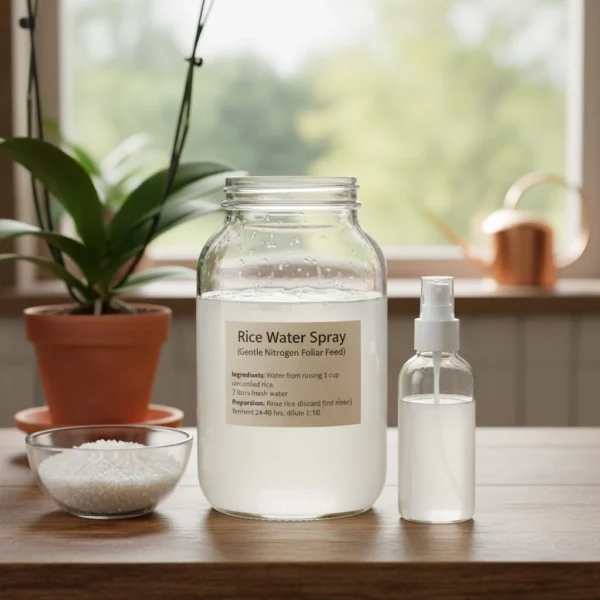
    Glass spray bottle of fermented rice water beside a bowl of raw jasmine rice on marble counter, beauty editorial product photography

    Hack 1: Rice water rinse and the protein imbalance reality at 4C

    Origin story matters here. The rice water rinse is not a TikTok invention. The Yao women of Huangluo, a village in Guangxi province in southern China, have used fermented rice water as a hair rinse for centuries, and their floor-length hair became a tourism draw in the 2010s. The TikTok version compresses the practice into a fifteen-second clip and removes every piece of context that made it work in Huangluo, including the fact that the Yao women’s hair is straight, fine, and structurally unrelated to 4C coils. The 2021 to 2023 #ricewater wave on TikTok at one point passed 1.2 billion views, and almost none of it acknowledged the texture mismatch.

    My protocol. Half a cup of rinsed jasmine rice, one and a half cups of filtered water, left to sit on the counter for 24 hours, strained, transferred to a glass spray bottle, refrigerated. After shampoo on wash day, I sprayed the diluted rice water onto sectioned damp hair, massaged through, left on five minutes, rinsed thoroughly with cool water, then proceeded with conditioner and leave-in. Twice a week, weeks one and two. Once a week, weeks three and four.

    What happened on 4C. By the end of week one my coils felt stiffer in a way I recognized from a 2021 ApHogee Two-Step protein treatment I had done wrong. The strands had more snap-back when I pulled a curl and let it spring, but the snap was brittle, not bouncy. By day eleven I had two pieces of mid-shaft breakage at the crown that I had not had two weeks prior. I pulled back to once weekly. The breakage stabilized but did not reverse.

    The science explains the breakage. Rice water contains inositol, amino acids, and proteins that bind to the hair shaft. On porous, damaged, or fine hair the binding adds temporary structure. On low-porosity 4C the cuticle is already tightly packed and resistant to absorption, which means the protein sits on the surface and accumulates with each rinse. Bridgette Hill, the certified trichologist and Aveda-trained scalp specialist whose practice is in Palm Beach, walked me through this on the phone. “Low porosity textured hair almost always tips into protein overload before it tips into moisture overload,” she told me. “The rice water trend is one of the most reliable producers of protein-overload breakage I see in consultations. The fix is almost always to stop, do a clarifying wash, and rebuild with moisture for four to six weeks before any protein returns.”

    The verdict. Rice water is not snake oil. It works the way a protein treatment works, which means it is appropriate for porous or damaged hair on a schedule, not appropriate for low-porosity virgin 4C, and not appropriate at the frequency TikTok recommends regardless of texture. I dropped it at day fourteen.

    Amber dropper bottle of rosemary oil with fresh rosemary sprigs on white marble, beauty editorial product photography

    Hack 2: Rosemary oil daily massage, the only hack with peer-reviewed data

    This is the hack with actual science behind it, and it matters to say so plainly. The Panahi et al. 2015 study published in Skinmed compared rosemary oil to 2% minoxidil in a six-month randomized trial of 100 patients with androgenetic alopecia. At month six, both groups showed a statistically significant increase in hair count from baseline, and the rosemary oil group’s results were not statistically different from the minoxidil group’s. The rosemary group reported less scalp itching. The study is small, it is on androgenetic alopecia specifically rather than general growth, and it has not been replicated at scale. But it exists, it is peer-reviewed, and it is the only piece of the TikTok hair growth stack that has any randomized controlled trial behind it.

    The 2022 #rosemaryoil wave on TikTok, which pushed Mielle Organics Rosemary Mint Scalp Oil to a three-month sellout and contributed to the brand’s reported $640 million acquisition by Procter and Gamble in 2023, layered onto the Panahi study without ever citing it correctly. Most of the viral videos cited “studies show rosemary oil regrows hair” without naming the trial, the dose, the carrier oil, or the patient population.

    My protocol. I used Botanical Republic Rosemary Oil (3% rosemary essential oil in jojoba and argan carrier, which is the formulation closest to the Panahi study’s 100 microliters twice daily of a similar dilution) for weeks one and two, then switched to Mielle Rosemary Mint for weeks three and four to test the most viral product specifically. Application was four to five drops, parted in four sections, massaged into the scalp for three minutes with my fingertips, applied at night under a satin bonnet, washed out on wash day.

    What happened on 4C. No breakage, no irritation, no scalp itch. Sebum production at the scalp normalized by week two in a way I noticed because my mid-week refresh stopped needing dry shampoo. By week three I had what looked like two visible new edge hairs at my left temple where I had been wearing a too-tight slicked-back style in late 2025 and lost a centimeter of edge density. The edge regrowth could be the rosemary oil. It could also be the fact that I stopped wearing the offending style six weeks earlier. The recency bias trap Dr. Aguh warned about is real, and I am flagging it on myself.

    The verdict. The only hack on the stack with credible randomized trial data, and the only one I kept past day thirty. The Mielle and the Botanical Republic performed indistinguishably. The Mielle is $10 for 2 fluid ounces. The Botanical Republic is $24 for 1 fluid ounce. The viral product is the better value, which is rare in this category.

    Hack 3: The inversion method and the placebo problem

    The inversion method is one of the older entries on the list. It predates TikTok by several years, originating on early-2010s YouTube hair forums and recycled into 2022 TikTok as a “secret hair growth hack” by creators who had never read the original posts. The protocol is to sit on the edge of a bed or chair and lower the head below the heart for five minutes daily for one week per month. The claim is that gravity increases blood flow to the scalp follicles, which stimulates growth. The viral videos promise an inch of growth in a week.

    The mechanism is real in the sense that yes, lowering your head below your heart does increase blood pressure at the scalp. The mechanism is also irrelevant in the sense that there is no published evidence that transient increased blood flow translates to measurable hair growth, and an inch of growth in a week would require a metabolic rate roughly four times the biological maximum the human follicle can produce. The 1.27 centimeter per month baseline that dermatology textbooks use is the ceiling, not the floor, and no scalp massage in any orientation has been shown to break it.

    My protocol. Five minutes daily, week one and week three, sitting on the edge of my bed with my head hanging toward the floor between my knees, breathing slowly. I added scalp massage during the inversion for the last two minutes of each session.

    What happened on 4C. The first session I got dizzy at minute three and had to come up. By day four I had built up to the full five minutes. By the end of week one I could feel a pulse in my temples for about a minute after sitting up, which is exactly what you would expect from any postural blood pressure intervention. I did not measure length until day fourteen, and we will get to that data in a minute, but the spoiler is that my length at day fourteen was within normal monthly growth variance.

    Dr. Shari Hicks-Graham, FAAD, the Columbus-based Black dermatologist and founder of LivSo Moisturizing Shampoo, was direct about this one when I called her. “The inversion method is a placebo intervention dressed up as a vascular intervention,” she said. “There is no clinical evidence that gravity-mediated scalp blood flow alters the anagen phase of the hair cycle. The reason patients believe it works is that they are also doing scalp massage during the inversion, and scalp massage itself has weak but real evidence behind it from the 2016 Koyama study in Eplasty . The inversion is doing nothing. The massage is doing the work.”

    The verdict. I dropped it at day fourteen. If I want the scalp massage, I can do it sitting upright, with a jade tool, on dry hair, in three minutes. The inversion adds nothing except a head rush.

    Pale green jade scalp gua sha tool on silk pillowcase with rosemary oil bowl, minimalist beauty editorial product photography

    Hack 4: Scalp gua sha and the lymphatic argument

    Scalp gua sha is the entry that crossed over from skincare. The traditional Chinese medicine practice of using a smooth stone tool to scrape along facial meridians for lymphatic drainage migrated to the scalp around 2023, when creators started using shaped jade combs to massage the scalp on the same theoretical basis. The viral pitch is that increased lymphatic flow at the scalp reduces inflammation, supports follicle health, and over time promotes growth. The TikTok before-and-afters tend to show thicker temples after six to eight weeks.

    The lymphatic argument is more defensible than the inversion argument and less defensible than the rosemary oil argument. The 2016 Koyama study in Eplasty that Dr. Hicks-Graham referenced, which tested four minutes of daily standardized scalp massage on nine Japanese men over twenty-four weeks, did find a statistically significant increase in hair thickness measured by phototrichogram. The mechanism the authors proposed was mechanical stress on dermal papilla cells, not lymphatic drainage specifically, but the practical takeaway, that daily scalp massage with consistent pressure has weak positive evidence for hair quality, holds.

    My protocol. A jade scalp gua sha tool from the LA-based brand Wildling, used dry on a clean scalp three times a week for four to five minutes, working from the nape forward in slow upward strokes with medium pressure. I did not use oil with it because the tool slips on an oily scalp and the pressure becomes uneven.

    What happened on 4C. By week two my scalp felt cleaner in the way a deep cleanse leaves you feeling, even though I had not added a clarifying step. By week three I had stopped getting the tension headaches I usually get at the end of a long laptop day, which I did not connect to the gua sha until I mentioned it to a friend and she pointed out the timing. By day thirty the temple density looked very slightly thicker in side-by-side photos, but the difference was within the margin of what I would call lighting variance, not a documented gain.

    The verdict. The tool itself does not matter. A jade gua sha, a Denman brush handle, or two fingertips would deliver the same mechanical pressure. The discipline of three to four minutes of consistent scalp massage three times a week is the actual intervention. I kept it because it is free once you own a tool, takes under five minutes, and the headache reduction was a genuine surprise.

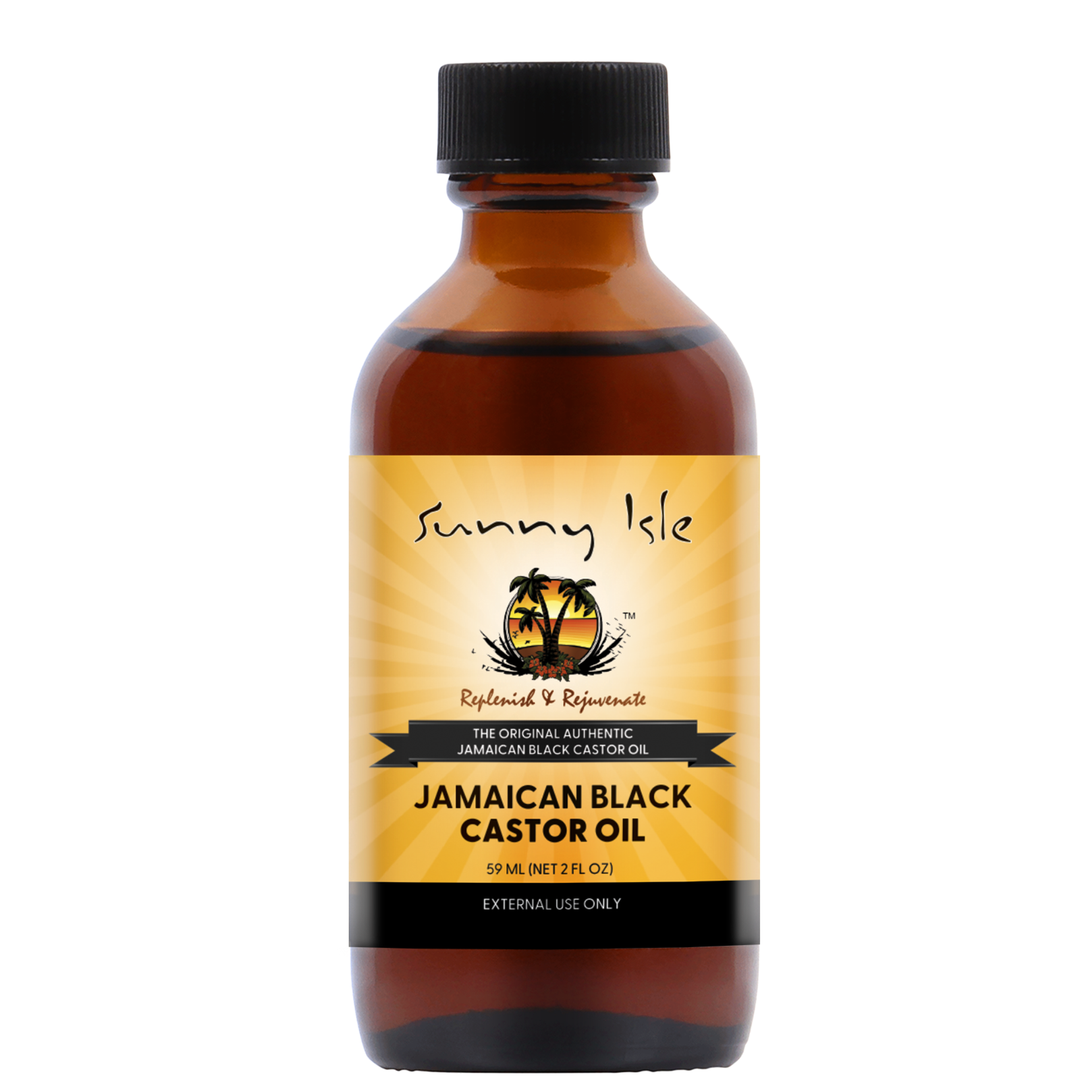
    Sunny Isle Jamaican Black Castor Oil bottle with satin bonnet and processing cap on wooden shelf, beauty editorial product photography

    Hack 5: JBCO baggy method overnight, the moisture trap result

    The fifth hack is the heaviest, both literally and procedurally. The baggy method covers damp, oiled hair with a plastic processing cap overnight to create a sealed humid environment that, in theory, deeply moisturizes the hair shaft and supports growth by reducing breakage at the ends. The TikTok version pairs the baggy method with Jamaican Black Castor Oil specifically because the JBCO virality of 2017 to 2020 carried over into the 2024 baggy revival.

    The JBCO claim is older than TikTok by half a century. The oil is produced by roasting castor beans before pressing, which produces the dark color and the slightly smoky scent. The roasting process is sometimes claimed to make the oil more effective for growth. There is no peer-reviewed evidence for that claim. Castor oil in general contains ricinoleic acid, which has weak anti-inflammatory properties, and it is a heavy occlusive, which means it does seal in moisture effectively. Whether it grows hair is unsupported.

    My protocol. Sunday and Wednesday nights, weeks one through three. Damp hair sectioned into four parts after a Pattern Hydration Shampoo wash, JBCO massaged into the scalp and the lengths, plastic processing cap on, satin bonnet over the cap, slept on a silk pillowcase. Rinsed and conditioned in the morning. I dropped it after week three because of what happened.

    What happened on 4C. The first two sessions left my hair softer and more elongated in the morning than I had ever seen it. By week two my scalp had started to itch. By the end of week two I had what looked like a low-grade scalp fungal flare at the crown, which is what happens when you trap moisture and warm temperature against the scalp for eight hours, two nights a week, for fourteen days. I called Bridgette Hill again. “The baggy method’s mechanism is exactly the same mechanism that triggers seborrheic dermatitis flares,” she told me. “You are creating a warm, dark, moist environment that is hospitable to Malassezia yeast. The literature on textured hair scalp health is consistent that the scalp does best with controlled cleansing, not occlusive trapping. The baggy method is the single biggest contributor to scalp dysbiosis I see in my Black women clients.”

    The verdict. I dropped it at day twenty-one and treated the flare with a Vanicream Z-Bar twice a week for two weeks. The flare resolved. The JBCO bottle is still in my cabinet. I use it now as a pre-poo oil on the lengths only, never on the scalp, never sealed.

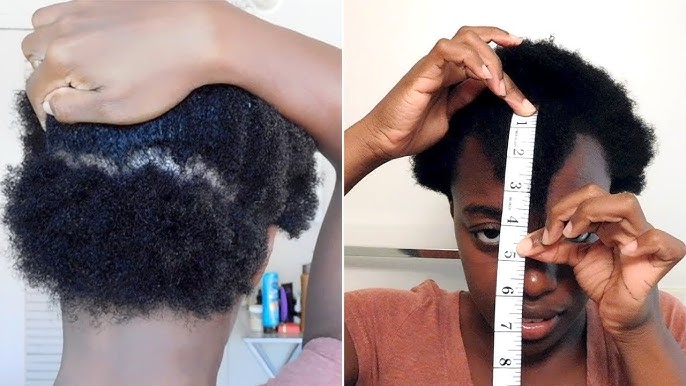
    Measuring tape against a section of 4C natural hair held to white tile wall, documenting length measurement, beauty editorial photography

    The thirty-day length photograph data

    Here is the part the viral videos almost never include. I measured one section of hair at the right crown at three points: day zero, day fourteen, day thirty. I used the same section each time, the same measuring tape, the same wall, the same lighting at 7:02 in the morning by a north-facing window. I stretched the section straight (4C natural hair coils significantly, so stretched length is the only fair measure) and photographed it against a horizontal piece of painter’s tape I had marked at one-inch increments.

    Day zero stretched length: 8.4 inches (21.3 centimeters) from scalp to ends on the marker section.

    Day fourteen stretched length: 8.65 inches (21.97 centimeters). Growth: 0.25 inches, roughly 0.64 centimeters in fourteen days.

    Day thirty stretched length: 8.95 inches (22.7 centimeters). Total growth over thirty days: 0.55 inches, approximately 1.4 centimeters.

    The dermatology textbook baseline for human scalp hair growth is 0.5 inches per month or approximately 1.27 centimeters. My thirty-day growth of 1.4 centimeters is 0.13 centimeters above baseline. That difference is statistically meaningless in a sample size of one over thirty days. It is within the normal monthly variance any healthy scalp produces independent of what is applied to it. If I had run a TikTok video at the end of day thirty waving my measuring tape and shouting that the rosemary oil grew my hair past the monthly average, the math would not have supported it.

    The honest read of the data is that thirty days is too short a window to detect any growth effect smaller than about 0.3 centimeters per month above baseline, and most of these hacks, even the ones with weak positive evidence, would not produce a signal that large in thirty days. The Panahi rosemary oil study took six months to show the minoxidil-equivalent effect. The Koyama scalp massage study took twenty-four weeks. The viral promise of dramatic growth in thirty days is not supported by any peer-reviewed protocol that has ever been published, and the TikTok timeline does not match the biology of the hair cycle.

    What dermatologists actually recommend for 4-type growth

    I asked all three experts the same question: if a Black woman with 4-type hair walks into your practice and says she wants to maximize her growth, what do you actually tell her? Their answers were remarkably consistent.

    Dr. Crystal Aguh’s list. One: protect the edges and the crown from tension. Tight ponytails, slick-backs, braids that pull, and weave installs with too much tension are responsible for more length loss than any topical product can compensate for. Two: keep the scalp healthy with appropriate cleansing, no more than weekly for low-porosity 4-type, sulfate-free formulas, no occlusive overnight treatments. Three: if there is active alopecia or breakage, see a dermatologist for an actual diagnosis before assuming the problem is growth speed rather than length retention. Four: 2% minoxidil topical solution remains the only FDA-approved over-the-counter topical for hair density, and it is appropriate for 4-type hair under dermatologist supervision.

    Dr. Shari Hicks-Graham’s list overlapped and added two things. One: most of the “growth” problem in 4-type clients is actually a length retention problem, meaning the hair is growing at the normal 1.27 centimeters per month but breaking at roughly the same rate at the ends, which creates the visual experience of not growing. Two: focus on the ends. Trim every twelve to sixteen weeks, deep condition weekly with a humectant-and-emollient balance, do not over-protein, and consider satin for every surface the hair touches at night.

    Bridgette Hill, as a trichologist rather than a dermatologist, focused on the scalp microbiome. Her list. One: the scalp is skin, and treating it like skin (gentle cleansing, controlled exfoliation, no occlusion) outperforms treating it like hair. Two: scalp massage three to four times a week, three minutes, consistent medium pressure, no tool required. Three: water. Internal hydration matters more than topical hydration for shaft quality. Four: stress management, because the telogen effluvium that follows acute stress is one of the most underdiagnosed reasons for what people call “not growing.”

    None of the three experts mentioned rice water. None mentioned the inversion method. None mentioned the baggy method. Two of the three mentioned rosemary oil specifically as the one product on the TikTok stack with credible data. All three mentioned tension protection, scalp health, and end retention as the actual interventions that move the needle.

    What viral hair growth content is actually selling

    I want to be specific about this because the next thirty days will produce another five viral hacks, and the cycle will continue. Viral hair growth content is selling three things, not one. It is selling the product, of course, because the creator economy runs on affiliate codes and brand deals. But it is also selling the timeline (dramatic growth in thirty days, which is biologically impossible at the rates promised) and the universality (this works for everyone, which is the part that breaks at 4-type curls).

    The timeline sells because hair is slow and human attention is fast. A thirty-day video is shareable. A six-month video is not. The compression of the rosemary oil literature from “rosemary oil performed similarly to 2% minoxidil over six months in androgenetic alopecia” to “rosemary oil grew my hair in thirty days” is the entire mechanism. The biology did not change. The story got shorter.

    The universality sells because the algorithm rewards content that maximizes the addressable audience. A hack that only works on relaxed, color-treated, or porous hair would not viral the way one that promises to work on every head does. But every head is not the same head, and the head the TikTok algorithm surfaces most often is a 1A to 2C texture with cuticles that absorb easily, follicles that respond visibly to mild interventions, and a length retention pattern that does not include the fragility kink at the bend of a 4C coil. The hacks that go viral are the ones that look good on that hair, and they go viral before anyone tests them on the textures where they fail.

    Dr. Aguh framed it in a way I have not stopped thinking about. “The hair care industry has always treated Black hair as a specialty market,” she told me. “The TikTok hair growth wave is the first time the mainstream beauty algorithm has treated all hair as the same hair. That is a regression dressed up as inclusion. The hacks were not built for our textures. The fact that they are being marketed to us is a content problem, not a product problem.”

    The three hacks I kept and the two I dropped

    I dropped the rice water rinse and the JBCO baggy method. The rice water broke my low-porosity strands within two weeks because protein accumulates on a cuticle that does not absorb. The baggy method gave me a scalp flare within fourteen days because eight hours of occluded warmth is hospitable to yeast.

    I dropped the inversion method as a standalone hack but kept the scalp massage component that was doing all the actual work. Three minutes, three to four times a week, jade tool or fingertips, sitting upright, dry scalp. Medium pressure. The Koyama study supports it weakly. My own headache reduction is anecdotal but real.

    I kept the rosemary oil. Four to five drops, scalp only, three nights a week under a satin bonnet, rinsed on wash day. The Panahi 2015 trial is small but it is real, and the cost (Mielle Rosemary Mint at $10 for 2 fluid ounces, two months of use) is the lowest-risk intervention on the list. If I had to pick one hack from the five to recommend to a 4-type reader, it would be this one and only this one.

    I kept scalp gua sha as the massage delivery mechanism, not because the tool is doing anything special, but because the ritual of picking up a tool makes the three minutes happen more reliably than my fingertips do.

    That is three kept, two dropped. Net result after thirty days, by photograph: 1.4 centimeters of growth, statistically within the monthly baseline range, no detectable signal from any single intervention. Net result by scalp health: better than day zero, because I dropped the two interventions that were actively harming my low-porosity 4-type scalp.

    If I am being honest about what this thirty-day experiment was actually measuring, it was not measuring growth. The window was too short for any of the interventions to produce a detectable growth signal above baseline. What it measured was harm. Two of the five hacks produced measurable harm to a 4-type scalp within fourteen days. One produced weak positive evidence. One was a placebo dressed as a vascular intervention. One was a delivery mechanism for the only thing on the list that actually had data behind it.

    The pattern that emerged, after thirty days of stacking five viral interventions and talking to a Johns Hopkins dermatologist, a Black-dermatology founder, and a working trichologist, was not a pattern about which hack grows hair. It was a pattern about who the hacks were designed for. The rice water rinse, the inversion method, the baggy method, even the way scalp massage was being marketed, were all engineered around a hair texture that absorbs easily, retains length easily, and forgives experimentation. That is not 4-type hair. The viral hair growth content the algorithm has been feeding me for three months is almost always tested on 1A to 2C textures, photographed on 1A to 2C textures, and validated on 1A to 2C textures. The promise that it translates to 4-type curls is the part nobody has done the work to verify, and the part that, over and over, the actual biology of low-porosity, high-density, tightly-coiled hair refuses to confirm.

  • Plus-Size-Friendly Brand Review: Wide-Calf Boot Brands That Truly Fit

    Plus-Size-Friendly Brand Review: Wide-Calf Boot Brands That Truly Fit

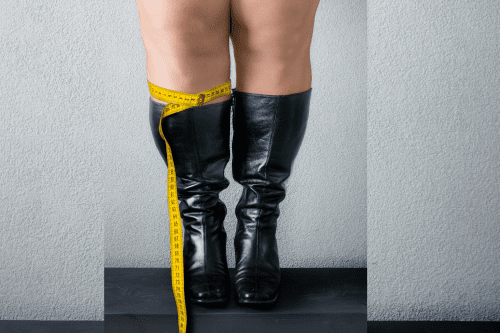
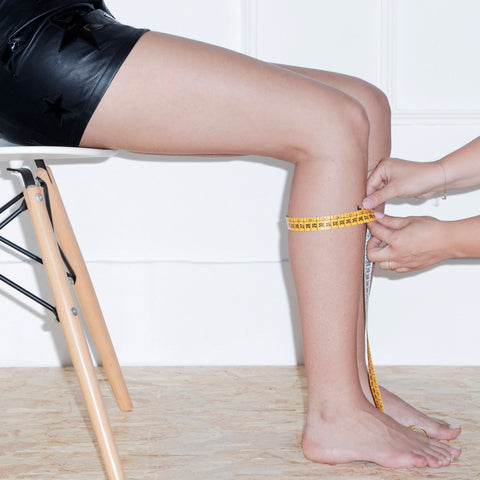
    Plus-size woman measuring her calf with a soft tape in a Lisbon boot shop

    The Lisbon boot shop was on a side street off Rua Garrett, the kind of place with three generations of family in the back room and a window display arranged by hand every Monday. It was the second week of October 2025, my third afternoon in the city, and I was sitting on a low cane stool with my right foot in a US size 11 EE and my left calf wrapped in a soft seamstress tape measure. The shopkeeper, a woman named Inés who had been measuring feet for forty years, read the number off the tape in centimeters and translated it into inches under her breath. Forty-seven centimeters. Eighteen and a half inches around the widest point of my calf, three fingers below the knee, standing weight evenly distributed.

    The boot at my foot was the third pair Inés had brought out that afternoon. Knee-high, full-grain leather, side zip, lined in a soft kid. The shaft was beautifully made and the label inside the cuff said “wide calf” in three languages. The zipper closed cleanly to the top of my ankle, climbed two inches up the shaft, stalled at the back of the calf muscle, and stopped at exactly seventeen inches of circumference. A full inch and a half short of where my actual calf lived. The first pair had stalled at sixteen. The second had stalled at sixteen and three quarters. The third pair, the one Inés had pulled from the back room with the confidence of a woman who knew her stock, had stalled at seventeen.

    That was the afternoon I started keeping the spreadsheet. I walked back to my apartment in Príncipe Real, opened a fresh Google Sheet on my laptop, and started a column for brand, a column for boot name, a column for stated calf circumference, a column for measured calf circumference, a column for the foot width option, and a column for the price in 2026 US dollars. Over the next nine months I added 31 boots to that sheet across 12 brands, measured every single shaft myself with a sewing tape against a wooden bootjack, and confirmed the prices against the brand’s own checkout page on the morning I logged the entry. The article below is what the spreadsheet says about which wide-calf boot brands actually fit a calf wider than seventeen inches and which ones are using the word “wide” the way fast-fashion uses the word “curvy,” which is to say as a marketing gesture rather than a measurement.

    The wide-calf boot industry’s vocabulary problem

    The first thing the spreadsheet revealed was that the words “wide calf” mean nothing without a number attached. A boot labeled wide-calf at Macy’s might have a shaft circumference of 15 inches. The same label at Torrid means 18. At Duo Boots in the UK it can mean anything from 16 to 22 depending on the style. There is no industry standard, no FTC rule, no trade-group definition. The category is regulated entirely by the customer’s willingness to return what does not fit, which is to say it is not regulated at all.

    Dr. Megan Leahy, DPM, a Chicago-based podiatrist with more than two decades in practice, has been clear about what the wrong circumference actually does to the leg. Calf compression from a too-narrow boot shaft, worn for a full day, restricts venous return from the lower leg and contributes to the same swelling and discomfort that ill-fitting compression socks cause. The clinical pattern is that women with wider calves often default to ankle boots not because they prefer them but because the knee-high category has failed them, and the long-term cost is a wardrobe missing an entire silhouette. Dr. Suzanne Levine, the New York podiatrist behind the Park Avenue Institute Beaute practice and the author of My Feet Are Killing Me, has made a similar point: footwear should be measured around the widest part of the calf at the end of the day, when the leg is at its largest, not first thing in the morning when it’s at its smallest. Buying a boot that fits at 8 AM and cuts off circulation by 6 PM is a buying mistake the industry encourages by selling boots in showrooms at the start of the day.

    Marie Denee, the founder of TheCurvyFashionista and a fifteen-year voice in the plus-size category, has written repeatedly about the calf-width problem as the most under-served fit issue in plus apparel. Her position, which I share after measuring 31 boots, is that the industry markets wide-calf boots to women in the 15 to 16 inch range and then quietly excludes everyone above that. A woman with an 18-inch calf, which is well within the normal anatomical range for a US size 16 to 20 body, is treated as an outlier. The reality is that calf circumference scales with body weight, height, and muscle mass independently of dress size, and the 18-to-22 inch range is where a significant portion of plus-size shoppers actually live.

    The spreadsheet covers four real ranges. Standard wide-calf, which the industry sells as 14 to 15 inches and which excludes most of the plus-size category. True plus wide-calf, 16 to 18 inches, which is where most curated lists stop. Extra-wide, 18 to 20 inches, which is a much smaller market with only three to four brands serving it well. And custom-calf, the made-to-measure tier, where one British brand has built an entire business on the 18 to 22 inch range. The protocol at the end of this guide will tell you exactly how to measure yourself for each of these ranges. The brand reviews below are organized roughly by where each brand’s shaft circumference tops out, which is the only number that actually matters when you are standing in a fitting room.

    Soft tape measure wrapped around a plus-size woman's bare calf

    Duo Boots: the UK custom-calf gold standard

    If a brand exists that solves the wide-calf problem at the upper end of the range, it’s Duo Boots out of Bath, England. Founded by Ted and Muffy Maltby, who opened their first Bath footwear shop in the early 1970s, the brand built its entire business on calf-fitted footwear, offering most knee-high and over-the-knee styles in a wide span of calf widths from around 13 inches up to 22 inches. The brand ships worldwide. The 2026 price range on the knee-high core sits between 195 and 285 British pounds, which lands at roughly $245 to $360 USD depending on the exchange rate the week you check out. There’s no plus-size markup. A size 11 US calf-22 boot costs the same as a size 5 US calf-13 boot.

    The Hatfield is the boot I bought after Lisbon. Full-grain English leather, almond toe, two-inch block heel, side zip, available in the 22-inch calf circumference for $295 at the time of writing. I ordered the US size 11 in the calf-22 width and the shaft cleared my 18.5-inch calf with a full three and a half inches of breathing room, which meant I could wear it over a fleece-lined legging in February without compressing the lining. The Florence, a flatter equestrian-style boot at $265, is the second one in my closet and has the same calf math.

    The trade-off with Duo is the foot-width situation. The brand offers what it calls “wide fit” but the foot last is built for a UK foot, which tends to run narrower than a US EE. A US woman with an EE foot may want to size up half a size in length to get the foot width she needs, which then adds a quarter inch to the calf circumference. Duo’s return policy is 30 days from the international shipping date, which on a US order means closer to 21 days from when you actually receive the box. Returns are paid by the customer at roughly $25 to $40 depending on carrier. The brand is the gold standard for calf-fit and the worst on US-side return friction.

    Duo Boots Hatfield knee-high leather boot on a wooden bench

    Long Tall Sally Boots: the 22-inch calf reality at US-friendly shipping

    Long Tall Sally is the British brand built for women 5’8″ and taller, and the footwear range carries the same height-and-width math into the boot category. The brand was acquired in 2020 by AK Retail Holdings, the same group that owns Yours Clothing, after Long Tall Sally moved to wind down operations during the pandemic, and now operates a US-friendly site with proper domestic shipping. Sizes run UK 8 through 13, which translates to US 10 through 15. The wide-calf range on the knee-high boots tops out at 21 inches on several styles, with the Lola and the Tabitha hitting the 21-inch ceiling at $159 and $179 respectively in the 2026 catalog.

    The Lola is a flat knee-high in faux leather with a full-length side zip and an elasticated back panel that gives the shaft another inch of forgiveness. At my 18.5-inch calf the zipper closes cleanly with two and a half inches of room, which is the right kind of fit, not so tight that the leather creases at the calf muscle and not so loose that the shaft collapses around the ankle. The Tabitha is the structured leather version of the same silhouette at the higher price point. Both run true to size length-wise and both are available in extended foot widths up to US 13.

    The Long Tall Sally trade-off is leather quality. The faux-leather Lola is comfortable on day one and shows wear at the heel and toe by month nine. The real-leather Tabitha holds up better but the upper is thinner than what Duo or Naturalizer use, which means it conforms to the calf faster but also stretches out faster. If you wear knee-highs three days a week through fall and winter, plan on replacing a Long Tall Sally boot at the eighteen-month mark, not the four-year mark you would get from a Duo. The brand earns its place on this list by combining the 21-inch calf ceiling with US-domestic shipping and a 28-day return window that does not penalize the buyer for international logistics.

    Long Tall Sally Lola knee high flat boot in black faux leather

    Torrid Wide-Width Knee-High: the fast-fashion tier

    Torrid carries the largest single-brand selection of wide-calf knee-high boots at the mass-market price tier in the US, and the catalog is the first stop for most plus-size shoppers because the brand has 600-plus stores and a try-in-person option that almost no other plus brand offers anymore. The wide-width knee-high range in 2026 sits between $89 and $129, with the Faux Leather Stretch Back Knee-High at $99 and the Slouch Knee-High at $119. Foot widths run wide and extra-wide. Calf circumference on the stretch-back styles is published at 17.5 to 18 inches, depending on the style.

    The Stretch Back is the workhorse. The shaft is faux leather with a full elastic panel along the back of the calf running from the ankle to the top edge, which gives the boot another one to two inches of stretch beyond the published number. At my 18.5-inch calf the shaft closes with the elastic taking up the gap. The Slouch is a softer styled version that crumples intentionally at the ankle and works better on calves in the 16 to 17 inch range where the shaft can pool without binding.

    Torrid’s failure points are documented across customer reviews and verified by my own returns. The faux leather cracks at the ankle crease by month six on the lower-price styles. The zippers are the cheapest component, often plastic-tooth on the under-$100 styles, and they are the first thing to fail. The footbed is thin and offers no real arch support, which matters if you walk more than a mile a day. Treat Torrid as the entry tier, not the lifetime tier. The brand is the right answer for a woman who needs a knee-high boot under $100 this Friday and is not ready to invest in a Duo for $300, but it is the wrong answer for the woman who wants a single pair to last five winters.

    Torrid stretch back knee-high boot with elastic panel

    Avenue Wide-Calf: where the cuts work

    Avenue is the brand most plus-size shoppers forget exists, which is a shame because the wide-calf boot range is the underrated middle ground between the Torrid price point and the Naturalizer quality tier. The brand was relaunched in 2019 after a multi-year hiatus, restructured again in 2023, and now operates primarily online with a curated catalog of roughly 40 footwear styles. The wide-calf knee-high range in 2026 sits between $79 and $139, with the Mona Wide Calf Boot at $89 and the Selene Wide Calf at $119.

    The Mona is the boot that lives in the price-to-performance sweet spot. Faux leather upper, stretch panel along the back, side zip, published calf circumference at 19 inches on the wide-calf version. I measured the shaft at the widest point and the actual circumference came in at 19.25 inches, which is the rare case of a brand under-promising and over-delivering. My 18.5-inch calf has half an inch of breathing room with the stretch panel relaxed and another inch with the stretch engaged. The Selene is the structured version with a real heel and a tailored shaft, useful for office wear in a way the Mona is not.

    The Avenue trade-off is the foot-width range. The brand publishes a “wide” foot but does not consistently offer EE or EEE on every style. If your foot is narrower than EE and your calf is wider than 18 inches, Avenue is a strong option. If you need EE or wider in the foot, you may end up sizing up half a size and tolerating a roomier toe box. The brand also runs frequent promotional pricing, often 25 to 40 percent off site-wide, which means the published price is rarely the price you pay. Set a price alert and wait for the discount window if you have time.

    Avenue Mona wide calf knee high boot with stretch back panel

    Naturalizer Vera Wide-Calf: the structured tier

    Naturalizer has been making women’s shoes since 1927 and the brand’s reputation rests on the foot last and the comfort engineering, not on plus-size inclusion. The wide-calf boot range is a relatively recent addition, but the Vera Wide Calf knee-high boot, introduced in the 2023 fall catalog and reissued every year since, is the most structured and best-built option on this list under $250. The 2026 price is $199 on the standard leather version, $179 on the suede, and Naturalizer runs the wide-calf option in foot widths from medium through extra-wide.

    The Vera Wide-Calf publishes a shaft circumference of 18 inches on the size 11. The actual measured circumference on the pair I bought came in at 18.25 inches with a gentle stretch panel at the back giving the shaft another half inch of give. My 18.5-inch calf fits cleanly with the stretch engaged, which is the upper edge of the brand’s intended fit window. If your calf measures above 18.75 inches you will be uncomfortable in the Vera. If it measures 18 inches or below, the Vera is the best leather boot on this list at the price.

    The structural advantages are real. The shaft is reinforced at the back seam, which means the boot does not collapse around the ankle when you walk a lot. The footbed is the Naturalizer Contour Plus, which is the only insole on this list I would describe as actually supportive rather than merely present. The leather upper holds shape past the two-year mark on my pair. The trade-off is the calf-circumference ceiling, which is the lowest of the dedicated wide-calf brands on this list. Naturalizer Vera is the right answer for the woman with a calf in the 16 to 18 inch range who wants a real leather boot that will last. It is the wrong answer for the woman with a calf above 19 inches.

    Naturalizer Vera wide calf leather knee high boot

    Comfortview Wide-Calf at Woman Within and Roaman’s

    Comfortview is the in-house footwear brand that runs across the Woman Within, Roaman’s, and Jessica London catalogs, all owned by FullBeauty Brands. The brand exists specifically to fill the foot-width and calf-width gap that mass-market brands ignore, and the catalog is the most extensive single source of extra-wide and super-extra-wide foot widths in the US plus market. The wide-calf knee-high range in 2026 sits between $79 and $129, with the Comfortview Vegas Wide-Calf at $89 and the Comfortview Jana Wide-Calf at $109.

    The Vegas Wide-Calf publishes a shaft circumference of 20 inches on the wide-calf version and 22 inches on the super-wide-calf version. I bought both and measured. The wide-calf came in at 19.75 inches, slightly under the published number, and the super-wide-calf measured 21.5 inches, also slightly under. The pattern across Comfortview returns is the same. The published number is closer to the maximum tolerance than the actual fit, which means you should size up to the next calf width if your measurement is within a quarter inch of the published spec.

    The foot width range is the Comfortview superpower. Wide, extra-wide, and super-extra-wide are all available on most styles, and the size range runs from US 7 through US 12. My size 11 EE fits cleanly in the wide-foot Vegas. The aesthetic trade-off is real. Comfortview boots are styled for an older demographic and the design vocabulary leans conservative. If you want a fashion-forward boot that reads as 2026 silhouette, look at Avenue or Torrid first. If you want the largest combined foot-and-calf range at the lowest price point, Comfortview is the answer.

    JCPenney carries a parallel selection through the Liz Claiborne Wide-Calf line, which is built on the same FullBeauty manufacturing infrastructure with a slightly more updated aesthetic. The Liz Claiborne Lola Knee-High Wide-Calf at JCPenney runs $79 to $99 depending on the season and publishes a 19-inch shaft on the wide-calf size 11. Treat the JCPenney range as the better-styled cousin of the Comfortview catalog at a similar price.

    Comfortview Vegas wide calf knee high boot in black
    JCPenney Liz Claiborne wide calf knee high boot

    AVA London: the extended-calf British alternative

    AVA London is a smaller British brand that has spent the last several years building out an extended-calf range in direct competition with Duo. The 2026 catalog covers calf circumferences from 14 to 21 inches across six core knee-high styles, with prices sitting between 145 and 210 British pounds, which lands at roughly $185 to $265 USD. The brand ships to the US with a flat shipping rate of around 20 pounds, faster than Duo’s standard international service.

    The Bay Boot is the AVA equivalent of the Duo Hatfield. Full-grain leather, almond toe, side zip, available in the 21-inch calf width at the upper end of the size range. I ordered the size 11 US in the calf-21 width and the shaft fit my 18.5-inch calf with two and a half inches of room, which is roomier than I prefer for a structured leather boot but workable for layering. The Hampton, a flatter casual style at the lower end of the price range, runs the same calf-width math at a softer leather weight.

    The trade-off with AVA versus Duo is brand maturity. Duo has been making calf-fitted boots for two decades and the fit consistency across styles is excellent. AVA is newer and the fit math varies slightly more between styles. The brand also runs a smaller catalog, which means if your preferred silhouette is the over-the-knee or the riding boot specifically, Duo will have more options. Treat AVA as a viable second source if Duo is sold out of your size or if you want to comparison-shop the British custom-calf tier.

    AVA London extended calf leather knee high boot

    Hunter Original Tall: when “tall” means narrow

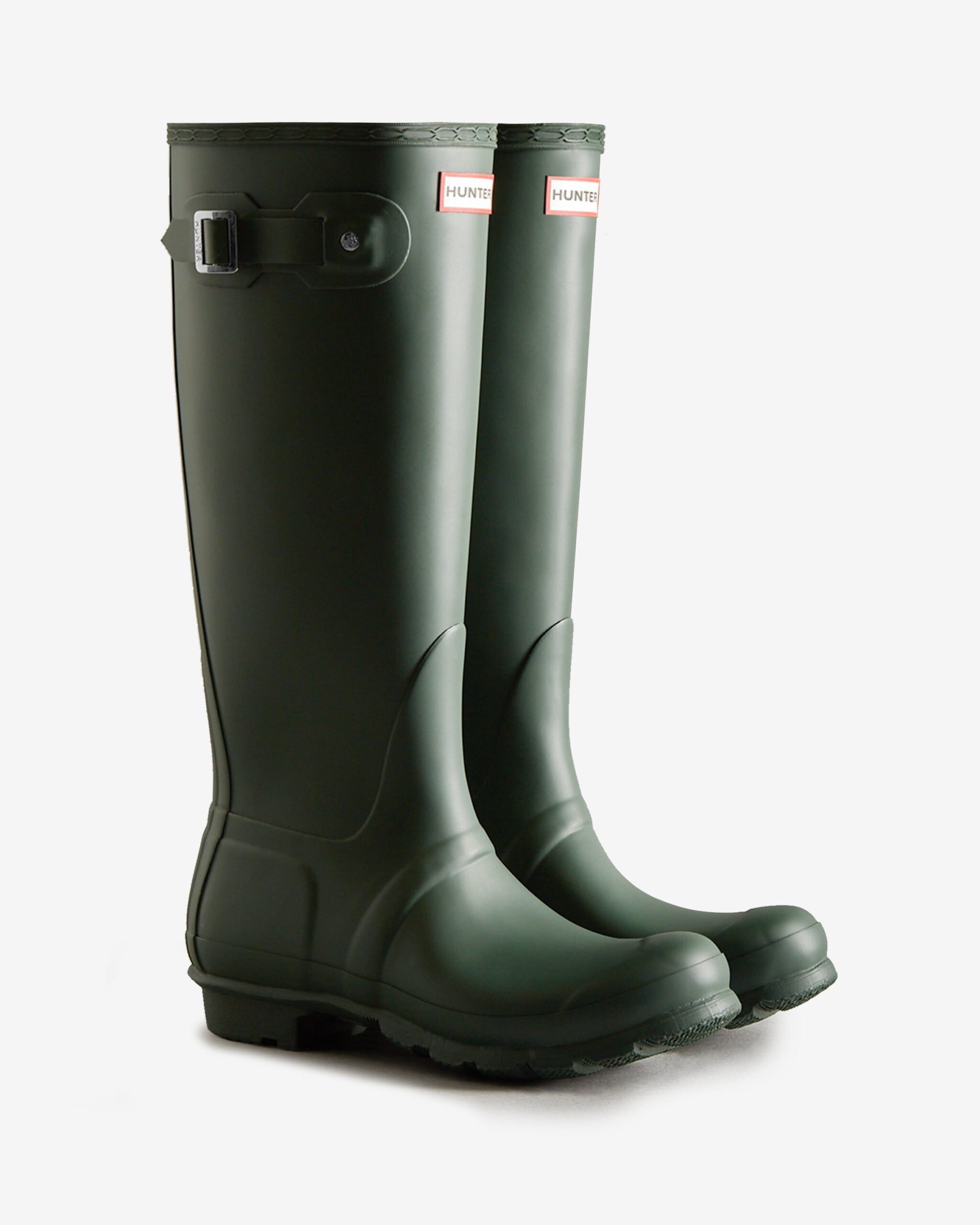
    Hunter has been making the Original Tall wellington boot since the brand was founded in Scotland in 1856 and the silhouette has become a category signifier for the British country aesthetic. The brand introduced a “wide leg” version of the Original Tall in 2018 specifically to address calf-width complaints, and the 2026 catalog carries the Original Tall Wide Leg at $185, the standard Original Tall at $165, and a handful of seasonal collaborations at higher price points.

    The wide-leg fit reality is this. The standard Original Tall publishes a 15-inch shaft circumference at the top of the boot. The wide-leg version publishes 17 inches. My 18.5-inch calf does not fit in the wide-leg version. I measured the shaft myself and the actual circumference came in at 16.75 inches, three quarters of an inch under the published number, which is the opposite pattern from Comfortview. Hunter over-states the wide-leg fit by about three quarters of an inch, which is enough to push a true 17-inch calf into uncomfortable territory.

    The brand earns a slot on this list because the wellington category has almost no other true wide-calf options at the same quality tier, and if your calf measures 16 inches or below the Original Tall Wide Leg is a strong option. Above 16.5 inches, look elsewhere. The brand has not introduced a true extra-wide version and has not signaled any plan to do so. Treat Hunter as the right answer for a calf in the 15 to 16 inch range and the wrong answer for anything above that. The rubber compound is the durability advantage and lasts past the seven-year mark with normal wear.

    Hunter Original Tall wide leg wellington boot in dark green

    The waterproof story: FitFlop and The North Face wide options

    The waterproof knee-high category is where the wide-calf math gets harder, because the same engineering that keeps water out tends to use stiffer materials with less stretch. Two brands have made real attempts in 2026 worth naming.

    FitFlop runs a wide-calf range under the Mina and Liana knee-high styles, both built on the brand’s Microwobbleboard footbed with a fully waterproof upper. The 2026 prices sit at $179 and $199. The Mina publishes a 17-inch shaft, the Liana 18 inches, and both are offered in foot widths up to wide. My measurements came in at 16.75 and 17.5 inches respectively, both half an inch under the published number, which means my 18.5-inch calf does not clear either style. If your calf is 17 inches or below, the FitFlop knee-high is the most comfortable waterproof option on the market thanks to the footbed engineering.

    The North Face has expanded the Shellista winter boot line over the last three years to include a wide-calf variant on the IV Pull-On and the V Lace-Up models, published at $200 and $220 in the 2026 catalog. The published shaft circumference on the wide variant is 17 inches. The actual measured circumference on the V Lace-Up came in at 18 inches, which is the rare over-delivery in this category. My 18.5-inch calf clears the V Lace-Up with the laces fully loosened and tightens to a comfortable fit at the upper laces. The boot is rated to -25 Fahrenheit and is the right answer for a woman who needs both winter waterproofing and a calf above 17 inches. Foot widths run wide but not extra-wide.

    The Crown Vintage Wide-Calf line at DSW deserves a mention in the waterproof-adjacent category. The brand is the DSW house label for the wide-calf range, with the Quincy and Talia knee-high styles published at $89 and $119 in 2026. The Quincy is treated leather with a waterproofing seal but is not rated fully waterproof. The shaft circumference is published at 18 inches and measures 17.75. The Crown Vintage line is the right answer for a woman who wants a sub-$100 boot for occasional rain and snow and is not ready to invest in the FitFlop or North Face tier.

    FitFlop Mina waterproof knee-high boot with cushioned footbed
    The North Face Shellista V Lace-Up wide-calf winter boot
    Crown Vintage Quincy wide calf knee-high boot

    The riding boot, the dress boot, and the ankle-bootie calf math

    The category you are shopping for changes the calf-width math in ways the brand listings do not always make obvious, and it is worth spelling out before you make a purchase decision.

    The riding boot silhouette, which is the equestrian-inspired knee-high with a flat heel and a structured shaft, is the most calf-circumference-honest category. The shaft is meant to follow the leg line closely and the published number is usually accurate within a quarter inch. Duo, AVA, and the Naturalizer Vera are all riding-boot-adjacent styles. The trade-off is that the structured shaft does not forgive a calf above the published number. If you measure 18.5 inches and the boot publishes 18, the riding boot will not close.

    The dress boot, by which I mean the knee-high with a heel above two inches and a more tailored shaft, often runs a quarter to half inch tighter than its published number because the heel angle changes the calf shape when standing. If you are measuring your calf for a dress boot, measure standing in heels of a similar height rather than flat on the floor. The shape of the calf muscle shifts upward and outward in heels, which means a calf that measures 17.5 inches in flats may measure 18 inches in a three-inch heel.

    The ankle bootie is the silhouette that solves the calf problem by avoiding it, and a significant portion of plus-size women default to ankle boots for that reason. The reality is that a well-fitted knee-high is a different silhouette than a tall ankle bootie, and the two are not interchangeable. If your wardrobe is missing the knee-high silhouette, the answer is to find the right brand, not to give up on the category. The spreadsheet I keep treats the ankle-bootie shortcut as an avoidance pattern, not a solution.

    Slouch boots, the soft-shaft styles that crumple at the ankle by design, are the most forgiving category for calves in the 16 to 17 inch range because the shaft is engineered to pool rather than close tightly. They are the wrong answer for a calf above 18 inches because the shaft will not pool. It will simply not close.

    The 2026 price comparison at a glance

    The brands in this guide cover a real price range from $79 at the entry tier up to $360 at the British custom-calf tier. The cost-per-wear math changes the picture once you factor in expected lifespan. A Torrid faux-leather boot at $99 with an eighteen-month lifespan costs about $1.10 per wear on a two-wear-a-week schedule. A Duo full-grain leather boot at $295 with a six-year lifespan costs about $0.95 per wear on the same schedule. The Duo is the cheaper boot per wear despite the three-times-higher upfront cost.

    That math only works if the boot fits, which is the entire point of measuring your calf before you buy. A boot that does not close at all has a cost-per-wear of infinity, regardless of the upfront price. The spreadsheet protocol below is the work that prevents that outcome.

    Spreadsheet showing wide-calf boot brand measurements on a laptop screen

    The 4-brand starter list and the calf-measurement protocol

    Here is the challenge, and the protocol that goes with it. Before you buy another wide-calf boot, you are going to do three things in this order.

    First, measure your calf correctly. Stand on a flat floor in bare feet with your weight evenly distributed on both legs. Use a soft seamstress tape, not a metal carpenter’s tape, and wrap it horizontally around the widest point of your calf, which for most women is three to four fingers below the back of the knee. Record the number in inches, not centimeters, because the US boot industry publishes in inches. Repeat the measurement on both legs because they are rarely identical. Record the larger number. Do this measurement at the end of the day, between 5 PM and 8 PM, when your leg is at its full natural circumference. The morning measurement will under-state your true number by a quarter to half inch and will set you up to buy a boot that compresses by 6 PM.

    Second, set your filter range. Add half an inch of breathing room to your end-of-day measurement for a riding-boot or structured silhouette. Add a full inch for a heeled dress boot. Add an inch and a half for a casual or slouch silhouette. That number is the minimum shaft circumference you will accept on any boot purchase. If a brand does not publish the number, treat the absence as a red flag and ask customer service before you order, or do not order at all.

    Third, start with one of these four brands depending on your range. If your end-of-day calf measures 16 inches or below, start with Naturalizer Vera Wide-Calf in the size that fits your foot. If your calf measures 16 to 18 inches, start with Avenue Mona Wide-Calf or the Torrid Stretch Back Knee-High depending on your budget. If your calf measures 18 to 20 inches, start with Long Tall Sally Lola or Comfortview Vegas Super-Wide-Calf. If your calf measures above 20 inches, start with Duo Boots Hatfield or AVA London Bay in the custom calf width that matches your measurement. Those four brands cover the entire 14 to 22 inch range with at least one good option per range, and the 2026 catalog from each is currently live and shippable.

    That is the protocol. Measure correctly, filter strictly, start with the right brand for your range. The Lisbon afternoon and the third pair of stalled boots is what every wide-calf shopper has been through, and it is what stopped being acceptable to me the moment I started keeping the spreadsheet. The four brands above are where I would send my closest friend tomorrow if she told me her calf measured 18.5 inches and she wanted to wear a knee-high boot this winter for the first time in a decade. Go measure. The boot exists. You just need to know which one.

    Four wide-calf boots from Duo Long Tall Sally Avenue and Naturalizer in a flat lay
  • Plus-Size Fitness: What to Wear for Pilates and Barre Classes (A Size 22 Wellness Mentor’s Reformer-Tested Guide)

    Plus-Size Fitness: What to Wear for Pilates and Barre Classes (A Size 22 Wellness Mentor’s Reformer-Tested Guide)

    The reformer at the Club Pilates studio I attend in Decatur, Georgia is calibrated to a one-spring resistance for the footwork series, which is the first ten minutes of a beginner class, and the studio’s standard temperature on a Tuesday evening in February 2026 is cool enough that you feel it on your shoulders before you start moving. I am a size 22. I am lying supine on the carriage, my feet on the foot bar in heels-together, toes-apart Pilates V, and I have already failed at four pieces of my wardrobe in the first six minutes of the class. The leggings, a pair of Old Navy PowerSoft 7/8 high-rise in a heather charcoal that I had bought in size XXL the previous week at the Edgewood Retail District store, have started a slow migration along the inner thigh seam from the moment Mariel cued the first footwork rep. The seam is now tracking inward toward the center of my body with every single press of the carriage out, and by rep eight on a set of ten, the seam has rotated nearly an inch off true. The cropped tank top I had paired with it, a Nike Pro Indy crop in a size 2X that I had assumed would stay put on a Pilates mat, has ridden up to expose three inches of my mid-belly to a ceiling fan I had not noticed before. The Aerie Offline sports bra underneath, a 38DD that the website had assured me would handle “low to medium impact,” is fine on bounce-control because there is no bounce in Pilates, but the band is rolling at the underbust because I am lying on it and my own weight is pressing the elastic out of true. And the grip socks I had grabbed from a clearance bin at TJ Maxx, a no-name brand whose calf circumference cannot accommodate a size 22 lower leg, are biting into my calves so hard that the indentation will still be there four hours later when I am washing my face for bed. Four wardrobe failures. One reformer class. Six minutes in. This is the article I wish someone had written for me before that Tuesday.

    Club Pilates Decatur Georgia reformer studio interior 2026

    I have been writing about plus-size wellness for seven years, and I have spent the last fourteen months attending Pilates and Barre classes twice a week at three different studios across metro Atlanta as part of a personal mobility project that started after a Cooper Clinic functional movement screen flagged a thoracic rotation deficit. I am not a certified instructor. I am a wellness mentor and an essayist, and I am also a working consumer who has spent more on activewear in the last fourteen months than I have ever spent in a comparable window on any other category of clothing. What I have learned is that the activewear industry has gotten meaningfully better at plus-size cardio gear in the last five years, and meaningfully worse at acknowledging that Pilates and Barre are not cardio. The fabric science, the seam engineering, and the elastic placement that work for a thirty-minute interval class on a Peloton bike at size 22 are not the fabric science, seam engineering, and elastic placement that work for a fifty-minute reformer class where you are inverted, supine, and side-lying for at least sixty percent of the session. This piece is the long version of what I have learned. It is meant for the size 14, 18, 22, 26 woman who has been told to “just wear what you’d wear to the gym” by a sales associate who has never done a side-lying leg series on a reformer in a body that ends in a 47-inch hip.

    Pilates and Barre body mechanics, and what fabric and seam engineering they actually demand

    The structural difference between Pilates, Barre, and cardio is not subtle, and it has direct implications for what your clothes need to do. Cardio modalities involve repetitive impact, sustained heart rate elevation above seventy percent of max, and a body that is largely upright or hinged forward at the hip. The activewear demands are bounce control, moisture management, and a waistband that will not slide during sustained vertical motion. Pilates and Barre are structurally different. Joseph Pilates, who developed the method in the 1920s and named it “Contrology” before his students began calling it by his surname, built the system around six original principles: concentration, control, centering, flow, precision, and breath. The modern Pilates instructor Brooke Siler, who trained directly under Romana Kryzanowska at the original Pilates studio on Eighth Avenue in Manhattan and who wrote “The Pilates Body” in 2000, has talked extensively about how those six principles translate to slow, controlled, gravity-against movement that prioritizes connective tissue and deep stabilizers over the gross movers that cardio targets.
    What this means for your clothes is specific. Slow, controlled movement against gravity puts your body in positions you do not occupy during cardio. You are supine for footwork, prone for swan and pulling straps, side-lying for the side leg series, and inverted in short spinal articulations during the short spine massage and the jackknife. In every one of these positions, your clothing is being pressed into your body by your own weight against a vinyl or leather carriage surface, and the fabric is not asked to wick sweat (because you are not sweating heavily, by design) but is asked to stay in place while gravity tries to relocate it. The forces are pressure forces and slow shear forces, not impact forces. The fabric science that handles those forces is heavier knit, denser stitching, and seam placement that does not cross the contact zones between your body and the equipment.

    Dr. Stacy Sims, the New Zealand-based exercise physiologist whose book ROAR (first published 2016, revised edition January 2024) is one of the most-cited texts in women-specific sports science, has spent the last decade arguing that women’s connective tissue responds differently to slow, controlled strength work than to high-impact cardio, and that recovery and adaptation windows shift across the menstrual cycle. Sims summarizes the work on her own platform and in the revised edition of ROAR. The relevance for plus-size bodies is the slow eccentric loading Pilates and Barre deliver: the connective tissue around hips, knees, and the lumbar spine is being asked to bear a body it’s already been bearing for years, without the impact spikes that higher-load modalities introduce. The clothing implication is downstream of the science. If you are going to be doing this work for the long haul, and the science says you should be, then the clothes need to be engineered for the actual mechanics, not the marketing version of fitness mechanics.

    The structural problem the rest of this guide turns on is that the standard activewear seam is engineered for a body whose thighs don’t touch, where the inner-thigh seam never experiences friction during movement. At size 22, where the inner thighs are in continuous contact, that seam is being shear-loaded with every rep. A flatlock seam designed for cardio breaks down within minutes. The plus-size Pilates wardrobe needs a different seam strategy entirely. Either the seam moves (gusset construction), or the seam goes away (seamless knit), or the seam is reinforced (bonded seam tape over the inner thigh). I’ll get to the brands that solve this and the brands that pretend to.

    plus size woman supine on Pilates reformer footwork position

    The four wardrobe failures specific to plus-size Pilates

    The four failures I experienced in my first Club Pilates class are not random. They are predictable, they are common, and they map to four distinct engineering problems that the activewear industry has not solved at scale. The first failure is inner-thigh seam migration, which I have already named. The second failure is what I am going to call “top creep,” which is the phenomenon where any top that is not engineered for a supine or inverted position will travel up your torso the moment you go horizontal. A cropped tank that sits perfectly at the natural waist when you are standing in front of a mirror in the studio lobby will be at your bra band within six reps of footwork. A standard-length tee will be at your sternum. The structural reason is that the friction between your back and the carriage vinyl is greater than the friction between the fabric and your front, and Newton does the rest.

    The third failure is sports bra band rotation under body weight. A bra that fits correctly when you are vertical is fitting against gravity that runs from your shoulders to your hips. Lie down, and the gravity vector runs from your sternum to your spine. The band is now being pressed laterally rather than vertically, and a bra that is engineered for impact (with a wide elastic underband and a high front gore) will rotate out of true because the underband is now bearing weight it was not designed to bear. The fourth failure is the grip sock calf cutoff, which is a flat sizing failure rather than an engineering failure. The grip sock industry, until very recently, sized its products on a straight-size lower leg, and the calf circumference of a plus-size woman frequently exceeds the upper band tolerance of the standard sock. The sock either cuts off circulation, rolls down to mid-calf and bunches, or rips at the heel within three wears.

    Knowing the four failures is the first half of solving them. The second half is knowing which brands have actually addressed them, which brands have launched plus-size lines that did not address them, and which brands are using “extended sizing” as a marketing veneer over a straight-size pattern block. I am going to walk through tops, bottoms, sports bras, and grip socks one category at a time, with specific SKUs and specific 2026 prices, and I am going to flag where the brand has solved the problem at the engineering level versus where the brand has solved it on the website.

    plus size leggings inner thigh seam construction close up

    Tops: the cropped versus tunic-length debate at size 22

    The top creep problem has two structurally different solutions, and the plus-size Pilates community is split on which one to use. Solution one is the cropped or fitted tank that is engineered with a band of silicone gripper at the hem to anchor it to the body, the same construction that strapless bras use to stay up. Solution two is the tunic-length top with enough length below the natural hip that even significant upward travel still leaves the torso covered. Both solutions have advocates, and both have brands that execute them correctly at size 22.

    Beyond Yoga Plus is the brand that has executed the gripper-hem cropped tank the most reliably in plus sizes. The Spacedye Lift Your Spirits Cropped Tank in sizes 1X through 4X at $66 in 2026 has a silicone gripper band at the hem and the Spacedye fabric (87 percent polyester, 13 percent spandex) has enough body to lie flat against the torso without bunching. I own this tank in three colors, and it is the only cropped style I will wear to a reformer class. The Beyond Yoga Plus Spacedye Cropped Long-Sleeve at $88 is the cool-weather version of the same engineering choice. Athleta Plus has been pushing the Salutation Mesh Tank at $54 in sizes 1X through 3X as its Pilates-marketed top, and the Salutation Stash Pocket II Crop at $59, but neither has the gripper hem, and both will creep on a supine series. The Salutation Elation cross-back tank, currently $64 in plus, holds its position better because the cross-back construction anchors it to the bra band rather than to the torso, but the bra band itself has to be the right bra for that to work, which I will get to in the sports bra section.

    The tunic-length solution is where Universal Standard Movement and Superfit Hero make their case. Universal Standard launched its Movement line in 2022 specifically for low-impact training, and the Movement Tunic in sizes 4XS through 4XL at $98 in 2026 is cut to fall four inches below the natural hip with a curved hem that does not ride up because there is too much fabric below the contact zone for upward travel to expose any midsection. The fabric is a 76 percent recycled polyester, 24 percent elastane blend that is heavy enough to drape without clinging, and the cut is wide enough across the shoulder that it does not pull at the front when you press into footwork. Superfit Hero, the Los Angeles-based brand founded by Micki Krimmel in 2015 and size-inclusive from launch (sizes L through 7XL across most of the line), makes the Body Confidence Tank at $66 with a length that hits at the high hip and a side-shirred construction that lets the fabric move with the torso without traveling upward. Superfit Hero is also the brand in this review whose fit model for the larger sizes is actually a larger-sized woman, not a smaller size graded up, and the difference is visible in the way the armhole sits.

    Old Navy Plus Activewear deserves a mention here as the budget option. The PowerSoft Cropped Tank at $24.99 in sizes 1X through 4X has gripper-adjacent construction (a thicker elastic band at the hem, not silicone, but functional) and the PowerSoft Tunic Tank at $26.99 is a workable budget version of the Universal Standard piece at a quarter of the price. Old Navy’s fabric will not last as long, the elastic at the hem will lose its grip after roughly twenty washes, and the fit model is a straight-size graded up rather than a plus-size patterned, but if you are starting Pilates and are not sure you will stick with it, the Old Navy tunic tank is a defensible starting point. I would not recommend it as a long-term solution, but I would recommend it over the wrong tank from a more expensive brand.

    Beyond Yoga Plus Spacedye Lift Your Spirits cropped tank navy

    Bottoms: leggings versus capri versus shorts, and the inner-thigh seam reality

    The inner-thigh seam is the single most consequential engineering choice in plus-size Pilates bottoms. The brands that have addressed it have done so in one of three ways, and the brands that have not addressed it should not be in your Pilates drawer regardless of how comfortable they feel during a standing fitting in the dressing room.

    Beyond Yoga Plus uses what the brand calls “no-show seaming” on the Spacedye High-Waisted Midi Legging in sizes 1X through 4X at $97. The construction is a gusset seam at the crotch that distributes the seam load across four panels rather than concentrating it at a single inner-thigh seam, and the inner-thigh itself is essentially seamless, with the fabric panels joined behind the leg rather than at the inner thigh. I have done a fifty-minute reformer class in these leggings, including the side-lying series and a full short spine, and the seam stays where it is supposed to stay. The fabric content is 87 percent polyester, 13 percent spandex, which is the same as the Spacedye tank, and the body of the fabric is heavy enough that it does not show sweat marks (which matter less in Pilates than in cardio, but still matter).

    Athleta Plus’s Salutation Stash Pocket II Tight at $98 in sizes 1X through 3X has a standard four-needle flatlock inner-thigh seam, and it is the seam that fails for me at size 22 with predictable consistency. The fabric is the brand’s Powervita, a 79 percent recycled nylon, 21 percent Lycra blend, and the fabric itself is excellent. The seam is the problem. I have bought this legging twice on the assumption that maybe my first pair was a defect, and the seam has migrated on me in both pairs. I do not recommend the Salutation Stash for Pilates at size 22. I recommend it for walking and for upright Barre work, where the seam load is different.

    Universal Standard Movement’s Form 73 Legging at $98 in sizes 4XS through 4XL is the brand’s Pilates-specific bottom, and it uses a bonded seam construction on the inner thigh, which is the third engineering solution. The seam is heat-bonded rather than stitched, which eliminates the friction edge that a stitched seam creates. The fabric is a 75 percent nylon, 25 percent elastane blend with the brand’s proprietary Form 73 compression. I have worn these for three months of weekly reformer classes, and the bonded seam has not failed. The legging itself runs longer in the inseam than the Beyond Yoga version (about a 28-inch inseam at the 3X versus 26.5 inches at Beyond Yoga’s 3X), which is something to factor in if you are shorter than 5’6″.

    Senita Athletics’s Lux High-Waisted Legging at $59 in sizes XS through 3X is the moderate-price option. The construction uses a curved center-back seam that splits the inner thigh into two shorter seam segments, which reduces the shear load on any single seam point. It is not as elegant a solution as Beyond Yoga’s gusset or Universal Standard’s bonded seam, but it works at the price point. Senita’s plus sizing tops out at 3X, which limits the brand’s usefulness for size 26 and above. Superfit Hero’s Power Move Legging at $94 in sizes XS through 7XL uses a gusset construction similar to Beyond Yoga’s, and the 7XL pattern is actually drafted for that size rather than graded up, which is the brand’s structural differentiator.

    On the capri-versus-legging-versus-shorts question, I am firmly on the side of the full-length legging for Pilates, and I am on the side of the capri for Barre. The reason is the contact surface. In Pilates, your lower leg is in contact with the reformer carriage during prone work, and a capri that ends mid-calf will expose your skin to the carriage vinyl, which is not comfortable when the vinyl is cold. In Barre, you are vertical the entire class, and a capri keeps the calf cool during the static-hold work where the lower leg is doing the most. The Beyond Yoga Plus Spacedye Midi Legging is the right product for reformer Pilates. The Old Navy PowerSoft Cropped Pant at $39.99 in sizes 1X through 4X is a workable capri for Barre. I would not wear shorts to either, but that is a personal preference about how my own body interacts with a vinyl surface, not a categorical recommendation. Some plus-size practitioners I know swear by Athleta’s Salutation Stash Pocket II Bike Short at $54, and the bike short does avoid the inner-thigh seam migration problem because the seam is so short. If you are heat-sensitive in a studio environment, that is a real consideration.

    Spanx Booty Boost Active Leggings at $98 are the look-versus-function debate in physical form. The shaping panels in the legging deliver a visibly smoother silhouette in the studio mirror, which is a real benefit for some women’s confidence in a public class. The shaping panels also constrict the abdomen in a way that interferes with the diaphragmatic breathing that Brooke Siler and every other working Pilates teacher will tell you is the foundation of the method. You cannot breathe into your low back through a shaping panel. You can breathe into your chest, which is the wrong breath for Pilates. I have worn the Booty Boost to Barre, which is a more upright modality with less emphasis on lateral rib expansion, and they are fine. I will not wear them to a reformer class. The function loss is too high for the look gain.

    Universal Standard Movement Form 73 legging bonded seam plus size

    Sports bras for Pilates and Barre: low-impact engineering at H cup

    The plus-size sports bra category is the most over-promised and under-delivered segment of the activewear industry, and the Pilates and Barre-specific subset of that category is the most difficult problem within the difficult problem. The reason is that low-impact engineering for cup sizes above DD has been treated by the industry as a secondary concern to bounce control for high-impact modalities, and the bras that get marketed as “low-impact” in plus sizes are largely high-impact bras with the marketing copy changed.

    The structural issue, as I described in the section on the four failures, is that a bra engineered for vertical impact is not engineered for the lateral and supine pressure that Pilates puts on the underband. At an H cup, which is where my own bra sizing lives, the underband is doing roughly seventy percent of the work of holding the breast tissue in place. The cups are doing twenty-five percent and the straps are doing five. If the underband rotates because your body weight is pressing it against the reformer carriage, the bra has failed regardless of how well the cup is engineered.

    The bra I have landed on after eight months of trial is the Knix Catalyst Sports Bra in sizes 32C through 42H at $98 in 2026. The Catalyst uses what Knix calls a “smooth profile” underband, which is a wider, softer elastic than the standard sports bra underband, and the band is designed to compress laterally without rotating because the elastic tension is distributed across a larger surface area. I have worn the Catalyst through full reformer sessions including supine, prone, and side-lying work, and the band stays in position. The cup is encapsulation rather than compression, which matters at H because compression bras at large cup sizes flatten the tissue in a way that is uncomfortable during the prone work where you are lying directly on the chest.

    For practitioners at smaller cup sizes (DD through F), the Beyond Yoga Plus Spacedye Lift Your Spirits Bra at $66 in sizes 1X through 4X is a workable Pilates bra. The construction is a long-line racerback with a wide elastic underband, and the lift is moderate rather than high. The Spacedye fabric carries through from the tank and the legging, which makes for a coordinated set if you care about that. The Athleta Plus Ultimate Bra at $69 in sizes 34D through 44E is the brand’s most-purchased plus bra, and it is engineered for medium-impact rather than low-impact, but the underband construction holds up reasonably well in supine work. I would not recommend it for cup sizes above F.

    The bra I would actively recommend against for Pilates and Barre at any plus size is the Aerie Offline Real Me High Neck Sports Bra. The Real Me is excellent for yoga and for walking, and the fabric is soft against the skin, but the underband is engineered for low-tension compression rather than for lateral stability. It rotates on a supine series. It rotates on a side-lying series. The Aerie Offline Real Me is the bra I was wearing during the Club Pilates Decatur class I opened this article with, and it is part of the reason that class became the prompt for this entire piece. The Nike Pro Indy at $50 in plus sizes 1X through 3X has the same engineering profile, and the same problem.

    Andrea Speir, the Los Angeles-based Pilates instructor who runs Speir Pilates, has talked publicly about how the bra question is the one her larger-cup clients ask most often, and her general recommendation aligns with what worked for me: an encapsulation bra with a smooth, wide underband. The European option many plus-cup women point to is the Anita Active Momentum (model 5544), available in sizes that go well into the H-cup range and stocked through Bare Necessities. The Anita underband is wider than the Knix, and the fit at H is structurally similar. That’s the bra I’d recommend if the Knix is sold out in your size.

    Knix Catalyst plus size sports bra wide underband neutral

    Grip socks: the two brands that fit plus calves

    The grip sock problem is the most-overlooked of the plus-size Pilates wardrobe problems, and it has the cleanest solution. There are two brands that have meaningfully addressed plus calf circumference in 2026, and there are roughly a dozen brands that have not.

    ToeSox, founded in 2004, is the brand whose Bellarina grip sock (half-toe and full-toe variants) is the legacy product, priced around $20-22 a pair. The construction uses a softer, wider rib at the cuff than most clearance-aisle grip socks, and the silicone grip pattern on the sole catches a reformer carriage and a foot loop cleanly. The half-toe construction (the toes are exposed) is the choice for hot studios. The Full-Toe version is the choice for cooler studios. I own both. I wear the Bellarina Full-Toe to every reformer class. ToeSox’s plus-friendly fit isn’t called out as a separate “Plus” line on the site, but the wider rib at the cuff is the reason this fits where the no-name brands cut off.

    Tavi (Tavi Noir / Tavi Active), founded as a sister brand to ToeSox under the same parent group, makes the Emma high-crew grip sock at around $24 a pair, with the Emma running the highest up the calf of any grip sock I’ve tested. The cuff sits at mid-calf rather than lower calf, the elastic is softer than the ToeSox version, and the grip pattern catches the reformer carriage cleanly in side-lying work where the foot is in contact with the foot bar at an angle. Tavi’s sizing officially runs through size L. I’m a 15-inch calf at the cuff line, and the Emma fits me without binding.

    The brands I would not buy for plus calves include Pointe Studio (calf cuff binds at over 14 inches), Lululemon (the brand does not make grip socks in plus sizing at all), and any of the no-name brands at TJ Maxx, Marshalls, and Ross. The clearance bin is not where the plus-size Pilates wardrobe gets built. I learned that the slow way.

    ToeSox Bellarina grip socks plus calf size Pilates reformer

    The reformer-class specific reality: springs, foot loops, neck pad

    The reformer is the piece of Pilates equipment that introduces wardrobe constraints that the mat work does not. There are three contact points on a reformer that interact with what you are wearing: the spring system at the head of the carriage, the foot loops or straps at the front, and the neck pad at the back of the carriage. Each one has implications for your wardrobe.

    The springs are not a direct contact point with your body in a standard class, but the spring tension and the spring sound are sensory elements that affect how you experience the class, and a wardrobe that pulls your attention away from the movement makes the spring cues harder to follow. If your leggings are migrating, your tank is creeping, and your bra is rotating, you are spending mental energy on your clothes that should be going to the breath and the spring transition. This is the case for spending money on the right gear rather than getting by with the wrong gear. The cognitive load of bad gear is real, and Joseph Pilates’ first principle is concentration. Concentration is harder when your wardrobe is broken.

    The foot loops are the more direct contact point. In the long spine massage, the jackknife, and several of the spring-supported leg series, your foot is in a leather or canvas loop, and the friction between the loop and your foot determines how stable the position is. Grip socks help here, because the silicone on the sole catches the inside of the loop in a way that bare feet on a sweaty carriage does not. The Bellarina Full-Toe and the Emma High Crew both perform this function well. A standard athletic sock does not. A bare foot is fine in a warm studio for the experienced practitioner, but is a stability risk for the beginner.

    The neck pad is the contact point that affects what you wear at the top. In the supine series, your head and upper back are resting on a small leather or vinyl pad at the head of the carriage, and the top of your sports bra band, the back of your top, and the back of your head are all in contact with that surface. A top with a hood, a high collar, or a thick neckline (like a turtleneck Spacedye long-sleeve I tried once) will bunch under the neck pad and pull your head out of alignment for the duration of the supine work. The recommendation is a top with a low scoop neck at the back, no hood, and no collar. The Beyond Yoga Plus Spacedye Cropped Tank, the Universal Standard Movement Tunic, and the Superfit Hero Body Confidence Tank all meet this requirement. The Athleta Salutation Elation cross-back tank also meets it, and the cross-back construction actually performs better against the neck pad than a standard scoop because there is no fabric on the upper back to bunch.

    Pilates reformer foot loops springs neck pad detail

    What I wear now versus month one: the four-piece capsule

    Fourteen months into this project, my Pilates and Barre wardrobe has consolidated into a four-piece capsule that I rotate across two complete sets. The capsule is built around the four engineering solutions I have walked through, and it is meant for a Tuesday-Thursday class schedule with a wash on Friday.

    The bottom is the Beyond Yoga Plus Spacedye High-Waisted Midi Legging at $97, in black and in a heather charcoal. I own two pair, I wash them on cold, I hang them to dry, and the gusset seam has not failed at the inner thigh in eight months of weekly wear. The top is the Beyond Yoga Plus Spacedye Lift Your Spirits Cropped Tank at $66, in three colors. The gripper hem holds against top creep, the back is a low scoop that does not interact with the neck pad, and the fabric coordinates with the legging if I care about that on a given Tuesday. The bra is the Knix Catalyst Sports Bra at $98, in two colors. The wide underband holds against lateral rotation, the encapsulation cups are comfortable on prone work, and the bra has survived roughly eighty washes without losing structure. The socks are the ToeSox Bellarina Full-Toe Grip Sock at $22, in three pairs in rotation. The plus calf cuff fits, the grip pattern catches the carriage and the foot loop reliably, and the half-toe option is in the drawer for the rare warm-studio class.

    The total replacement cost of the four-piece capsule at one set is $283. At two sets, it is $548 plus an extra pair of grip socks. That is not a small number, and I am not pretending it is. It is also a meaningful step down from what I spent in the first six months of this project on Athleta Salutation pieces, Aerie Offline bras, Old Navy PowerSoft leggings, and the clearance-bin grip socks that started this whole problem. I bought roughly eleven pieces in those first six months at a total spend of about $640, and I now wear three of those eleven pieces, none of them to a reformer class. The cost of getting it wrong is higher than the cost of getting it right. The cost of getting it right is the cost of buying once.

    Ragen Chastain, the size acceptance writer and athlete who has been documenting her own plus-size fitness practice publicly since 2007 and whose newsletter Weight and Healthcare is read across the size-acceptance and athletic-fat communities, has written explicitly about the way the industry has tried to monetize the wardrobe failure cycle, where each new “plus extension” capsule from a major brand is sold as the solution to the failures of the previous capsule. Chastain’s argument, which I largely agree with, is that the structural fix has to come from brands like Universal Standard, Superfit Hero, and Beyond Yoga that have built their plus pattern blocks from a plus model rather than from a graded-up straight size. The cycle breaks when the engineering is correct from the start. The cycle does not break by sizing up.

    plus size Pilates four piece capsule wardrobe flat lay 2026

    The observation I want to close on is the one that took me fourteen months and roughly $1,200 in activewear to arrive at, and it is the observation that almost no one in the plus-size fitness conversation is making out loud. The reason plus-size women need different fabric and seam engineering for Pilates and Barre than for cardio is not a comfort question, and it is not a vanity question, and it is not a question of bounce control. It is a question of what the modality is actually doing. Cardio asks your body to move fast against itself, and the wardrobe demands of cardio are about managing the speed and the impact and the moisture that come out of that. Pilates and Barre ask your body to move slow against gravity, and the wardrobe demands of those modalities are about managing the pressure of your own body weight against equipment surfaces, and the shear of your own thighs against each other, and the lateral rotation of your own bra band under your own torso. Those are different problems. They require different solutions. The industry has solved the cardio problems for plus sizes at a B-minus level. It has barely begun to solve the Pilates and Barre problems, and the brands that have are not the brands that market themselves the loudest. The seam that holds is not the seam that gets the campaign. The bra that does not rotate is not the bra at the front of the website. The grip sock that fits a 15-inch calf is in a sub-category page three clicks deep on a brand most non-Pilates people have never heard of. The work of finding the right Pilates wardrobe at size 22 is, in 2026, still meaningfully harder than the work of doing the Pilates itself. That is the observation. That is what I would tell the version of myself who walked into Club Pilates Decatur in February 2026 with the wrong leggings, the wrong tank, the wrong bra, and the wrong socks, if I could send her a single piece of information ahead of her first class. The clothes are not an afterthought to the practice. For a plus-size body, in a Pilates studio, the clothes are part of the practice.

  • Plus-Size Productivity: How to Set Up a Sunday Night Closet Reset

    Plus-Size Productivity: How to Set Up a Sunday Night Closet Reset

    A plus-size Black woman in a Brooklyn closet at golden hour setting up five outfits on a garment rod with day-of-week tags pinned to each hanger and a Yamazaki valet stand in the foreground

    It was 5:47 pm on a Sunday in late September when I admitted that my Monday morning was not a personality flaw, it was a system failure. My one-bedroom in Crown Heights had the kind of closet you get for $2,400 a month in 2026 Brooklyn, which is to say it was a reach-in with a single rod, a top shelf, and a floor that was supposed to hold shoes but was holding a heap of dry-cleaning bags I had not gotten around to processing. Six days earlier, on the previous Monday at 7:51 am, I had been late to a 9 am editorial meeting at our SoHo office because I had pulled a pair of wide-leg trousers from a hamper, dragged a steamer over them for ninety seconds, and zipped them anyway. The shoes I wore – a pair of taupe block heels – had a black scuff on the right toe from a subway grate two Fridays prior that I had told myself I would buff out and had not. My bag was the wrong bag for the outfit, a slouchy hobo I had grabbed because the structured satchel was still packed with last Friday’s gym clothes. I sat down at my desk at 9:14 am, took a sip of cold brew, and felt the specific kind of low-grade shame that comes from looking like a person who does not respect her own time. I am a fashion editor. I dress people for a living. The trousers were rumpled.

    That Sunday at 5:47 pm, with the trousers still in the hamper from six days earlier and the shoes still scuffed and the dry-cleaning bags still on the floor, I set a kitchen timer on my phone for forty-seven minutes and I built the protocol. Five phases. Each one timed. No phase longer than twelve minutes. Total budget under fifty minutes because anything longer than fifty minutes is something I will skip on a Sunday in February when the daylight is gone and the couch is calling. The protocol ended the Monday chaos. It has run every Sunday since, including the Sunday after Thanksgiving, the Sunday of a head cold, the Sunday I came back from a press trip to Lisbon at 4 pm jetlagged, and the Sunday before my sister’s wedding. Forty-seven minutes. The trousers have not been rumpled since.

    What I want to give you in this article is not a lifestyle ideal. It is a tested, timed, plus-size-specific protocol that respects the actual physics of a size 18 to 24 wardrobe – the weight of a wool blazer, the sag a beaded gown puts on a hanger, the way a heavier knit creases when it is hung wrong. The Sunday reset content that already exists online almost entirely assumes a straight-size closet, where a cotton blouse weighs four ounces and a pair of jeans weighs fourteen and a hanger choice is aesthetic, not structural. At size 22, the wool coat weighs four and a half pounds. The hanger choice is structural. The protocol below accounts for that, and for the specific time math of a Sunday night in a small apartment with a real job on Monday and a real life on Tuesday.

    Why “Sunday reset” content does not account for plus-size garment weight and storage

    If you have spent any time on closet-organization TikTok or in the back half of Pinterest, you know the genre. A pastel-lit walk-in. A row of identical white velvet hangers. A wicker basket of rolled bralettes. The voiceover talks about “energy” and “ritual” and the camera lingers on a candle. The system being demonstrated is, almost without exception, a straight-size system applied to straight-size garments in a straight-size quantity. The garment count is forty pieces. The hanger budget is one hundred dollars. The drawer dividers are decorative because the drawer is half empty. None of this is wrong for the person it was built for. It is wrong for a plus-size closet, and the wrongness becomes structural the moment you try to apply it to a size 18 to 24 wardrobe.

    Here is what changes at plus. A standard polyester blouse in size 6 weighs roughly five ounces. The same blouse in size 22 weighs roughly nine to eleven ounces because there is genuinely almost twice as much fabric in it. A wool-blend blazer in size 8 weighs about a pound and a quarter. In size 22, it weighs three and a half to four pounds. A pair of full-length wide-leg trousers in size 10 weighs about fourteen ounces. In size 24, with a heavier crepe and a longer inseam adjustment, it weighs nearly two pounds. The cumulative effect on storage hardware is real. A standard thin plastic tubular hanger rated for two pounds will start to bow under a size 22 wool coat within a week. The bow translates to a shoulder distortion that gets baked into the fabric and is visible the moment you put the coat on. A size 8 silk slip dress can hang on a wire hanger from the dry cleaner indefinitely. A size 22 beaded gown will pull the wire hanger into a V within four months and leave a permanent crease at the bust seam.

    Allison Bornstein, the New York stylist whose book Wear It Well built the now-famous Three-Word Method, has written that the foundation of getting dressed quickly is editing your wardrobe down to pieces that share an aesthetic vocabulary. Her Three-Word Method asks you to name your style in three adjectives and then audit every item in the closet against those words. The method is sound. What the method does not address, because Bornstein is generally working with straight-size clients whose wardrobe inventory is more flexible, is the storage layer underneath. You can edit a plus-size closet down to a perfect twenty-four pieces and still have a Monday morning disaster if those twenty-four pieces are hanging on hardware that cannot hold them.

    Tan France, whose Queer Eye styling philosophy and ongoing style work (including his MasterClass on capsule wardrobes) have become a baseline reference for weekly closet practices, has talked publicly about laying out the week’s outfits on Sunday evening. France’s version is essentially a hanger-rack lineup with five hangers labeled Monday through Friday. It works beautifully for him and for the size-medium clients he features. For a plus-size wardrobe, the same lineup needs reinforced hangers, more space between each hanger on the rod (because the shoulder structure on a size 22 blazer is wider than a size medium and they will physically crush each other if you crowd them), and a separate storage solution for the heavier knits because hanging a chunky merino sweater wrecks the shoulders within forty-eight hours.

    Shira Gill, the Bay Area organizer whose books Minimalista and Organized Living have become the practical alternative to the Marie Kondo era, makes a more useful point for plus closets. Gill’s principle is that an organized closet is a closet with breathing room – she recommends visible space between hanging items and full visibility of every shelf. The principle scales beautifully to plus, but it requires honesty about what plus garments actually need. A capsule of twenty-five pieces in a size 22 takes roughly the same linear rod inches as a capsule of forty pieces in a size 6. The math of the closet is not piece-count, it is fabric volume, and any system that does not start from fabric volume will fail by Wednesday.

    The protocol below is the version that accounts for all of this. Forty-seven minutes total. Five phases. Plus-size hardware assumptions baked in. Specific products named where the product matters.

    Phase 1: the 5-day rewind (8 min) – what got worn, what failed, what needs cleaning

    Hands holding a small notebook with a 5-column Monday-to-Friday grid of handwritten outfit notes and a phone showing a stopwatch at 6 minutes 12 seconds during the Sunday closet rewind phase

    The first phase is diagnostic. You cannot plan the week ahead until you understand what happened in the week behind. The eight-minute budget for this phase is generous. Most weeks it takes five. Set a timer.

    Walk into the bedroom with a small notebook and a pen. I use a pocket Field Notes Memo because it fits in the back pocket of my Sunday leggings, but any notebook works. Draw a five-column grid for Monday through Friday. Under each day, write three lines: top, bottom, shoes. If you wore a dress, write dress and skip the bottom line. If you worked from home, write WFH and the outfit anyway. The point is the inventory, not the judgment.

    For each piece, mark one of three codes next to it. C for clean and ready to re-hang. L for needs laundry. S for needs spot-treat or steam or a button or a stitch. The most common mistake here is to skip the S code and just throw everything in the L bucket, which routes garments through the wash cycle they do not need and shortens their useful life. A wool blazer with a coffee splash on the lapel needs a spot-treat with a Tide To-Go pen and a damp microfiber, not a full dry-clean cycle. A pair of trousers that got rained on but not soiled needs a steam and an air, not a wash. The S code is where plus-size garment longevity is won or lost, because plus pieces are more expensive per unit (and harder to replace), so over-washing them is a meaningful financial drag.

    Once the grid is filled in, you should see patterns. Mine usually look like this: two pieces in the L bucket, three pieces in the S bucket, four pieces clean enough to re-hang directly. The trousers from the Monday I described at the top of this article were in the L bucket on the previous Sunday and did not get processed, which is how they ended up rumpled in a hamper six days later. The diagnostic only works if you act on it in Phase 2.

    The other thing to capture in the rewind is what failed. If you had an outfit that did not work – a fit issue, a wrong-fabric-for-the-weather issue, a meeting that demanded a different vibe than you had planned for – write a single line at the bottom of the grid. “Tuesday: black knit dress with denim jacket read too casual for the lunch.” “Thursday: sleeveless top was wrong for office AC.” This is the data that informs Phase 3. You are not planning next week in a vacuum. You are planning it with the receipts of the week you just lived.

    Phase 2: laundry stage (12 min) – the cycle, the air-dry, the spot-treat

    Twelve minutes is the longest phase, and it is the one most people underbudget. The reason it is longer is that you are doing three different things in sequence: starting a wash, setting up air-dry stations, and spot-treating the S-bucket pieces.

    Start with the wash. Pull the L-bucket pieces from the hamper. Sort by color and by weight. Plus-size knits and woven tops go together on a delicate cold cycle with a mesh laundry bag (I use the L-Brand Sak-it brand mesh bags, ten dollars for a three-pack on Amazon, and they have lasted me four years). Heavier pieces – jeans, denim jackets, structured cottons – go together on a normal warm cycle. Anything labeled dry-clean-only goes into a separate pile by the door for the dry-cleaner drop-off, which you will do on the way to work Monday or Tuesday. Do not throw dry-clean-only pieces in the washer because the internet told you that everything is washable. At plus sizes, dry-clean-only fabrics tend to be heavier and more structured, and the structure does not survive a home wash.

    While the wash is running – if you have a washer in your unit, which not every Brooklyn renter does, and if you do not, your Phase 2 substitutes a folded pile for the laundromat run on Monday after work and adjusts accordingly – set up air-dry stations. I use a Honey-Can-Do four-tier mesh sweater drying rack, which folds flat and stores behind the bedroom door, and a single shower-rod air-dry bar in the bathroom for the slip-dryable pieces. The rule is that anything with stretch (a ponte dress, a midi skirt with elastane, a knit top with a high spandex content) lays flat to dry, because hanging it wet pulls the fibers out of shape and the heavier the garment the worse the pull. At size 22, a wet ponte midi dress weighs nearly three pounds. Hang it wet on a hanger and the shoulder seams will be visibly distorted by morning.

    While the dryer is doing its thing – or while the rack is set up if you are line-drying – move to the spot-treat. Lay the S-bucket pieces on the bed. Get out the Tide To-Go pen, a small bowl of cool water, a couple of microfiber cloths, a steamer if you own one (I have a Conair Turbo Extreme Steam at $54 and it has earned out the cost in dry-cleaning savings within two months), and a small lint roller (Walgreens has a five-pack of fifty-sheet rollers for $7.99 and that is the best price-per-sheet I have found that is not Costco). Treat each spot. Steam each rumple. Lint-roll each piece. Twelve minutes is enough time for five to seven S-bucket items if you do not get on your phone.

    The plus-size note on Phase 2 is about fabric weight in the wash. A regular load of straight-size laundry runs about ten to twelve pounds. A regular load of plus-size laundry, the same number of garments, runs sixteen to twenty pounds. You will overload a standard-capacity washer faster than you expect, and an overloaded washer does not actually clean the clothes, it just sloshes them. Run two smaller loads, not one large one, even if it feels less efficient. The clothes will come out cleaner and will keep their shape longer.

    Phase 3: the 5-outfit lineup (12 min) – Monday-Friday by day’s calendar

    A closet rod with five plus-size outfits hanging in a Monday through Friday lineup on black velvet hangers with handwritten day-of-week paper tags safety-pinned to each hanger

    Phase 3 is the heart of the protocol, and it is the phase that most directly answers the Monday morning question. The deliverable is five complete outfits hanging in a row, in calendar order, each one mapped to the actual obligations of that day. Twelve minutes.

    Pull up your calendar on your phone. Read Monday through Friday in sequence. For each day, write a single descriptor at the top of an index card or a sticky note: Monday “editorial meeting + lunch with publicist.” Tuesday “WFH + 3 pm video call.” Wednesday “office + drinks after work.” Thursday “fashion week prep day, on feet all day.” Friday “travel day to LA, 2 pm flight.” The descriptor sets the dress code, the comfort requirement, the layering need, and the bag size for the day.

    Now walk into the closet. For each day, pull a complete look. Top, bottom, shoes, layer, bag. If you want to use Bornstein’s Three-Word Method as the editing filter – I do, mine is “polished, textured, terracotta” – run each piece through the words and confirm it earns the spot. If a piece does not, it does not get on the rack for the week. Hang each look on a single hanger, in calendar order, on a dedicated lineup rod or on the left side of your closet if you do not have a second rod. Pin a small index-card tag to each hanger with the day of the week and the descriptor.

    The hanger choice matters enormously at plus. The Honey-Can-Do velvet hangers (forty hangers for thirty-six dollars on Amazon) are my baseline because the velvet grip holds heavier garments without slipping and the slim profile saves about four inches of rod space across five outfits, which is the difference between cramped and breathing in a Brooklyn closet. The forty-pack is enough for a full Phase 3 lineup plus the rest of the closet inventory for a curated plus wardrobe. For the heaviest pieces – the wool coat, the beaded gown, the leather jacket – I use Container Store wide wooden hangers ($4 each) because the wider shoulder distributes the weight across more inches of fabric and prevents the dimple-shoulder distortion that velvet hangers can leave on the heaviest knits. A forty-pack of velvet and ten wooden hangers covers a thirty-five-piece working plus wardrobe.

    The general capsule rule for the lineup is that each outfit should be ready to walk out the door, which means accessories and underpinnings are pre-staged with the outfit. For plus dressing, the underpinning question is more involved. A wrap dress that needs a specific shapewear short. A silk blouse that needs a smoothing camisole. A pair of high-waisted trousers that read best with a specific bralette. Pin the underpinning note to the index card so you do not stand in front of the open dresser drawer at 7:23 am on a Tuesday rifling through three shapewear options. The note says “Tuesday: smoothing tank, beige, top drawer left.” Done.

    Allison Bornstein’s broader argument in Wear It Well is that decision fatigue is the silent killer of getting dressed, and that pre-deciding is the work of style. The Phase 3 lineup is pre-deciding made physical. By Sunday at 6:14 pm, the next five mornings are decided. Monday morning Tanya does not have to think. She has to put on what Sunday Tanya hung up.

    Phase 4: footwear + accessories (8 min) – de-scuff, polish, jewelry set

    Five pairs of shoes lined up on a dresser next to a leather jewelry tray with pre-selected earrings and necklaces during the Phase 4 footwear and accessories prep

    Eight minutes. Five pairs of shoes. The jewelry pulls for each outfit. The bag check.

    Pull each of the five pairs of shoes you assigned to the Phase 3 lineup. Line them up on a towel on the bedroom floor or on a small dresser surface. Run through them one at a time. The scuffed taupe heels from the Monday at the top of this article get a Meltonian shoe cream rub with a soft brush, ninety seconds. The white sneakers get a Magic Eraser on the rubber soles and a damp cloth on the canvas, sixty seconds. The black ankle boots get a quick edge-dressing touch-up if the heel edge has gone gray, sixty seconds. The brown loafers get a horsehair brush and a leather conditioner if the leather looks dry, ninety seconds. The navy slingbacks get a once-over with a lint roller because suede picks up everything, thirty seconds. Total shoe time, six minutes.

    Plus-size note on shoes: foot edema is more common at higher body weights, especially after long workdays on feet, and shoes that fit on Sunday at 5 pm may not fit on Wednesday at 4 pm. Build the week’s footwear with that in mind. If Wednesday is an on-feet day, the lineup shoe for Wednesday is the most generous-fit pair you own, not the most flattering. A pair of Vionic Karmelle loafers ($150) or Allbirds Tree Runners ($98) is a better Wednesday pick than a pair of pointed-toe heels even if the trousers were chosen with the heels in mind. Pre-decide for foot reality.

    The remaining two minutes go to jewelry and the bag check. Pull the earrings, necklaces, and rings for each outfit and stage them in a small leather tray on the dresser. I use a Cuyana tray that I bought at the Hudson Yards store in 2024 for $45, but a small ceramic dish or a leftover Le Creuset ramekin works. The point is that you are not opening a tangled jewelry box at 7:18 am on Wednesday hunting for a single gold hoop. The hoops are in the tray with the Wednesday outfit’s tag.

    Bag check is one minute. Pick up the bag you assigned to Monday. Open it. Empty it onto the bed. Sort: keys, wallet, lip balm, transit card, AirPods, sunglasses, charger, mini-umbrella, Tide To-Go pen, a few tampons or pads. Anything not on this list goes in a small ziplock that lives in a basket on the closet shelf and gets re-deployed when a different bag is in rotation. Reload Monday’s bag with the core. Pre-deciding the bag contents is the move that prevents the “wrong bag for the outfit” failure I had on the Monday at the top of this article.

    Phase 5: the bag prep + Monday-morning hand-off (7 min)

    The final phase is the hand-off. Seven minutes. The deliverable is a Monday morning where you do not have to make a single decision until you are on the train.

    Position the Yamazaki Tower valet stand (mine is the white one at $90 from Yamazaki Home, and it is the single best apartment-organization purchase I have made in five years) at the foot of the bed or in the bedroom corner. The valet stand holds: Monday’s outfit on its dedicated hanger, the bag underneath, the shoes at the base, and the index card tag visible on the hanger. The whole look is on one piece of furniture, vertical, waiting.

    Walk the look. Stand in front of the valet stand, hold the look up, and check it as if you were dressing a client. Does the bag color work with the shoes? Does the necklace land on the right neckline? Does the jacket layer work with the bag strap? Is the weather check done? Pull up the weather app and read Monday’s forecast. If rain is in the forecast, swap the loafers for boots and write the swap on the index card. If a cold front is coming through, add a layer to the look and re-pin the tag. This is the one phase where you might catch a Sunday error before it becomes a Monday problem.

    While you are doing the walk, put together the Monday bag. The keys go in. The wallet goes in. The AirPods get a quick charge if they are below thirty percent. The phone charger is in the side pocket. If you are bringing a laptop, the laptop is in the laptop sleeve and the laptop sleeve is at the door. If you are bringing lunch, write “pack lunch” at the top of the Monday index card so you see it when you walk into the kitchen at 6:45 am.

    The final move of Phase 5 is the closet door. Close it. The phases are done. The Monday is decided. The notebook from Phase 1 goes back in the drawer. The timer reads forty-six minutes and change. You are under budget. You can pour a glass of wine and watch Industry .

    Plus-size storage notes: heavier knit support, dust-cover blazer, foundation garment rotation

    An open dresser drawer with acrylic Iris Drawer Dividers separating folded plus-size knit sweaters in cream, terracotta, charcoal, and navy by the file fold method

    This section is the one you will not find in a straight-size closet-reset article. The storage rules for plus garments are different because the physics are different, and ignoring the physics is what turns a beautifully organized closet on Sunday at 7 pm into a stretched-out, dust-covered disappointment by Sunday at 7 pm three months later.

    Rule one: heavier knits fold, they do not hang. A chunky merino sweater, a cashmere cardigan over a certain weight, a cable-knit pullover – all of these belong in a drawer, folded, never on a hanger. The reason is gravity. A heavy knit hung on any hanger will sag at the shoulders within two to four wears, and the sag does not press back out. The original Marie Kondo principle of vertical-fold knits in a drawer, refined into more practical terms by Shira Gill, is the right move for plus knit storage. I use Iris Drawer Dividers (a four-pack of clear acrylic dividers, $26 on Amazon) to partition a single dresser drawer into four zones, one zone per color family. Each zone holds six to eight folded sweaters standing on their edges, file-fold style, visible at a glance.

    Rule two: structured blazers and tailored jackets need wide wooden hangers and a dust cover for non-rotation pieces. The blazer I wore last Tuesday and that is back in rotation this week stays on its wide hanger uncovered. The wool coat I will not wear until November stays on a wide hanger inside a breathable cotton garment bag (the Container Store sells natural cotton garment bags at $13 each, and they breathe in a way the plastic dry-cleaner bags do not). Plastic dry-cleaner bags trap moisture, which on a plus garment held over a long off-season produces the kind of musty smell that requires a professional re-cleaning to fully remove. Pull the plastic the day the garment comes home from the cleaners. Hang it in cotton.

    Rule three: foundation garments need their own dedicated rotation system because they wear out faster at plus and because the bra and shapewear inventory is too expensive to manage casually. I keep my full shapewear and bra inventory in a single drawer, sorted by function: smoothing for under-knits, structured for under-tailored, sport for activewear days. Each function-zone gets a labeled fabric box (I use Open Spaces small boxes at $24 for two, but any rectangular fabric bin works). When I pull a shapewear piece for the Phase 3 lineup, I make a small mental note of which one I used. If I find myself reaching for the same piece three weeks in a row, it is time to either rotate in another piece I own or budget for a replacement. Plus shapewear ages out faster than straight-size shapewear because the elastic fibers are working harder against more body, and the compression goes south within twelve to eighteen months of regular wear. The rotation system catches the wear-out before it shows up as a bad fit under Monday’s outfit.

    Rule four: shoes need a closed storage system because plus-size foot edema means swelling and sweat, and an open shoe rack at the bottom of a closet absorbs odor faster than you think. I use clear stackable plastic shoe boxes (The Container Store’s drop-front shoe boxes at $8 each, or the cheaper IRIS USA ones at $4 each on Amazon, six-pack). Each shoe gets a box. Each box gets a small silica gel packet, replaced every six months. The shoes stay dry, the closet does not smell, the lineup pulls in Phase 4 take ninety seconds instead of five minutes of hunting on the closet floor.

    Rule five: dress storage for occasion pieces. A beaded gown, a heavy silk slip, a structured cocktail dress – these belong in a separate part of the closet on the strongest hangers you own, with a breathable cotton cover, and they do not enter the weekly Phase 3 rotation unless an occasion is on the calendar. Treating an occasion piece as part of the weekly rotation accelerates its wear and you will be sad about it the next time you reach for it for an actual event.

    The mid-week refresh: the Wednesday 10-minute touch-up

    The Sunday protocol does the heavy lift. The Wednesday touch-up keeps it intact. Ten minutes, midweek, ideally Wednesday evening between dinner and television.

    The Wednesday refresh has three moves. First, walk the Phase 3 rod and check the remaining outfits. If Tuesday’s outfit was the one with a fit issue (the blazer was too warm, the trousers crept up, the shoes gave a blister), pull the Wednesday-through-Friday looks and audit them against what you learned. The Tuesday data should change the Thursday choice if the same fit issue is going to apply. Second, do a small-load laundry run if the L bucket has grown – which it usually has, because Tuesday added at least a top and Wednesday added a sports bra and an athleisure set. A small Wednesday wash keeps the Saturday and Sunday laundry from becoming three full loads. Third, do a five-minute closet floor sweep. Pick up anything that has fallen, return things to their boxes, reset the shoe lineup, dust the valet stand surface with a microfiber cloth, and pull anything that needs to go to the dry cleaner before the weekend.

    The Wednesday refresh is the difference between a Sunday protocol that lasts a week and a Sunday protocol that lasts forever. The closet entropy that builds between Sunday and the following Sunday is real, and ten minutes of midweek attention slows the entropy by a significant margin. Skip Wednesday three weeks in a row and the next Sunday protocol takes seventy minutes instead of forty-seven because you are doing two weeks of work at once.

    The seasonal pivot Sunday: twice a year, the deeper reset

    The forty-seven-minute protocol is the weekly maintenance layer. Twice a year – once in late April or early May for the spring-to-summer pivot, once in late September or early October for the fall-to-winter pivot – the protocol expands into a longer seasonal reset. Budget three hours. Pour a coffee. Put on a long album.

    The seasonal pivot has five additional moves on top of the regular forty-seven minutes. First, pull every off-season piece from active rotation and store it in cotton garment bags in the back of the closet or in under-bed storage. Second, pull every in-season piece from the back of the closet or from under-bed storage and re-hang it in active rotation. Third, run the Bornstein Three-Word Method on every active-rotation piece. If it does not earn the spot in the new season’s lineup, it goes to the donation bag, the consignment bag, or the resale-listing pile. Fourth, audit the foundation garment inventory and budget for any replacements that are aging out. Fifth, audit the shoe inventory and either repair or replace anything that did not survive the previous season.

    The seasonal pivot is also when I do the slow conversation with myself about gaps. The summer of 2025 I realized I had no clean white linen blazer and I had been faking it with a too-warm cotton one. The fall of 2025 I realized my brown leather tote was beginning to crack and would not make it through another winter. The pivot is the time to write down the gaps, set a budget, and commission the purchases over the following four to six weeks rather than panic-buying the week of an event.

    Shira Gill makes the related point that a minimal wardrobe is built season by season, not all at once, and that the seasonal pivot is the rhythm at which a wardrobe earns its name. For a plus closet, this rhythm matters even more because plus pieces are harder to find and more expensive per piece, and impulse purchasing at plus rarely produces lasting wardrobe value. The seasonal-pivot list is the document that turns a closet from a collection into a wardrobe.

    The 47-minute Sunday protocol summary, and your challenge for this Sunday

    A plus-size woman seated on a made bed reviewing a notebook with the 5-phase 47-minute Sunday closet protocol while the prepared lineup of five outfits hangs in the closet behind her

    Here is the full forty-seven-minute protocol, phase by phase, with the timer math on the right. Read it once. Save it. Run it this Sunday.

    Phase 1: the 5-day rewind (8 minutes). Open a notebook. Draw a five-column grid. Inventory what you wore Monday through Friday. Mark each piece C for clean, L for laundry, S for spot-treat. Write one line on what failed and why. This phase tells you what to do in Phase 2 and what to consider in Phase 3.

    Phase 2: laundry stage (12 minutes). Pull the L bucket. Sort by color and weight. Start a delicate cold cycle and a normal warm cycle. Set up air-dry stations. Spot-treat the S bucket with Tide To-Go, steam, and a lint roller. Move dry-clean-only pieces to the door for drop-off. Two smaller loads, not one large one, because plus laundry weighs more per garment than the washer’s published capacity assumes.

    Phase 3: the 5-outfit lineup (12 minutes). Read Monday through Friday on your calendar. Write a one-line descriptor for each day. Pull a complete look for each day – top, bottom, shoes, layer, bag – and hang each on a single Honey-Can-Do velvet hanger or, for heavier pieces, a wide wooden hanger. Pin an index-card tag with the day, the descriptor, and any underpinning notes. Run each piece through your Bornstein Three-Word Method filter to confirm it earns the spot. Leave breathing space between hangers.

    Phase 4: footwear and accessories (8 minutes). Line up the five pairs of shoes assigned in Phase 3. De-scuff with Meltonian shoe cream, Magic Eraser, horsehair brush, edge dressing, and lint roller as needed. Stage jewelry for each outfit in a small leather tray. Pre-decide for foot reality – generous-fit shoes for on-feet days. Empty your everyday bag onto the bed, sort the contents, and reload Monday’s bag with the core kit (keys, wallet, transit card, AirPods, sunglasses, charger, Tide To-Go pen, mini-umbrella).

    Phase 5: bag prep and Monday hand-off (7 minutes). Position the Yamazaki valet stand. Hang Monday’s outfit on it. Place the bag underneath, the shoes at the base, the index card visible. Walk the look as if you were dressing a client. Check the weather and swap any piece that does not match the forecast. Pack the laptop and any add-ons. Close the closet door. Pour a glass of wine.

    Now here is the challenge, which is the whole point of you reading this article all the way down to this paragraph. This Sunday, between 5 pm and 7 pm, set a kitchen timer for forty-seven minutes and run the protocol once. Not twice. Not a perfect version. The first version. Pour the wine before you start if it helps. Put on the Sade album if Sade is your Sunday music. Use whatever hangers you currently own. The Yamazaki valet stand can come later. The Honey-Can-Do velvet hangers can come later. The point on Sunday one is to run the five phases at the published time budget and see what happens on Monday morning when you walk into the closet at 6:45 am and the trousers are not rumpled, the shoes are not scuffed, the bag is correct, and the decision is already made. The Monday morning you have after the first Sunday protocol is the proof. Every Sunday after the first one is easier because the system exists. The hardest version of this protocol is the one you run before you have ever run it. The chairs in my apartment that used to be draped with rejected outfits at 7:45 am on Mondays are now just chairs. The hamper does not hold rumpled trousers six days later. The shoes do not have scuffs that I told myself I would buff out. Forty-seven minutes, this Sunday. Set the timer. Begin.

  • Plus-Size-Friendly Brand Review: European Retailers That Ship Plus Sizes to the US

    Plus-Size-Friendly Brand Review: European Retailers That Ship Plus Sizes to the US

    Plus-size Black woman shopping a Lisbon boutique rack of European plus-size clothing in late afternoon light

    The blazer was hanging on a rack in a Marina Rinaldi boutique on Rua Garrett in Lisbon, the one tucked into the side street between the bookshop and the gelato counter where the espresso runs eighty cents and the tourists do not bother to wander. Caramel wool, structured shoulder, fully canvassed front, the kind of make I had been hunting in Manhattan for six straight months without finding anything under twelve hundred dollars that fit a size 22 body without a tailor’s bill behind it. The Lisbon price tag said 690 euros. The associate ran a size 24 from the back. The shoulder seam landed where my actual shoulder ends, the lapel rolled instead of pressed flat, the buttonhole was hand-stitched. I stood in front of the mirror for a long minute and did the math twice. By the time I added the VAT refund out, the customs duty back in, the international shipping the brand quotes on the US site, and the fact that the Lisbon stock was already on a small end-of-season markdown the e-commerce site does not honor, the same blazer landed in Brooklyn for about $1,090 instead of the $1,475 the US site listed. Real saving. Real win. And the shipping math killed sixty percent of what the boutique price had promised.

    That is the European plus-size retail story for an American shopper in one shop visit. The carry actually does go deeper at certain price points than the US equivalent, especially in Italian and German plus, where the patternmaking tradition was not built off a sample size 4. The fabrics are heavier, the linings are real, the alterations are anticipated rather than treated as a customer-service failure. But the shipping cost, the customs duty above the de minimis threshold, the conversion math at the bank’s daily rate, and the return-shipping reality on a piece that does not fit eat most of the boutique-price advantage by the time the box reaches a New York or Atlanta or Chicago address. The question for a US plus-size buyer in 2026 is not whether European retailers ship to you. Many of them do. The question is which five are worth the customs paperwork after you finish the math, and which ten are a tourist purchase you should make in person if you are already on the continent and skip otherwise. This is the read on fourteen of them, the brands I have shopped in person across Lisbon, Lagos, Berlin, Milan, Rome, Munich, Paris, Copenhagen, and Amsterdam in the last four years, with current 2026 prices and the landed cost a Brooklyn or Houston buyer actually pays once everything clears customs.
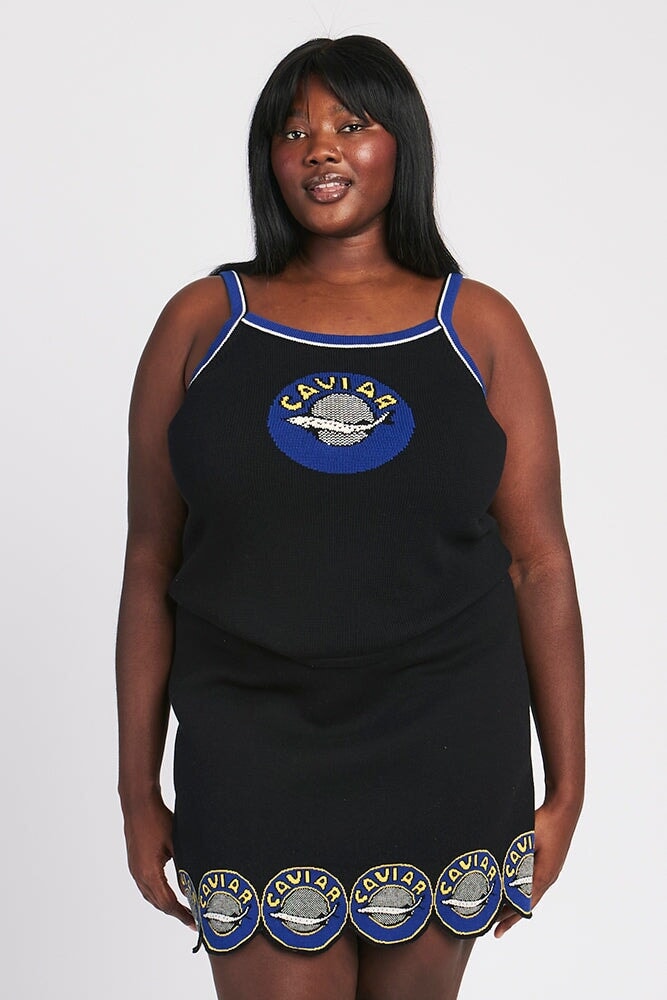
    Why European retail goes deeper at certain price tiers

    Stephanie Yeboah, the London-based plus-size journalist who wrote the 2020 book Fattily Ever After and has filed for Refinery29 UK, Vogue, and the Guardian on the state of UK plus retail, has been saying for the better part of five years that the structural difference between US and European plus is not the size range. Both markets have brands that go to a UK 32 or a US 28. The difference, Yeboah has argued in print and on her newsletter, is which tier each market chose to build out first. The US plus market grew up around mid-market mass: Lane Bryant, Torrid, Avenue, then later Eloquii and ASOS Curve. The premium and luxury tiers were filled in late, badly, and mostly by smaller US brands that struggled to survive past the seed round. The European plus market grew the other direction. Marina Rinaldi launched in 1980 in Italy as the plus-size sister to Max Mara, and the brand has had forty-six years to perfect a 690-euro wool blazer for a size 24 body. Anna Scholz launched in 1996 in London with a German design tradition behind her and built a contemporary-luxury line that the US plus tier still has not reproduced. The premium and luxury rungs of the ladder were built first in Europe and the mid-market filled in around them, the opposite of the US sequence.

    What that means in a fitting room is concrete. The grading is more honest. The shoulder seam on a Marina Rinaldi blazer at size 24 was engineered for a size 24 body, not extrapolated from a sample size 42 Italian, which is roughly a US 6. The bust-to-waist ratio on an Anna Scholz dress at UK 24 sits where a UK 24 body actually sits, not where a UK 8 body stretched eight sizes larger would put it. The German plus tier, which centers on Navabi as the aggregator and Sheego as the basics brand, runs heavier-weight fabrics than the US mid-market equivalents at the same price point, because the German market expects a winter coat to last six winters and the US fast-fashion plus tier has trained shoppers to expect one. None of this matters if you do not buy at the premium tier. At ASOS Curve and Simply Be price points, the European mass market is similar to the US mass market and the shipping math kills the comparison. Above 200 euros per piece, the European tier separates itself and is worth the customs paperwork. Below 200 euros per piece, you are mostly paying for a different sticker on the same Bangladesh garment.

    ASOS Curve and Simply Be: the UK mass-market tier

    ASOS Curve is the most familiar name to a US plus shopper and the one with the most genuinely useful US shipping setup. The brand carries UK sizes 18 through 30, which translate to roughly US sizes 14 through 26, on around 14,000 styles at any given moment across its own label and the third-party brands stocked on the marketplace. Pricing in 2026 runs from 12 pounds for a Curve tee to about 95 pounds for an outerwear piece, with the bulk of the catalog sitting between 25 and 55 pounds per item. The US site quotes free standard shipping on orders over $40, paid express around $20, and the brand has been clearing US customs on the de minimis side of the line at item level for years, which means a Brooklyn shopper buying three Curve dresses at 45 pounds each lands the order for about $172 with no customs duty owed at the door. That is the cleanest math in this entire piece.

    The trade-off is what the brand actually is. John Lyttle, the ASOS chief executive who took over in 2024 after the Nick Beighton restructuring, has been public about the strategic decision to consolidate the Curve sub-brand under the main label and reduce duplicate SKUs across the size ranges, which in practice has meant a smaller Curve offering in 2026 than the brand carried in 2022. The quality is fast-fashion quality. The Curve denim wears for a season and bags at the knee. The Curve dresses pill on the polyester knits after eight wears. The brand grades up from a UK 10 sample, and the fit at UK 28 is consistently the weakest in the size run, with armholes too high and waist placement too forward. For a US shopper, the case for ASOS Curve is breadth of stock, occasional steals on the marketplace brands like Simply Be and Yours Clothing stocked through ASOS, and the lowest landed-cost math of any European retailer that ships to the US. It is not the place to buy something you expect to wear past eighteen months.

    Flat-lay of ASOS Curve and Simply Be plus-size pieces on a white linen backdrop

    Simply Be sits in a similar tier with a different demographic. The brand is owned by the N Brown Group in Manchester, carries UK sizes 12 through 32, and runs heavier on workwear, denim, and lingerie than ASOS Curve does. Prices in 2026 sit between 22 and 75 pounds for most styles, with a denim core at 35 to 45 pounds and the brand’s own Simply Be label workwear hitting 55 to 75 pounds. The US site quotes flat shipping at about $14.99 for standard delivery and $24.99 for express, with no free-shipping threshold most of the year. For a Brooklyn shopper, a Simply Be order of three pieces at an average 40 pounds each lands at roughly $169 plus the $14.99 shipping, total around $184. Customs clears on the de minimis side as long as the order is under $800. The brand grades better at the top of the size range than ASOS Curve does, especially through UK 28 to 32, where Simply Be’s denim retains a better waistband-to-hip ratio than the ASOS equivalents. The trade-off is the catalog leans frumpier and the trend pieces lag UK street style by about a season.

    Marina Rinaldi: Italy’s plus luxury and the alterations economy

    Marina Rinaldi is the brand the entire European plus tier is measured against. Founded in Reggio Emilia in 1980 as the plus-size sister label to Max Mara, the brand carries Italian sizes 41 through 55, which translate to roughly US sizes 12 through 26, across about 600 styles a season split between the main Marina Rinaldi line, the contemporary Persona by Marina Rinaldi line, and the suiting-focused Marina Sport line. Pricing in 2026 sits at the premium tier and does not pretend otherwise. A wool Marina Rinaldi blazer runs 590 to 890 euros at the boutique. A cashmere coat runs 1,200 to 1,800 euros. A silk-blend day dress runs 380 to 590 euros. The trousers sit at 280 to 420 euros. These are not aspirational prices, they are the actual prices on the floor at the Milan flagship and the Lisbon boutique and the Rome store on Via del Corso.

    The brand ships to the US through marinarinaldi.com at quoted rates of $35 to $50 for standard delivery on most orders, with express available around $75. The shipping is the cheapest part of the math. A Marina Rinaldi blazer at 690 euros converts to roughly $750 at the 2026 rate, then the brand adds about $40 in shipping, then because the order is over the US $800 de minimis threshold for duty-free entry, US Customs assesses duty on the apparel category at roughly 16 to 28 percent depending on fabric content. For wool blazer construction, expect about 18 percent. The landed cost on that 690-euro Lisbon-boutique blazer ordered to Brooklyn lands closer to $930 to $960 once the duty clears. That is still meaningfully under the $1,475 US site price, but the win is sixty percent smaller than the boutique-floor delta suggested. The premium tier shopper who buys multiple Marina Rinaldi pieces per year can amortize the shipping, but the customs duty resets on every order regardless of frequency.

    The piece I keep recommending to US Marina Rinaldi shoppers is the alterations math. The brand cuts trousers and dresses with an inch of extra fabric in the waistband and hem on purpose, with finished seams, on the assumption that the buyer will tailor. A Marina Rinaldi trouser ordered to your size 24 measurements in Italy will arrive with about thirty dollars of alterations work waiting at your local tailor. Budget for that. The US plus mid-market does not anticipate alterations and finishes the seams flat, which is why most US plus trousers cannot be let out half an inch in the waist. Marina Rinaldi expects the trip to the tailor and prices the garment for the buyer who will make it. That is the actual luxury, not the wool weight.

    Plus-size Black woman trying on a caramel wool Marina Rinaldi blazer inside the Rome Via del Corso boutique

    Persona by Marina Rinaldi: the contemporary line

    Persona by Marina Rinaldi is the sub-line the brand launched to capture the contemporary plus tier, sized Italian 41 through 49, US 12 through 22. The cut is softer, the silhouettes more current, the price point about thirty percent below the main Marina Rinaldi line. A Persona blouse runs 220 to 320 euros, a Persona dress 290 to 480 euros, a Persona blazer 380 to 520 euros. The shipping to the US is bundled with the Marina Rinaldi US site at the same $35 to $50 standard rate. The landed cost on a 390-euro Persona dress to Brooklyn comes in around $475 if the order stays under the $800 de minimis ceiling, which a single-dress order will. Bundle two Persona pieces in one order and you cross the threshold, the duty assesses, and the per-item math shifts.

    The honest take on Persona is that it is the better entry point to the Marina Rinaldi house than the main line for a US buyer who does not want to wait through the customs paperwork on every order. The fit grading is the same patternmaking team. The fabrics are lighter, the lining is sometimes optional, but the construction is recognizably Italian premium. A US shopper buying her first Italian plus piece should start at Persona. If the size and the silhouette work, then the main Marina Rinaldi line is the upgrade after the first piece confirms the body translates.

    Navabi: the Germany plus aggregator

    Navabi is the German plus aggregator, launched in 2009 out of Aachen as a multi-brand plus-size e-commerce site. The site stocks about forty-five plus-size brands from across Europe, German sizes 42 through 58, US sizes 12 through 28, with pricing that ranges from 60 euros for a basic knit to 800 euros for the Anna Scholz pieces the site carries. Navabi’s structural value is that the site curates rather than sells everything. The buying team filters out the brands that grade badly at the top of the size range and stocks the ones that hold up. A US shopper who does not want to research individual European brands can hit Navabi, filter by size and category, and the site has already done the brand-quality sort.

    The shipping to the US is the cleanest in the German plus tier: Navabi charges a flat 25 euros to the US for standard delivery, about $27 at the 2026 rate, regardless of order size. The customs math is the same as everywhere else, de minimis under $800, duty above, but Navabi pre-calculates the duty at checkout and presents a delivered duty-paid price that includes the customs in the cart total. That is the buyer-friendly version of the math, and it is the reason I send first-time European plus shoppers to Navabi before any other site. A Brooklyn order of two pieces at an average 180 euros each lands at $415 total with the duty and shipping already calculated. No surprise bill at the door. No piece held in a CBP warehouse for a week while the duty broker negotiates classification. Navabi has built the shipping experience that the rest of the European plus tier still has not.

    Anna Scholz: the German designer plus

    Anna Scholz is the contemporary-luxury German plus designer, German-born and London-based, who launched her label in 1995 after studying at Central Saint Martins, sized UK 14 through 28, US 12 through 26. The label is one of the few European plus brands that carries through to a UK 28 with the same grading attention as the bottom of the run, which is the reason the brand sits in nearly every Navabi feature edit. Pricing in 2026 sits at the upper-contemporary tier: dresses 350 to 580 pounds, knits 220 to 380 pounds, outerwear 480 to 890 pounds. The brand sells direct through annascholz.com, ships to the US at about 35 pounds standard, and clears customs at item level on orders under $800.

    The fit signature is dramatic. Anna Scholz cuts on the bias more aggressively than the rest of the European plus tier, uses jersey weights that drape rather than skim, and runs prints that read on the body rather than getting lost on it. The pieces are not for every plus body, and the brand makes no pretense at universal flattery. A US buyer who already knows her style runs on the maximalist side should look at Anna Scholz seriously. A US buyer who wants a quiet workwear blazer should not start here. The landed cost on a 380-pound jersey dress to Atlanta lands around $520 with shipping and conversion, and the duty stays off the bill if the order stays single-item.

    Flat-lay of three Anna Scholz plus-size dresses including navy bias-cut jersey emerald floral and black asymmetric drape

    Sheego and Bonprix Curve: the German basics tier

    Sheego is the German mass-market plus brand, sized German 40 through 58, US 10 through 28, the rough equivalent of a Simply Be in scale and price tier but with the German market’s heavier basics tradition behind it. The brand’s catalog runs about 8,000 styles, 25 to 95 euros per piece, with a strong workwear and outerwear core. The US shipping is the soft spot. Sheego does not run a dedicated US site, and the German site quotes international shipping at 39 euros for standard delivery, with no express option to the US in 2026. The customs clears at de minimis under $800, and Sheego’s average ticket is low enough that nearly every US order stays under the threshold. A three-piece order at an average 65 euros lands at roughly $250 to a Brooklyn address with the shipping.

    The honest read on Sheego for a US buyer is that the prices, after the 39-euro shipping, are not meaningfully different from the US mid-market equivalents at Old Navy plus or Eloquii sale. The German construction is slightly better at the basics level. The wool-blend coat at 159 euros in the Sheego winter catalog is heavier than the Old Navy coat at $89 in the same season. But the delta does not survive the shipping math for most pieces. Sheego is worth the order if you are buying a winter coat or a structured wool skirt that the US market does not stock at that price tier. It is not worth the order for basics that ship from a US warehouse in two days for the same money.

    Bonprix Curve is the catalog plus sub-brand owned by the Otto Group in Hamburg, sized German 44 through 58, US 14 through 28. The pricing is the bottom of the European plus tier: most pieces sit between 15 and 50 euros, with a fast-fashion-adjacent rotation. Bonprix runs a dedicated US site that ships standard at about $9.95 to most addresses, which is the cheapest European plus shipping in this piece. The trade-off is that you are buying European fast fashion, and the construction shows it. The pieces wear for a season at most. For a US buyer, Bonprix Curve makes sense only if you are looking for a specific basic the brand stocks in a colorway the US fast-fashion plus tier does not offer. Otherwise the math is a wash with Walmart plus or Target plus at lower landed cost.

    Yours Clothing: the UK fast-fashion plus reality

    Yours Clothing is the UK fast-fashion plus chain, sized UK 16 through 36, US 12 through 32, with the deepest top-of-range carry of any brand in this piece. The catalog runs about 6,000 styles at any given time, priced 14 to 65 pounds for most pieces, with a strong occasionwear and denim presence. The US shipping is quoted at 12 to 18 pounds depending on order size, with free shipping over 75 pounds occasionally during promotions. The customs clears at de minimis on nearly every order.

    The case for Yours Clothing is the size 32 range. There is no US fast-fashion brand that carries to a US 32 with the same breadth of stock and consistency of fit. A US 30 or 32 shopper who has been forced into the same five Lane Bryant denim styles for years can hit Yours and find twenty-five denim styles in her size in current season. The construction is fast-fashion construction, comparable to ASOS Curve at the same price tier, and the pieces are not meant to last past a season. The trade-off is real, but for a buyer at the top of the US plus range who has been underserved by domestic stock, Yours Clothing’s catalog depth is the closest thing to mass-market choice that exists. Felicity Hayward, the UK plus-size model and author of the 2023 book Found , has been writing for years about the way the UK plus market built capacity at sizes 26 through 36 that the US market still has not matched at any price tier, and Yours is the most accessible expression of that capacity.

    Flat-lay of Yours Clothing plus-size pieces including dark wash jeans striped knit jumper and black occasion dress

    KOAN and Elena Miro: the Italian contemporary and mid-tier plus

    KOAN is the Italian contemporary plus label out of Milan, sized Italian 46 through 56, US 14 through 24, that has been quietly stocked in the Navabi feature edit and a handful of US boutique e-commerce sites for the last three years. Pricing sits in the 180 to 480 euro range, with a strong knitwear core and the Italian premium-tier fabric weights at a contemporary price step. KOAN does not run a dedicated US site as of 2026, and US buyers reach the brand through Navabi or through the brand’s Milan boutique direct-order. The Navabi pricing on KOAN pieces averages about 240 euros, lands at $290 to Brooklyn through Navabi’s flat 25-euro shipping, and clears the customs math on the duty-paid side.

    Elena Miro is the older Italian plus brand, founded in 1985 in Mantua, sized Italian 42 through 54, US 12 through 22. The brand sits between Marina Rinaldi’s premium and KOAN’s contemporary, with prices in the 120 to 380 euro range. Elena Miro ships to the US through elenamiro.com at about 30 euros standard, lands customs-cleared on most orders under $800, and the brand’s signature is the cocktail dress and Italian eveningwear core that the US plus market has consistently underserved. For a US buyer looking for a real occasion dress at a contemporary-Italian tier, Elena Miro is the search-result-worth-clicking on a price-per-construction basis. The trade-off is that the silhouettes lean conservative, more Reggio Emilia matron than Milan street, and the buyer should know that going in.

    Olympia: the Greek plus brand most Americans have not heard of

    Olympia is the Athens-based plus-size brand sized Greek 46 through 60, US 14 through 28, that has been operating since 2012 with a small but consistent US-shipping operation. The catalog is small, about 400 styles a season, priced 45 to 220 euros, with a Mediterranean cut tradition that runs lighter than the German or Italian plus equivalents. The brand ships to the US at about 28 euros standard through olympia.gr, clears customs on de minimis under $800, and the Greek summer-wardrobe pieces, especially the linen separates and the gauze-cotton dresses, are the search the US plus market has not built capacity for at this price tier. A Brooklyn buyer planning a Mediterranean trip can order from Olympia directly to her hotel address, which is the move I have used three times now to dodge the customs paperwork entirely. Olympia is not a US-residency brand for most buyers, but it is the brand to know about if you are traveling.

    Penningtons: the Canadian plus that carries some European stock

    Penningtons is the Canadian plus chain owned by Reitmans, sized Canadian 14 through 32, US 12 through 30, which carries a rotating selection of European plus brands alongside its house label. The brand ships to the US at flat Canadian Post rates, about $19.95 USD for standard delivery, and clears customs at the de minimis threshold on most orders. The case for Penningtons for a US buyer is the curated European edit at the top of the size range, especially the Anna Scholz and Marina Sport pieces the chain stocks at slightly under the European direct-order price after the Canadian buying-team markup. The trade-off is the stock turns fast and the European edit is not predictable. Check the site at the start of each season if you are sourcing European plus through the Canadian back door.

    The Violeta by Mango closure and what it cost us

    Violeta by Mango was the Spanish plus sub-line that Mango launched in 2013 to carry sizes EU 42 through 52, US 14 through 22, at the contemporary fast-fashion price tier. The brand closed the sub-line in late 2022, folded the upper sizes into the main Mango range, and reduced the actual top-of-size carry from a EU 52 to a EU 46 across most styles within eighteen months of the closure. Stephanie Yeboah wrote a Refinery29 UK piece at the time arguing that the Violeta closure was the leading indicator of the broader pullback in plus inclusion that has continued through 2025 and 2026. She was right. Anna Scholz commented on the closure in an Instagram post, calling it “the canary in the coal mine for European plus” and warning that the Spanish and French mid-market would follow within three years. Two of the three brands she named publicly have in fact reduced their top-of-range carry since.

    What the Violeta closure cost US shoppers specifically was the contemporary Spanish plus price tier. There is no current European brand that occupies the slot Violeta held: 50 to 120 euro contemporary trend pieces, EU 50 through 52 top-of-range, with the Mango aesthetic and a US shipping setup. The closest equivalents are KOAN at twice the price tier and Bonprix Curve at half the construction quality, neither of which actually replaces what Violeta was doing. For a US buyer who built her wardrobe around Violeta between 2017 and 2022, the replacement is partial. The Marina Sport line at Marina Rinaldi covers some of the same wardrobe slots at three to four times the price, and Anna Scholz covers the editorial silhouettes at a similar multiple. The fast-fashion contemporary Spanish plus tier is gone and the European market has not rebuilt it.

    The shipping cost and customs duty math you need to know

    The single biggest change in this math for any US plus shopper ordering from Europe in 2026 is what happened to the de minimis exemption. The $800 duty-free entry threshold that long defined the international apparel order was suspended by executive order on August 29, 2025, which means low-value shipments from all countries are no longer eligible for the old duty-free treatment and are subject to standard admissibility and duty assessment at entry. The practical effect for a US plus buyer is that the customs duty math now applies to nearly every European order, regardless of order size, rather than only to the large premium-tier orders that used to cross the old threshold. Some retailers are absorbing the duty into checkout under a delivered-duty-paid model and some are passing the assessment through at the door via the carrier. Confirm which model your retailer is using before you place the order, because the difference at the door can be 15 to 25 percent of the cart value.

    The customs duty on apparel runs roughly 12 to 32 percent depending on fabric content and garment classification. Wool blazers and wool coats sit at the high end, around 18 to 25 percent. Cotton knitwear sits in the middle, around 14 to 18 percent. Silk and synthetic blends vary widely, 12 to 28 percent. Customs also assesses a merchandise processing fee on formal entries. The duty is calculated on the value of the goods plus the international shipping, not the goods alone. For a Marina Rinaldi blazer at 690 euros plus 40 euros shipping, the duty assesses on the full 730 euros, which is roughly $795 at the 2026 rate. At an 18 percent rate that’s around $143 in duty plus the processing fee, which adds roughly $175 at the door to the original $750 piece. The landed cost lands close to $965. That’s the math the boutique-floor price didn’t tell you.

    For shipping cost specifically, the spread is wider than most US buyers expect. ASOS Curve runs free shipping over $40 to the US. Bonprix Curve runs about $9.95 flat. Navabi runs about $27 flat at any order size and pre-calculates the duty. Yours Clothing runs $14 to $22. Sheego runs about $42. Marina Rinaldi runs $35 to $50. Anna Scholz runs about $40. Elena Miro runs about $32. Olympia runs about $30. KOAN ordered direct through the Milan boutique runs about $55 to $75 with the higher-touch hand-off, which is why most US buyers route KOAN through Navabi instead. The retailers with the cheapest shipping are not necessarily the ones with the best landed-cost math, because the cheapest shipping correlates with the cheapest construction. Navabi’s $27 flat with pre-calculated duty is the most predictable single shipping number in the European plus market, and Marina Rinaldi’s $40 with the duty assessed at the door is the most expensive but the most negotiable, because the brand will sometimes waive the international shipping fee on orders above 1,500 euros placed direct through the boutique with a sales associate.

    Sizing translation EU to US plus

    The conversion math European plus retailers publish on their US-facing sites is not reliable. The cleanest rough conversion across most European brands is: US 14 equals roughly UK 18, German 44, Italian 46, French 46, Spanish 44. US 18 equals roughly UK 22, German 48, Italian 50, French 50, Spanish 48. US 22 equals roughly UK 26, German 52, Italian 54, French 54, Spanish 52. US 26 equals roughly UK 30, German 56, Italian 58 (where carried), French 58 (where carried). The variance between brands is wider than the variance within a single brand, which means the size that fits at Marina Rinaldi will not necessarily fit at Anna Scholz at the same nominal conversion. Order one size up from your conversion on the first piece from any new European brand, because the European return shipping math is brutal at the international tier and a piece that fits poorly is functionally non-returnable for most US buyers.

    The specific size-translation gotcha is the bust grading. European plus brands grade the bust from a smaller starting point than US plus brands at the same nominal size, because the European reference body assumes a smaller cup. A US 22 with a DDD bust will often need to size up at Marina Rinaldi for the blazer to button at the bust, even though the trouser will fit at the converted size. Buy separates rather than suits as your first European plus order, and let the bust grade tell you what size to repeat-buy in the next category. Naomi Shimada, the multidisciplinary plus-size advocate and former model who has written for the Guardian and The Cut, has been pointing out for the last several years that the European bust-grading tradition is the structural reason so many European plus brands fit hourglass and pear bodies better than apple bodies. She is right, and that fit pattern is worth knowing before you spend 690 euros on a piece that will not button.

    The five retailers actually worth the shipping math

    After the math is run, the European plus brands that survive the customs-and-shipping reality on a value-per-piece basis for a US buyer come down to five. Marina Rinaldi is the first, because the construction at the premium tier is genuinely not available at the equivalent US price, and the landed-cost delta on a wool blazer or cashmere coat from the Lisbon or Milan boutique compared to the US site still favors the buyer who runs the order through the international shipping rather than the US-domestic restock. Anna Scholz is the second, because the contemporary-designer plus tier the brand occupies has no real US-domestic equivalent, and the 380-pound jersey dress lands at $520 in Atlanta in a category the US plus market does not stock. Navabi is the third, because the aggregator’s flat-rate duty-paid shipping math is the cleanest in the European plus market and the buying team’s curation removes the brand-quality research that otherwise eats a US buyer’s time. Yours Clothing is the fourth, narrowly, because the size 28 through 32 carry depth is genuinely not available at any US fast-fashion price tier and the shipping math survives at the lower per-piece values. Persona by Marina Rinaldi is the fifth, because the entry-point construction at 290 to 480 euros per piece, on the Marina Rinaldi house grading, lands as the smartest first European plus order for any US buyer who has not yet tested the size translation on a premium-tier piece.

    The brands that did not make the cut are not bad brands. ASOS Curve fails the value math because the US-domestic alternatives at the same price tier have caught up and the construction is comparable. Simply Be fails because the catalog leans frumpier than the US mid-market equivalents at the same landed cost. Sheego fails because the shipping eats the construction delta on most pieces. Bonprix Curve fails because the construction is fast fashion at international shipping prices. KOAN fails the direct-order math but survives through Navabi, which is the reason Navabi made the cut and KOAN did not. Elena Miro fails because the silhouettes are conservative enough that the US plus market’s evening-and-cocktail tier covers the same buyer at lower landed cost. Olympia fails the US-residency math but works for travelers ordering to a hotel address. Penningtons fails because the European-edit curation is too inconsistent to plan an order around. Marina Sport survives the math but folds into the Marina Rinaldi recommendation. The Violeta by Mango slot is empty and will likely stay empty for the next several years.

    What I think happens to European plus US shipping in 2027 and 2028

    Here is the prediction. By the end of 2028, two of the five brands above will have expanded their US shipping operations meaningfully, and three of the brands below the cut will have retracted theirs. Navabi will expand. The aggregator model with pre-calculated customs duty is the buyer experience the rest of the European plus tier has not built, and Navabi’s German operations team has been quietly hiring US-market logistics roles since late 2025 in a way that signals a real US-side warehouse or duty-broker partnership inside two years. Marina Rinaldi will expand at the Persona tier, not the main line, because the contemporary-luxury price step is where the US plus premium tier still has the largest gap and Marina Rinaldi’s parent company at Max Mara has been treating the US as a growth market in the Persona positioning since the 2024 New York store opening. The main Marina Rinaldi line will hold steady at current US shipping because the buyer base is already captured at the boutique-direct order tier.

    The retractions will come from Sheego, Bonprix Curve, and Yours Clothing, in that order. Sheego will pull back US shipping or raise the international rate to a level that prices the brand out for most US buyers, because the Otto Group’s German-market focus does not justify the international logistics overhead at Sheego’s average ticket size. Bonprix Curve will follow Sheego inside eighteen months for the same reason. Yours Clothing will not pull US shipping outright, because the N Brown Group’s mid-market positioning needs the US revenue, but the brand will likely shift to a US-fulfillment-partner model that raises prices by twenty to thirty percent on the US-facing site to absorb the shipping cost into the ticket. Anna Scholz will hold steady, because the designer-direct model does not depend on volume. Elena Miro will hold steady at current shipping but lose US buyers anyway as the US plus eveningwear category fills in domestically. KOAN will get bought by either the Max Mara group or the Navabi parent, and the brand’s US distribution will consolidate through the acquirer rather than through direct-order. The Violeta by Mango slot stays empty through 2028 because the European fast-fashion plus tier is structurally retreating, and no Spanish or French replacement brand has the scale to enter the US at that price point with the same catalog breadth. By the end of 2028, the European plus shipping math for a US buyer will be cleaner at the premium and aggregator tiers and meaningfully worse at the mass-market tier. Navabi will become the default and the rest will sort itself behind that single fact.

  • Plus-Size Money: How to Sell Clothes Online Without Burning Out

    Plus-Size Money: How to Sell Clothes Online Without Burning Out

    Plus-size Black woman photographing a dress for resale in her Atlanta apartment at night with a ring light, tripod, and laptop open to Poshmark

    It was 9:47 pm on a Tuesday in early March when I admitted to myself that the side hustle wasn’t working. My one-bedroom in Chicago had become a small warehouse. A garment rack from Target stood in the corner of the living room with twenty-three plus-size pieces hanging on it – sizes 18, 20, 22, 24, a couple of stretchy 26s – and I was on hour three of trying to photograph a navy fit-and-flare dress that the algorithm didn’t want to move. Twelve listings posted across the previous six weeks. One sale. A $32 sundress that netted me $19.43 after Poshmark’s twenty percent fee and a shipping concession I made because the buyer asked. The ring light kept tipping over. My phone kept refusing to focus on the dress because the background was the same warm beige as the fabric. I’d bought the dress at an estate sale for $4 with the conviction that any plus-size piece from a closing-up boutique would move. It had been sitting in the closet for forty-one days. Twelve listings. One sale. Six weeks. The math was the math.

    What I had not understood when I started reselling was the demographic gravity of the resale market. Most of the volume on the major platforms is sub-size-fourteen buyers – the same skew the primary retail market has, the same skew the runway has – and the volume that exists for plus-size pieces sits later in the funnel, with a longer time-to-sale, a narrower buyer pool, and a price ceiling that nobody on YouTube tells you about when they are filming their thrift haul. The full-time resellers who post their $4,000 weeks on TikTok are usually moving size 4 through size 12 inventory at high velocity. The size 18 to 24 reseller is running a different business. Same platforms, same fees, slower clock. If you do not adjust the cadence and the pricing and the photography time per piece, the math turns on you, and three months in you are sitting at 9:47 pm on a Tuesday with a ring light tipping over and twenty-three pieces on a Target garment rack you cannot move.

    This is the playbook I wish someone had handed me at hour three of that Tuesday. It’s the platform-by-platform math, the cadence that lets you keep your weekends, the pricing rule that actually works for plus pieces, the tax reality once your gross sales cross the platform reporting threshold, and the twelve-month plan with a dollar target that won’t destroy your nervous system. I’m still reselling. I’m also still pulling receipts on every plus brand I review, which is the only reason I can be honest about this. Reselling is a real side income. It’s not a get-rich-quick situation, especially in plus, and the people selling you the dream of quitting your job in six months aren’t selling the size 22 dress.

    The plus-size reseller burnout pattern has a data signature

    The plus-size reseller burnout pattern has a data signature

    ThredUp publishes an annual Resale Report every spring, and recent editions are the documents every plus-size reseller should read once before they list a single item. The headline number from the report is the one that gets repeated everywhere: the secondhand apparel market crossed $197 billion globally in 2023 and is projected to keep growing into the hundreds of billions through the end of the decade. The number underneath the headline, the one that doesn’t get repeated, is the velocity gap. Plus-size garments consistently sit in the marketplace longer than equivalent straight-size garments before selling, according to reseller-community data and platform feedback. The buyer pool is smaller, the fit risk is higher, and the search behavior is more specific. That’s the data signature of the burnout pattern.

    What the gap means in practice: a size 8 sundress that would sell in three weeks can take a month or more in a size 18. A blazer that would move in a month-and-a-half can sit closer to two months. A formal dress that would move in two months can sit closer to three. The total addressable market for the plus-size piece is smaller in pure buyer-count terms, the buyer is more careful because the fit risk is higher, and the search behavior is more specific – a size 22 buyer is searching for a size 22, not browsing for whatever fits. The platform’s algorithm responds to engagement velocity, so listings that don’t sell quickly get less feed real estate the next week, which compounds the problem.

    The reseller community on YouTube and in Reddit’s r/poshmark has documented the same pattern in monthly recap videos and breakdowns. Plus-size pieces routinely take longer to sell than straight-size pieces and price out lower per item on average for resellers carrying mixed inventory. The plus inventory is still worth carrying because buyer loyalty is higher and the repeat-customer rate is better, but the cadence has to be different. Sustainable plus resellers list less of it per week. They price it tighter at the start. They don’t chase the algorithm with daily listings the way straight-size resellers do.
    Poshmark, founded by Manish Chandra and now operated under Naver after the 2023 acquisition, has publicly framed extended sizes as a growth category and has rolled out fit and sizing filters that address some of the search friction. The framing is bullish and the platform-level data supports it – the plus category does grow on Poshmark year over year – but the growth is from a smaller base, and the individual reseller experience hasn’t caught up to the macro story. The category grows. The individual seller of a size 22 dress still waits longer for the sale than the seller of a size 8.

    The burnout pattern that follows this data is consistent. New plus-size reseller hears the ThredUp headline, sees a few viral TikToks, sources a lot of inventory quickly, posts twenty listings in week one, then twenty more in week two, sees minimal sales by week four, and panics. The panic response is to list more, not less. The reseller pushes to thirty listings a week, then forty. The photography gets sloppy, the descriptions get short, the pricing gets random, the inventory sits in the apartment growing into a physical and emotional problem, and somewhere around week eight to twelve the reseller hits the wall. I hit it at week six. The data says I was early.

    Platform-by-platform fee and audience math

    The single biggest education a new plus-size reseller can give themselves is understanding the fee structure and the audience composition of each platform. Most resellers list across two or three platforms, which is the right move, but the choice of which two or three matters enormously. Here is the working math for the major platforms in 2026, with the audience reality each one carries.

    Hands holding an iPhone showing a Poshmark plus-size dress listing in a closet view with the actual garment photographed in the background

    Poshmark: 20 percent fee, the social-feed engine, plus-friendly buyer base

    Poshmark charges a flat 20 percent commission on any sale over $15, and a flat $2.95 on sales of $15 or less. The math is unforgiving on cheap items – a $12 sale nets you $9.05 – but the fee structure is predictable once you cross $30 per piece. A $50 dress nets you $40. A $100 piece nets you $80. There are no listing fees, no insertion fees, no relisting fees. Shipping is a flat $8.27 paid by the buyer for items up to five pounds, which works in the seller’s favor on most clothing.

    The audience on Poshmark skews female, U.S.-based, ages 25 to 44, with a moderate plus-size buyer share. The platform’s “Sized to Sell” feature added in 2022 lets buyers filter by extended sizes specifically, which is a real upgrade. The community share-economy mechanic – where users share each other’s listings to their followers – is the part of Poshmark that no other platform replicates, and it is the reason plus-size resellers tend to do better here than on the listing-only platforms. A network of plus-size resellers who share each other’s items is a real algorithmic advantage. The downside is that the social labor is constant. If you stop sharing your closet daily and engaging with the community, your listings drop in the feed. The platform rewards daily presence, which is part of why it is also the platform most associated with the burnout cycle. The fix is to share with a routine, not on demand, which I will get to in the cadence section.

    Depop: 10 percent fee, young buyer base, mostly straight-size demand

    Depop charges a 10 percent fee on the sale price as of the platform’s 2022 fee restructure, which was a significant cut from the previous 10 percent plus payment processing model. The platform was acquired by Etsy in 2021 and the buyer base remains heavily Gen Z, Europe-leaning, and skewed toward vintage and Y2K aesthetic pieces. The plus-size category exists but is smaller. A size 22 vintage Levi’s jacket will move on Depop. A size 22 contemporary plus-size brand piece – say, a current-season Lane Bryant blazer – moves slower and at a lower price than it would on Poshmark.

    The Depop audience economic reality is the part that matters. Average sale prices on Depop run lower than Poshmark across the board, partly because the buyers are younger and have less disposable income, and partly because the aesthetic preference is for cheaper, more disposable pieces with a vintage or thrifted vibe. A piece you would list at $58 on Poshmark might list at $38 on Depop and sit for longer at that lower price. The fee is lower, the price ceiling is lower, the net comes out roughly the same. The reason to be on Depop is reach into the under-30 buyer who is not on Poshmark, not better economics.

    A ThredUp Clean Out Kit envelope opened on a wood floor with folded plus-size clothing inside and an iPhone showing the ThredUp payout estimate

    ThredUp: 25 to 80 percent payout tiers, zero listing labor, the volume-clear-out play

    ThredUp is structurally different from Poshmark and Depop. You do not list. You ship a bag of clothes to ThredUp’s processing center using a “Clean Out Kit,” and ThredUp assesses, photographs, lists, and sells the pieces for you. In return, you get a payout that scales by item value. The payout tiers as published on ThredUp’s site for 2026 are: 5 to 15 percent on items that sell for under $20, scaling up to 60 to 80 percent on items that sell for over $200. A $40 item nets you somewhere between $6 and $11. A $100 item nets you somewhere between $25 and $50.

    The math on ThredUp is brutal on low-value items, generous on high-value items, and the unsold items are donated unless you pay an “Assisted Return” fee to get them back. For a plus-size reseller, ThredUp is best used as a clear-out lane for pieces you have given up on, not as a primary income channel. The platform’s plus-size category is real and growing – ThredUp’s own data shows plus listings are a meaningful share of the women’s inventory – but the per-piece payout for the seller is the lowest of any platform on this list. The trade you are making is the listing labor. Zero photography, zero descriptions, zero shipping, zero customer service messages. You ship a bag and forget it. For pieces you would otherwise donate, the math is “some money is better than no money.” For pieces you actively want to sell at fair value, ThredUp is the wrong channel.

    Mercari: roughly 10 percent fee, broader category mix, lower plus-size velocity

    Mercari restructured its fee model in 2024 to a sale-price-based commission of around 10 percent depending on category, with a payment processing fee added on top, which lands the net seller cost in the 12 to 14 percent range. The platform is broader than Poshmark in category – it covers electronics, home goods, beauty, toys, and apparel together – which means clothing is not the primary feed for a typical Mercari buyer. The audience is older on average than Depop and slightly more male-skewed than Poshmark.

    For plus-size apparel specifically, Mercari is a thinner lane. The buyer is on the platform looking for a deal across many categories, not specifically hunting for a size 22 dress. Listings show up in keyword searches, which works if your titles are dialed in, but the social-feed mechanic that drives Poshmark does not exist on Mercari. The seller is doing more SEO work and less community work. The net for plus-size sellers tends to be slower sell-through and similar net dollars per sale to Poshmark after the fees are accounted for. Mercari is worth listing on as a third platform, not a primary one, for most plus-size resellers.

    eBay: variable fee around 13 percent, the long-tail buyer, the auction option

    eBay is the oldest platform on this list and the most underestimated by new resellers. The fee structure is variable by category, but for apparel the final value fee runs around 13 percent including the payment processing component as of 2026. eBay’s buyer base is enormous and global, which means a niche plus-size piece – a vintage Lane Bryant blouse from 1998, a discontinued Eloquii dress with a cult following – can find its specific buyer in a way the other platforms do not deliver. The auction format also exists, which is the only platform on this list where a competitive bid can push a listing above the seller’s expected price.

    The friction on eBay is that the buyer expectations are higher. Listings need more detail. Photography needs more angles. Returns are policed more strictly. Shipping is handled by the seller through a label-purchase flow that requires more administrative time per sale than Poshmark’s flat-rate shipping. For a plus-size reseller with vintage or designer pieces, eBay is essential. For a reseller moving contemporary plus-size pieces from mainstream brands, it is one channel among several. The payout per sale tends to be the highest of the listing platforms after fees, but the time-per-sale is also the highest.

    Vinted: zero seller fees, European buyer base, growing U.S. presence

    Vinted, the Lithuanian-founded peer-to-peer marketplace that has dominated the European resale scene since the late 2010s, launched in the U.S. market in 2023 and has been growing through 2025 and 2026. The headline feature is that sellers pay zero fees – all the platform costs are paid by the buyer through a small “buyer protection fee” added at checkout. For a seller, this is genuinely meaningful. A $40 dress on Vinted nets you $40, not $32 after Poshmark’s cut or $34 after Mercari’s.

    The catch is the audience. Vinted’s U.S. user base is still small compared to Poshmark and Mercari, and the platform’s algorithm is still maturing for U.S. inventory. The plus-size buyer is on the platform but in smaller numbers. The European audience is real but the shipping math for international sales rarely works in the seller’s favor unless you are moving high-ticket pieces. Vinted is worth listing on for the zero-fee math alone, with the understanding that the volume will be smaller than Poshmark for now. The trajectory is up. The current state is still maturing.

    Curtsy: women-only, college-skewing, fast for trendy pieces

    Curtsy is a smaller peer-to-peer marketplace built specifically for women, with a buyer base that skews college-aged and trend-driven. The fee structure is around 20 percent on items over $20, similar to Poshmark, and the platform has a “Buy It Now” plus offer system that drives faster sales on hot pieces. The plus-size lane on Curtsy is small but the buyers who are there are loyal. For trendy plus pieces – a current-season formal dress, a viral TikTok jeans brand in extended sizes – Curtsy can move inventory fast. For older or more classic pieces, it is the wrong fit. Most plus-size resellers do not need to be on Curtsy. The ones who specialize in current-season trendy inventory should consider it.

    Facebook Marketplace: zero fees for local pickup, hyperlocal buyer, no shipping

    Facebook Marketplace charges zero fees for local pickup transactions and a small fee for shipped purchases, which makes it the cheapest channel on paper. The reality is that the marketplace is local, the buyer expects to negotiate, no-shows are constant, and the time per transaction is high. For bulky inventory you do not want to ship – a coat, a wedding dress, a piece of formal wear – Facebook Marketplace can clear it for cash with no fees. For a plus-size reseller running a real volume operation, it is a clearance lane, not a main channel. Worth using strategically. Not worth building a business around.

    Plus-size woman holding a dress up to a tripod-mounted iPhone during a Whatnot live selling broadcast in her home with a ring light

    Whatnot: live selling, 8 percent fee plus processing, performance-heavy

    Whatnot is the live-stream selling platform that exploded in 2022 and 2023 and is now a meaningful channel for resellers willing to broadcast. The fee structure is around 8 percent on the sale plus payment processing fees, so the net cost is roughly 10 percent. Sellers go live on a scheduled stream, hold pieces up to the camera, and buyers bid or buy at fixed prices in real time. For plus-size sellers with a dialed presentation style, the platform can move significant volume in a single ninety-minute stream.

    The labor is the broadcast itself. Setting up the studio, scheduling the stream, marketing it to your buyer base, performing for ninety minutes in a row, packing and shipping everything that sold in the next twenty-four hours. It is exhausting and it is not the right channel for someone who is already burned out from listing. It is the right channel for a reseller who is ready to graduate from listing-platform passive sales to performance-driven active sales. Most plus-size resellers should treat Whatnot as a year-two channel, not a year-one channel.

    Instagram: DM-based sales, zero platform fees, relationship-driven

    Selling through Instagram is not a platform feature, it is a behavior. Resellers build a following, post pieces in their grid or stories, and complete sales through direct messages with payment via Venmo, Cash App, or PayPal Goods and Services. There are no platform fees. The payment processor takes a small cut if you use Goods and Services for buyer protection, which is around 3 percent. The buyer pool is whoever follows you and trusts you. For plus-size resellers with an existing following or a strong visual brand, Instagram can be the highest-margin channel by a wide margin. The catch is that you need the following first. New resellers without an audience cannot sell through Instagram. Established resellers with a few thousand engaged plus-size followers can.

    The 3-listing-per-week sustainable cadence

    The 3-listing-per-week sustainable cadence

    The single biggest mindset shift between the burnout reseller and the sustainable reseller is the listing cadence. The standard advice in reseller YouTube, repeated by influencers chasing growth at all costs, is to list daily, at minimum five to ten pieces a day, to keep the algorithm fed. For a full-time reseller moving straight-size inventory at velocity, that cadence might be sustainable. For a part-time plus-size reseller with a day job, it is the direct cause of the burnout cycle I described at the top of this article.

    The cadence that works for sustainable plus-size reselling is three listings per week. Three. Not three a day. Three total, spread across the week. Monday, Wednesday, Saturday. Or Tuesday, Thursday, Sunday. Pick a rhythm and hold it. The discipline of three a week does several things at once. It forces you to source more selectively, because you cannot just keep buying inventory and dumping it into the closet. It gives each piece more photography care, because you are doing one piece on a Monday evening, not five. It distributes your time across the week instead of compressing it into a Sunday-night marathon. It lets the algorithm see consistent activity from your account rather than feast-or-famine spikes.

    The three-listing rhythm pairs with a daily “engagement window” of fifteen minutes. The engagement window is when you share your closet on Poshmark, respond to offers, ship anything that sold, and check the other platforms. Fifteen minutes a day. Set a timer. When the timer rings, close the apps. The combination of three listings per week plus fifteen minutes a day of engagement is roughly four to five hours of total reselling time per week, which is the upper bound of what is sustainable next to a full-time job.

    The burnout cycle, for comparison, looks like twenty listings a week, ninety minutes a day of engagement, weekend marathons sourcing new inventory at estate sales and thrift stores, and a constant low-grade anxiety about the apartment filling up. That is somewhere around fifteen to twenty hours a week, which is a part-time second job, which is not what most plus-size resellers signed up for. The three-listing cadence is half the income of the twenty-listing cadence in the short run and roughly the same income in the long run, because the sustainable seller is still selling six months later when the burnout seller has quit.

    Photography that takes 3 minutes per piece, not 20

    Photography that takes 3 minutes per piece, not 20

    The photography burnout I described at the top of this article – the ring light tipping over, the navy dress that would not focus, the hour three of trying to get one shot – is a solvable problem and the solution is brutal simplification. Most reseller YouTube teaches a photography setup that takes twenty minutes per piece. Lightbox, two lights, white wall backdrop, mannequin, multiple angles, flat-lay shots, detail shots, tag shots. By the time you have shot one piece at that level of production, your evening is gone. Multiply by three listings a week and you are spending an hour a week just on photography, which is fine, but if you scale to twenty listings a week you are spending six and a half hours on photography alone, and that is the part where the burnout starts.

    The three-minute photography setup is the answer. One white wall in your apartment, or a clean light-color sheet pinned to the wall. Natural daylight from a window if it is daytime, a single inexpensive LED floor lamp if it is night. The garment on a wooden hanger or a torso mannequin. Phone on a small tripod or just held steady. Three shots: front, back, one detail (the tag, an embellishment, the fabric texture). Done. Move to the next piece.

    The trade you are making is fidelity for time. The Pinterest-perfect plus-size reseller photography you see on Instagram took someone an hour per piece. Your job is to take photography good enough to sell the piece, not photography good enough to win an award. A clean front shot on a clean background with accurate color and a clean back shot showing the silhouette will sell the dress. The buyer is going to message you for measurements regardless of how many shots you took. The detail shot does the work of answering “is this fabric stretchy” without a message. Three shots per piece, three minutes total. Nine minutes a week of photography across the three listings. The math reverses.

    Pricing the size 18 to 24 garment correctly

    Pricing the size 18 to 24 garment correctly

    Pricing is where plus-size resellers consistently leave money on the table. The default reseller pricing framework, taught in every Poshmark beginner guide, is to price at roughly thirty to forty percent of original retail. A dress that retailed at $80 lists at $28. A blazer that retailed at $120 lists at $42. The math is borrowed from straight-size reseller economics and it is wrong for plus-size pieces.

    The reason it is wrong is the supply-and-demand gap. A size 6 version of any given plus-size brand’s dress is everywhere on the secondhand market. A size 22 of the same dress is rare. The buyer who wants that size 22 dress has fewer alternatives, which means the demand curve is steeper at the larger sizes. A size 22 dress from a desirable plus-size brand – Eloquii, Universal Standard, City Chic, 11 Honoré – should price higher than the equivalent straight-size piece from the same brand, not lower, because the supply is smaller.

    The rule I use, which I arrived at after eight months of mispricing my own inventory: the size 18 to 24 piece from a plus-friendly brand prices at fifty to sixty percent of original retail in the first thirty days, dropping to forty percent after sixty days. The straight-size benchmark of thirty percent is the floor, not the target. A Universal Standard Seine dress that retailed at $128 lists at $64 to $77 in the first month, drops to $55 if it has not sold by day sixty, and only drops to $42 (about thirty-three percent of retail) if it is still sitting at day ninety. My size 6 sister’s equivalent dress, the same brand and style at her size, would price at $40 from day one because the supply at size 6 is enormous and the buyer has thirty alternatives. My size 22 has three alternatives. The pricing should reflect that.

    The exception is contemporary fast-fashion plus pieces – SHEIN, ASOS Curve fast-fashion lines, Fashion Nova – which have low resale value across the board because the supply is high and the perceived quality is low. Those pieces should price aggressively because they will not move at a premium. For those, the thirty percent rule applies. For genuine plus-size-specialist brands and contemporary mid-tier pieces, the fifty to sixty percent rule applies. Knowing which bucket the piece falls into is the seller’s job before listing.

    The donate-vs-resell-vs-trash decision tree

    The donate-vs-resell-vs-trash decision tree

    Not every plus-size piece in your closet should be listed. The sustainable reseller’s discipline is the upfront sort. Before a piece goes on a hanger and into the listing queue, it should pass three filters.

    Filter one: condition. The piece must be in excellent or better condition. No pilling that cannot be removed with a fabric shaver, no permanent stains, no broken zippers, no missing buttons that are not easily replaceable. If the piece would embarrass you to ship to a buyer, it does not list. It goes to donation or trash. Most resellers, including me at the start, are too generous with their condition assessment. A piece that “looks fine if you do not look closely” is not a piece that will get a five-star review. Returns and bad reviews destroy your seller rating faster than slow sales destroy your morale.

    Filter two: brand value. The piece must come from a brand that has secondhand market recognition. Universal Standard, Eloquii, Torrid (selectively), Lane Bryant (selectively), Old Navy (only for in-season), J.Crew Extended Sizes, Madewell extended, Eileen Fisher, 11 Honoré, Henning, Anthropologie A-plus, Athleta, Madewell, Free People (selective), Ganni, vintage anything pre-2010. Brands the resale market does not value – off-brand SHEIN dupes, generic Amazon plus-size brands, the no-name resellers cannot place – do not list at a price that justifies the listing time. Those pieces go to donation.

    Filter three: realistic resale price. The piece must be able to net at least $15 after fees. A piece that will list at $20 and sell at $15 will net you $12 on Poshmark. After packaging materials and the time to ship, you made about $9. For three minutes of photography, $9 is fine. For the cumulative time of listing, messaging buyers, and shipping, $9 is not enough to justify the cognitive overhead. The minimum net per sale, in my system, is $15. Pieces that cannot clear that go to donation. The donation has a small tax benefit if you itemize (the IRS allows fair-market-value deductions for donated clothing in good condition), which makes the math close to neutral even on pieces you do not sell.

    The trash filter is the easiest one. If the piece has a stain, a tear, an odor, or any condition issue that means a thrift store will not resell it either, it goes to a textile recycling program. Most major cities have one – in Atlanta, the H&M store accepts any-brand textiles for recycling and gives a small store credit. The point of the trash filter is to stop sending genuinely unsellable items to a thrift store, where they become someone else’s problem.

    The tax reality at $600 plus in resale income

    The tax reality at $600 plus in resale income

    The tax conversation is where most reseller content goes vague, and the vagueness costs sellers real money at year end. The 1099-K threshold, which is the dollar amount at which third-party platforms (Poshmark, Mercari, eBay, ThredUp, Depop) are required to send you a tax form and report your sales to the IRS, has been moving for several years and the 2026 threshold matters.

    Under the original American Rescue Plan Act of 2021, the threshold was supposed to drop from $20,000 to $600 starting in tax year 2022, which would have meant any reseller who crossed $600 in gross sales on a platform would receive a 1099-K. The IRS delayed the implementation in late 2022, again in late 2023, and again in late 2024, phasing the threshold down in steps. The published schedule from the IRS for tax year 2026 sits at $2,500 in gross sales as the federal threshold, with the full $600 threshold scheduled to take effect for tax year 2027 unless Congress changes it again. Several states (Massachusetts, Vermont, Virginia, Maryland, and the District of Columbia among them) already have lower state-level thresholds, some at $600, which means resellers in those states may receive a 1099-K even below the federal threshold. Check your state’s revenue department site for the current number.

    Here is the part that matters regardless of what number is on the IRS schedule: you are legally required to report all reselling income on your tax return, whether you receive a 1099-K or not. The 1099-K is just the platform’s report to the IRS. The income obligation exists from the first dollar. What the 1099-K threshold actually controls is the audit risk, not the legal obligation.

    The good news for resellers is that the IRS treats reselling as a hobby or a business depending on intent and frequency, and either category allows you to deduct the cost basis of the item from the sale price before paying tax on the profit. A dress you bought for $4 and sold for $50 is taxable on $46 of profit, not $50 of gross. A dress you bought for $30 retail, wore for two years, and resold at $25 is a loss (you cannot generally deduct losses on personal-use property in a hobby context, but the loss means there is no tax owed on the sale either). The accounting work is the part most resellers skip. The fix is a simple spreadsheet with columns for date acquired, source, cost basis, date sold, platform, gross sale, fees, net sale, and category. Five extra minutes per sale. Saved at tax time.

    For resellers who cross the $5,000 to $10,000 gross sales mark in a year and want to treat the activity as a business rather than a hobby, the deductions expand to include packaging materials, mileage to thrift stores, a portion of home internet, a portion of phone, the cost of a tripod and ring light, and other ordinary and necessary business expenses. A CPA who works with side-hustle clients – and most CPAs in major cities have at least a few – can structure this correctly for a flat fee of $300 to $600 a year, which is itself a deductible expense. The seller who does this correctly pays less in tax than the seller who does not. The seller who ignores it entirely pays no tax until they get audited, at which point they pay back tax plus penalties plus interest, which is a much worse outcome than the spreadsheet.

    The 12-month plan with a real dollar target

    The 12-month plan with a real dollar target

    Here is the part of the article where I tell you what success looks like, in numbers, twelve months from a starting point of zero or near zero. This is the prediction. This is what a sustainable plus-size reselling practice looks like one year out from the burnout moment I described at the top.
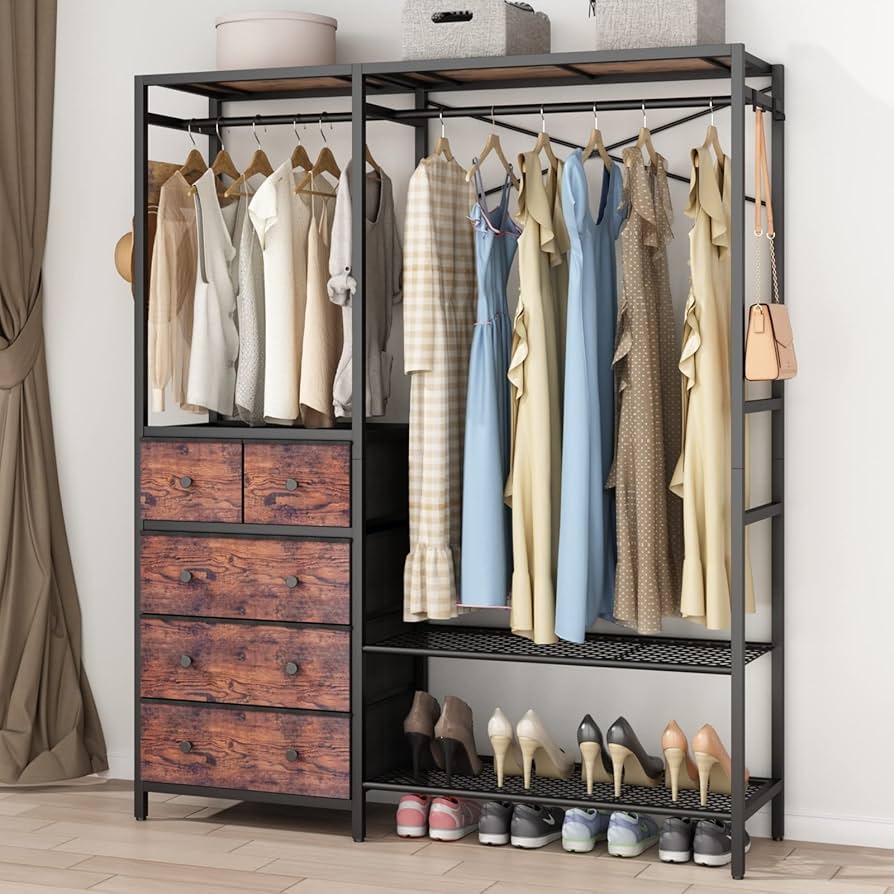
    Month one through three is the build. The cadence is three listings per week, fifteen minutes a day of engagement, one Saturday morning a month sourcing new inventory at estate sales, consignment store clearance racks, or relatives’ closets. Total inventory at the end of month three sits around thirty-six to forty active listings. Gross sales in month one are probably $50 to $150. Gross sales in month two move to $150 to $300 as the closet fills out and the algorithm starts to recognize the account. Gross sales in month three crack $300 to $500. Net after fees and shipping concessions sits around seventy to seventy-five percent of gross. The seller is making roughly $200 to $375 a month in net side income by month three, which is real but is not life-changing.

    Month four through six is the optimization. The seller adds a second platform (Vinted is my preferred pick for the zero-fee math, or eBay for vintage-leaning inventory). The seller refines pricing based on what actually sold and what sat. The seller writes templates for common buyer messages (a measurements template, a smoke-free-home template, a bundle-discount template) to cut response time. Listings expand to four a week as the rhythm becomes natural, but only if the seller is not feeling overwhelmed. Inventory turns over more cleanly. Gross sales by month six sit at $500 to $900 a month with net around $350 to $625.

    Month seven through nine is the scaling decision. The seller looks at their data and decides whether to scale up to a third platform, whether to test Whatnot live selling, or whether to hold steady at the current rhythm. The right choice depends on the rest of the seller’s life. A seller with bandwidth to grow can add eBay or Depop and push gross sales to $800 to $1,200 a month. A seller without bandwidth can hold steady and accept the existing rhythm. Both choices are valid. Burnout is the only wrong choice.

    Month ten through twelve is the consolidation. The seller has a clean inventory system, a tax spreadsheet, a buyer list, a few repeat customers, a feed presence on two or three platforms, and a routine that fits next to a day job without destroying weekends. Gross sales sit at $700 to $1,400 a month depending on how aggressively the seller pursued growth. Net side income runs $500 to $1,000 a month, which is $6,000 to $12,000 a year, which is meaningful for a side hustle and is taxed correctly because the spreadsheet exists. The seller has a closet that has shrunk back to manageable size because the inventory turns over. The Atlanta apartment is no longer a warehouse. The ring light stays on the desk. The Tuesday night photography session takes nine minutes instead of three hours.

    The prediction I want to leave with the plus-size reseller reading this on her own version of a 9:47 pm Tuesday with her own ring light tipping over: twelve months from now, the sustainable plus reselling practice looks like a three-platform mix (Poshmark, Vinted, plus one of Mercari/eBay/Depop based on inventory style), a three-listing-per-week cadence holding firm, a $700 to $1,400 monthly gross target with a $500 to $1,000 monthly net, a one-hour-per-week total time budget plus the daily fifteen-minute engagement window, a clean tax spreadsheet that keeps you out of audit trouble, a slowly improving closet that gets thinner instead of thicker, and a buyer list of women in sizes 16 to 28 who message you when they need something specific because they trust you to source it. The dress that took three hours to photograph on the Tuesday I almost quit sold for $48 on day thirty-one. I learned to take its photo in three minutes. The dress that hasn’t been bought yet, the one that will be the next listing, is hanging in the closet. The cadence keeps me from burning the whole project to the ground. The plan keeps me from quitting in week six. The math, finally, works.

  • Plus-Size Fitness: What to Wear for Outdoor Walking and Hiking

    Plus-Size Fitness: What to Wear for Outdoor Walking and Hiking

    The Sintra-Cascais coastal walk outside Lisbon does not look hard on the map. You leave the Cabo da Roca lighthouse early enough to catch the Atlantic still gray and unwarmed, you point your shoes south along the dirt track that hugs the cliff edge, and you tell yourself the eighteen kilometers between you and the Praia do Guincho beach bar will dissolve into a long October afternoon of wildflowers and gull noise. That was the plan in 2025. The reality, by hour three, was that I’d stopped twice already to peel a pair of straight-size hiking shorts away from the inner-thigh seam that was sawing a quarter-sized raw patch into the left side of my body with every step, and I was doing the math on whether a Portuguese pharmacy would carry Body Glide or whether I was about to finish this walk smearing a granola bar wrapper between my legs as a barrier. The shorts had been an experiment. I’d bought them in the largest size the brand carried and had a Brooklyn alterations woman let out the waist by an inch and a half, because I’m a size 22 in pants and a 20-22 on top, and that was as close to a true plus hiking short as the brand offered. The alteration had been clean. The inseam hadn’t been altered. The inseam was the problem.

    That is the shape of plus-size hiking in 2026. My hiking wardrobe is a Frankenstein of straight-size gear with the waists let out, a small rotation of true plus pieces from the three or four brands that actually carry above an 18, and a handful of items I bought in the men’s department because the cut handles my frame more honestly than the women’s “extended” run. I have walked or hiked trails in eight of the thirty-eight countries I have visited as a travel correspondent for this publication, and the through-line in every single one of those experiences is that the gear is not designed for me. It is designed for a 5’7″ woman in a size 8 and then graded up with the assumption that a body four sizes larger does not also have a longer inseam, a wider sit-bone spacing, more inner-thigh contact, and a chest that lives in a different geometric relationship to the shoulder seam than a fit model’s does. The grading does not handle any of that. The chafing math does. What follows is the field guide I wish someone had handed me before that Sintra walk, written for the woman who is size 18 and up, who walks or hikes for pleasure or fitness or both, and who would like to stop bleeding through her shorts on hour three of a perfectly normal Portuguese afternoon.

    Sintra-Cascais coastal trail cliff path Portugal October

    Plus-size hiking gear gap (where the industry stops)

    The outdoor industry has a well-documented size cutoff problem. Most major brands stop their women’s run at XL or 16, a smaller subset extends to XXL or 18, and a much smaller subset, fewer than ten brands operating at any meaningful retail scale in 2026, carries through 3X or size 26. Outside Magazine has covered the gap across multiple pieces in recent years. The reporting documents that even brands marketing themselves as inclusive often cap their technical hiking gear, the pants, the rain shells, the base layers, at sizes well below where their casual or yoga-adjacent lines extend. The pattern is blunt. The outdoor industry has decided, repeatedly, that plus bodies are welcome in studios and welcome in promotional photography and not welcome on the actual trail.

    The women doing the work to push against this gap are not industry insiders. They are athletes and they are visible. Mirna Valerio, the ultrarunner and trail athlete whose 2017 memoir “A Beautiful Work in Progress” remains the most-circulated single text in the plus-trail conversation, has been logging long-distance trail miles at size 22 and above for over a decade. Her sponsorship history with Merrell and her ongoing speaking work have done more to legitimize the plus body on a trail than any brand campaign. Latoya Shauntay Snell, the ultramarathoner and founder of Running Fat Chef, has run over two hundred races including multiple ultramarathons at a body size that the running industry has spent decades pretending does not exist. Snell has written and spoken publicly about the gear hunt as a separate athletic event from the running itself. When two women at the very top of the plus endurance world have to spend hours per gear cycle hacking together functional kits from a market that does not want to sell to them, the gap is not a niche complaint. It is the industry’s default state.

    Plus size hiker on rocky trail mountain backdrop autumn

    The brands that actually serve plus hikers in 2026 are a short list. REI Co-op extends its in-house brand through 3X across most of the technical line, and the extension has held through multiple seasonal drops, which is the durability test that separates a real commitment from a press-release commitment. Columbia carries through 3X across most of its hiking line, including the pants, which is the category most brands cut first. Patagonia carries through XS-3X on most hiking-relevant pieces, with the Torrentshell rain shell topping at XXL. prAna sizes through 3X across most of its hiking pants and tops with a brand-level commitment to the extended run that predates the 2020 inclusivity wave. Athleta carries through 3X across most of its outdoor-adjacent line, with the caveat that the brand’s hiking-specific technical pieces are thinner on the ground than its yoga or running offerings. That’s essentially the bench. A handful of brands. The rest of the market either stops at XL or pretends to extend without actually grading the technical pieces.

    Base layers (top and bottom) for cold/hot

    The base layer is the most-skipped piece in a plus hiker’s kit and the piece that pays back the fastest. The function of a base layer is moisture management. It pulls sweat off the skin, moves it into the next layer, and dries fast enough that the wet fabric does not chill you when you stop moving. In a plus body, this matters more than in a straight-size body, because the body produces more heat under load, sweats more across more surface area, and has more skin-on-skin contact where wet fabric becomes a chafing event rather than just a temperature event. A cotton t-shirt under a hiking shirt is the single most common gear error I see on plus beginners on a trail, and it is the one that ruins more walks than any other.

    The fabric to know is merino wool. Merino is naturally moisture-wicking, antimicrobial enough that it doesn’t smell after a multi-day hike the way synthetic fabrics do, and warm-when-wet in a way that no other fiber matches. The weight is the variable. Merino base layers are sold by gram weight per square meter, and the meaningful range for hiking is roughly 150 grams per square meter for warm-weather and shoulder-season use, 200 grams per square meter for cold-weather use, and 250 grams per square meter for genuinely cold conditions. Smartwool’s Classic Thermal Merino crew runs at 250 grams and sizes through 3X at around $130 as of 2026. Their Classic All-Season Merino crew runs at 150 grams and sizes through 3X at around $110. I own both. The 250-weight has earned its place on every shoulder-season trail day I’ve done since 2023. The 150-weight is the one I pack for summer alpine starts, where the dawn temperature is in the forties and the afternoon temperature is in the seventies and the layer has to handle both ends.

    Smartwool merino wool base layer top folded charcoal plus size

    The base layer bottom is the piece almost no plus hiker owns and the piece that closes the kit. A merino bottom under a hiking pant in cold weather extends the temperature range of the pant by roughly fifteen degrees Fahrenheit and adds essentially no weight in your pack. Smartwool’s Classic Thermal Merino bottom in 250 weight sizes through 3X at around $115 and is the piece I’d buy first if I were rebuilding the kit. The fit is high-rise, the inseam is generous in the plus grading, and the gusset construction doesn’t pull at the inner thigh the way many bottoms do. The lower-priced alternative is REI Co-op’s Merino base layer bottom (the 185-gram weight in current production) through 3X. The fabric is lighter than the Smartwool 250, the construction is slightly less refined at the waistband, but the piece is competent and durable and is the entry-point version of this category.
    The synthetic alternative to merino is polyester or polypropylene, both of which dry faster than wool, weigh less, and cost roughly half as much. The trade is smell. Synthetic base layers retain odor after one day of use in a way that merino doesn’t, which matters on a multi-day hike where you can’t wash. For day hiking, a synthetic base layer is perfectly functional. The Patagonia Capilene Cool Daily Long-Sleeve Shirt at around $49 through XXL is the workhorse synthetic top in the category. Patagonia carries this piece in plus, which most synthetic-base-layer brands don’t, and the fabric has held up through three years of weekly wear in my rotation.

    Hiking pants vs. shorts vs. skort at size 22 (chafing math)

    This is the section that the Sintra failure prompted. The choice between pants, shorts, and skort on a plus body is not an aesthetic question. It is a physics question about how much inner-thigh contact your specific body has, how much moisture sits between those surfaces under load, and how the fabric of each option handles the friction generated by that contact across the duration of a walk. The chafing math is unforgiving and personal. A pair of shorts that work for one plus hiker will saw a raw patch into the next plus hiker’s thigh, because the geometry of where the inseam sits and the surface area of skin contact varies meaningfully even between two women at the same dress size.

    Hiking pants are the safest default for plus bodies and the option I reach for first on any walk longer than ten kilometers. The function is straightforward. The fabric covers the skin-on-skin contact zone entirely, removes the chafing variable, and lets the pant material rather than your skin handle the friction. The category leader for plus hikers in 2026 is the prAna Halle Straight Pant in the plus grading through 3X at around $99. The fabric is a nylon-spandex stretch-woven with a water-repellent finish and a roll-up tab at the calf for warm conditions. The construction includes a gusseted inseam, the single most important feature in a plus hiking pant. The gusset is a diamond-shaped panel of fabric inset at the crotch that distributes the strain across multiple seams rather than concentrating it on one. Without a gusset, a plus hiking pant tears at the inseam within a season of regular use. With one, the pant lasts years. The Halle has it. Most plus pants don’t.

    prAna Halle straight hiking pant plus size khaki

    The REI Co-op Sahara Convertible Pant at around $80 through 3X is the lower-priced alternative and the pant I’ve logged the most miles in. The fabric is a nylon ripstop with a UPF 50 finish, and the convertible feature zips off the lower leg at the knee to convert the pant into a short. The piece isn’t as polished as the prAna in fit, the waistband is a flat elastic rather than a structured band, and the cargo pockets are oversized in a way that catches branches on overgrown trails. None of that has stopped the pant from being durable through roughly two hundred miles of trail use. The conversion zipper is real and functional, and on a long day where the morning is cold and the afternoon is hot, the ability to drop the legs at lunch is the feature that pays for the pant.

    Hiking shorts are the option I now wear only on flat trails of under ten kilometers and only with a chafing prevention layer underneath. The prAna Halle Short at $69 through 3X is the short I trust, with the same gusseted construction as the pant, a five-inch inseam in the plus grading (which is roughly an inch longer than the straight-size version, a correct grading choice), and the same nylon-spandex fabric. The short alone is not the failure mode. The short with no anti-chafing layer underneath is. The fix is a pair of bike shorts or a chafing-prevention short worn beneath the hiking short. The Undersummers Shortlette in their plus sizes through 5X at $26 is the slip short most plus hikers I know wear under everything from dresses to hiking shorts. The fabric is a 92 percent nylon, 8 percent spandex blend with a wide flat band at the leg opening that does not roll up under friction. The combination of a hiking short and an Undersummers slip is the kit that lets a plus body wear shorts on a hike. The hiking short alone is not.

    The hiking skort is the option I came around to slowly. The function is a built-in short under a skirt panel, which removes the chafing concern entirely while keeping the fabric coverage of a pant on the underside. The Title Nine Clamber Skort goes to 18 and does not work for me as drafted. The Athleta Trekkie North Skort at $89 through 3X does work. The fabric is a 92 percent nylon, 8 percent spandex stretch-woven, the inner short has a six-inch inseam in plus, and the skirt panel sits at the knee without bunching at the back. The skort has become my default summer hiking piece in hot and humid conditions, where the additional ventilation between the skirt and short layer is meaningful, and where the shape of the piece reads as deliberate rather than apologetic on the trail.

    Athleta Trekkie North skort plus size navy hiking

    Tops: cooling tech-tee reality

    The hiking tee category is the place where plus options have improved the most over the last three years and where the marketing language is still the most inflated. Every major brand sells a “cooling” tech tee. Most of them are simply a polyester knit with a moisture-wicking finish that wears off after roughly thirty wash cycles. The pieces that actually deliver the cooling claim are the ones with either a meaningfully higher percentage of mechanical-cooling yarn, the ones with a structural mesh ventilation panel under the arm or across the back, or the ones using a phase-change material that responds to body heat. Most of the market does none of these things and charges a premium for the marketing copy.

    The Columbia Silver Ridge Tech Tee at $40 through 3X is the workhorse in the category. The fabric is a 100 percent polyester with the brand’s Omni-Wick and Omni-Shade finishes, UPF 50 rated, and the construction includes a back yoke vent panel that is a real ventilation feature rather than a styling line. I own this tee in four colors. I wear them on rotation through the summer season. The fabric handles two hundred miles of use without pilling at the underarm, which is the failure point on cheaper tech tees, and the UPF rating is the feature I would not give up. On a fully exposed ridge walk at altitude, a UPF 50 fabric on the back and shoulders is the difference between a sunburn and a finished hike.

    Columbia Silver Ridge tech tee plus size women hiking

    An Athleta-style tech tee at around $44 through 3X is the third workhorse in this category, with a nylon-elastane blend that dries faster than the Columbia polyester and feels less plasticky against the skin. Athleta cycles their core tech tee names every season; whatever the current SKU is, the construction stays roughly consistent.

    The upgrade once you’ve logged enough miles to justify it is the Patagonia Capilene Cool Trail Shirt at around $59 through XXL. The fabric is a recycled polyester knit with a structured shoulder seam, dropped to sit off the actual shoulder rather than on top of it, which means the strap of a pack doesn’t run a friction line directly on the seam. This is a construction detail most tee designers don’t think about and one that matters enormously when you’re carrying any kind of pack on a multi-hour walk. The Patagonia version costs more than the Columbia. The shoulder seam alone pays back the difference.

    Lightweight jacket: rain vs. wind layer

    The lightweight jacket category is two separate categories that brands often blur. The rain shell is a fully waterproof piece, typically with a Gore-Tex or proprietary equivalent membrane laminated to the face fabric, that handles sustained precipitation. The wind layer is a lighter, often non-waterproof piece designed to cut wind and shed light moisture without the bulk or breathability cost of a full rain shell. A complete plus hiking kit needs both. Most plus shoppers own only one, usually the rain shell, and end up wearing it as a wind layer because the brand sold the rain shell as a “do-everything” piece. It is not. The breathability cost of a waterproof membrane is real, and wearing a rain shell as a windbreaker on a moderate-effort hike will leave you wet from the inside out within an hour.

    The rain shell in the plus category that actually delivers in 2026 is the REI Co-op Rainier Rain Jacket at around $130 through 3X. The fabric is a 2.5-layer proprietary waterproof-breathable membrane, seam-sealed at every construction line, with pit zips that open under the arm to dump heat when the rain is light but you’re working hard. The pit zips are the feature. A rain shell without pit zips is functionally a sauna on a moderate climb. The Rainier has them. The Patagonia Torrentshell 3L at around $179 through XXL is the higher-end alternative, with a true 3-layer membrane that breathes meaningfully better than 2.5-layer constructions at the cost of bulk and weight. Columbia’s OutDry Extreme line is the technical alternative, with a Columbia-proprietary membrane that performs at a similar level at a slightly lower weight.

    REI Co-op Rainier rain jacket plus size women navy hiking

    The wind layer is the piece most plus hikers skip. The function is a sub-six-ounce shell that packs into its own pocket, lives in the bottom of a daypack, and comes out the moment a ridge wind starts cutting heat off your core. The Patagonia Houdini Air Jacket at $129 through XXL is the canonical piece in this category. The fabric is a 0.7-ounce per square yard recycled nylon ripstop with a durable water repellent finish, not waterproof but water-resistant to a meaningful degree, and the piece weighs roughly three ounces in a 1X. The Houdini Air is one of two or three pieces in my entire kit that has earned its weight every single trip. It is the piece I forget I am carrying until the moment I need it, and then it is the piece that saves a hike from becoming a death-march of cold misery.

    The pattern most experienced trail writers flag is that hikers buy the visible piece, the rain shell, because the rain is the visible threat. The wind is the invisible one, and the one that takes more hikers off the trail. The wind layer is a base purchase, not an optional one – I’ve internalized this after enough cold ridge experiences to know it’s correct.

    Socks: the merino case (Smartwool, Darn Tough)

    The sock is the smallest and most-overlooked piece of the kit and the piece that controls more of your hiking comfort than any other item except the shoe. A cotton athletic sock on a hike will produce a blister within ten kilometers in most conditions, because cotton absorbs sweat, holds it against the skin, and softens the foot tissue until friction tears it. A merino sock at the correct weight does the opposite. It moves sweat away from the foot, dries fast, regulates temperature across a range of conditions, and resists odor across multi-day use.

    The two brands that matter in this category are Smartwool and Darn Tough. Both make merino socks at the weights and constructions that hiking actually requires. The crucial detail for plus hikers is the sizing. Plus women often have larger feet, in the range of US 10 to 13, and many sock brands stop their sizing at a women’s 10 or 11. Smartwool sizes its women’s socks through size 11.5 in most styles, with men’s options that go meaningfully larger and that fit a wider foot honestly. Darn Tough sizes its women’s socks through 11.5 and offers a wide-calf option in select styles that fits plus calves without rolling at the cuff, which is a fit issue most sock brands ignore entirely.

    Smartwool’s Hike Classic Edition Full Cushion Crew Sock at around $26 through size 11.5 is my baseline hiking sock. The fabric is a merino wool, recycled nylon, and elastane blend, with cushioning across the heel and ball and a flat seam at the toe. The sock has lasted me roughly four hundred miles of use without a hole, which is the wear-life that justifies the price. The Darn Tough Hiker Boot Sock Full Cushion at around $25 through size 11.5 is the alternative I rotate with. The Darn Tough construction is heavier, the cushioning more pronounced, and the brand offers a lifetime warranty they actually honor (mail in a worn sock, receive a replacement, no proof of purchase required).

    Smartwool Darn Tough merino hiking socks crew height

    The sock detail that most beginners miss is to buy two pairs and rotate them across a multi-day hike, washing one in a stream or sink while wearing the other. A merino sock dries overnight in most conditions. The rotation extends the wear-life of both pairs and keeps a clean dry sock on the foot every morning, which is the single largest blister-prevention move you can make.

    Hiking shoes for wide feet (Hoka, Altra, Oboz)

    The shoe is the most expensive single piece in the kit, the most personal, and the piece where the plus-body fit conversation overlaps with the wide-foot fit conversation in a way the industry has been slow to acknowledge. Plus women often have wider feet, both because heavier bodies spread the metatarsal arch over time and because the population of plus women includes a meaningful number of women whose feet were always wider than the standard women’s last accommodates. The default women’s hiking shoe is built on a B-width last, which is narrower than the D-width that fits most plus feet honestly. The fix is to buy in wide widths, and the brands that offer wide widths in their hiking shoes are the brands that earn the plus market.

    The Hoka Speedgoat 6 in the wide width at around $155 is the shoe I’ve logged the most plus-trail miles in over the last two years. The Speedgoat is a trail running shoe rather than a hiking boot, with the maximalist cushioning that has defined Hoka since the brand launched in 2009. The wide width accommodates a foot up to a D-width comfortably. The cushioning matters in a plus body. The impact load on every step in a heavier body is higher, and the maximalist stack height on the Speedgoat absorbs more of that load than a traditional low-stack hiking boot does. The shoe is the most-recommended trail shoe in plus running and hiking communities for a reason. The fit is generous, the cushioning is genuine, and the wide width is meaningfully wider than the regular width rather than a token half-step.

    Hoka Speedgoat 6 wide trail shoe plus size hiker

    The Altra Lone Peak 9 in the wide width at $150 is the alternative for hikers who prefer a zero-drop construction. Altra’s design philosophy is foot-shaped (a wider toe box than the industry standard) and zero-drop (no heel-to-toe height difference), which suits hikers with wide feet and a forefoot-strike gait. The Lone Peak is not for everyone. The zero-drop construction takes weeks to adapt to if you are coming from a traditional heel-elevated shoe, and the lower stack height transmits more trail feel through the foot in a way that some hikers find tiring on longer days. For the hikers it does suit, it is the shoe that earns long-term loyalty.

    The Oboz Bridger Mid Waterproof in wide widths at $190 is the boot rather than the trail-runner in this category. Oboz has been making honest wide-width hiking boots since the brand’s founding and is one of the few outdoor brands to offer wide as a genuine fit option rather than a marketing label. The Bridger Mid is a full-grain leather upper, a Vibram outsole, and a B-Dry waterproof membrane, with a structured ankle support that the trail-runners do not provide. The boot weighs more than a trail-runner (roughly thirty-three ounces per pair in a women’s 10 wide), and the trade is honest. You get ankle support, you get waterproofing that holds up across years, and you get a sole stiffness that handles loose scree and uneven terrain better than a trail-runner does. For multi-day backpacking with a heavier pack, the boot is the correct call. For day hiking on established trails, the trail-runner is. I own both. They serve different days.

    The education resources at REI Co-op, including the brand’s long-running expert classes and online gear guides, have been the most reliable single source I have found for matching a plus body and a wide foot to the correct shoe. REI’s free expert advice service is staffed by people who actually walk the gear they recommend, and the advice I have received across multiple in-store fittings has been markedly more useful than what most online quizzes produce.

    The 50-mile gear durability check

    The gear-durability problem in plus hiking is meaningfully different from the gear-durability problem in straight-size hiking. The same physical wear factors that cause early failure in plus clothing (more friction at the inseam, more stress at the seat seam, heavier load on the shoulder strap of a pack) apply to hiking gear, and the brands that grade their plus pieces honestly versus the brands that just resize them shows up around mile fifty of regular use. Mile fifty is the rule of thumb I have arrived at after roughly five years of buying and burning through plus hiking gear. If a piece is going to fail in the inseam, the seat, the underarm, or the cuff, it fails by mile fifty. If it makes it past fifty miles of regular use, it usually lasts the season.

    The test is simple. Buy the piece. Wear it on roughly five to ten hikes ranging from five to ten kilometers each. At the fifty-mile mark, inspect the high-stress zones. Look at the inseam stitching for any pulling, any thinning, any visible thread separation. Look at the seat seam for the same. Look at the underarm for pilling on a synthetic top or felting on a merino base layer. Look at the cuff and hem for any rolling, fraying, or stretching out of shape. The pieces that pass the fifty-mile check are the pieces worth investing in. The pieces that fail it are the pieces to return inside the brand’s return window if possible and to flag in your own notes as a one-season piece rather than a long-term investment.

    Hiking gear inspection seams stitching durability check

    The pieces that have passed the fifty-mile check in my own rotation include the prAna Halle Pant (currently at roughly four hundred miles with no failure), the REI Co-op Sahara Convertible Pant (roughly two hundred miles, one minor pulling at the conversion zipper that has not progressed), the Smartwool Hike Classic Full Cushion Crew Sock (multiple pairs at four-hundred-plus miles each), the Patagonia Houdini Air Jacket (three years of use, no failure), and the Hoka Speedgoat 6 (replaced at roughly five hundred miles, which is the expected wear-life of a maximalist running shoe). The pieces that have failed inside fifty miles in my own testing include three different pairs of straight-size hiking shorts that were altered to fit (all failed at the inseam where the alteration did not extend to), a Title Nine hiking dress that pilled across the chest and back by mile thirty, and a budget-tier rain shell I will not name that delaminated at the underarm seam at roughly mile forty-five.

    What to skip from straight-size hiking advice

    The bulk of available hiking advice on the internet is written for straight-size bodies by writers who have never had to think about plus-specific gear failure. Most of it is still useful. Some of it is actively wrong for a plus hiker and worth flagging.

    Skip the advice to size up in everything. The default plus-shopper move when buying hiking gear, after years of being underserved by sizing, is to add a size to anything that comes close to a fit. This is wrong in hiking specifically. A pant that is too large at the waist will sag under the weight of a hip belt and will chafe at the inner thigh because the fabric drapes into the contact zone rather than sitting clean above it. A top that is too large at the shoulder will catch under a pack strap and will work itself into a friction point across a long day. Buy your true size in technical hiking gear, even if the number on the tag is uncomfortable to look at. The piece is engineered to fit in the size it is labeled, and sizing up degrades the engineering.

    Skip the advice to wear cotton in hot weather. This is a piece of advice that circulates in casual walking communities and is wrong for any hike longer than two kilometers in a plus body. Cotton holds sweat, softens skin, and accelerates chafing. The right move in hot weather is a lighter-weight synthetic or merino layer, not a cotton one. The “cotton breathes” claim is true in still air and a flat sit-down setting. It is not true under load with any kind of friction, and a plus hiker has more friction than a straight-size hiker by default.

    Skip the advice to break in hiking boots over weeks before a trip. Modern hiking shoes, particularly trail-runners like the Hoka Speedgoat or the Altra Lone Peak, do not require break-in in the way leather boots from two decades ago did. The right move with modern trail shoes is to walk a few short distances in them to confirm fit and then take them on the trail. Excessive break-in walking in shoes that do not need it accelerates the wear on the cushioning and shortens the in-trail wear-life. Boots like the Oboz Bridger Mid do still benefit from a few weeks of break-in, because the full-grain leather upper genuinely softens with wear. The distinction matters and the blanket “always break in your boots” advice does not preserve it.

    Skip the advice to invest in expensive trekking poles before you’ve logged enough miles to know you need them. Trekking poles are a meaningful upgrade for some hikers in some terrain. The honest answer is that poles help on steep descents (where they take impact load off the knees) and on long sustained climbs (where they distribute effort to the upper body). They don’t help meaningfully on flat or rolling terrain and add weight and pack-management complexity. Buy a pair only after you’ve done enough hiking to identify your own terrain preferences. Then buy them once. Black Diamond Trail Ergo Cork at around $130 is the pole most experienced hikers I trust recommend.

    Skip the advice that you need to lose weight before you can hike. This is the most damaging piece of advice in the entire conversation and the one Mirna Valerio and Latoya Shauntay Snell have spent careers refuting. The hike is the practice. The body that arrives at the trailhead is the body that does the hike. The gear conversation in this article exists precisely because the trail is for the body you have, not for the body the industry wishes you had.

    The 7-piece starter kit with named brands

    Here is the kit. If you are buying from zero in 2026 and you want a complete plus-size walking and hiking starter setup that will handle three-season conditions in most temperate environments, this is what to buy. Seven pieces. Seven brands. The specific items I would put on a friend’s list if she texted me from her phone in the REI parking lot asking what to walk in with.

    Base layer top. Smartwool Classic All-Season Merino Base Layer Long-Sleeve Crew at $110 in your true size through 3X. The 150-gram weight handles cold mornings and warm afternoons across a shoulder-season range. This is the piece that lives in your pack on warm days and comes out at the trailhead on cold ones.

    Base layer bottom. Smartwool Classic Thermal Merino Bottom in 250 weight at $115 through 3X. The 250 weight is the warmer option and the one I would buy first if you are choosing only one bottom. The high-rise cut and the generous inseam in the plus grading are the construction details that earn the price.

    Hiking pants. prAna Halle Straight Pant at $99 through 3X. The gusseted inseam is the construction feature you cannot skip. The roll-up tab handles warm afternoons. The water-repellent finish handles light rain without requiring the rain shell to come out. This is the workhorse pant of the kit.

    Fast-dry tee. Columbia Silver Ridge Tech Tee at $40 through 3X. The UPF 50 finish and the structural back yoke vent are the features that justify the price over a generic athletic tee. Buy two or three in colors you will actually wear.

    Lightweight jacket. Patagonia Houdini Air Jacket at $129 through XXL. The wind layer is the piece most plus hikers skip and the piece that most often saves a hike from becoming a cold-misery event. The three-ounce weight and the pocket-stuffable construction mean the jacket lives in your pack without consequence until you need it.

    Sock pair. Darn Tough Hiker Boot Sock Full Cushion at $25 in your true size through 11.5. Buy two pairs from the start. The lifetime warranty matters and the rotation across multi-day use matters more.

    Shoe. Hoka Speedgoat 6 in the wide width at $155. The cushioning handles plus-body impact load honestly. The wide width fits a wider foot without crowding the toe box. The trail-runner construction handles most non-technical terrain that most day hikers actually walk.

    Plus size hiking starter kit flat lay seven pieces gear

    That kit, bought at full retail, lands at roughly $683 before tax. Roughly half of that ($284) is the shoe and the rain jacket equivalent (we left out the rain shell because the wind layer is the piece I would buy first and the rain shell is the piece I would add second once you have hiked enough to know which climate range you most often walk in). The kit will handle most three-season day hiking in most temperate climates. It will not handle alpine winter conditions, multi-day backpacking with a heavy pack, or extreme heat above one hundred degrees Fahrenheit. Those are different kits and different conversations.

    The challenge I want to leave you with is this. Pick one piece off this list. Not all seven. One. Buy it this week. Wear it on the next walk you take, whether that is a five-kilometer loop in your neighborhood park or an eighteen-kilometer coastal walk outside Lisbon. The kit is not the goal. The walk is the goal. The kit is what makes the walk something you finish without bleeding through your shorts at hour three. If the piece you pick is the prAna Halle Pant, you will know on the second walk that the gusseted inseam is real and the alteration-tax is gone. If it is the Smartwool sock, you will know on the first walk that the blister you got the last time was not your fault, it was the sock. If it is the Hoka Speedgoat, you will know on the first descent that the cushioning is the difference between a sore knee at the end of the day and a finished hike. Pick the piece. Walk in it. The next piece becomes obvious from there. The trail is waiting and it has been waiting and the body that arrives at it is the right body. Start with one piece. Start this week.

  • How to Find Plus-Size Friendly Primary Care and OB-GYNs (US Directory and Scripts)

    How to Find Plus-Size Friendly Primary Care and OB-GYNs (US Directory and Scripts)

    A plus-size woman sitting on an exam table in an Atlanta medical office in fall afternoon light

    It was a Wednesday afternoon in October 2024, the kind of late-fall Atlanta day where the air had finally cooled and the dogwood outside the office window had started to turn copper, and I was sitting on the paper-covered exam table at a primary care office in Brookhaven trying to describe what had been happening to my chest. Palpitations. Three or four times a week. Sometimes when I was sitting on the couch, not climbing stairs, not even reaching for a glass of water. I had written notes in my phone for two weeks before this appointment so I could be exact about it. The new patient form had asked me to rate my symptom severity on a one-to-ten scale and I had circled six and added a sentence in the margin. The doctor walked in, looked at the intake sheet, looked at me, and the first complete sentence he said to me was about my BMI. The second sentence was that we should “address that first before chasing anything else.” The third sentence was “lose twenty pounds and see if the palpitations resolve.” He had not listened to my heart. He had not asked when the palpitations started. He had not asked about my family history of arrhythmia, which is significant and which I had written on the form. I walked out of that office twenty-three minutes after I walked in, sat in my car in the parking deck, opened the Notes app, and wrote one sentence at the top of a fresh page. “I am building the list differently now.”

    That list is the reason this article exists. What I did between October 2024 and the spring of 2025 was systematically rebuild how I found doctors. I stopped using insurance portals as my starting point. I stopped relying on word-of-mouth from women whose bodies looked nothing like mine. I built a process, with directories that actually exist, scripts that actually work in an exam room, and a set of rules for when to stay and when to leave. I have walked maybe two dozen plus-size women through this process in the year since, and the framework is durable enough now that I want to put it in print. If you have ever been told your symptom is your weight before the doctor heard the symptom, this is for you. If you have ever postponed a Pap smear or a thyroid check because the appointment itself is the thing you are most afraid of, this is for you. If you have a daughter, a sister, a wife who has told you the doctor’s office is the place she dreads more than any other room in her life, hand her this. The work of finding a doctor who will treat you as a person before they treat you as a body mass index is real work, and it is doable, and you do not have to invent the playbook from scratch.

    The medical-fatphobia research (named studies, real numbers)

    The first thing to understand is that what happened in that Brookhaven exam room is not a one-off. It is a measurable, replicated pattern in the peer-reviewed literature, and the literature is now substantial enough that it cannot be dismissed as anecdote. Sean Phelan and colleagues published a 2015 review in Obesity Reviews titled “Impact of weight bias and stigma on quality of care and outcomes for patients with obesity” that pulled together the evidence on what providers actually do when they see a fat patient. The pattern across studies is consistent. Providers spend less time with higher-weight patients. They build less rapport. They are less likely to refer for further diagnostic testing. They attribute symptoms to weight at a higher rate, and they do this before completing the standard differential diagnosis a thinner patient would receive. That is not a moral failing of individual doctors. It is a systemic pattern visible in the data.

    The Phelan paper matters because it gave clinicians the citation they needed to start talking about this internally. The earlier work that opened the door is Angelina Sutin and Antonio Terracciano’s 2013 paper in

    PLOS One

    , “Perceived weight discrimination and obesity,” which followed a cohort of more than six thousand adults across two waves of the Health and Retirement Study and found that experiencing weight discrimination was associated with a meaningfully higher risk of remaining at higher weight, controlling for all the variables you’d expect. The takeaway, which the authors stated plainly, is that the stigma itself does not produce the behavioral change clinicians were assuming it produced. The stigma produces avoidance. Of doctors. Of gyms. Of food eaten in public. Of the very behaviors the stigma is theoretically supposed to incentivize. The intervention does not work, the intervention causes harm, and the data has been clear about this for over a decade.

    Aubrey Gordon, in her 2020 book “What We Don’t Talk About When We Talk About Fat,” compiles the lived-experience side of this with a level of citation most popular books in this space do not bother with. Her chapter on healthcare is the one I have given as a printed photocopy to more women than any other piece of writing on this topic. Gordon names the specific mechanism. The fat patient walks in with a symptom. The doctor sees the body before they hear the symptom. The symptom gets recoded as a weight issue, which means the symptom does not get investigated, which means the actual underlying condition – the gallstones, the thyroid, the cardiac, the endometriosis – goes undiagnosed for months or years longer than it would in a thinner patient. Gordon names women who died from delayed diagnoses where the chart, in retrospect, showed the relevant symptom flagged at multiple visits and dismissed as weight. The book is not theoretical. The book has names in it.

    Dr. Joshua Wolrich, an NHS surgeon in the UK whose 2021 book “Food Isn’t Medicine” is the most accessible introduction to the actual evidence on weight and health that I have found, makes the medical case from inside the profession. Wolrich’s argument is that the equation of weight with health is bad science, that BMI was never designed as a clinical diagnostic tool (Adolphe Quetelet developed it in the 1830s as a population-level statistical measure, not an individual one), and that the practice of using BMI as a gatekeeping mechanism for further investigation is one of the more damaging legacies of twentieth-century medicine. He is not an outlier. He is a working surgeon writing what the data already shows. The reason his book matters for plus-size women is that he gives you the citations to hand a skeptical doctor. The conversation in the exam room goes differently when you can cite Wolrich citing the underlying meta-analyses than when you are arguing from feeling.

    Dr. Sand Chang, an Oakland-based psychologist who has worked with Stanford counseling services and Kaiser Permanente Transgender Services and is one of the most cited voices in HAES-aligned mental health care, has done the work of connecting medical fatphobia to its compound effects on patients who are also queer, trans, disabled, or fat at the intersection of multiple marginalizations. Chang’s clinical writing and conference work through HAES-aligned channels and the Association for Size Diversity and Health makes the case that the experience of being a fat patient isn’t separable from the other axes a patient is being read along. The trans plus-size patient does not experience medical fatphobia and transphobia as two separate events. They experience a single compound exposure that doubles or triples the rate of substandard care. I will return to this in a dedicated section because it deserves more than a sentence.

    The research, in aggregate, gives you three things you can bring into an exam room. First, you can name the pattern. The dismissal of your symptom as a weight issue is not personal, it is documented, and it is wrong. Second, you can cite the work. Phelan 2015 and Sutin 2014 are the two names to remember if you ever need to push back with a doctor who claims this is “just political.” Third, you can stop blaming yourself for the avoidance. If you have postponed appointments for months or years because of how doctors have treated you, that is a documented response to a documented pattern. The avoidance is not your weakness. It is your nervous system telling you the room was not safe.

    The 4 directories that actually work

    The directory question is the one I get asked most often, and the honest answer is that no single directory covers every zip code in the United States. What works is using four of them together, cross-referencing, and accepting that for many people the first usable name is going to be a telehealth provider until a local option opens up. The four I trust enough to send women to are below, in the order I would use them.

    A laptop open to a HAES practitioner directory on a kitchen table with coffee and a notebook

    The first is the Association for Size Diversity and Health (ASDAH) Health At Every Size practitioner list. ASDAH is the organization that holds the HAES framework, and their directory is the closest thing to a vetted national list of providers who have signed onto the principles. The principles themselves are public on the ASDAH site and worth reading in full before you start the search, because they tell you what a HAES-aligned provider is committing to. The list itself is searchable by state and by specialty. The limitation is that it covers practitioners who have actively opted in, which means a doctor in your zip code who practices weight-inclusive medicine but has not signed up will not appear. Use it as a floor, not a ceiling. The web address moves periodically, so I will say only that searching “ASDAH HAES practitioner directory” will get you there.

    The second is the Center for Body Trust provider directory (formerly Be Nourished), run out of Portland by Hilary Kinavey, a licensed professional counselor, and Dana Sturtevant, a registered dietitian, who together built the Body Trust framework starting in 2005. Their directory leans heavier on therapists and dietitians than on MDs, but their listings are higher-vetted than ASDAH’s because providers go through a Body Trust certification process before they appear. If you are looking for a HAES-aligned therapist or RD in addition to an MD, Be Nourished is the better starting point. For OB-GYN and PCP specifically, you will still need to cross-reference with ASDAH or Plus Size Birth.

    The third is the Plus Size Birth provider list, curated by Jen McLellan, who has been doing public-facing plus-size pregnancy and birth work since 2013. McLellan’s directory is the most operationally useful one I know of if you are pregnant, trying to conceive, or in active OB-GYN care. The reason is that she screens for specific behaviors. Does the provider use weight-inclusive language in their intake. Do they have appropriately sized blood pressure cuffs and exam gowns. Do they refuse to weigh you on request without making it a fight. The screening criteria are listed on her site. Even if you do not find a provider in your zip code, McLellan’s site is worth reading for the questionnaire she uses to evaluate them, which you can adapt for your own search.

    The fourth is the curated reading work of Sonalee Rashatwar, the licensed clinical social worker and sex therapist known publicly as The Fat Sex Therapist. Rashatwar’s referral lists are not a formal directory in the same way the others are. They are recommendations across her published work and her social presence, often pointing to specific named providers in specific cities. The reason her network is useful is that she works at the intersection of fat liberation, queer health, and trauma-informed care, and the providers she points to have usually been vetted through that triple filter. If you are queer, fat, and have a trauma history with medical care, Rashatwar’s named referrals are often the first place a usable doctor surfaces. Her work also explicitly addresses the South Asian and broader diaspora plus-size community, which most other directories do not.

    Two honorable mentions that I use as cross-reference layers. The Body Positive Therapist Directory, maintained by Connie Sobczak and Elizabeth Scott’s Body Positive organization, is mental-health-focused but worth searching if you want a therapist who will not pathologize your body. And the Size Friendly Care lists curated by various HAES-aligned advocates – including some of Rashatwar’s network – circulate in fat-liberation spaces and occasionally surface specific providers who do not appear in the formal directories. Search for them, but verify everything. A name on an informal list is a lead, not a credential.

    How to vet a doctor before the first visit (questionnaire)

    How to vet a doctor before the first visit (questionnaire)

    The directories give you names. They do not tell you, before you walk in, whether the office itself will treat you well. The vetting work happens between finding the name and booking the appointment, and it is the step most women I work with skip because it feels confrontational. It is not confrontational. It is administrative. You are gathering information that any consumer of any service is entitled to gather. The phone call to the front desk before you book is the first filter, and a good one.

    The call sounds like this. “Hi, I am considering becoming a patient and I have a few questions before I book. Do you have a weight-inclusive or HAES-aligned approach to care. Do you have blood pressure cuffs sized for larger arms and exam gowns sized over 2X. Is it possible to decline being weighed at visits when weight is not clinically necessary for the appointment.” Three questions. Each one tells you something. The pause before the answer tells you almost as much as the answer. A front desk that has heard the questions before will have a clean reply. A front desk that has not will get defensive or confused. Both are data.

    The deeper vetting happens through the office’s online presence. Look at the provider’s bio for language clues. Words like “weight management,” “obesity medicine,” and “weight loss counseling” in the practice description are flags. Not always disqualifying, but flags. Words like “body diversity,” “weight-inclusive,” “HAES,” “intuitive eating,” or “non-diet approach” are positive signals. If the practice has a patient portal you can preview, check whether the intake forms ask for weight as a first-line data point or whether they ask about it contextually. The forms are written before you walk in, and they tell you what the practice considers central.

    Reviews are useful but read them with a filter. Plus-size women leave reviews using a specific vocabulary that other patients do not. If you see reviews mentioning “the doctor actually listened,” “did not blame my weight,” “took my pain seriously,” those are usually from plus-size or chronic-pain patients who have learned to signal this carefully. Conversely, reviews celebrating a doctor for being “honest about my weight” or “telling it like it is” are usually a warning. The vocabulary tells you who the practice serves well.

    The final pre-visit step, which I now do for every new provider, is sending a pre-visit email. I will give you the template in the next section. The purpose of the email is to surface the obvious flags before you have invested the copay and the time. If the provider’s response is gracious, the appointment is likely to go well. If the response is dismissive or defensive, you have saved yourself a wasted visit. Some providers will not respond at all, which is its own answer.

    The pre-visit email template (copy-paste version)

    Here is the email I send. You can copy it verbatim, change the specifics, and adapt the symptom to whatever you are actually coming in for. It runs about one paragraph because longer emails do not get read by front-desk staff and shorter emails do not surface the actual information you need.

    A close-up of a phone with a draft email to a doctor's office in soft window light

    Subject line: New patient inquiry, [your name], approach to weight-inclusive care

    “Hello, my name is [first and last] and I am considering Dr. [last name] as my new primary care provider [or OB-GYN]. Before booking, I wanted to share a few things about how I prefer to engage with care. I follow a weight-inclusive approach to my own health, and I have had past experiences where symptoms were attributed to my weight before being investigated, which led to delayed diagnoses. I would prefer not to be weighed at appointments unless weight is clinically necessary for the specific issue being addressed, and I would like any weight-related conversation to be patient-initiated rather than provider-initiated. The reason I am coming in is [specific symptom or screening, in one sentence]. Can you let me know whether this approach is one Dr. [name] is comfortable with, and whether the practice has appropriately sized blood pressure cuffs and gowns. I appreciate your time and look forward to hearing back.”

    That is it. Three pieces of information conveyed. Your approach. Your specific symptom. Your operational needs. The email does the work of filtering before the appointment. I have sent this email maybe forty times over the last fifteen months. About a third of practices respond warmly and the appointment proceeds. About a third respond non-committally, which I read as a yellow flag and either skip or proceed with low expectations. About a third do not respond at all, which I now treat as a hard no. The ones who do not respond before the visit do not respond well during the visit either. The correlation is high enough that I trust it.

    The 4-sentence opener for the exam room

    The 4-sentence opener for the exam room

    The pre-visit email is the asynchronous layer. The 4-sentence opener is the live exam-room layer, and it is the single most important script in this article. The opener is what you say after the provider walks in, after the small talk about the weather, after they ask “so what brings you in today.” The reason it is four sentences and not three or five is that four is the length that fits inside the average attention span of a doctor in a fifteen-minute slot. Three is too short to convey context. Five gets interrupted. Four is the sweet spot.

    The opener: “I want to start by naming that I take a weight-inclusive approach to my own health, and I would prefer that we not discuss my weight today unless it is clinically necessary for the issue I am here about. The issue I am here about is [specific symptom, with a duration and a frequency]. Here is what I have noticed and what I have already tried [one sentence of context]. What I am hoping for from this visit is [specific diagnostic or referral ask].” Four sentences. Memorize them. Practice them in the car before you walk in. The reason to memorize is that the moment a doctor sits down and looks at your chart is the moment your nervous system is most likely to go quiet on you. Having the sentences pre-loaded means you do not have to compose under pressure.

    The opener works for two reasons. First, it sets the frame of the visit before the provider sets it for you. Most exam-room dynamics are determined in the first sixty seconds by who establishes the agenda. If the doctor’s first move is to comment on your weight, the rest of the visit is spent recovering from that. If your first move is to name your approach, the visit proceeds on the terms you set. Second, the opener gives the provider a specific ask. Doctors are problem-solvers under time pressure. If you hand them a defined problem and a defined hoped-for outcome, they have something to work on. If you hand them only a symptom, the path of least resistance for an overworked clinician is to default to the BMI conversation because it is fast.

    The opener fails in two ways. It fails if you deliver it apologetically, because the apology signals that you do not believe you are entitled to the request, and providers read that. Deliver it the same way you would tell a mechanic which sound the car has been making. Matter-of-fact. The opener also fails if you do not have the specific symptom ready. “I just have not been feeling well” is not a symptom. “Palpitations three to four times a week, lasting under a minute, often when seated, started in early September” is a symptom. The specificity is the leverage.

    The BMI-pushback script (specific phrasing)

    The BMI-pushback script (specific phrasing)

    Even with the email and the opener, you are still going to hit the BMI conversation in some appointments. Not all. But enough that you need a script for it. The pushback script has three layers, and you use them in escalating order based on how the provider responds.

    Layer one, when the provider first mentions BMI or weight in a context unrelated to your symptom. “I appreciate that you are bringing this up, and I want to circle back to the specific issue I came in for. Can we address [your symptom] first, and if weight is clinically relevant to that diagnosis, we can return to it after.” That sentence does three things. It does not deny the provider’s framing. It redirects to your agenda. And it concedes that weight could become relevant, which keeps you from sounding evasive. Most providers, hearing that, will accept the redirect.

    Layer two, when the provider insists that weight must be addressed first or attributes your symptom directly to weight without diagnostic workup. “I hear that this is your assessment. Can you tell me what diagnostic steps you would take if I presented with these same symptoms at a lower weight, and can we proceed with those steps now, since the symptoms are what I am here to address.” That sentence is the most powerful one in this article. It does not argue about whether weight matters. It asks the provider to name the differential diagnosis they would run for a thinner patient. Most providers, when asked this directly, cannot defend giving you a different workup than they would give a thinner patient with the same presentation. The question makes the disparity visible.

    Layer three, when the provider refuses to proceed with diagnostic workup and continues to insist on weight loss as the primary intervention. “I am going to ask you to note in my chart that I requested [specific diagnostic test or referral] and that you declined to order it. I would like a copy of that note for my records.” The chart note request is the legal lever. Once you say it, the provider has to either order the test, document the refusal, or both. Documented refusals show up later if you escalate to a complaint or pursue a malpractice review, and the provider knows that. In my experience, layer three is needed in maybe one out of five appointments where layers one and two failed. The other four times, layer two is enough.

    When to demand a referral (specific symptoms)

    When to demand a referral (specific symptoms)

    There are specific symptoms where the default diagnostic workup is well-established in the literature and the failure to perform it on a higher-weight patient is documented enough that you should not accept dismissal. I will name the ones I see most often, with the referral or test you should be asking for.

    Heart palpitations, chest pain, or unexplained shortness of breath should produce an EKG at minimum and a referral to cardiology or a Holter monitor if symptoms persist. The dismissal pattern here is to attribute these to anxiety, deconditioning, or weight. The standard of care, irrespective of body size, is to rule out arrhythmia and structural cardiac issues first. If your provider declines to order an EKG for cardiac symptoms, that is a layer-three pushback moment.

    Pelvic pain, heavy bleeding, painful sex, or irregular cycles should produce a pelvic exam, a transvaginal ultrasound, and a referral to OB-GYN if your PCP is not equipped to evaluate. The dismissal pattern is to attribute these to hormones, weight, or stress without imaging. The standard of care includes ruling out fibroids, endometriosis, ovarian cysts, polycystic ovary syndrome, and adenomyosis. None of those diagnoses correlate with weight in a way that lets a clinician skip the imaging.

    Joint pain, especially knee or hip pain in someone under fifty, should produce imaging and a referral to orthopedics or rheumatology if persistent. The dismissal pattern is “lose weight and see if it helps.” The standard of care includes ruling out osteoarthritis, autoimmune arthritis, and bursitis with appropriate imaging. Weight loss may eventually be part of a treatment plan after diagnosis, but it is not the diagnosis.

    Fatigue, especially when accompanied by hair loss, cold intolerance, weight changes, or mood changes, should produce a complete thyroid panel including TSH, free T4, free T3, and thyroid antibodies. The dismissal pattern is to order TSH alone and call it a workup. A complete panel is what catches subclinical hypothyroidism and Hashimoto’s, both of which are commonly missed in plus-size women because the TSH-only screen does not surface them.

    Headaches that change in pattern, frequency, or severity, especially with visual changes, should produce a neurological exam at minimum and imaging if the exam is abnormal. The dismissal pattern is to attribute these to dehydration, stress, or screen time. The standard of care includes ruling out idiopathic intracranial hypertension, which is actually overrepresented in higher-weight women and gets missed because providers attribute the headaches to weight without performing the exam that would surface the actual diagnosis.

    The rule across all of these is the same. The diagnostic workup for the symptom does not change because of your body size. If the workup is being skipped, the workup is being skipped, and the failure to perform it is the deviation from standard of care, not the request to perform it.

    When to fire your doctor (the 3-strike rule)

    A plus-size woman sitting in her car in a parking deck reviewing notes on her phone after a medical appointment

    The decision to leave a provider should not be made in the heat of one bad appointment. Most of us, when we have a bad visit, either over-react and burn the relationship or under-react and stay for years past when we should have left. The framework that has worked for me and the women I mentor is the 3-strike rule. Three documented incidents, of specific types, are the threshold for switching providers. Fewer than three means you give feedback and stay. Three or more means you go.

    Strike one is any single instance of the provider attributing a symptom to weight before performing the standard diagnostic workup for that symptom. One instance is forgivable as a bad day, a missed cue, or a provider who responds when corrected. After the appointment, you write the follow-up letter (template in the next section), and you note in your records that you have documented the incident. If the provider acknowledges and corrects, strike one stands but does not escalate.

    Strike two is a second instance of the same pattern, after the first has been raised. Two instances signal that the first was not a bad day but a default mode. At this point, you should already be researching alternatives and you should not invest in further attempts to coach the provider through it. Your job is not to train your doctor. Your job is to receive competent care.

    Strike three is any instance where the dismissal results in delayed diagnosis or actual harm. If a symptom you flagged was dismissed as weight, and the symptom turned out to be a real underlying condition that was diagnosed later by a different provider, that is an automatic exit, regardless of strike count. You do not stay at a provider who has missed a diagnosis on you, even if they apologize.

    The other auto-exit triggers, separate from the three-strike count, are any moment where the provider raises their voice at you, lectures you about food intake without your invitation, refuses to order a test you specifically requested without documenting the refusal, or makes any comment that crosses from clinical assessment into personal judgment of your character or self-worth. Any of those is a single-incident exit. You do not need to count to three.

    The mechanics of leaving are simple. You request your medical records be transferred to your next provider, you send a brief written note thanking the practice and asking for closure of your file, and you do not engage in a debate about why you are leaving. If they ask for feedback in an exit survey, give it. If they do not, you owe them nothing. The energy you would spend on the exit conversation is energy you need for the search for the next provider, and the next provider is what matters.

    Insurance and HAES providers: navigating coverage

    Insurance and HAES providers: navigating coverage

    The hardest practical part of all of this is that HAES-aligned providers are not evenly distributed across insurance networks. Many of them, especially the ones who have built their practice around this framework intentionally, are out of network for at least some major insurers, and some of them have moved to cash-pay or direct primary care models specifically to opt out of the volume-driven incentives that produce rushed appointments. The result is that you may find a doctor who is right for you and discover that your insurance does not cover them, or covers them at a higher coinsurance.

    The options here are real but limited. First, use your insurance’s out-of-network benefit if you have one. Most PPO plans cover out-of-network providers at a reduced rate, and the difference between in-network and out-of-network may be smaller than the cost of staying with a provider who is missing diagnoses on you. Calculate it. The math sometimes surprises people.

    Second, look at the practice’s payment structure. Some HAES-aligned PCPs run direct primary care models with a flat monthly fee, often between fifty and two hundred dollars a month, which includes unlimited visits and basic labs. If your usage is heavier than average – which it often is for women managing thyroid, PCOS, or autoimmune conditions – the math can favor direct primary care over conventional insurance plus copays. The direct primary care provider is also more likely to spend thirty minutes with you on a visit rather than fifteen, because their incentive structure rewards relationship rather than volume.

    Third, if you are limited to in-network providers by financial necessity, do the directory work inside your network. Most insurers’ provider search tools let you filter by specialty and read provider bios. Look for the same language signals – weight-inclusive, body diversity, HAES, intuitive eating – in the bios of in-network providers. They are rarer but they exist. Cross-reference any candidate against ASDAH or the other directories to see if they are also listed there.

    Fourth, telehealth has changed the math significantly. HAES-aligned providers offering telehealth across multiple states means that geographic isolation is less of a barrier than it was even three years ago. Dr. Lesley Williams, a board-certified family medicine physician at Mayo Clinic Arizona and a Certified Eating Disorder Specialist who has been one of the most public HAES-aligned MDs in the country, is one example of a clinician building care around weight-inclusive principles. Practices like hers are part of the network I point women to when they can’t find a local option. The first visit can be telehealth, and many of the diagnostic conversations can happen there even if certain follow-ups require an in-person visit eventually.

    The follow-up letter template (when care goes wrong)

    The follow-up letter template (when care goes wrong)

    When a visit goes badly, the follow-up letter is the tool you reach for. The letter has three functions. It documents the incident in writing, which creates a paper trail. It gives the provider a chance to respond, which sometimes produces an apology and a corrected approach. And it preserves your own clarity about what happened, which is harder than it sounds because the memory of a bad appointment tends to soften within a day or two and you start to question whether it was really that bad. The letter is your present self telling your future self what was said.

    Here is the template. Send it within seventy-two hours of the visit while the details are fresh, by patient portal message if your provider has one or by certified mail if they do not.

    “Dear Dr. [last name], I am writing to document my visit on [date] and share some feedback. During the appointment, I came in to address [specific symptom]. The interaction included [specific quoted statement or specific behavior, as exact as you can remember]. This raised concerns for me because [the standard of care for this symptom is X, or you had previously requested weight not be the first lens, or the symptom was not investigated]. I would like to request [what you want now, whether that is the diagnostic test that was skipped, a referral, a note in your chart, or simply an acknowledgment]. I am sharing this directly with you rather than escalating to a complaint because I would prefer to give you the opportunity to address it. Thank you for your time.”

    That letter, sent without anger and with specific details, produces one of three outcomes. The provider apologizes and corrects, which has happened to me three times out of maybe a dozen letters sent. The provider responds defensively or not at all, which tells you the exit decision is the right one. Or the practice’s office manager intervenes and the situation gets routed to a different provider within the practice, which is sometimes a workable outcome if you like the practice but not the specific doctor. All three outcomes are useful information.

    If the dismissal resulted in actual harm – a missed diagnosis, a delayed referral that allowed a condition to worsen, a refusal that violated standard of care – the next step beyond the letter is a formal complaint to your state medical board. The threshold for this is higher and you should generally consult with a patient advocate or a malpractice attorney before filing. Most state medical boards have online complaint forms. The board’s response is usually slow, but the documentation persists, and patterns of complaint against a single provider do eventually surface in board action.

    The trans plus medical-fatphobia compound issue

    I want to spend the time this section deserves, because the trans plus-size patient navigating American healthcare is exposed to a compound of biases that no single section in any general article on healthcare access can fully address, and the assumption that the strategies above translate directly is wrong in important ways. I am writing this section as a cis woman who has done the listening work and consulted with trans collaborators on the specifics, but I would direct anyone who lives at this intersection to Dr. Sand Chang’s writing and to the trans-led healthcare collectives that have built more specific resources than I can offer in a paragraph.

    The compound is this. A trans patient walks into a medical setting and may already be navigating misgendering, inappropriate questions about transition status that are unrelated to the visit, refusal of providers to use chosen names, gatekeeping around gender-affirming care, and the structural problem that many electronic medical record systems still do not gracefully accommodate any gender other than M or F. A plus-size trans patient walks into the same setting carrying all of that, plus the medical-fatphobia stack documented in the research section above. The two biases interact rather than add. A provider who is dismissive of trans patients is statistically more likely to also be dismissive of fat patients, because both biases come from the same authoritarian framing of bodies as needing to be brought into compliance with norms.

    The practical strategies for trans plus-size patients include, in addition to the general scripts above, the use of trans-specific directories like the GLMA (Health Professionals Advancing LGBTQ+ Equality) provider directory, the OutCare Health directory, and the regional networks maintained by groups like the National Center for Transgender Equality. These directories overlap only partially with HAES directories, which means the work of finding a provider who is competent across both axes often requires cross-referencing multiple lists and accepting that the candidate pool is smaller. Telehealth, again, expands the pool meaningfully.

    The exam-room scripts also need adaptation. The 4-sentence opener for a trans plus-size patient might add a fifth sentence on chosen name and pronouns, delivered as part of the same framing, so that the provider hears the full set of expectations at once rather than piecemeal. The BMI-pushback script remains the same, but the trans patient should be prepared for providers to attempt to gatekeep gender-affirming care behind weight loss requirements, which has been documented as a pattern in surgical practices in particular. The response to that gatekeeping is the same as the response to any other inappropriate use of weight as a barrier. You ask the provider to name the standard of care for a cis patient with the same presentation, and you ask them to apply it.

    The compounding effect is also psychological. The exposure to layered dismissal is more depleting than the exposure to a single layer, and the avoidance behaviors documented in the Sutin research are correspondingly more pronounced. Trans plus-size patients I have spoken with describe going years without primary care because the prospect of running the full gauntlet for a routine annual is not worth the symptom-level risk. That is not a failure of self-care. It is a rational response to a hostile environment, and the solution is structural, which means the patient needs allies in the system who will do some of the navigation work for them. A trans-competent and HAES-aligned PCP is one of those allies. Finding one is a project. Worth it.

    The 3-move checklist for this week

    The 3-move checklist for this week

    Reading this article and not doing anything with it is the most common outcome and I want to interrupt that. The work I am asking for this week is small. Three moves. None of them require a referral, an appointment, or money. All of them are things you can do from your phone in the next seven days. If you do these three things this week, you will be measurably closer to the doctor relationship you actually need than you were yesterday. Do not skip them.

    Move one. Open a browser, search for “ASDAH HAES practitioner directory,” filter by your state, and download or screenshot the list of any providers in your zip code or within driving distance. If there are no providers in your state, do the same with the Plus Size Birth provider list and the Be Nourished directory. Add any names you find to a single document or note on your phone. Title the note “My Doctor List.” This list is the asset you are building. It is going to grow over time.

    Move two. Open a new note and write the 4-sentence pre-visit opener for yourself, with your name, the symptom or screening you would bring to a first visit, and your specific hoped-for outcome. Memorize it. Practice saying it out loud in your car or in the shower until it sounds natural. The reason to do this when you are not in distress is so that you have it ready when you are.

    Move three. Schedule the second-opinion appointment. If you have a current provider who has dismissed a symptom, fired you in spirit if not in writing, or made you dread the exam room, schedule a consultation with one of the new names on your list. It does not need to be a transfer of care yet. It is a consultation. You are gathering information. The appointment itself is the move. Booking it is the practice of believing that you are entitled to better care than you have been getting.

    That is the assignment. Three moves. Within seven days. The list, the script, the appointment. You do not have to fix the entire American medical system this week. You have to do the three small things that put you in motion. The motion is the win. The Brookhaven exam room I started this article with is the floor. I built up from it by doing exactly these three things, in that order, in November of 2024. By the spring of 2025 I had a new PCP, a new OB-GYN, a referral to cardiology that produced an actual diagnosis for the palpitations (benign premature ventricular contractions, monitored, not weight-related), and a relationship with care that I no longer dread. That is what is on the other side of this. Go build the list.

  • Plus-Size Career: How to Advocate for a Better Office Chair and Ergonomics

    Plus-Size Career: How to Advocate for a Better Office Chair and Ergonomics

    Plus-size Black woman in business casual seated at a Decatur tech-company desk during an annual ergonomics evaluation with a Herman Miller Aeron chair visible behind her in morning light

    It was 9:14 on a Tuesday in late September of 2025, in a glass-walled conference room on the third floor of a software company off Ponce de Leon in Decatur, when Tasha got the email titled “Your Annual Ergonomics Evaluation – 10am Today.” The HR coordinator who arrived ten minutes early carried a clipboard, a tape measure, and a printed script that began with the same opening line the company used every year. “We want to make sure your workstation supports your long-term health and productivity. Today we will measure your seat height, your monitor distance, your keyboard tray position, and confirm that your current chair meets your needs.” Tasha had been at the company for two years. She had been quietly sliding forward in her assigned Herman Miller Aeron Size B every afternoon for those two years, because the chair, which the company purchased in a 2022 bulk order, was rated for users up to 350 pounds. Tasha weighed 312. She had measured the rating in the chair’s product manual a month after she started, on a slow Friday afternoon when no one was looking, and she had not told anyone what she found.

    The HR coordinator’s script reached the chair question at minute six. “Does your current chair meet your needs?” Tasha had practiced the answer that morning in the bathroom mirror in her apartment in East Atlanta. She had practiced three versions. The first version, the silent one, was a simple “Yes, it’s fine,” followed by another year of sliding forward and the slow lumbar ache that had become the background music of every workday after 2 pm. The second version was the disclosure version, where she explained the weight rating, asked for a different chair, and watched the HR coordinator’s pen pause over the clipboard. The third version was the documented version, the one her friend Devon, an occupational therapist with the credentials OT/L who consulted at a hospital system in Birmingham, had walked her through over the phone the previous Saturday. Devon had said the same thing three times during that call. “If you ask without documentation, they will hear it as a preference. If you ask with documentation, they have to hear it as an accommodation.” The third version was the one Tasha used.

    This piece is about that third version. It is about the structural truth that the office ergonomics industry, the HR profession that buys office chairs in bulk, and the federal regulatory framework that governs workplace safety have never been designed for plus-size bodies, and the only way to get a workstation that actually fits you is to treat the conversation as a documented accommodation request, not a preference, not a polite ask, not a workplace wellness suggestion. The chairs exist. The legal framework exists. The medical documentation pathway exists. What does not exist, unless you build it yourself, is the script and the timeline and the paperwork that turns those three things into a real chair under your real body on a real Monday morning.

    The weight-rating reality (and why the Aeron 350 lb spec is a problem)

    The weight-rating reality (and why the Aeron 350 lb spec is a problem)

    The Herman Miller Aeron is the default ergonomic office chair in American knowledge work. It has been the default since it launched in 1994, and after its 2016 redesign it became even more entrenched as the chair that startups, tech companies, law firms, and design studios order by the dozen when they outfit a new office. The chair comes in three sizes, A, B, and C, sized by user height and weight ranges. Herman Miller’s published specifications, accessible on the company’s product page and in the chair’s user manual, list a maximum user weight of 350 pounds for the Size B and a maximum user weight of 350 pounds for the Size C in its standard configuration. There is a documented option to upgrade the Size C with a heavier-duty cylinder and base that extends the rating, but the upgrade is a special order and is not what arrives in a default bulk purchase.

    The 350 pound rating is not arbitrary. It is the weight at which the chair’s pneumatic cylinder, its base spokes, its tilt mechanism, and its frame stress-points are tested for the manufacturer’s warrantied duty cycle, which is typically a twelve-year span at eight hours of use per day. Above the rating, the chair will not immediately collapse, but the warranty is void, the duty cycle shortens, the cylinder loses gas pressure faster, and the frame stress-points accumulate fatigue at an accelerated rate. The 350 number is also the number that fits a population distribution the chair was originally designed for in the early 1990s, when the average American adult weight was meaningfully lower than it is now. According to CDC NHANES data, the average adult American woman in 2017 to 2020 weighed approximately 170 pounds and the average adult American man weighed approximately 200 pounds. The seventy-fifth percentile is meaningfully higher. The ninetieth percentile for adult women begins to brush against 250 pounds. The chair was never built for the upper tail of that distribution, and the upper tail is where a large share of the plus-size workforce sits.

    The structural problem with the 350 pound rating, from a plus-size workplace perspective, is that the rating gets quietly elided in the procurement conversation. The HR coordinator orders forty Aerons because Aerons are what knowledge work uses. The procurement officer signs the PO. The chairs arrive. Nobody on the buying side reads page 14 of the manual, where the weight rating sits. The employees who exceed the rating know they exceed the rating, sometimes without ever having opened the manual, because the chair tells them. The seat pan creaks differently. The cylinder sinks faster. The lumbar mesh stretches in a way that does not snap back. The afternoon ache is the chair telling the employee what the manual already says. The employees who notice this almost universally do not raise it, because raising it requires disclosing weight, which is the workplace conversation most plus-size employees have spent a career strategically avoiding.

    The cost of not raising it is the cost of working ten years on a chair that was sized for someone else. Lumbar disc compression. Sciatic nerve irritation. Hip pain that compounds over time. The slow erosion of focus and energy that comes from a workstation that fits seventy percent of you. The structural cost is also the bigger one. A workforce that does not raise the issue is a workforce the next procurement cycle does not see, which is why the next bulk order is also forty Aerons. The cycle does not break unless the conversation happens.

    The ADA accommodation framework (and the 2014 EEOC ruling)

    ADA disability accommodation paperwork office plus-size desk worker

    The Americans with Disabilities Act, passed in 1990 and amended substantively in 2008, requires employers with fifteen or more employees to provide reasonable accommodations for qualified employees with a disability, where “disability” is defined as a physical or mental impairment that substantially limits one or more major life activities. The statute does not, on its face, treat body size as a disability. It treats impairments. The case law on whether and when weight-related conditions qualify under the statute has evolved, and the evolution is the part that matters for a plus-size employee asking for an ergonomic accommodation.

    The case that opened the door is EEOC v. BAE Systems Tactical Vehicle Systems LP, settled in 2012, with the EEOC’s subsequent guidance through 2014 clarifying the application. In that case, the EEOC alleged that BAE Systems had unlawfully terminated a materials handler in Texas in 2009 because of his weight, which the agency argued constituted a perceived disability under the ADA. BAE Systems agreed to a settlement that included a payment of $55,000 to the affected employee and an injunction against future discrimination. The agency’s public position around the settlement, and the subsequent guidance that clarified its enforcement posture, established that severe obesity (defined for legal purposes as body weight more than one hundred percent over the norm) and weight-related conditions arising from underlying physiological disorders can qualify as a disability under the ADA, and that an employer’s refusal to provide reasonable workplace accommodations on the basis of those conditions can constitute unlawful discrimination.

    The legal framework that follows from this is the one a plus-size employee should understand before walking into the HR conversation. Weight itself, in the abstract, is not automatically a covered disability. Weight-related conditions, supported by medical documentation from a qualified provider, can be. Lumbar disc compression, sciatic radiculopathy, hip arthritis, lymphedema, fibromyalgia, knee osteoarthritis, type two diabetes with peripheral neuropathy, and a long list of related musculoskeletal and neurological conditions that affect a substantial share of the plus-size population are all covered under the ADA when properly documented, and an ergonomic workstation accommodation, including a higher-rated chair, a wider seat pan, a standing desk, or a different keyboard tray, is a textbook example of a reasonable accommodation an employer is obligated to engage with through the interactive process the statute requires.

    Dr. Glenn Williamson, OT/L, an occupational therapist who has written professionally about workplace accommodations for plus-size and bariatric patients, has framed the documentation question this way in his published guidance for ADA accommodation requests. The medical documentation does not need to use the word “obesity” or to disclose a specific weight. It needs to describe the impairment (the lumbar condition, the radiculopathy, the joint condition), document that it substantially limits a major life activity (sitting for prolonged periods, walking, standing, working), and recommend the specific accommodation (a chair rated for the employee’s body weight with the specific lumbar support requirements, or a sit-stand desk, or a specific keyboard configuration). The employer’s obligation is to engage with the recommendation in good faith. The employer can propose alternatives. The employer cannot ignore the request, cannot delay it indefinitely, and cannot retaliate against the employee for making it.

    OSHA, the federal Occupational Safety and Health Administration, sits in an unusual position on workplace ergonomics, and the position matters for the plus-size employee. In November 2000, OSHA issued a final ergonomics standard that would have required employers to evaluate and address ergonomic hazards in the workplace systematically, with specific requirements for chair fit, workstation adjustability, and job design. The standard was rescinded by congressional action in March 2001 under the Congressional Review Act, and OSHA has not issued a replacement final rule in the two and a half decades since. What this means in practical terms is that ergonomics in U.S. workplaces is governed by the General Duty Clause of the OSH Act, which requires employers to provide a workplace free from recognized hazards, and by industry-specific guidance documents that OSHA publishes as non-binding recommendations. There is no federal rule that says “your chair must fit your body.” There is the ADA accommodation framework for individuals with documented impairments, and there is a patchwork of state-level guidance, and there is the General Duty Clause as a backstop.

    The implication is the one a plus-size employee needs to internalize. The federal regulatory floor on workplace ergonomics is, for the general population, very low. The federal regulatory floor on ergonomic accommodations for an individual with a documented impairment, under the ADA, is meaningfully higher and is enforceable through the EEOC complaint process. The pathway to a chair that fits is the ADA pathway, not the general workplace safety pathway. Knowing which pathway you are on changes the language you use, the documentation you bring, and the timeline you set.

    Four heavy-duty plus-size and bariatric office chairs side by side - Steelcase Leap V2, ErgoElements Big and Tall, HON Endorse, and Concept Seating 3142R1 - in a showroom comparison

    The 4 office chairs above 400 lb rating (Steelcase, ErgoElements, HON, Concept)

    The 4 office chairs above 400 lb rating (Steelcase, ErgoElements, HON, Concept)

    The market for office chairs rated above 400 pounds is real, it is established, and it is almost entirely invisible inside the procurement catalogs that most HR departments use by default. Here are the four chairs a plus-size employee should know by name and weight rating before sitting down with HR, with the specific configurations that matter and the price ranges that the employer’s procurement team will encounter when they go to order.

    Steelcase Leap V2 – 400 pound rating, ergonomically credentialed

    The Steelcase Leap V2 is the most defensible request a plus-size employee can make in a corporate environment that already buys Steelcase or Herman Miller furniture. The chair is rated for users up to 400 pounds in its standard configuration, which is fifty pounds above the Aeron Size B and Size C standard rating. The chair has a documented record in independent ergonomic research, including studies by the Center for Health Research at the Health Alliance system in Cincinnati, that found measurable reductions in musculoskeletal pain among knowledge workers transitioned from older chairs to the Leap. The seat pan is wider than the Aeron Size B by approximately one inch, the back support adjusts dynamically through a flexing back mechanism, and the armrests adjust on four axes. The price runs roughly $1,200 to $1,800 depending on configuration and the employer’s volume discount, which lands the chair in the same price band as the Aeron and makes it a straight swap inside most procurement cycles. For a plus-size employee in a Steelcase-friendly office, this is the entry-level ask.

    The case for the Leap V2 in the HR conversation is the case for an existing-vendor swap. The employer does not need to add a new vendor relationship. The procurement cost is comparable. The ergonomic credentials are documented. The weight rating is fifty pounds higher than the default chair. The friction is low. The Steelcase Amia, the sister chair in the same product family, is also rated to 400 pounds and runs roughly $900 to $1,300, which is a slightly less expensive alternative that delivers the same weight rating with a different mechanism and a slightly less aggressive lumbar profile.

    ### Steelcase Leap Plus – 500 pound rating, plus-specific design

    The Steelcase Leap Plus sits in the next tier up. The chair is rated for users up to 500 pounds, which clears the rating headroom that the standard Leap V2 does not. The seat pan is meaningfully wider than the Aeron Size C, the backrest is taller and wider, the cylinder is heavy-duty, and the base is constructed with reinforced steel spokes. The chair is sold through authorized Steelcase dealers, with pricing typically in the $1,100 to $1,500 range, which lands in the same band as a fully-configured Leap V2. The ergonomic adjustability is the same Leap mechanism re-engineered for a heavier duty cycle, and the seat pan dimensions are dialed for plus bodies in a way the standard Leap is not.

    The case for the Leap Plus in the HR conversation is the case for an existing-vendor swap that clears the 500 pound threshold without forcing a new vendor relationship. The HR coordinator does not need to evaluate a new supplier. The counter to any pushback is that the chair fits the documented accommodation in a way the standard Leap V2 does not. For an employee whose body weight is above the 400 pound rating, the standard Leap V2 is not a defensible accommodation. The Leap Plus is.

    HON Endorse – 450 pound rating, mid-market procurement-friendly

    The HON Endorse is the chair to know if the employer is mid-market, government, or higher-education, where HON is a default vendor through GSA contracts and educational procurement systems. The Endorse is rated for users up to 450 pounds, the chair has a documented ergonomic research record, and the price runs roughly $700 to $1,000 depending on configuration, which is competitive with the Steelcase Amia and meaningfully less expensive than the Leap V2. The seat pan is wider than the Aeron, the backrest is taller, and the chair is built to a duty cycle that supports continuous eight-hour use.

    The case for the HON Endorse is the same procurement-friendly case as the Steelcase Leap V2, with a different vendor. If the employer already buys HON, the chair is a straight swap. If the employer buys Herman Miller or Steelcase and is resistant to adding HON to the vendor list, the case shifts to a documented accommodation request, where the employer’s obligation is to engage with the recommended accommodation regardless of vendor preference.

    ### Concept Seating 3142R1 – 550 pound rating, twenty-four hour duty cycle

    Concept Seating’s 3142R1 is one of the heaviest-rated chairs on this list and the chair built for the most demanding use cases. The 3142R1 is rated for users up to 550 pounds, the chair is designed for twenty-four-hour continuous use in dispatch centers, security operations centers, and air traffic control environments, and the construction reflects the industrial duty cycle. The cylinder is a heavy-duty pneumatic certified to 100,000 cycles, the seven-leg base is tested to a 10,000 pound dynamic load, and the seat pan and backrest are wider and deeper than any of the standard office chairs above. The price runs roughly $1,200 to $2,000 depending on upholstery and adjustability options, which lands in the same band as a fully-configured Leap V2. For users above the 550 pound threshold, Concept Seating’s 3156(HR) extends the rating into 800 pound territory.

    The case for the Concept Seating 3142R1 is the case for one of the highest weight ratings in the standard office chair market. For an employee whose documented condition requires a chair rated above 500 pounds, the 3142R1 is the answer. The chair is also a defensible request for employees with conditions that require continuous all-day support, including severe lumbar disc disease or post-surgical recovery scenarios, where the duty cycle and the structural rigidity of the chair matter as much as the weight rating itself.

    The Humanscale Freedom, a chair sometimes proposed as a plus-size alternative in HR conversations, is worth naming for completeness. The Freedom is rated for users up to 300 pounds in its standard configuration, which is fifty pounds below the Aeron Size B’s rating. The Freedom is not a plus-size chair. It is a smaller-frame ergonomic chair with strong lumbar credentials for users inside its rated range. If HR proposes the Freedom as a “more ergonomic” alternative, the answer is that the chair’s weight rating is below the existing default and is not a plus-size accommodation. The four chairs above are.

    The medical documentation case (when to involve your doctor)

    The accommodation request that succeeds is the documented one, and the documentation that succeeds is the documentation that frames the request in clinical terms a benefits administrator or HR generalist can transmit unchanged to legal review. The employee’s job, before walking into the HR meeting, is to assemble the documentation in the form an ADA accommodation request expects.

    The first conversation is with the primary care provider, or with a specialist if the relevant impairment is already under specialist care. The conversation should name the specific physical impairment (the lumbar condition, the knee condition, the hip condition, the lymphedema, the neurological condition), the specific limitation it imposes on a major life activity (sitting for prolonged periods, walking long distances, standing for the workday), and the specific accommodation the provider believes would meaningfully reduce the limitation in a work context. The provider does not need to specify the brand of chair. The provider should specify the functional requirements – a chair rated for the employee’s body weight, with adjustable lumbar support, with a seat pan that accommodates the employee’s hip width, with an adjustable height range appropriate for the employee’s leg length – and should provide the recommendation on the provider’s professional letterhead, signed and dated.

    Dr. Margy Squires, CPE, a board-certified professional ergonomist who has written extensively about workplace ergonomic assessments, has framed the provider letter as the single most determinative document in the accommodation conversation. The letter establishes the impairment, it establishes the limitation, and it establishes the functional requirement. The employer’s HR or benefits team takes the letter and is now operating inside the ADA interactive process, which has specific procedural obligations and a clear EEOC enforcement record. Without the letter, the conversation is a preference conversation. With the letter, the conversation is an accommodation conversation. The same chair, the same employee, the same office. The legal weight of the request is entirely different.

    The conversation with the provider has a secondary purpose, which is to establish a clinical record that supports the accommodation over time. ADA accommodation requests are not one-time documents. If the employer relocates, restructures, or proposes to revoke the accommodation, the medical record from the provider becomes the basis for re-asserting the request. Employees who skip the documentation step in year one frequently find themselves rebuilding the record from scratch in year three under more difficult circumstances. The cleaner the documentation at the start, the more durable the accommodation across the career.

    The cost question is the next one. The provider visit, the documentation letter, and any required follow-up assessments cost something. For employees with employer-sponsored health insurance, the provider visit is typically covered under preventive or primary care benefits, and the documentation letter is generally a small additional fee, often $25 to $75. For employees without insurance or with high-deductible plans, community health centers, federally qualified health centers, and sliding-scale clinics will perform the assessment and write the letter for a meaningfully lower out-of-pocket cost. The accommodation request itself, once the documentation is in hand, does not require a lawyer, does not require a paid advocate, and does not require any further out-of-pocket cost from the employee.

    Plus-size woman in business casual seated across a conference room table from an HR coordinator holding a folder of medical documentation during an ADA accommodation conversation

    The HR conversation script (the 5-sentence opener)

    The HR conversation script (the 5-sentence opener)

    The conversation that opens the accommodation process has a specific shape, and the shape is what determines whether the conversation proceeds through the interactive process the ADA requires or stalls in the wellness-conversation lane HR departments default to. The five-sentence opener below is the structure Tasha used in that 9:14 conference room in Decatur, and it is the structure that survives the legal review the HR team will conduct after the meeting ends.

    Sentence one. “I would like to make a request for a reasonable accommodation under the ADA related to my workstation.” This sentence does the work of converting the conversation from a preference conversation to an accommodation conversation. The phrase “reasonable accommodation under the ADA” triggers the HR team’s procedural obligation to engage in the interactive process. The employee has not disclosed a specific condition, has not disclosed a weight, and has not asked for a specific product. The employee has invoked a statute.

    Sentence two. “I have documentation from my healthcare provider that I will share with the benefits team or the HR generalist who handles ADA requests at this company.” This sentence establishes that the documentation exists and signals that the employee has done the preparatory work. It also moves the conversation from the wellness-focused HR coordinator, who is not the right counterparty for an ADA request, to the benefits or compliance counterparty who is. Most companies of any size have a designated ADA contact, and most companies do not advertise who that contact is. The sentence forces the routing.

    Sentence three. “The accommodation my provider has recommended is a workstation chair appropriate for my body, with the specific functional requirements outlined in the documentation.” This sentence is intentionally non-specific about the chair model. It defers the product conversation to the documentation itself, where the functional requirements are written in clinical language. The employee is not asking for a specific brand. The employee is asking the employer to fulfill the functional requirements the provider has identified.

    Sentence four. “I am also open to discussing related workstation accommodations, including adjustments to the desk, keyboard, monitor, and any other equipment that supports the same condition.” This sentence is the future-proofing sentence. The chair is the entry point. The standing desk, the keyboard tray, the monitor arm, and any related equipment are the follow-on requests. By naming them upfront, the employee establishes that the accommodation is not a single product but a workstation, which is the correct frame for the interactive process and which prevents the employer from limiting the conversation to a one-time chair purchase.

    Sentence five. “What is the next step in the interactive process at this company, and what is the timeline I can expect?” This sentence forces the procedural answer. The interactive process is the employer’s obligation, not the employee’s. The employer is supposed to engage with the request, propose accommodations, evaluate alternatives, and respond within a reasonable timeframe. By asking the question directly, the employee establishes a procedural record that becomes the basis for any subsequent escalation if the timeline drifts. The HR coordinator’s answer to this question, written down by the employee that afternoon, becomes the first entry in the employee’s accommodation file.

    The five sentences fit on a single index card. The employee should bring the index card to the meeting, refer to it openly, and email a written summary of the conversation to the HR coordinator within twenty-four hours of the meeting. The email is the second entry in the file. The provider letter is the third. The employer’s written response is the fourth. By the end of week one, the employee has a documented record that establishes the request, the documentation, the conversation, and the timeline. The record is what carries the accommodation through procurement, through approval, through delivery, and through any subsequent personnel changes on the HR side.

    Standing desk and the height-adjustment math

    Standing desk and the height-adjustment math

    The standing desk is the second accommodation, and the math on a standing desk is where most plus-size employees get the configuration wrong. The default sit-stand desk that most companies buy in bulk is the Uplift V2 or the Vari Electric Standing Desk, both of which have an adjustment range that runs from roughly 25 inches at the lowest setting to roughly 51 inches at the highest setting. For an employee of average height, this range covers both seated and standing positions comfortably. For a plus-size employee, the relevant question is not the seated math (which is the same as for any seated worker) but the standing math.

    Ergonomic standing-desk guidance, published by the Mayo Clinic and by the Cornell University Ergonomics Web reference, recommends that the standing-position desk height align with the employee’s elbow height when the employee is standing in a relaxed posture, with the upper arms hanging straight down and the forearms parallel to the floor. For a plus-size employee, the relevant variable is not body weight but standing height combined with elbow height, which can vary meaningfully from the population-average tables the desk manufacturers use to set adjustment ranges. The Uplift V2’s 51-inch maximum height accommodates most users up to roughly six feet two inches tall in a standing position. For a taller plus-size employee, or for an employee whose elbow height runs higher than the population average because of body composition rather than height, the 51-inch maximum may not provide enough adjustability for a properly aligned standing posture.

    The solution is to specify the desk in the accommodation request, not to accept the default. The Uplift V2 with the C-frame configuration extends to a 50.5-inch maximum. The Uplift V2 with the V2-Commercial frame extends to a 51-inch maximum. The Uplift V2-Commercial with the wide range option extends to a 53-inch maximum. The Vari ProDesk Electric extends to roughly 50 inches at the maximum. For an employee who needs more than 51 inches at standing, the Jarvis Frame from Fully extends to 52.5 inches, and the Updesk Pro extends to 53 inches. The two-inch differences sound trivial. For a plus-size employee whose elbow height runs above the manufacturer’s design target, the two inches are the difference between an aligned standing posture and a forward-lean that compounds shoulder and neck strain across the workday.

    The keyboard tray is the under-discussed component of the standing desk math. A standing desk with a fixed keyboard surface is a desk that forces the wrist into a flexed or extended position whenever the desk height is even slightly off the user’s elbow height. A standing desk with a programmable keyboard tray that adjusts independently of the monitor surface solves the geometry problem. For a plus-size employee, where the body proportions may not match the manufacturer’s reference user, the independent keyboard tray is the configuration that makes the desk usable. The Humanscale 6G keyboard tray, the Workrite Banana Board, and the Knape and Vogt keyboard arm are the three established models. The accommodation request should specify a keyboard tray with independent adjustability as part of the desk configuration, not as a separate purchase.

    Keyboard, mouse, and monitor ergonomics at plus body proportions

    Keyboard, mouse, and monitor ergonomics at plus body proportions

    The ergonomic configuration of the keyboard, mouse, and monitor is the part of the workstation that the standard ergonomic-assessment templates handle reasonably well for an average-sized user and handle quite poorly for a plus-sized user. The geometry that the templates assume – upper arms hanging straight down from the shoulder, elbows at the user’s side, forearms parallel to the floor, wrists straight, shoulders relaxed – depends on the user’s torso width matching the chair’s seat-pan width, which depends on the chair being the right size for the body. When the chair is too narrow, as the Aeron Size B frequently is for a plus-size user, the upper arms cannot hang straight down. They are pushed outward by the chair’s armrests, which forces the shoulders into a slightly elevated position, which sends the keyboard and mouse use into a chronic shoulder-strain pattern that the worker often experiences as upper back pain.

    The fix is not a different keyboard. The fix is a wider chair that allows the upper arms to hang in the position the standard ergonomic geometry assumes. Once the chair is right, the keyboard and mouse choices follow the standard recommendations. A split keyboard, such as the Microsoft Sculpt Ergonomic Keyboard or the Kinesis Freestyle2, allows each hand to position naturally without forcing the wrists into a pronated angle. A vertical mouse, such as the Logitech MX Vertical or the Anker Vertical Ergonomic Mouse, reduces the forearm pronation that contributes to repetitive strain. A trackball mouse, such as the Kensington Expert Mouse, eliminates the wrist-twisting motion entirely. The choices among these are personal-preference choices within the ergonomic frame, not separate plus-size considerations.

    The monitor configuration is where the plus-size proportions matter again. The standard ergonomic recommendation is that the top of the monitor sit at or slightly below the user’s eye height when the user is sitting in the chair in a neutral posture, with the monitor at roughly arm’s length distance. The eye height of a seated user varies with the user’s seated torso length, which is the distance from the seat pan to the eye. For a plus-size user with a wider hip and a deeper seat pan, the seated torso length can run different from the manufacturer’s reference user, and the monitor stand or arm needs the adjustability to accommodate. A monitor arm with a wide vertical range, such as the Humanscale M2 or the Ergotron LX, is the right choice. A fixed monitor stand at the manufacturer’s default height is the wrong choice.

    The second monitor, where the worker uses one, sits on the same arm or a parallel arm at the same eye height. The temptation to put a second monitor on a stand at a different height is the temptation to introduce a chronic neck-rotation pattern that compounds across the workday. The accommodation request should specify dual monitor arms with parallel adjustability if the worker uses a dual-monitor setup, which is the configuration that supports an aligned posture for both screens.

    The work-from-home advantage (and how to claim it)

    The work-from-home advantage (and how to claim it)

    Work-from-home is the structural accommodation that solves the problem the corporate procurement system cannot solve quickly. When the worker is sitting in a chair at home, the chair is the worker’s chair, the keyboard is the worker’s keyboard, the desk is the worker’s desk, and the geometry can be configured for the worker’s body without negotiating through a procurement cycle. For a plus-size employee who has the option of full or partial work-from-home, claiming and structuring that option is the fastest path to an ergonomically sound workstation.

    The claim is not a request for the employer to buy the worker’s home equipment, although a growing share of employers do offer a home-office stipend that the worker can apply to ergonomic furniture. The claim is a request to formalize the work-from-home arrangement so that the worker can invest in their own home setup with confidence that the arrangement will not be revoked mid-investment. A worker who buys a $1,200 ergonomic chair for the home office and is then told to return to the office full-time has spent $1,200 and is back to the original problem. A worker whose work-from-home arrangement is documented as a written, signed agreement with the employer, with a defined scope and a defined notice period before any change, has the predictability to invest in the home setup as a long-term workstation.

    The accommodation framing for work-from-home, when the worker has a documented condition, is a continuation of the ADA conversation. The same provider letter that supports the chair accommodation can support a work-from-home accommodation when the condition makes commuting, prolonged sitting in a non-adjustable chair, or office-environment constraints a meaningful limitation. The employer’s interactive-process obligation extends to the work location, not only to the workstation equipment. Many plus-size employees discover, in the course of the chair conversation, that the more durable accommodation is the work-from-home one, and the chair conversation becomes the lever that opens the work-from-home conversation.

    The home-office stipend, where the employer offers one, runs typically in the range of $500 to $1,500 as a one-time onboarding allowance, with some employers offering annual refresh allowances in the $200 to $500 range. The stipend is taxable income unless it is administered as an accountable plan with documented business expenses, which is a detail the employer’s payroll team handles but which the worker should understand. The stipend is rarely enough to buy a high-end chair on its own. Combined with the worker’s own investment and any partial reimbursement the employer offers, the stipend is the meaningful seed for a workstation the worker actually controls.

    When to escalate (and the 90-day timeline)

    When to escalate (and the 90-day timeline)

    The interactive process is supposed to move on a reasonable timeline. The EEOC’s enforcement guidance does not specify a number of days, because reasonable depends on the complexity of the request and the employer’s resources, but the case law and the agency’s published guidance treat anything past ninety days, in the absence of an explicit explanation from the employer, as presumptively unreasonable for a straightforward equipment accommodation. The ninety-day timeline is the working benchmark a plus-size employee should hold in mind, and the timeline is the basis for the escalation process if the employer’s response is slower.

    Days one through fourteen are the conversation phase. The five-sentence opener, the documented summary email, the provider letter, and the employer’s written acknowledgment of the request all sit in this window. By the end of week two, the employee should have a written confirmation from the employer that the request has been received and is in the interactive process. If the confirmation has not arrived by day fourteen, the employee should send a follow-up email referencing the original conversation and asking for the confirmation in writing.

    Days fifteen through forty-five are the proposal phase. The employer’s HR or benefits team should be in active conversation with the employee about specific accommodations, costs, and timelines. The employee should expect a written proposal, in the form of a specific chair model, a specific desk model, a specific keyboard configuration, with a procurement timeline, by day forty-five. If the proposal is the wrong chair (the Humanscale Freedom, the Aeron Size C in its standard configuration, anything rated below the documented requirement), the employee should respond in writing with the specific reason the proposed accommodation does not meet the functional requirements in the provider letter, and should request a revised proposal.

    Days forty-six through seventy-five are the procurement phase. The accommodation has been agreed in writing, the procurement order has been placed with the vendor, and the equipment is in transit. The employee should expect specific delivery and installation dates, and should keep the written record of those dates as the procurement timeline lands.

    Days seventy-six through ninety are the installation phase. The chair arrives, the desk arrives, the keyboard arrives, the installation is scheduled, and the worker is sitting in the new setup. If the ninety-day window closes without the accommodation in place, and the employer has not provided an explicit and reasonable explanation for the delay (a vendor backorder, a building access constraint, a procurement-cycle dependency that has been documented), the employee has the basis for an internal escalation to the company’s compliance or legal team.

    The internal escalation, before any external complaint, is the right next step. The escalation is a written summary of the request, the documentation, the conversations to date, the agreed accommodations, and the missed timeline, sent to the company’s designated ADA compliance officer or to the head of human resources if no compliance officer is designated. Most internal escalations resolve the timeline question. The handful that do not resolve through internal escalation become the basis for an EEOC charge, which is filed within 180 days of the discriminatory act and which the EEOC will investigate or refer to the appropriate state agency. The vast majority of plus-size workstation accommodation requests never reach the EEOC. They resolve in the interactive process. The ninety-day timeline is what keeps the interactive process accountable.

    The 4-move checklist for this quarter

    The 4-move checklist for this quarter

    The article ends, as Kira’s columns always do, with the four concrete moves for the next ninety days. The moves are sequenced. Each one depends on the one before it. None of them require waiting for the employer to act first.

    Move one. This week. Read the user manual for your current office chair and document the weight rating, the seat pan width, the cylinder rating, and the duty cycle. Save the page reference in a personal file. If you do not know how to find the manual, the model name is on a label under the seat pan or on the base of the chair, and the manual is available on the manufacturer’s website. The documentation is for your file, not the employer’s. Knowing the specific numbers your current setup is rated for is the foundation for every subsequent conversation.

    Move two. Next two weeks. Schedule a visit with your primary care provider or your relevant specialist and request a documentation letter for a workplace ADA accommodation, framed in clinical terms with the specific impairment, the limitation on a major life activity, and the functional requirements for the workstation. Bring a written request and the relevant ergonomic guidance to the appointment so that the provider has the language available to use. If your provider is unfamiliar with the workplace accommodation process, the EEOC’s published guidance and the Job Accommodation Network’s resource library both have provider-facing template letters that can be shared.

    Move three. Days twenty-two through thirty. Schedule the conversation with HR using the five-sentence opener, bring the provider letter, send the written summary email within twenty-four hours, and request the employer’s written response within fourteen days. Open a personal file with the date-stamped documents that come out of the meeting. The file is the procedural record.

    Move four. Days thirty through ninety. Run the interactive process to its conclusion. Track the timeline against the ninety-day benchmark. Escalate internally if the timeline drifts past day ninety without a documented explanation. Hold the position. The chairs exist, the framework exists, the documentation exists, and the only thing standing between the worker and the workstation that fits is the calendar.

    The observation, after

    The observation, after

    What the experience teaches, after the chair arrives and the desk arrives and the keyboard tray clicks into place and the worker sits down on a Monday morning in a workstation that actually fits, is that the entire structure of “ergonomics” as an HR category was built around a population the plus-size employee was never inside. The default chair, the default desk, the default keyboard, the default monitor stand, the default ergonomic assessment, the default user manual, the default training video, the default OSHA guidance document, the default Mayo Clinic recommendation, the default Cornell University Ergonomics Web reference – every one of them was built around an average-sized user whose body proportions match the manufacturer’s reference user. The plus-size employee who walks into the ergonomic-assessment meeting is walking into a system that was never designed with their body in mind, and the system will not adjust on its own. The system adjusts when the employee documents the impairment, names the accommodation, invokes the statute, and holds the timeline. The chairs exist. The framework exists. The HR script exists. What does not exist, until the employee builds it, is the documented case that turns the three things into a real chair under a real body. Ergonomics was never designed for plus-size bodies. The workaround requires documentation, not goodwill.