Author: Tanya Fields

  • Caitlin Clark’s Style Playbook – How to Wear Athleisure Off the Court at Every Size

    Caitlin Clark’s Style Playbook – How to Wear Athleisure Off the Court at Every Size

    The Tunnel Walk That Started a Thousand Group Chats
    The Tunnel Walk That Started a Thousand Group Chats

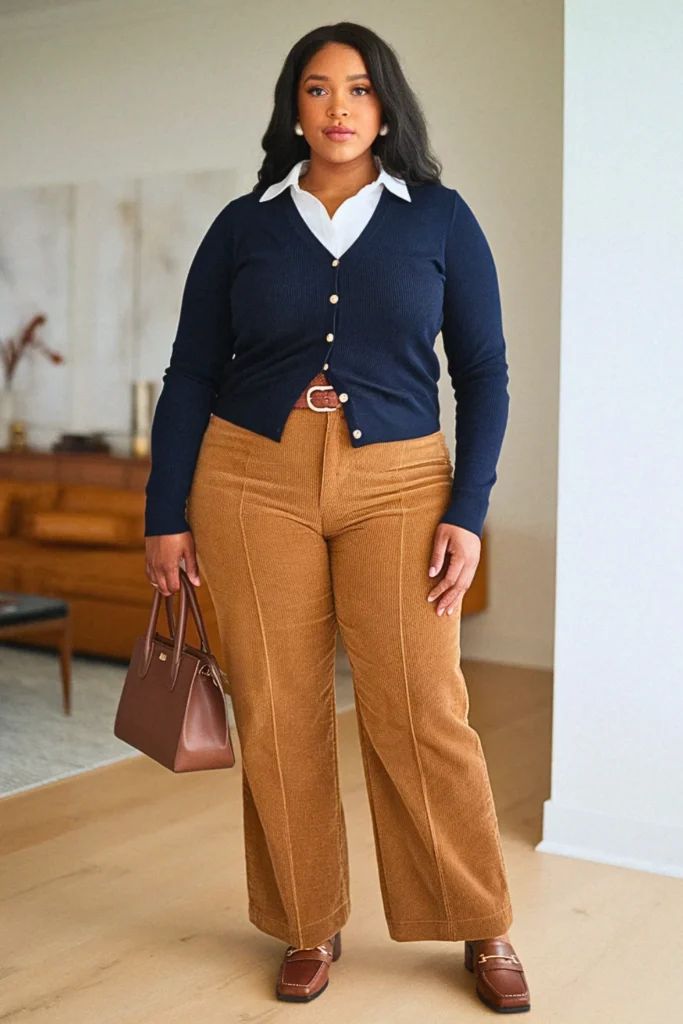
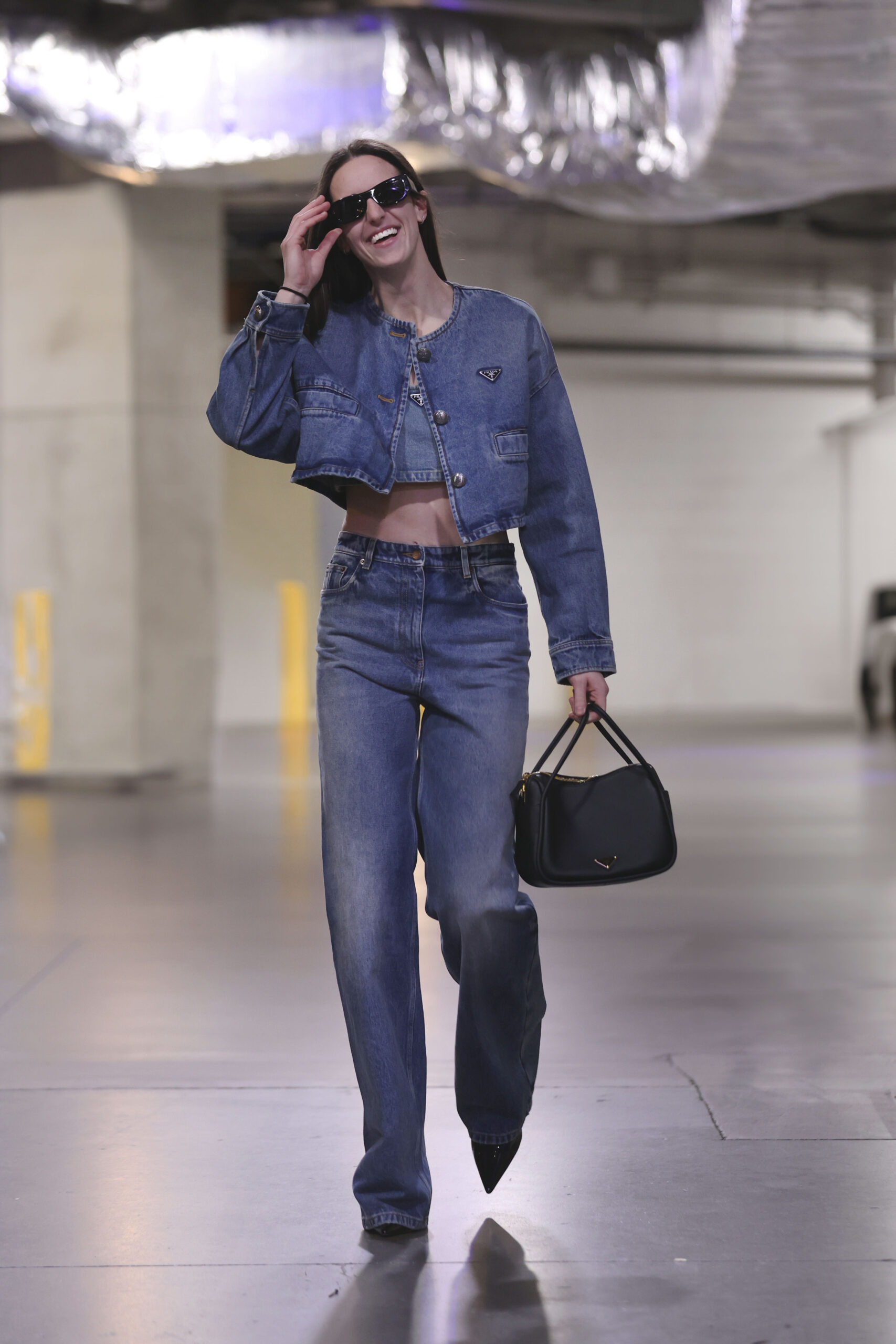
    Picture the corridor outside an Indiana Fever locker room, phones up, cameras clicking, and a tall point guard strolling through in a semi-sheer black suit with cropped trousers. No jersey yet, no sneakers laced for the game, just tailoring that reads “all business” before a single shot goes up. That walk – the WNBA tunnel – has quietly become one of the most-watched runways in sports, and Caitlin Clark has turned it into appointment viewing. One night she is in a Zac Posen-designed GapStudio trench, skort, and cropped shirt finished with granite-gray Prada slingbacks. Another she is in a brown pinstriped blazer over an oversized denim-effect button-down and matching jeans. The looks change. The formula underneath stays the same, and that formula is something any of us can borrow.

    Here is the part worth sitting with: the through-line in Clark’s style is not a designer label or a sample-size body. It is restraint, fit, and a handful of pieces that work hard. That is athleisure thinking dressed up, and it scales beautifully to a size 22 just as it does to a size 2. The blazer does not know your dress size. Neither does a clean white sneaker or a matching set in a color you love. So let’s pull her playbook apart and rebuild it for curvy and plus-size bodies, with real brands and real fits, because elevated comfort belongs to every one of us.

    Who She Is, and the Signature Underneath the Hype
    Who She Is, and the Signature Underneath the Hype

    Caitlin Clark plays point guard for the Indiana Fever in the WNBA and arrived in the league as one of the most hyped rookies in its history. A two-time All-Star, she became known first for logo-range three-pointers and second, almost as fast, for what she wore walking into the arena. In April 2024 she signed an eight-year Nike signature sneaker deal reported at roughly 28 million dollars, a figure that made headlines as one of the biggest of its kind for a women’s basketball player. Nike unveiled her signature logo and an apparel collection in 2025, and her first signature shoe, the Nike Caitlin 1, is set to launch on October 1, 2026, priced around 140 dollars for adult sizing in North America. The shoe carries her interlocking CC logo and a new upper Nike calls Opticast.

    Her fashion signature is easier to describe than to copy, which is exactly why it is worth studying. At the 2024 WNBA Draft she became the first player the league had ever seen dressed head to toe by Prada, in white satin and rhinestone mesh with black slingbacks. Since then her tunnel look has settled into something more wearable: minimalist, sporty, and elevated. Think tailored trousers, crisp white tops, beige trench coats, and the occasional sharp suit, with sneakers or a clean heel depending on the night. Nothing fussy. Nothing loud for the sake of it. The clothes are good, they fit, and they let her move. That last word – move – is the whole point of athleisure, and it is the bridge from her wardrobe to ours.

    The Elevated-Basics Formula
    The Elevated-Basics Formula

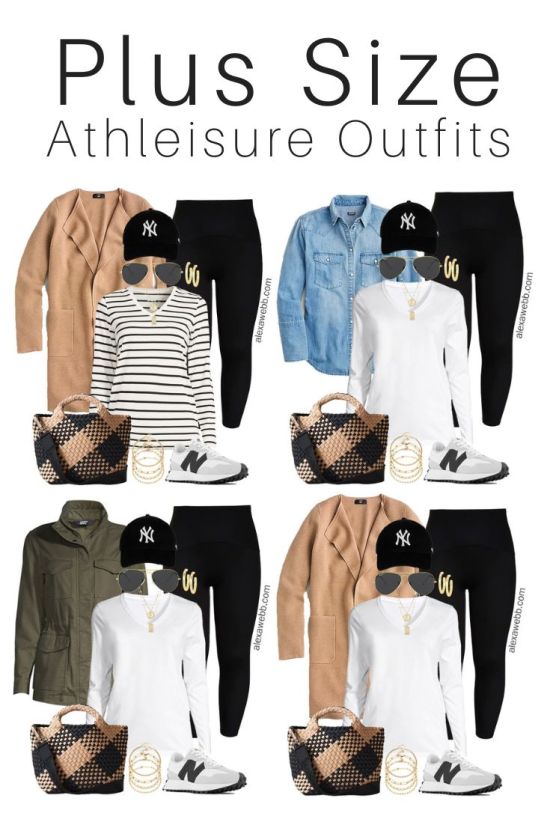
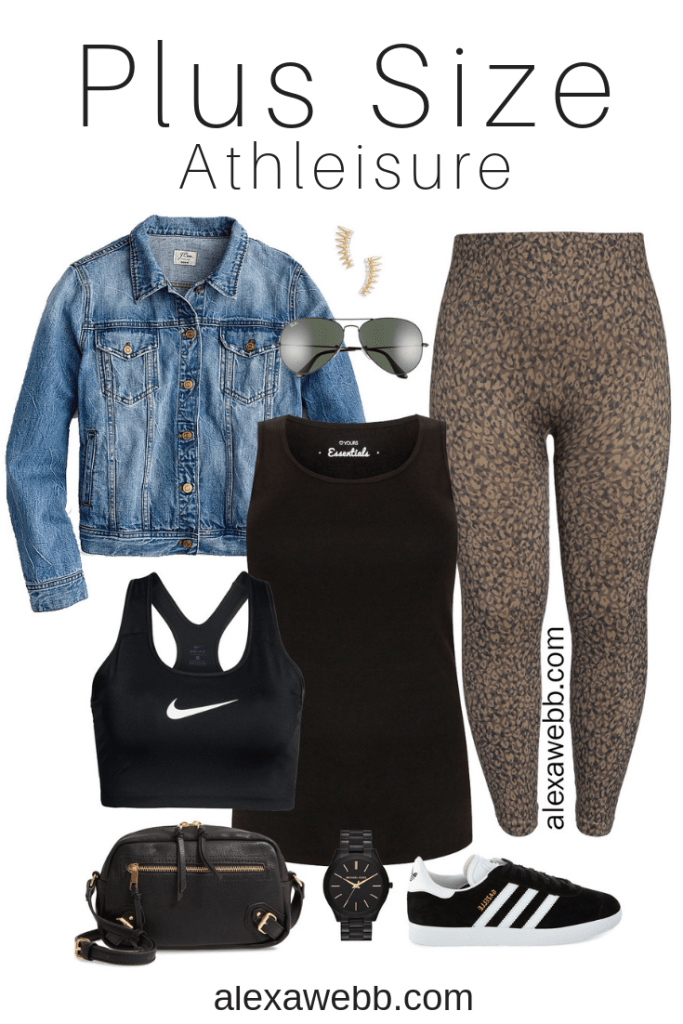
    Strip Clark’s look down to its bones and you get a short list: one structured piece, one soft piece, one clean shoe, and a fit that skims rather than swallows. That is the elevated-basics formula, and it is forgiving in the best way. The structured piece gives a look its spine – a blazer, a trench, a tailored trouser. The soft piece keeps it comfortable and human – a ribbed tank, a good legging, a relaxed tee. The clean shoe ties the room together. Get those three right and you can look pulled together in under five minutes.

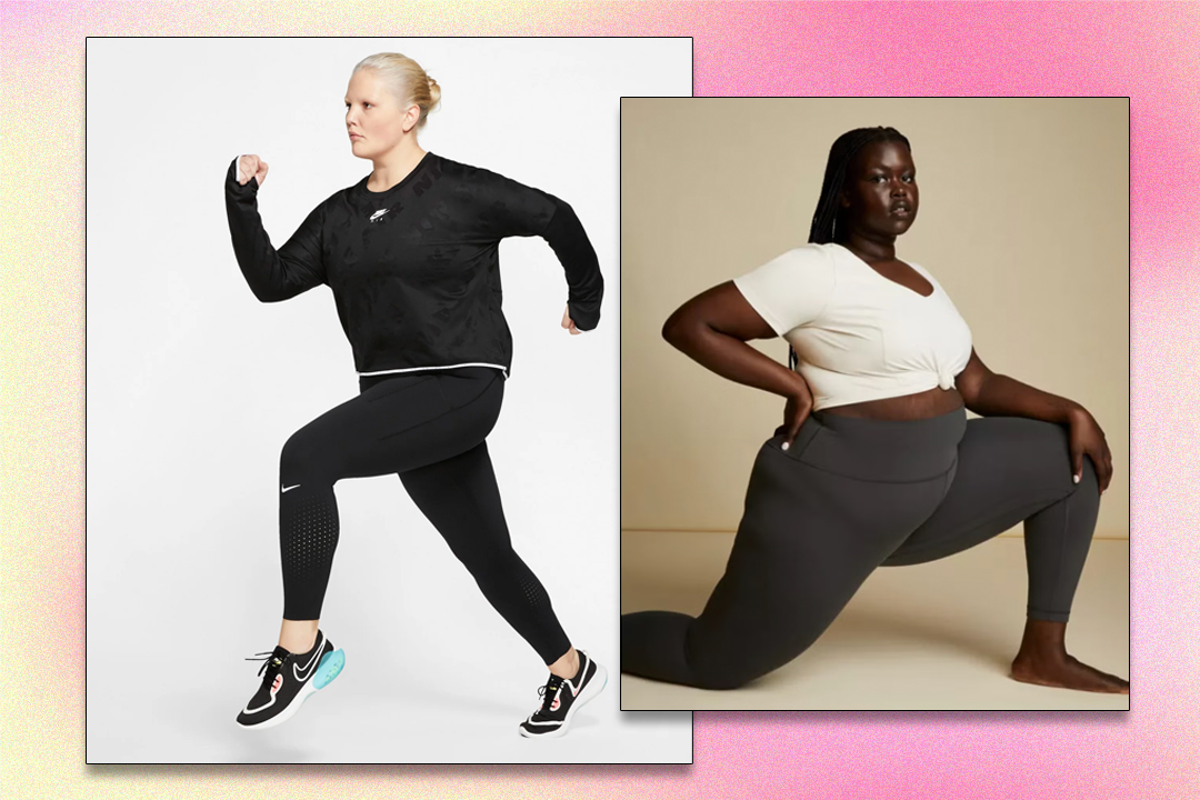
    For curvy and plus-size bodies, the formula needs one extra rule that thin frames can ignore: fabric has to hold its shape. Thin, clingy jersey reads cheap on every body, but on a fuller figure it also tends to grab and ride. Reach instead for compressive, structured knits with a touch of recovery, the kind that smooth without squeezing the breath out of you. A ponte legging holds a leg line better than a flimsy one. A ribbed tank in a heavier weight sits flat instead of rolling at the hem. Universal Standard, which runs sizes 00 to 40, built much of its reputation on exactly this idea, fabric engineered to drape rather than cling, and its athleisure pieces carry that same logic. The basics are only as good as the cloth they are cut from, so spend your attention there before you spend it on logos.

    Color does quiet work here too. Clark leans on a tight palette – black, white, brown, beige, the occasional denim blue – and that restraint is what makes cheap and expensive pieces read as one outfit. A neutral base lets you mix a 20-dollar tank with a heavier blazer and have the eye see a single intentional look rather than a pile of separates. Pick two or three colors you genuinely love against your skin, buy your basics in those, and watch how much easier getting dressed becomes.

    Matching Sets and the Monochrome Move
    Matching Sets and the Monochrome Move

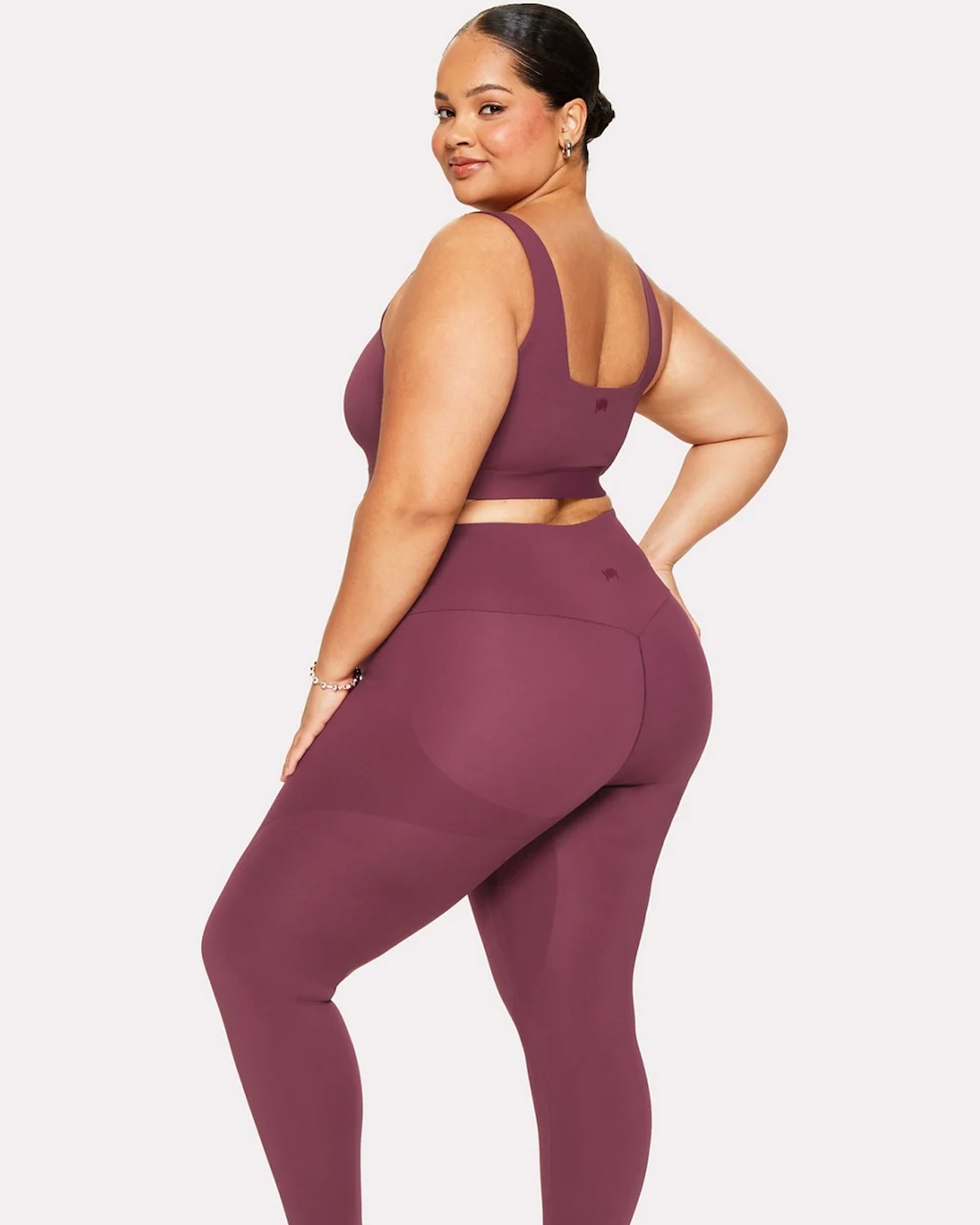
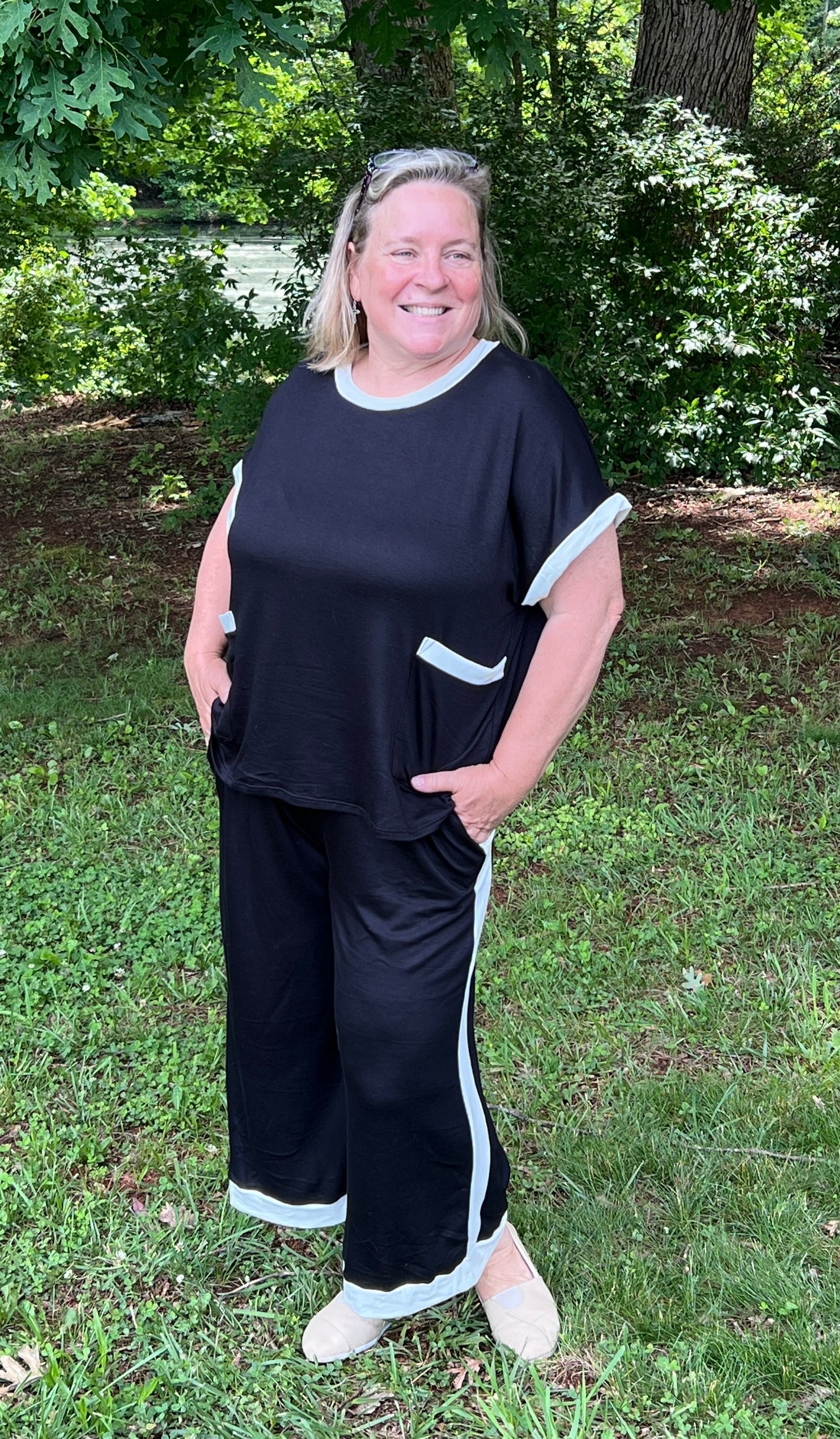
    If there is one trick that does the most work for the least effort, it is the matching set. A coordinated top and bottom in the same fabric and shade creates one long, uninterrupted line from shoulder to ankle, and a long line is endlessly flattering on a curvy frame because it gives the eye somewhere smooth to travel. This is the monochrome move, and it is everywhere in Clark’s elevated-casual rotation for good reason. Same color, top to bottom, instantly reads as deliberate.

    The plus-size sweet spot is a set in a mid-weight knit – a cropped or hip-length top with a high-rise legging or wide-leg pant in the identical tone. High-rise matters more on a fuller midsection than almost any other detail, because a waistband that sits at or above the navel stays put through movement and gives a smooth foundation for whatever goes on top. Girlfriend Collective, which offers sizing up to 6XL, has become a go-to for tonal sets in earthy, grown-up colors, and its compressive fabric is the structured kind that holds rather than clings. Old Navy Active is the budget-friendly counterpart, with extended sizing and frequent restocks of basic matching pieces in neutrals you can layer for years.

    Two small adjustments make a set feel styled rather than slept-in. First, vary the texture even when you keep the color – a ribbed top with a smooth-knit pant in the same shade gives subtle depth that a flat head-to-toe match misses. Second, break the monochrome with one hardware moment, a gold hoop, a structured bag, a watch. That single point of contrast is the difference between looking like you are running errands and looking like Clark walking a tunnel. The set does the heavy lifting. You just have to point the eye where you want it.

    The Blazer-Over-Athleisure Move, and Dressing It Up
    The Blazer-Over-Athleisure Move, and Dressing It Up

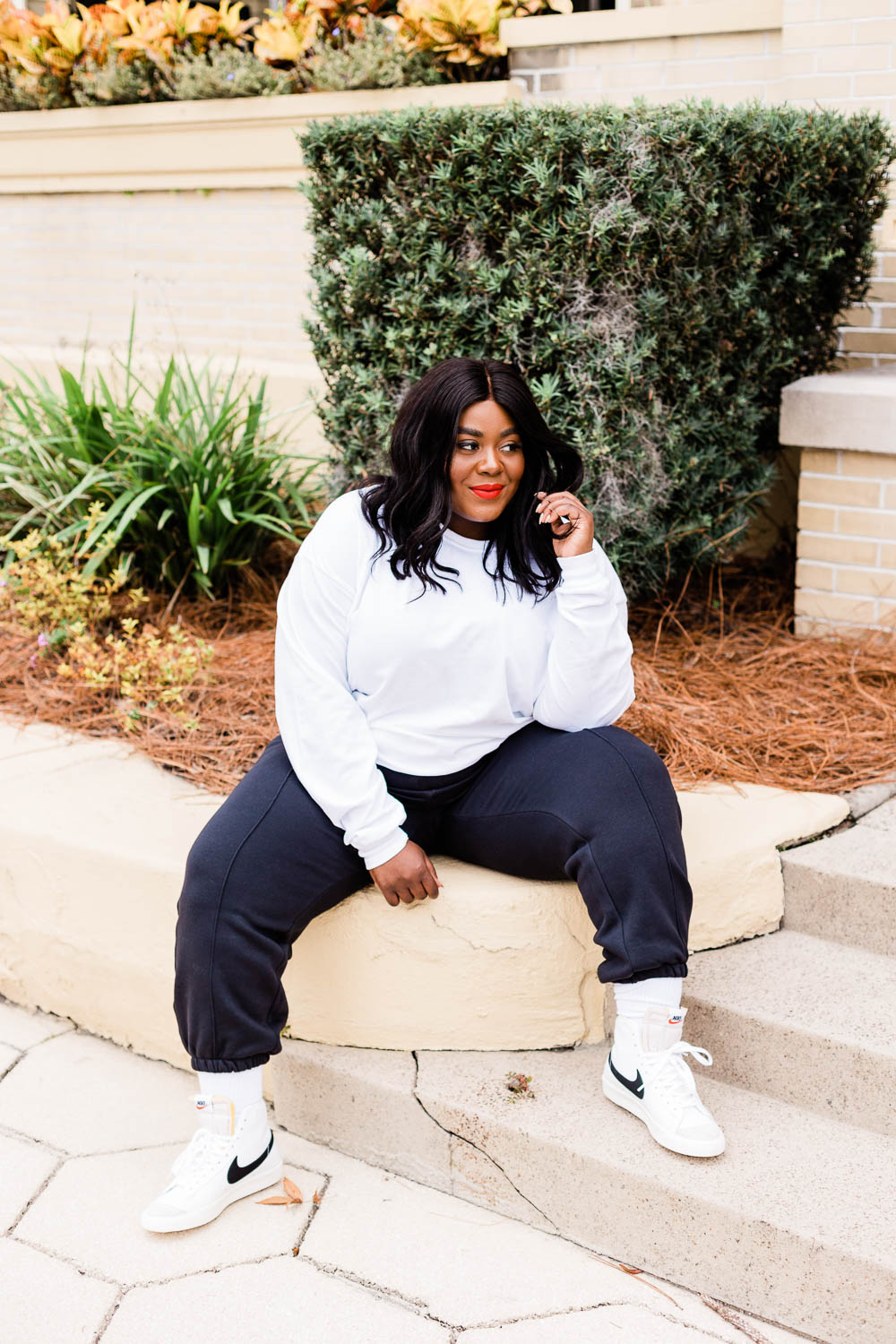
    This is the move that quietly defines Clark’s whole approach, and it is the most useful one to steal: put structure on top of softness. A blazer over a tank and legging set takes an outfit from the gym to a dinner reservation without a single uncomfortable garment in the mix. The blazer’s shoulder and lapel do the formal talking. The athleisure underneath keeps you breathing. Clark wears tailored jackets over relaxed pieces constantly, and the contrast – sharp over soft – is what makes the look feel intentional instead of lazy.

    For curvy and plus-size bodies, the blazer is where fit precision pays off most. Look for a jacket that closes comfortably across the bust without straining the button, or skip the closure entirely and wear it open, which elongates the torso and frames the body in two flattering vertical lines. A single-button or one-button stance hits at a more forgiving point than a high three-button. Length is personal, but a blazer that grazes mid-hip or just below tends to balance a fuller bottom half better than a cropped cut. Universal Standard and a growing number of mainstream brands now cut blazers in genuinely extended ranges, and a well-fitting jacket in black, camel, or pinstripe will outwork almost anything else in a wardrobe.

    Dressing the whole thing up is mostly about swapping two items. Trade the legging for a tailored trouser or a ponte pant with a pressed line, and trade the sneaker for a clean loafer, a slingback, or a low block heel. Keep the soft top underneath – that is the comfort secret nobody can see. Athleta, which carries plus sizing up to 3X and is built around movement, makes trousers and ponte pieces that pass for tailoring while moving like sweatpants, which is exactly the sleight of hand this look depends on. The blazer makes it serious. The hidden softness keeps it kind to your body through a long day.

    Sneakers, and the Art of Finishing

    A look lives or dies at the shoes, and Clark’s footwear choices are a study in matching the finish to the moment. For her own sport she has the Nike Caitlin 1 arriving in fall 2026, a signature performance shoe in bright racer blue with her CC logo, around 140 dollars. Off the court, though, the lesson is broader than any single sneaker: a clean, simple shoe finishes elevated athleisure better than a busy one. A low-profile white leather sneaker, the kind with minimal branding and a tidy sole, reads polished with a matching set or under a trench. It is the off-duty equivalent of a fresh white shirt.

    When the night calls for more, the finishing move is to swap, not to overhaul. Keep the set or the blazer-and-trouser base exactly as it is, and trade the sneaker for a heel or a sleek flat. A pointed slingback like the Prada style Clark favors lengthens the leg, and on a curvy frame that vertical lift balances proportion beautifully. If heels are not your comfort zone, a pointed loafer or a low block heel gives most of the same elongating effect with all of the stability. The garments can stay casual as long as the shoe makes the case for the occasion, which is why one good going-out shoe stretches a whole athleisure wardrobe so far.

    Accessories close the loop. Clark keeps hers spare – a watch, a fine chain, a structured bag – and that discipline is worth copying because too many competing pieces undo the clean line you worked to build. A single statement earring, a bag with a defined shape, sunglasses that suit your face. Pick one or two, not five. The finishing touches should whisper the last word, not shout over everything else you are wearing.

    Where to Shop Plus-Size Athleisure That Actually Holds Up

    The good news for curvy and plus-size shoppers is that the brands worth knowing are real, established, and easier to find than they were even a few years ago. Universal Standard is the anchor for inclusive fit, running sizes 00 to 40 with fabric engineered to smooth rather than cling, and its athleisure pieces share that structured-knit philosophy. Girlfriend Collective, sized up to 6XL, owns the tonal-set lane with compressive, sustainably made leggings and matching tops in grown-up colors. Athleta, built for movement and B-Corp certified, carries plus sizing up to 3X across leggings, trousers, and the ponte pieces that pass for tailoring.

    For range and price, a few names round out the kit. Nike’s dedicated plus-size line runs roughly 0X to 4X and is cut and tested specifically for curvier bodies rather than simply sized up from a straight-size pattern, which shows in how the leggings and sports bras sit through movement. Fabletics offers sizes from XXS to 4X with sports bras built across multiple cup and support levels, useful for fuller busts that standard compression bras flatten or fail. Beyond Yoga has long championed inclusive sizing with buttery, drapey fabrics that suit a softer, slower kind of athleisure. And Old Navy Active remains the value pick, with extended sizing and constant restocks of neutral basics you can buy in multiples without guilt.

    A practical way to spend: build the base in budget basics from Old Navy or a Nike plus staple, invest the real money in the structured hero pieces – the blazer, one excellent matching set, one ponte trouser – from Universal Standard, Girlfriend Collective, or Athleta, and let those anchors carry the cheaper layers. Sizing runs differently brand to brand, so order your usual size and one above when a fit chart looks unfamiliar, and judge a legging by whether it holds a squat without rolling at the waist. Comfort and structure are not opposites. The brands above prove it, and they prove it across the full range of bodies, not a narrow slice of them.

    A Look You Can Build This Weekend

    Open a drawer and start with what is already there. A high-rise legging that holds its shape, a ribbed tank in a color you reach for, a blazer that closes without strain or hangs open and easy, and the cleanest pair of white sneakers you own. Layer them in that order, neutral on neutral, structure over softness, and you are standing in Caitlin Clark’s elevated-basics formula without spending a dollar. Add a watch and a structured bag. Trade the sneaker for a slingback when the evening asks for it. Tonight that outfit walks you into a dinner; tomorrow the same pieces, relaced and unbuttoned, carry you through errands and a coffee that runs long. The tunnel walk was never about the labels. It was about a body moving comfortably through a room, dressed with intention, and that walk is yours to take at any size you happen to be.
  • The Gilmore Girls Style Guide – How to Dress Like Lorelai and Rory in 2026

    The Gilmore Girls Style Guide – How to Dress Like Lorelai and Rory in 2026

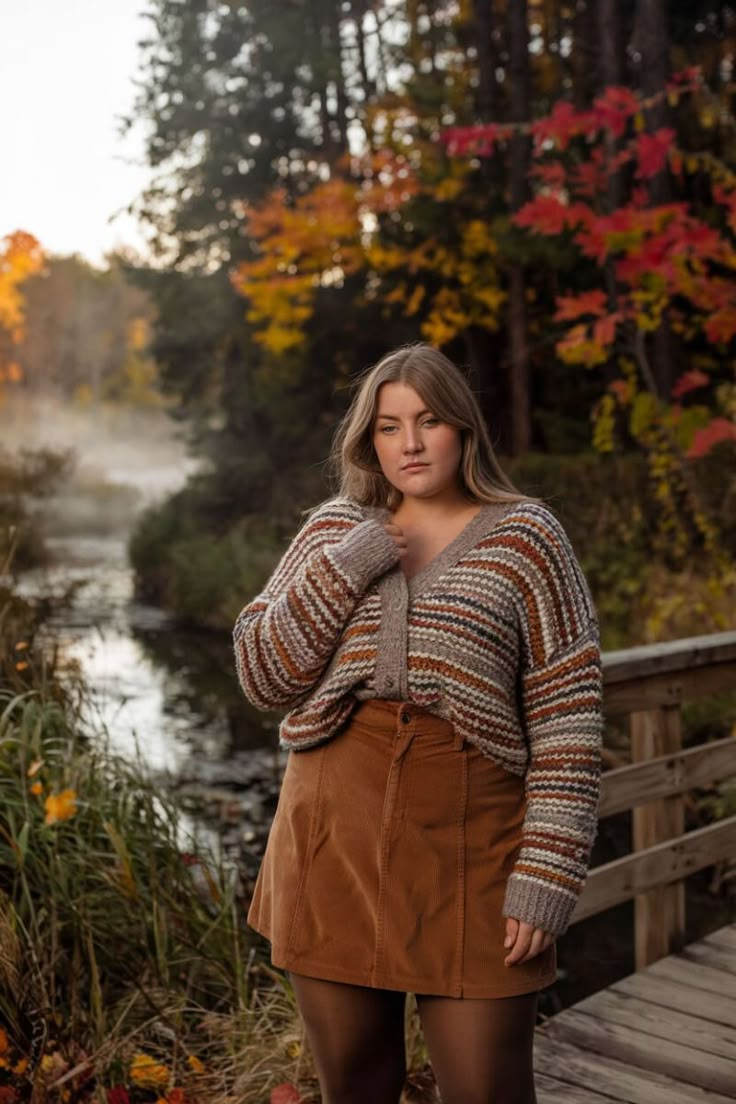
    Picture a Connecticut town square just after the first real cold snap, the gazebo strung with fairy lights, a paper cup of diner coffee warming your hands, leaves the color of cinnamon and rust scuffing across the cobblestones. That is the feeling so many of us chase every autumn, and it has a name now: Stars Hollow fall. The fictional New England town at the heart of the long-running mother-and-daughter dramedy keeps pulling new viewers back to streaming each September, and with every fresh wave of fans comes a fresh hunger to dress the part. The good news for curvy women is that this particular aesthetic was never about a body type. It is about texture, layering, coziness, and a little bit of personality, and all of that translates beautifully to a fuller figure when you know which pieces to reach for.

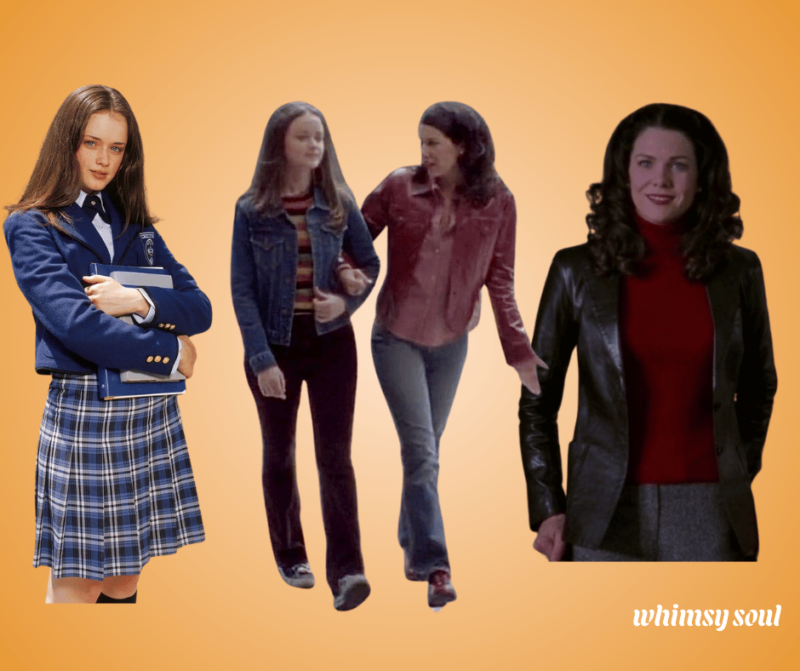
    The show first aired in the fall of 2000 and followed Lorelai Gilmore and her daughter Rory, a pair so close they finished each other’s pop-culture references. Their wardrobes told you almost everything about them before they opened their mouths. Lorelai was the bold one, all clashing prints and graphic tees and color worn without apology. Rory leaned preppy and bookish, layering soft sweaters and pleated skirts like a permanent first day of school. Two very different style stories, one shared closet of New England warmth. Here is how to borrow from both, in sizes that actually fit.

    What “Stars Hollow Fall” Actually Means for Your Closet

    Before the shopping starts, it helps to name what we are really after, because the aesthetic is more about mood than any single garment. Stars Hollow style is layered, lived-in, and a little eclectic. It is a cable-knit sweater you could imagine wearing to a town meeting, a trench thrown over jeans for a coffee run, a scarf wound twice around the neck because the air finally bit back. Nothing looks brand new or fussed over. Everything looks like it has a story.

    That matters for curvy dressing because the temptation with autumn layering is to pile on volume until the silhouette disappears. The Gilmore approach is the opposite. Each layer is intentional, and there is almost always a defined waist, a structured shoulder, or a deliberate proportion holding the look together. Think of the cozy pieces as the comfort and the structured pieces as the frame. When you balance the two, you get warmth without bulk, which is exactly the sweet spot for a fuller figure heading into the colder months.

    The color story is autumnal but not restrictive. Camel, oatmeal, forest green, burgundy, navy, charcoal, and plenty of plaid. Lorelai pushes brighter and bolder, Rory stays softer and more muted, and you can land anywhere along that spectrum depending on the day and your mood.

    Channeling Lorelai – Bold Prints and Edgy-Feminine Layering

    Channeling Lorelai - Bold Prints and Edgy-Feminine Layering

    Lorelai never met a print she could not commit to. Her wardrobe ran on color, pattern, and a slightly rock-and-roll edge that kept her from ever reading too sweet. To borrow her energy, you want pieces with personality, and you want to wear them like you are not asking permission.

    Start with a statement knit. A bold Fair Isle sweater, a sweater with an unexpected color block, or a chunky cardigan in a rich jewel tone all capture her refusal to fade into the background. Torrid is a reliable place to begin here because its knitwear is cut with curves in mind, so a chunky cable does not swallow you whole. For something a little sleeker, Eloquii leans trend-forward and often carries the kind of statement sweater that does the heavy lifting for an entire outfit. Pair either with a straight-leg or slim bootcut jean and you have already nailed the foundation.

    Then add the edge. Lorelai loved a leather or moto jacket thrown over something feminine, and that contrast is the whole point. A faux-leather moto from Lane Bryant or ASOS Curve over a floral midi dress or a graphic tee gives you the tough-meets-pretty tension she wore so well. Lane Bryant in particular has spent years perfecting outerwear that actually fits across the shoulders and bust, which is usually where curvy women get let down by jackets cut for a straight frame.

    Do not be afraid of prints layered on prints, because that was peak Lorelai. A plaid blazer over a striped tee, an animal-print scarf with a polka-dot blouse, a patterned cardigan over a solid slip dress. The trick that keeps it from tipping into chaos is anchoring the chaos with one solid, structured piece, usually the bottom half or the outermost layer. Universal Standard is your friend for those anchoring basics, since its tailored pants and clean column dresses run an unusually wide size range and give your busier pieces something calm to sit against.

    For shoes, Lorelai often went a touch more grown-up than Rory, reaching for a heeled boot or a pointed flat. A sturdy ankle boot with a block heel keeps you comfortable on cobblestones, real or imagined, and elongates the leg under a midi hem. Finish with a small structured bag rather than a slouchy tote, because that one modern detail is what pulls a Y2K-leaning look firmly into 2026.

    Channeling Rory – Preppy Schoolgirl Layers Done Cozy

    Channeling Rory - Preppy Schoolgirl Layers Done Cozy

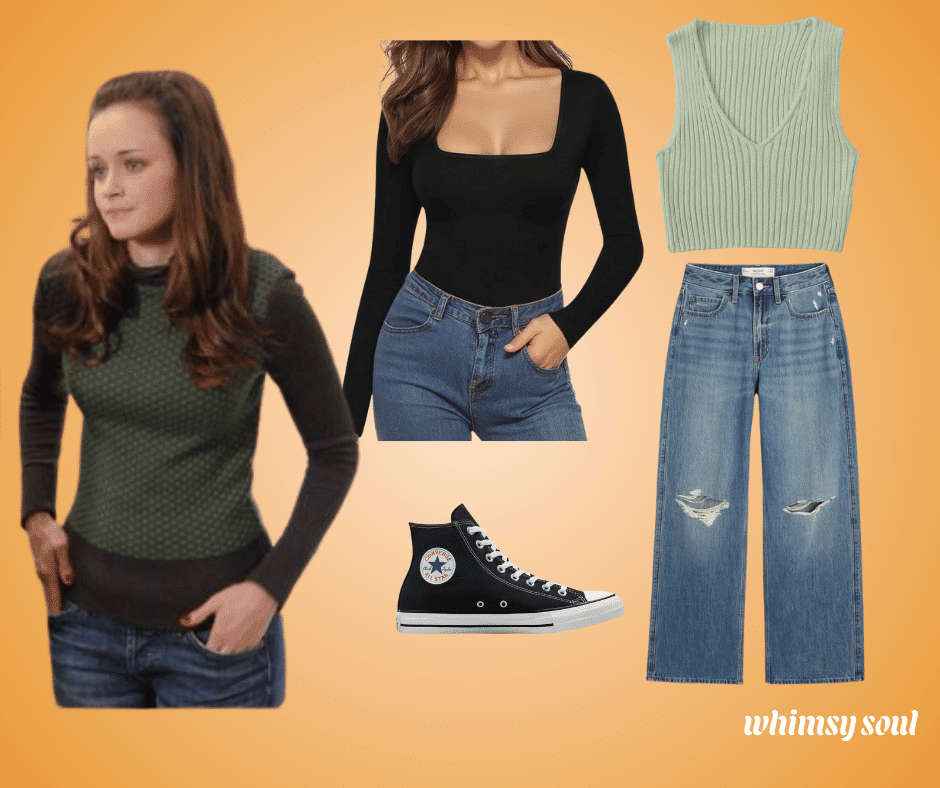
    Rory’s style was the quieter sister, but quiet does not mean boring. Hers was the look of someone who reads paperbacks at the diner counter and means it: soft sweaters, pleated skirts, button-downs, blazers, and a near-endless rotation of cardigans. It tipped gently toward what people now call dark academia, all tweed and tights and library-light layering, without ever feeling like a costume.

    The cornerstone of a Rory look is the layered top half. Start with a crisp button-down, then add a fine-gauge sweater or a cardigan over it, letting the collar peek out. That single move, a collar emerging from a knit, is the most reliably preppy thing you can do, and it works on every body. Madewell‘s plus-size range carries beautifully cut button-downs and elevated basics that hold their shape across the bust, so the collar lies flat instead of gaping, which is the small detail that makes or breaks the look.

    For the cardigan itself, you have options up and down the price spectrum. Old Navy keeps a steady stream of affordable cropped and waist-length cardigans in its extended sizes, which is ideal because Rory’s cardigans usually hit at or just below the natural waist rather than swallowing the hips. A waist-length knit is genuinely flattering on a curvy frame, defining the smallest part of the torso instead of erasing it. For a richer, more textured version, Anthropologie‘s plus assortment leans into the cozy academic feel with cable knits, marled wool, and the occasional unexpected button.

    Below the waist, Rory loved a pleated skirt over tights, and this is one of the most curve-friendly silhouettes in the whole guide. A pleated A-line skims the hips, the pleats add gentle movement, and opaque tights in burgundy, forest, or charcoal pull the whole thing into fall. Eloquii and Torrid both cut pleated and A-line skirts that sit at the natural waist and fall cleanly, which is what you want. If a skirt is not your speed, the look translates straight to a pair of dark, slightly cropped trousers with the same layered top half.

    For outerwear, Rory reached for structured layers more than statement ones. A classic trench, a wool peacoat, or a sherpa-lined denim jacket all live firmly in her world. A peacoat in navy or camel is one of the best investments a curvy wardrobe can make, because the double-breasted front and defined waist seam do real work for the silhouette. Universal Standard and Lane Bryant both carry coats engineered for fuller busts, with darting and button placement that closes properly instead of straining. Finish Rory style with ballet flats or low canvas sneakers, a leather satchel, and a thin headband, and you are ready for a town meeting or a college lecture, whichever Stars Hollow throws at you.

    The Pieces That Do the Heavy Lifting

    The Pieces That Do the Heavy Lifting

    If you strip both characters down to their essentials, a handful of garments keep reappearing, and those are the ones worth your investment. Build around these and the rest falls into place.

    The chunky knit is non-negotiable. One genuinely good cable-knit or Fair Isle sweater, in a color you love, will carry an entire season of outfits. Look for a knit that is substantial but not stiff, with ribbing at the cuff and hem to give it shape, because shapeless chunky knits are where curvy figures get lost. The plaid layer comes next, whether that is a plaid flannel shirt worn open like a jacket, a plaid blazer, or a plaid scarf, since nothing says New England autumn faster than a good check pattern. Then the coat, your trench or peacoat, the single most photographed item in any Stars Hollow look and the piece that ties a whole outfit together the moment you step outside.

    Underneath it all, you want reliable basics that layer without bulk: a few fitted long-sleeve tees and turtlenecks, a crisp button-down, and a pair of opaque tights. These are the unsung heroes, the pieces that let everything else sit correctly. Universal Standard and Madewell plus both excel at exactly this kind of foundational layer, the smooth, fitted base that keeps a four-layer outfit from looking like four layers. And do not skip the accessories, because a wound scarf, a structured bag, and a pair of practical-but-pretty boots are what separate a costume from a wardrobe you will actually wear.

    Making It Yours Across Sizes and Real Life

    Making It Yours Across Sizes and Real Life

    The single most freeing thing about this aesthetic is that it was built on comfort. Lorelai and Rory were written as women who ate, who ran late, who lived in their clothes, and that ethos is a gift for anyone who has ever felt squeezed by trend dressing. You do not need to be cold or constricted to look the part. You need warmth, texture, and a point of view.

    Fit is where the whole thing lives or dies, so let proportion guide you rather than rules about what curvy women supposedly cannot wear. A defined waist almost always reads as Gilmore, whether you create it with a belted coat, a waist-length cardigan, a tucked sweater, or a skirt that sits at your natural middle. Length is your other lever, since a midi skirt, a knee-length coat, and a cropped knit play differently on every body, and the only way to know your best proportions is to try the silhouette and trust the mirror over the size chart.

    Mix the two sisters freely, because almost nobody is pure Lorelai or pure Rory. Most of us want Rory’s cozy cardigan with Lorelai’s bold scarf, or Lorelai’s moto jacket softened by Rory’s pleated skirt. That blend is where personal style actually lives, and it is also where the look stops feeling like cosplay and starts feeling like you. The brands worth bookmarking for the long haul span the whole budget range, from Old Navy and ASOS Curve for affordable trend pieces, to Torrid and Eloquii for curve-cut statement items, to Universal Standard, Madewell plus, Anthropologie, and Lane Bryant for the structured investment layers that anchor everything.

    Build it slowly. One great coat this month, a chunky knit the next, a pleated skirt when you spot the right one. Stars Hollow style was never about a single shopping spree, and it photographs best when it looks gathered over time rather than bought in a single click.

    Your Town Square Is Wherever You Pour the Coffee

    Your Town Square Is Wherever You Pour the Coffee

    There is no gazebo in your neighborhood, probably, and the diner down the street does not have a surly owner in a backwards cap. None of that matters. The whole appeal of dressing like Lorelai and Rory is that the look meets you in your actual life: the school drop-off, the grocery run, the coffee you carry to your car with both hands because it is finally cold enough to need them. A camel peacoat over a burgundy cable knit reads exactly as warm and exactly as put-together in a real parking lot as it does on a backlot in Burbank. The clothes do the same job either way, which is to make a chilly ordinary morning feel like a scene worth being in. Put on the knit, wind the scarf twice, pour the coffee, and the autumn you have been watching on your screen is already on your shoulders.

  • How to Style a Sports Jersey as a Curvy Woman – Game Day Looks That Go Beyond the Bleachers

    How to Style a Sports Jersey as a Curvy Woman – Game Day Looks That Go Beyond the Bleachers

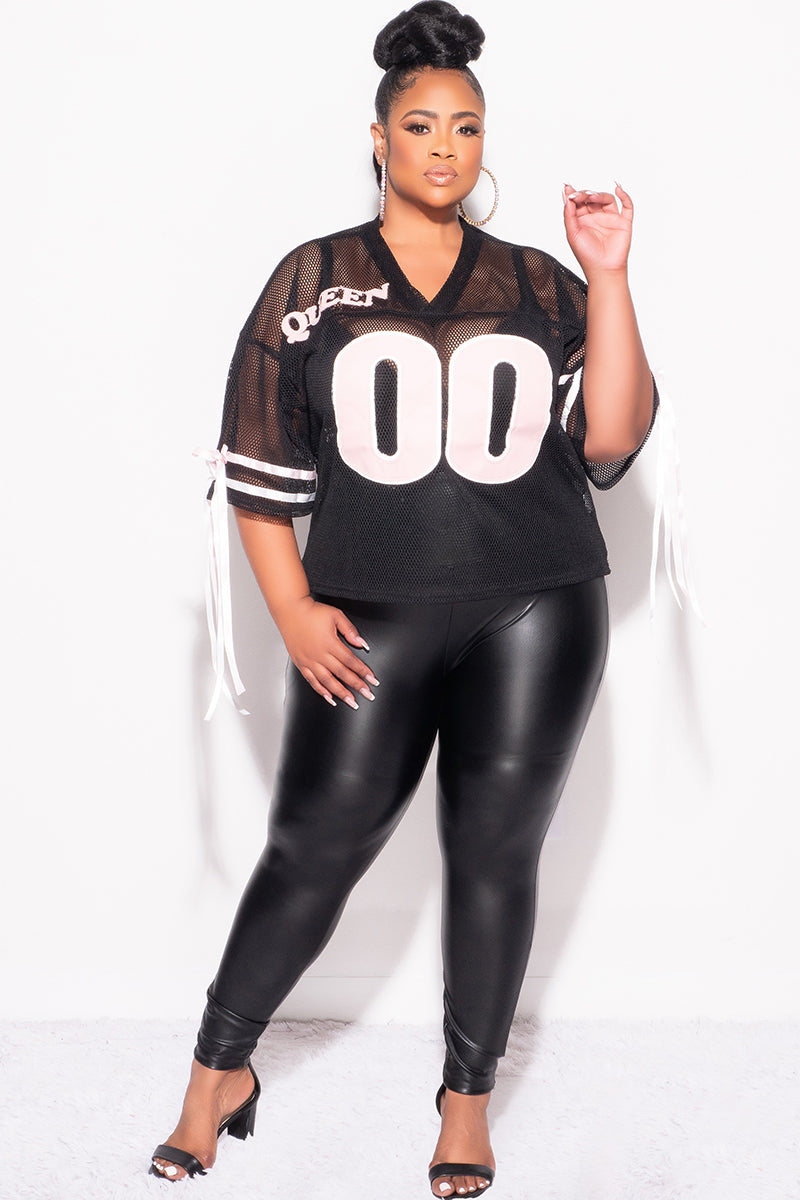
    Few pieces in a closet pull double duty quite like a sports jersey. One minute it is the most comfortable thing you own, the next it is the centerpiece of an outfit that turns heads on the way to brunch. The trick that nobody tells you is that a jersey was never meant to be a baggy afterthought thrown on over leggings on a Sunday. Worn with a little intention, that mesh top becomes a styling tool that flatters curves, shows off personality, and reads as fashion rather than fan gear. The catch for fuller-figured women has always been fit, because most jerseys are cut for a flat, straight frame and stop being fun the second the hem rides up over your hips or the armholes gape at your bust. Solve the fit, and everything else falls into place.

    This is a love letter to the jersey, and a practical map for wearing one when you have curves to dress around rather than hide. Whether you are heading to a stadium, a watch party, or a night out where the only sport involved is dancing, the same garment can carry you through all of it.

    Getting the Jersey Fit Right at Your Size

    The single biggest decision happens before you ever think about shoes or accessories, and it comes down to oversized versus fitted. Both can look incredible on a curvy body, but they do completely different things. An oversized jersey skims over the midsection and creates a relaxed, streetwear silhouette, which is brilliant when you want comfort and an effortless vibe. A more fitted jersey, often a women’s cut, hugs the waist and shows off an hourglass shape, which reads dressier and more deliberate. Neither is more correct than the other. The mistake is wearing an oversized jersey by accident because the fitted version was not available in your size, then feeling swallowed up by fabric.
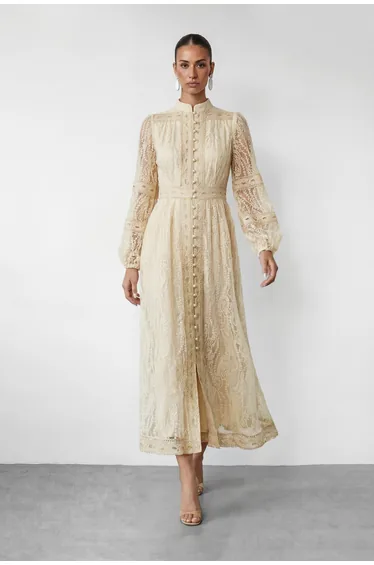
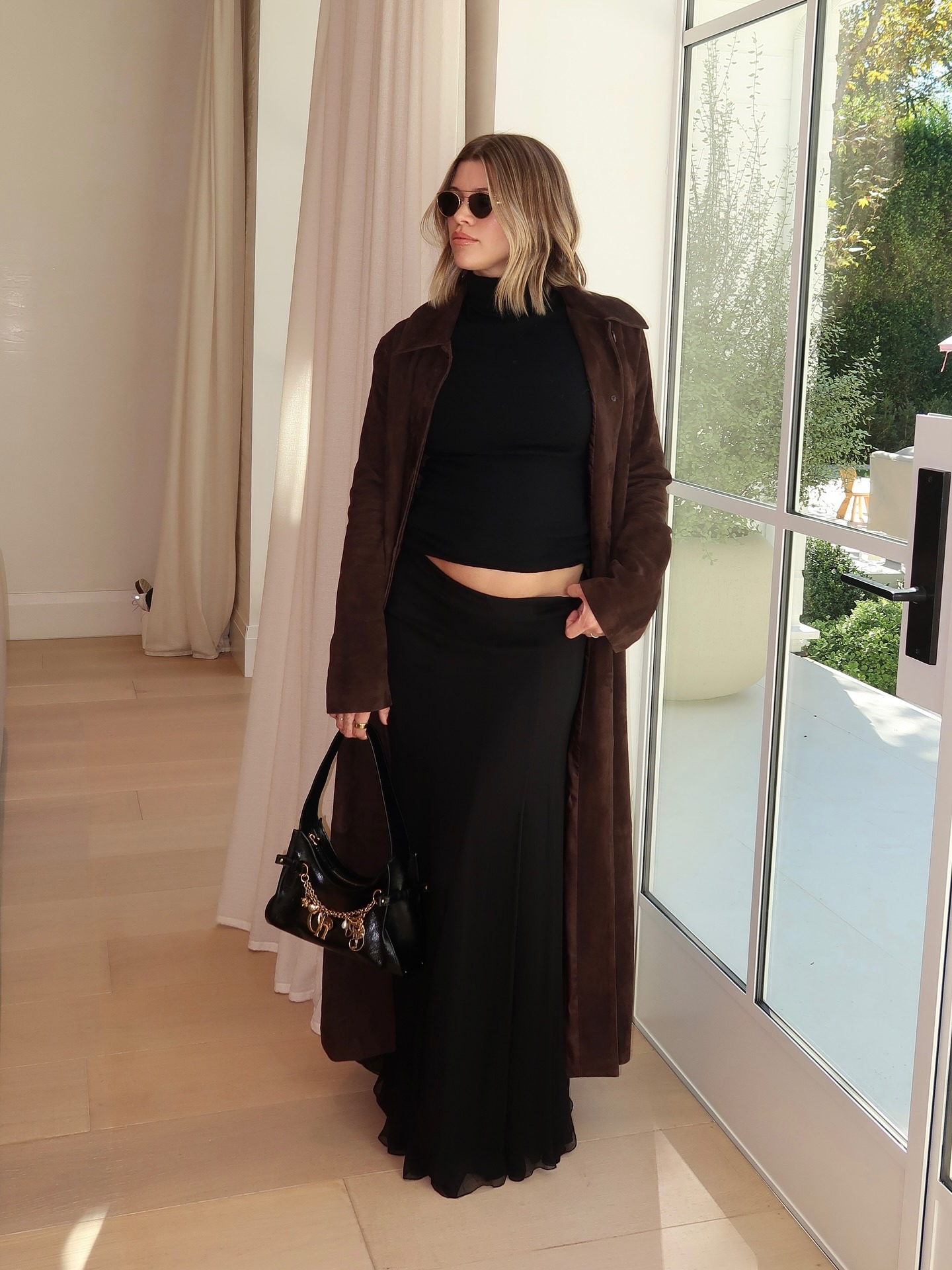
    Sizing is where a little homework pays off. Traditional jerseys sold in men’s or unisex cuts run boxy and short in the body, which means the hem can hit at an awkward spot on the hip and the chest can pull tight while the waist balloons. Women’s plus jerseys, by contrast, are increasingly cut with a longer torso and a touch more room through the bust and hip. Fanatics now carries officially licensed women’s plus jerseys in roughly 1X through 4X across the NFL, NBA, and other leagues, and Nike offers women’s plus styling in about 1X through 3X. Specialty retailers like Women’s Plus Size Sports stock licensed jerseys, tees, and hoodies in 1X to 4X for women who want a true women’s fit rather than a scaled-up men’s tee.

    A few fit habits make the difference. If you are between a fitted and an oversized look, size up one from your usual jersey size for the relaxed drape, or stay true to size for a women’s cut that nips in. Check the shoulder seam, because on a flattering jersey it should sit close to where your actual shoulder ends rather than halfway down your arm. Watch the armhole depth too, since deep cut sleeves on a tank-style basketball jersey can expose more side body than you want, easily fixed by layering a fitted tee or bodysuit underneath. And remember that mesh is unforgiving about what shows through, so the right base layer is doing real work, not just adding warmth.

    Length is the other quiet variable that decides whether a jersey works for your shape. A football-style jersey tends to run longer through the body, which makes it ideal for the dress-and-belt looks coming up, while a basketball tank typically hits higher and pairs better with a high-rise bottom. When you are shopping online and cannot try anything on, the size chart is your best friend, because women’s plus jerseys usually publish bust, waist, and hip measurements rather than a vague S-M-L-XL guess. Measure yourself once, write the numbers down, and match them against the chart instead of trusting the label, since a 2X at one brand can fit like a 1X at another. If the bust measurement is the part of you that needs the most room, size to that and let a tailor take in the waist later for pennies, which is the single most underused trick for getting a jersey to look custom on a curvy frame.

    The Going-Out Formulas That Change Everything

    The Going-Out Formulas That Change Everything

    Here is where the jersey stops being loungewear and starts being an outfit. The formulas below take roughly five minutes each and rely on pieces most curvy women already own.

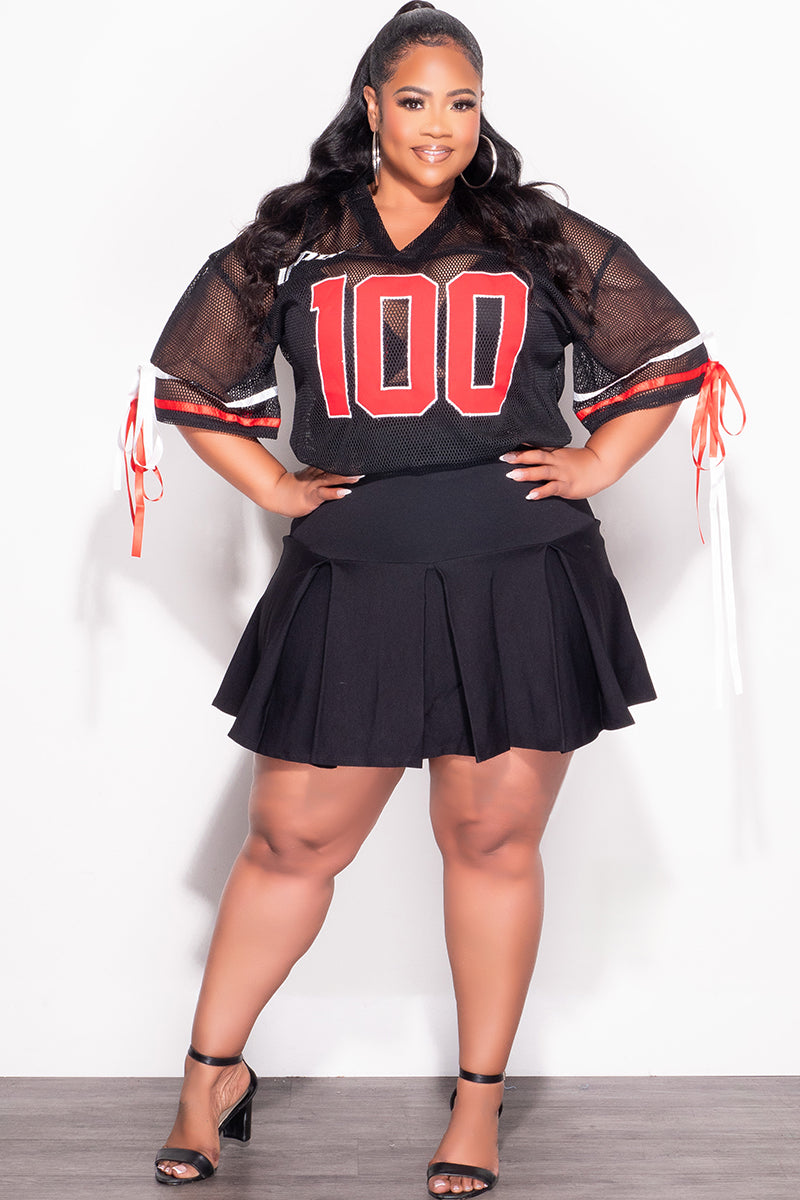
    The jersey plus slip skirt is the quiet showstopper. Take an oversized basketball or football jersey, half-tuck the front into a satin or bias-cut slip skirt, and let the contrast do the talking. Sporty mesh against liquid-shine fabric is a study in opposites that looks expensive and intentional. A midi-length slip skirt elongates the leg and skims over the hip and thigh, which is exactly what you want, and the half-tuck defines a waist without squeezing it. Finish with a heeled mule or a pointed boot and the look goes straight from casual to dinner. Slip skirts in curve-friendly lengths run roughly 30 to 60 dollars at Fashion Nova Curve, ASOS Curve, and similar retailers.

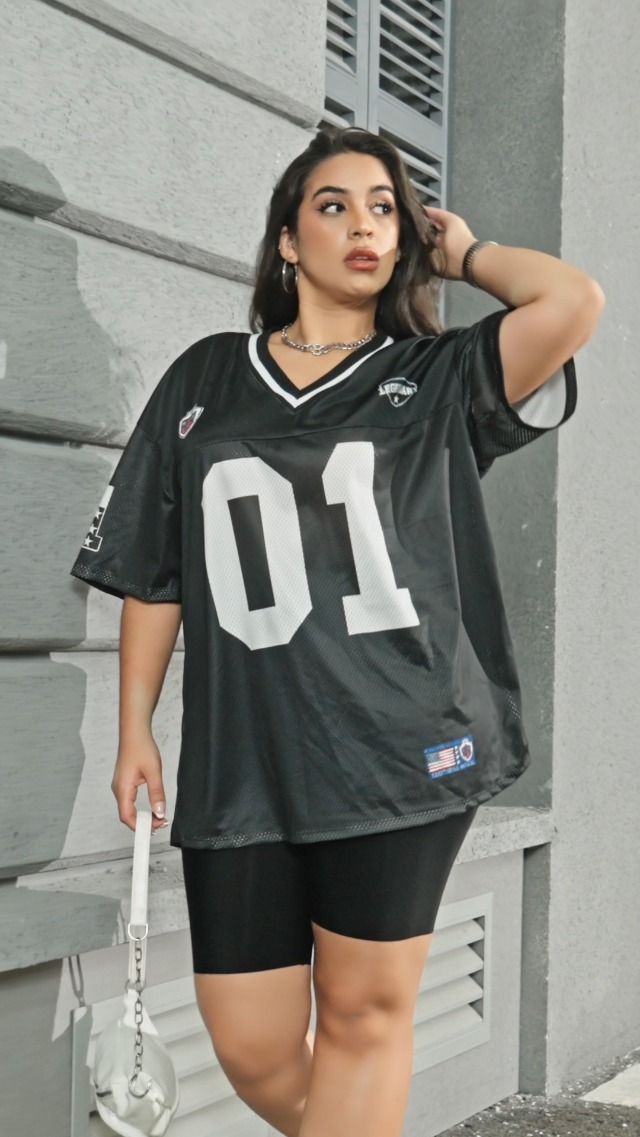
    The jersey as a dress is the trend everyone is leaning into right now, and it was practically invented for curvy frames. A genuinely oversized jersey, especially a longline football style, can be worn as a mini dress with nothing but a pair of bike shorts or seamless shorts underneath for coverage. Cinch a belt at the natural waist to turn that straight tube of fabric into an hourglass, or leave it loose and belt-free for a relaxed off-duty model look. The jersey dress trend has exploded enough that retailers now sell purpose-built basketball jersey dresses with the longer length baked in, available through Fashion Nova Curve and across Amazon in plus sizing, usually in the 25 to 50 dollar range. If you are going the DIY route with an actual jersey, look for one long enough to clear mid-thigh when you raise your arms, because the bleacher-seat test matters.

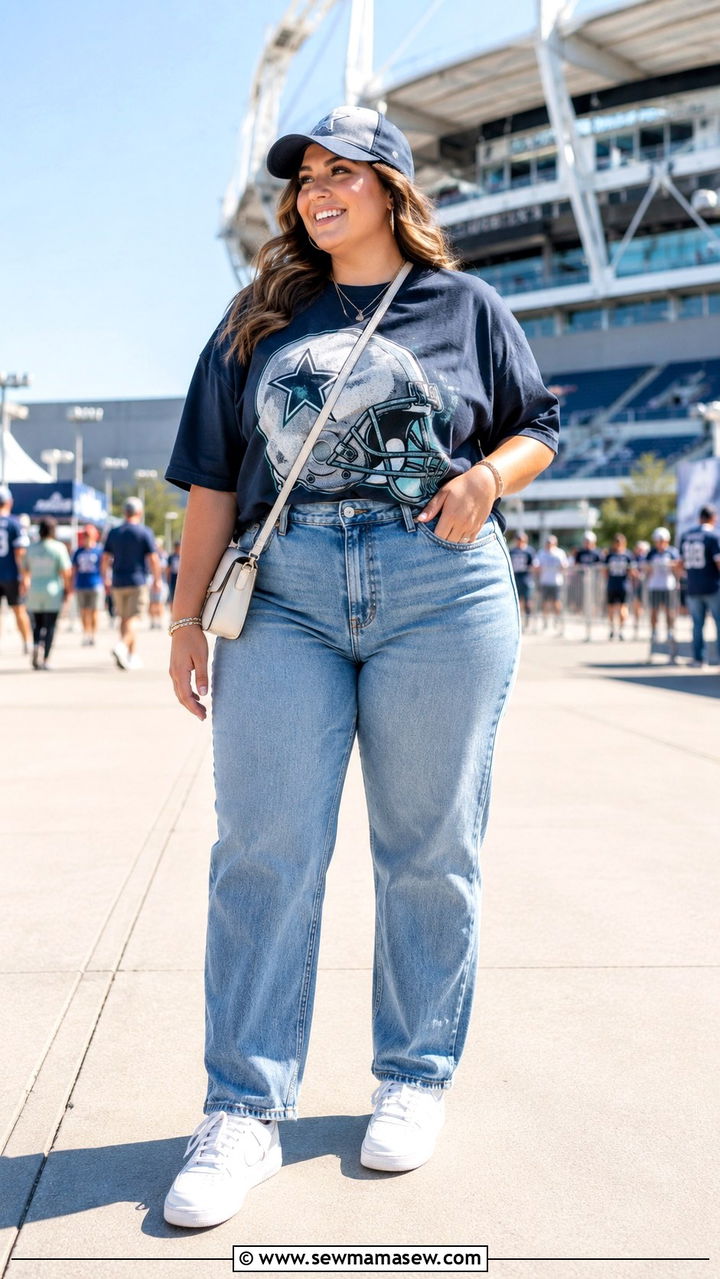
    The knotted jersey plus jeans is the formula for anyone who finds a full tuck fussy. Pull on your favorite high-rise curve jeans, then take the excess hem of an oversized jersey and tie a loose knot at one hip or dead center at the front. The knot creates a defined point at the smallest part of your waist and lets the rest of the fabric fall away over the hips, which is endlessly flattering. Straight-leg or wide-leg jeans balance the volume up top, while a bootcut keeps things classic. This one walks the line between game day and going out so well that you can wear it to the stadium and then to drinks without changing a thing.

    The jersey plus bike shorts deserves its own mention because it is the easiest entry point of all. An oversized jersey over coordinating bike shorts is comfort dressing at its sharpest, and when the shorts peek out just below the hem, the proportions read as deliberate athleisure rather than accidental. Add a structured tote and clean white sneakers and you have an outfit that works for errands, a casual watch party, or a low-key date.

    There is one more formula worth keeping in your back pocket, and it is the jersey plus tailored trousers. Pairing something sporty with something sharp is one of the oldest tricks in fashion for a reason, because the tension between the two registers as intentional styling rather than a single-mood outfit. A half-tucked jersey over wide-leg trousers, whether in a neutral or a bold color that echoes the team, takes the look somewhere a little more grown and a little more office-adjacent without losing the fun. Slide your feet into a loafer or a low heel and you have an outfit that could go to a creative workplace, a gallery opening, or a daytime event where you still want the comfort of a jersey but the polish of real pants. For a curvy frame, the high-rise trouser hits at the natural waist and lengthens the leg, while the relaxed jersey on top balances the proportions beautifully.

    Game Day Comfort Looks That Still Look Good

    Game Day Comfort Looks That Still Look Good

    Sometimes the assignment really is sitting in a stadium for three hours, and comfort has to win without surrendering style entirely. The good news is that the relaxed formulas above translate beautifully to a full day on the bleachers.

    Lead with the jersey plus leggings or bike shorts foundation, because you want full range of motion to jump up when your team scores. Opt for a thicker, supportive legging in black or your team color, and choose a jersey with enough length to cover the hip and seat comfortably when you sit. Layering is your friend in a stadium, where the temperature swings from blazing sun to evening chill. A cropped denim or utility jacket thrown over an oversized jersey adds structure to the silhouette and a layer you can tie around your waist later. A long-sleeve fitted top under a sleeveless basketball jersey works the same magic, adding warmth and turning a tank into a complete outfit.

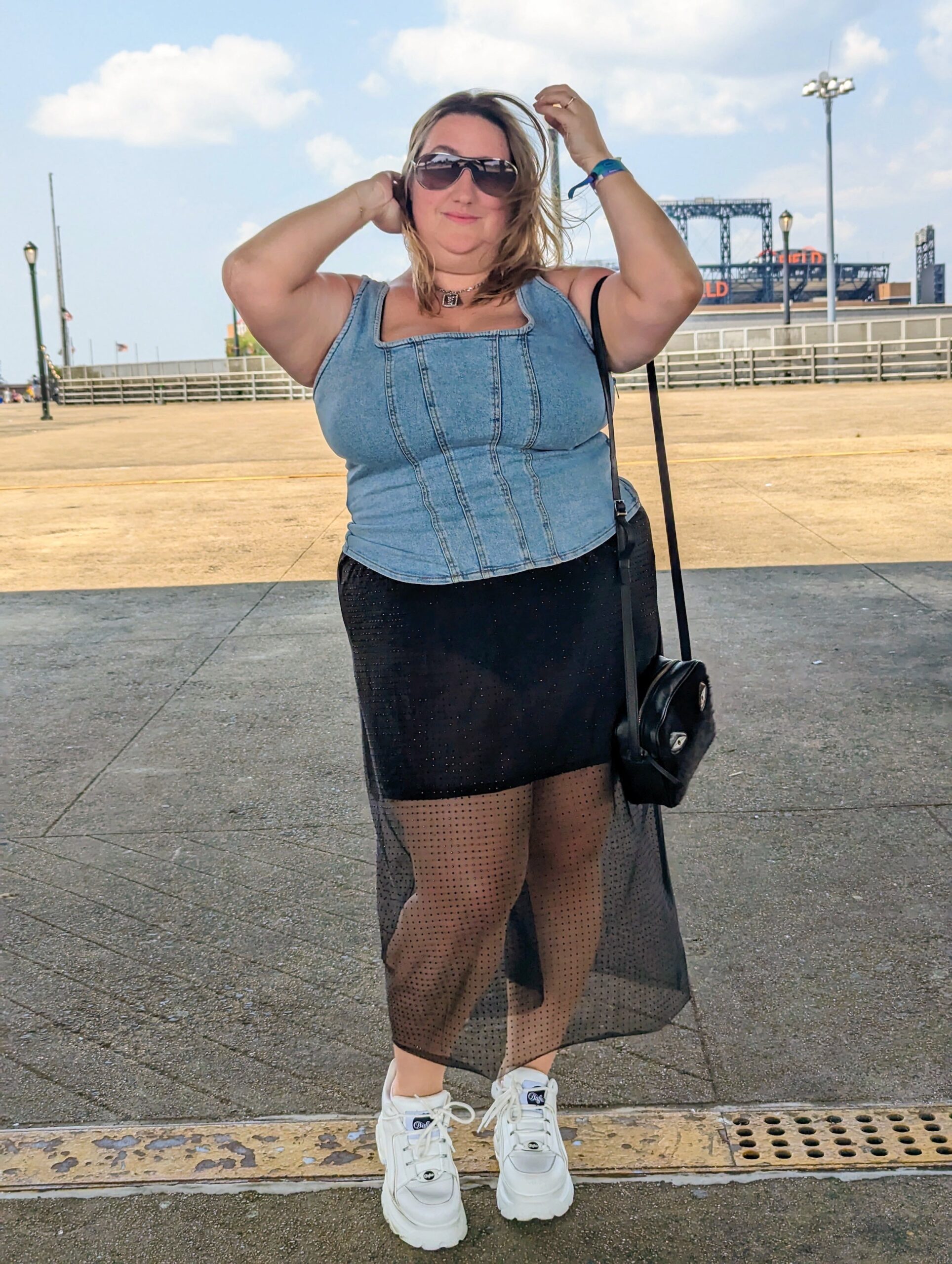
    For footwear, this is the day to let sneakers shine. A clean pair of chunky trainers or retro court shoes ties the whole sporty story together and, crucially, carries you across a packed parking lot and up a flight of concrete steps without complaint. Throw a crossbody bag over the look so your hands stay free for snacks and cheering, and you are set for the whole game with nothing to fuss over.

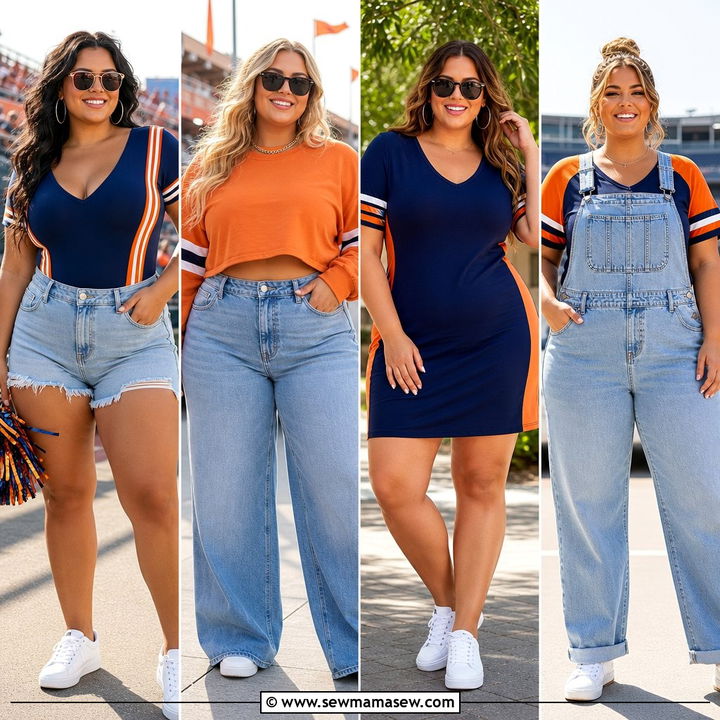
    Tailgating deserves its own small adjustment, since you are often standing, walking, and socializing for hours before you ever take a seat. This is where the knotted-jersey-plus-jeans formula earns its keep, because denim handles a long day better than thin leggings and the knot keeps the silhouette sharp in every group photo. A bucket hat or a baseball cap in the team colors does double duty as sun protection and an accessory, and a denim or canvas jacket tied at the waist gives you a layer for when the floodlights come on and the temperature drops. The whole point of a game-day look is that it should disappear from your mind the moment you put it on, leaving you free to actually enjoy the day, and a jersey that fits well does exactly that. Comfort and looking pulled together are not opposites here. The same outfit that lets you leap out of your seat is the one that photographs well in the concourse afterward.

    Accessories, Shoes, and the Finishing Details

    Accessories, Shoes, and the Finishing Details

    The styling secret that separates a fan in a jersey from a woman wearing a jersey as fashion almost always lives in the accessories. Because the jersey itself is bold and graphic, the pieces around it should either lean into that energy or deliberately dress it up.

    Jewelry does heavy lifting. Layered gold chains against a mesh jersey create a hip-hop-inspired contrast that feels intentional and confident, while chunky hoop earrings add polish without competing with the jersey’s print. Sunglasses, a sleek cap, or a silk headscarf can shift the whole mood from sporty to fashion editorial in seconds. A bold lip is one of the fastest ways to signal that you dressed up rather than dressed down, and a swipe of red or deep berry against a sporty top is the kind of contrast that stops people in their tracks. Nails matter more than people think too, since a fresh manicure peeking out as you adjust a chain or hold a drink quietly upgrades the whole picture.

    Shoes set the entire tone. Sneakers keep things grounded and casual, perfect for day and game day. Heeled mules, strappy sandals, or a pointed-toe boot instantly elevate the same jersey for night, and the contrast between athletic fabric and a dressy shoe is the engine of the whole look. A knee-high boot under a jersey dress is a particularly strong move for fall and winter, adding leg-lengthening lines that flatter a curvy frame. A structured handbag, even a small one, signals that the outfit was styled rather than thrown together. And do not underestimate a good belt, since a single waist-cinching belt over an oversized jersey or jersey dress can redefine your silhouette more dramatically than any other accessory in the mix.

    Where to Buy Plus-Size Jerseys

    Where to Buy Plus-Size Jerseys

    Finding a jersey that actually fits used to be the hardest part of this whole exercise, but the landscape has improved a great deal. Fanatics is the most reliable starting point for officially licensed gear, carrying women’s plus jerseys in roughly 1X through 4X across the NFL, NBA, MLB, and more, with prices generally ranging from about 70 dollars for replica styles up to 130 dollars and beyond for authentic versions. Nike offers women’s plus jerseys and sportswear in about 1X through 3X, available on Nike.com and through retailers like Dick’s Sporting Goods.

    Official team stores are worth a direct look, since many now stock women’s and extended sizes that do not always surface elsewhere, and specialty retailers like Women’s Plus Size Sports focus entirely on licensed gear in 1X to 4X, which takes the guesswork out of fit. For the fashion-forward jersey-dress and street-style versions rather than strictly licensed team gear, ASOS Curve and Fashion Nova Curve are strong picks. Fashion Nova Curve carries plus sizing in roughly 1X through 3X with trend-driven jersey dresses and sporty separates usually landing in the 25 to 50 dollar range, while ASOS Curve stocks football tops, kits, and sporty pieces across a deep size range. Between licensed retailers for authenticity and fashion retailers for the trend pieces, there is no longer a real excuse for being shut out of the jersey look at any size.

    Owning It With Confidence

    The jersey is one of those rare garments that asks you to take up space, and that is exactly why it suits a body-positive wardrobe so well. There is an old, tired idea that bold, graphic, body-skimming pieces are off-limits above a certain size, that curvy women should shrink into dark colors and apologetic silhouettes. A jersey laughs at all of that. It is loud, it is proud, it celebrates a team, and worn with intention it celebrates the woman inside it just as much.

    Confidence in a jersey is mostly about ownership. The half-tuck, the belt, the knot, the deliberate shoe choice all signal that you styled this on purpose and you know it looks good, and that energy reads louder than any number on a size tag. Curvy bodies bring something to a jersey that a straight frame cannot, since the same mesh that hangs flat on a hanger comes alive over real curves. Lean into that instead of fighting it. Wear the team you actually love rather than the one you think photographs well, because authentic enthusiasm is its own kind of style. And give yourself permission to take up the space the jersey was designed to fill.

    Body positivity here is not a slogan stitched onto the look. It is the practical decision to buy the size that fits your real body rather than the one you wish you wore, to choose the silhouette that makes you feel powerful rather than the one a trend chart approves of, and to walk into the room like the outfit was made for you. Because once the fit is right, it genuinely was.

    The Bottom Line

    The Bottom Line

    Pull the jersey out of the back of the closet this weekend and try one formula before you decide it is just for the couch. Belt an oversized one into a dress, knot another over your favorite jeans, or layer a fitted version under a denim jacket for the next game. Pair whichever you reach for with a shoe that surprises it, a chain or a hoop that finishes it, and a posture that says you meant every bit of it. The jersey has been waiting in there for a real outfit, and your curves are exactly what it needed to come to life.

  • Country Concert Style Guide – The Best Festival Outfits for Curvy Women at CMA Fest and Beyond

    Country Concert Style Guide – The Best Festival Outfits for Curvy Women at CMA Fest and Beyond

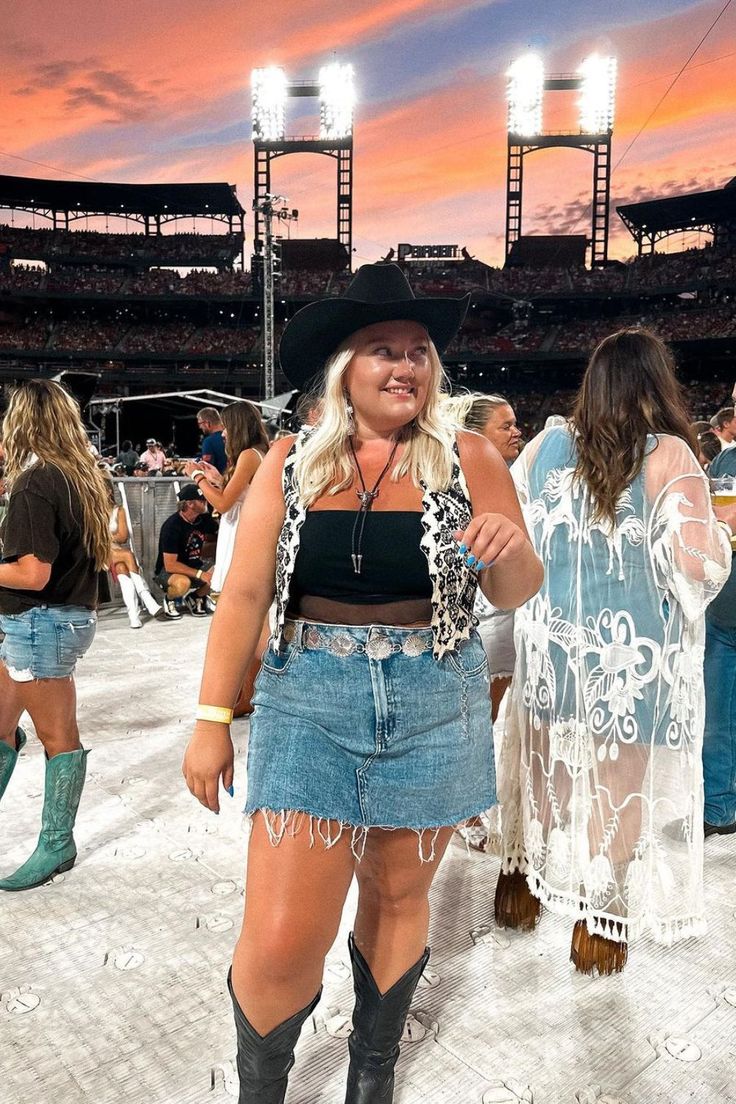
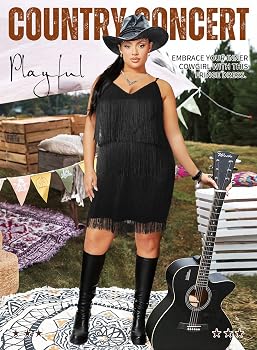
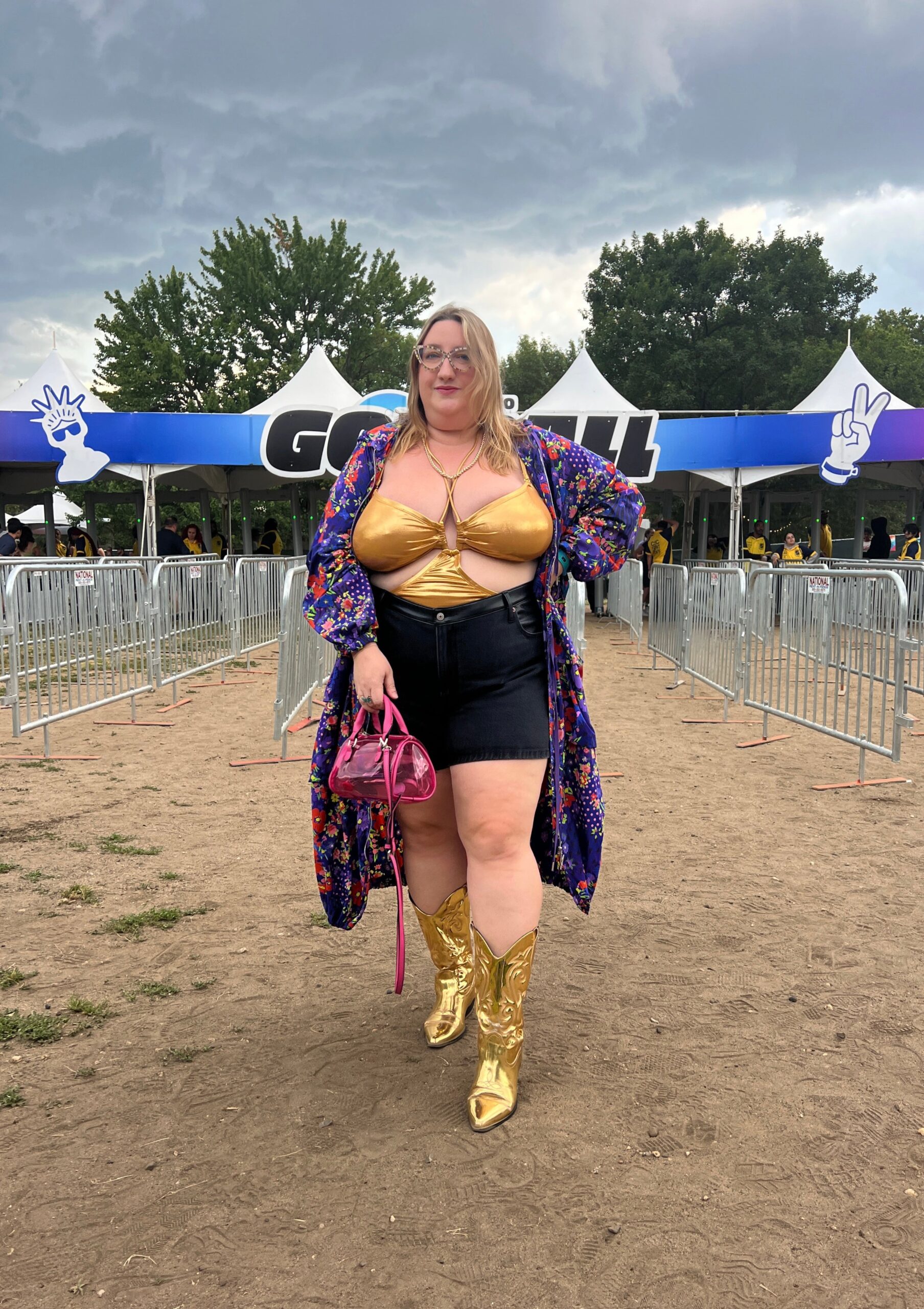
    Broadway is one long ribbon of neon and steel guitar, the sidewalks packed shoulder to shoulder, and the Nashville heat sits on the back of your neck like a wool blanket someone forgot to take off. Somewhere down the block a cover band is murdering a Tim McGraw song in the best possible way, and you are sweating through your first outfit of the day at noon with eight hours of music still ahead. This is CMA Fest, the four-day country takeover that turns downtown Nashville into a wall of denim and rhinestones every June, and it is one of the most joyfully overdressed, undersupervised style playgrounds a curvy woman can wander into. The whole city becomes a runway, and nobody is checking your size tag at the door.

    The trick to looking incredible at a country festival has almost nothing to do with squeezing into the smallest thing you own. It has everything to do with building outfits that move, breathe, and hold up through a day that runs from a humid morning honky-tonk crawl to a sweaty night under the stadium lights. Curvy bodies have specific needs at events like this, and the women who look the most effortless are usually the ones who planned for chafe, sunburn, and aching feet before they ever picked a hat. What follows is a full styling map for CMA Fest and any outdoor country or summer music festival you point yourself at, built around real brands that actually carry your size and real solutions that keep you dancing instead of hiding in the shade.

    The Denim Foundation That Does the Heavy Lifting

    The Denim Foundation That Does the Heavy Lifting

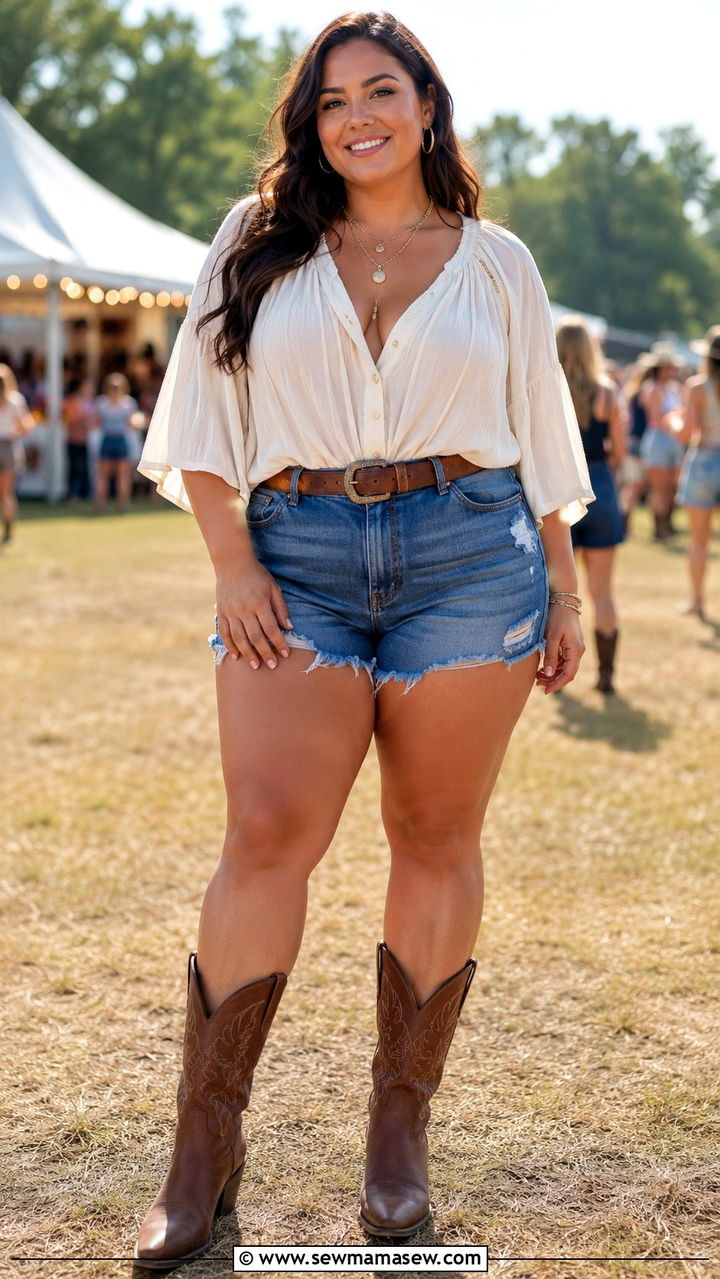
    Country style starts and ends with denim, so this is where your money and your fit obsession should go first. A great pair of jeans or shorts is the spine of every outfit you will build, and a bad pair will sabotage even the cutest top. For full-length jeans, Wrangler is the obvious heritage move, and their women’s range now runs well into extended sizing with that authentic Western cut that reads instantly country. A high-rise bootcut in a medium wash hits the exact note you want, long enough to break over a boot, structured enough to tuck a shirt into without bunching at the waist.

    When you want denim that hugs and holds, Lane Bryant and Torrid both build curve-specific jeans with real attention to the waist gap that plagues so many of us. Torrid in particular cuts for a defined waist and fuller hip, which means fewer gaping back pockets and more of that smooth line down the leg. Universal Standard deserves a spot in this conversation too, especially if you lean toward a cleaner, more elevated festival look rather than full rodeo, because their denim runs in an enormous size range and the fabric recovers beautifully after a long day of sitting on bleachers and dancing on cobblestones.

    For daytime heat, shorts are the smarter call, and this is where you need to be honest with yourself about chafe. A mid-length denim short that sits closer to your fingertips than your hip crease will save your inner thighs from a brutal end to the night. Maurices carries flattering curvy denim shorts with enough length and enough stretch to dance in, and Fashion Nova Curve runs a deep bench of trendier cutoffs if you want a more revealing, going-out energy for the night shows. Whatever brand you choose, buy the length that lets you raise your arms, sit on a curb, and two-step without a single tug, because at a festival you will be doing all three within the same hour.

    Sundresses and Rompers for the Days the Heat Wins

    Sundresses and Rompers for the Days the Heat Wins

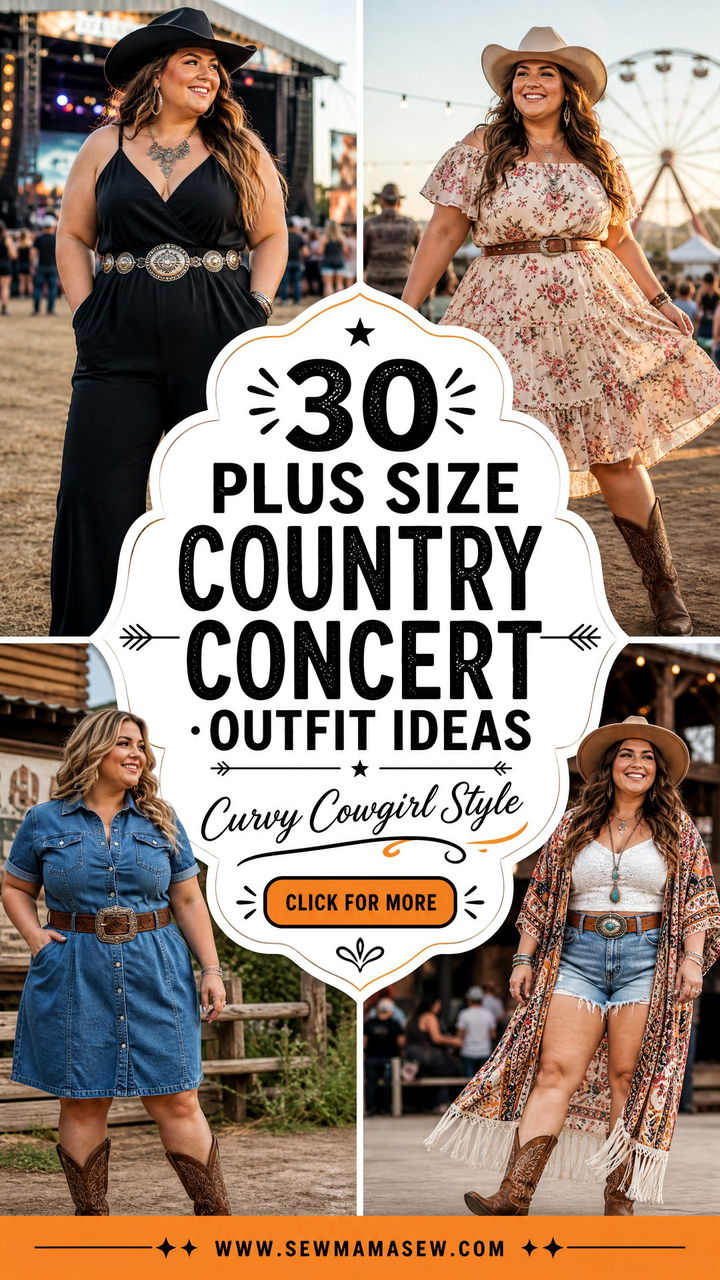
    There are days at CMA Fest when the humidity simply wins, and on those days a flowy sundress is the most intelligent thing in your suitcase. A dress skips the waistband pressure entirely, lets air move where it needs to, and photographs like a dream against a backdrop of string lights and skyline. The silhouettes that flatter curvy frames most reliably are the ones that define the smallest part of your torso and then release into movement: a smocked or elastic bodice that gives without squeezing, a tiered or A-line skirt that skims the hip rather than clinging to it, and a hemline that lands wherever you feel most confident.

    Torrid and Lane Bryant both produce sundresses cut specifically for fuller busts, which matters enormously, because a dress that fits your hips but gaps at the chest will read as ill-fitting in every photo. Look for adjustable straps, a little built-in shelf support, and necklines that frame rather than flatten. A tiered prairie dress in a soft floral or a gingham check leans fully into country charm, while a solid bodycon midi from Fashion Nova Curve brings a sexier, night-out attitude that pairs perfectly with boots and a denim jacket thrown over the shoulders once the sun drops.

    Rompers and jumpsuits are the underrated heroes here for anyone who wants the ease of a dress without the worry of a breeze. A wide-leg jumpsuit in a breathable cotton or linen blend handles a full festival day with grace, and the one-and-done nature of it means you spend zero mental energy on coordinating pieces when you are three iced teas deep and just want to get to the stage. The only real rule with rompers is to verify the rise and the torso length before the big day, since a too-short torso is the classic curvy romper trap. Order early, try it on at home, and do a full sit-and-squat test before you commit.

    Western Boots Built for Twelve-Hour Days

    Western Boots Built for Twelve-Hour Days

    Footwear is where festival dreams go to die, and it is the single most important investment on this entire list. You will be on your feet for ten or twelve hours, much of it standing on concrete and cobblestone, and the cute pointed-toe boots that feel fine in the store at minute three will become instruments of torture by hour six. Boot Barn is the destination here, both online and in their stores, because they carry the widest range of genuine Western boots and, critically, they stock wider widths and roomier calf options that so many curvy women need and so few retailers offer.

    When you shop, prioritize a broad or rounded toe box over a sharp point, a stacked heel under two inches rather than a tall one, and a leather or quality synthetic that has some give. Brands like Ariat, widely available through Boot Barn, build boots with actual athletic-style footbeds designed for people who work and walk all day, which is exactly the engineering you want under you at a festival. Break them in for at least two weeks before you travel, wearing them around the house in thick socks to mold the leather to your foot. A boot that is perfectly broken in is the difference between dancing through the encore and limping back to your hotel at nine.

    If full boots feel like too much heat for a daytime show, a Western-inspired ankle bootie or even a clean white sneaker dressed up with the rest of your outfit is a completely legitimate move. Nobody at a country festival is judging your commitment by the height of your boot shaft. Comfort reads as confidence, and confidence is the whole look. Pack moleskin or blister patches in your bag regardless of how broken in your boots are, because a single hot spot can end a great day early.

    Fringe, Hats, and the Accessories That Make It Country

    Fringe, Hats, and the Accessories That Make It Country

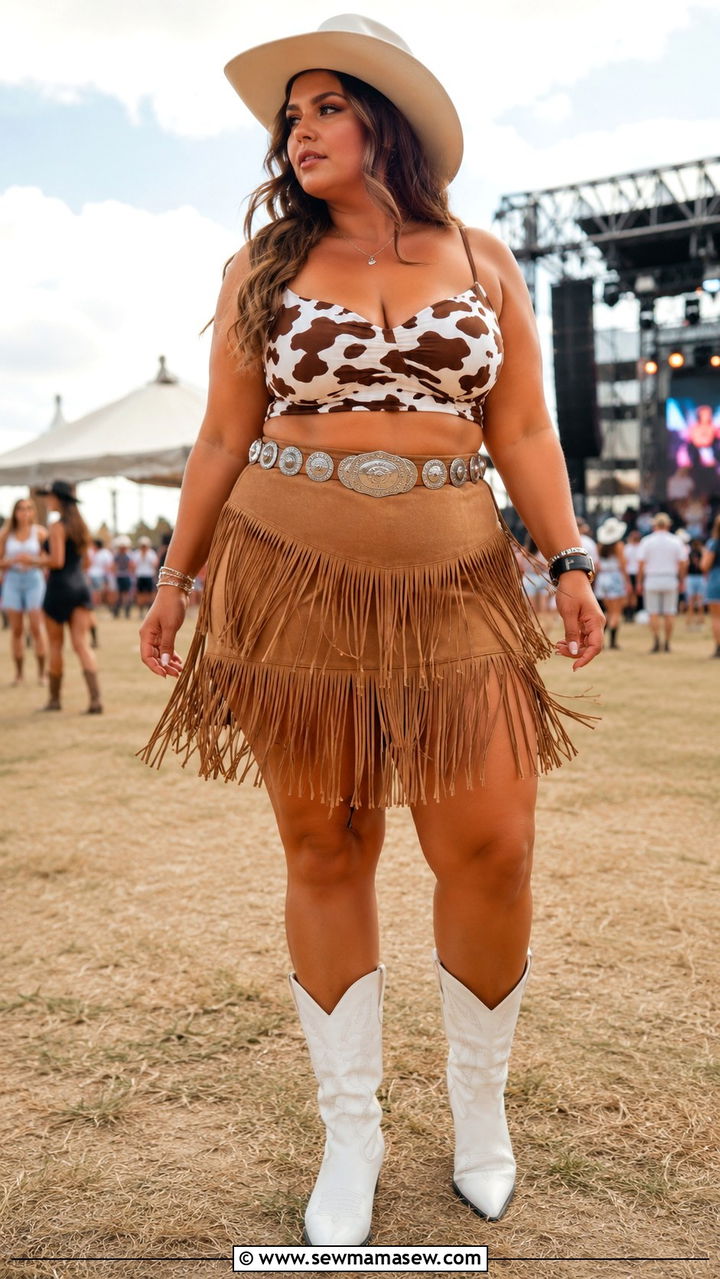
    This is the fun part, the layer where a simple jeans-and-tee base transforms into a full festival statement. Fringe is the shorthand for Western glamour, and a little goes a long way. A fringed crossbody bag, a fringed kimono or vest thrown over a tank, or a fringed jacket draped on your shoulders for the night shows adds movement and drama without adding heat. Curvy women sometimes get told to avoid anything with extra visual texture, which is nonsense. Fringe that hangs from a strong vertical line, like an open vest or a long duster, actually elongates the frame and looks spectacular in motion under stage lights.

    A hat is the crown of the whole outfit, and it does double duty as serious sun protection across a long Nashville afternoon. Charlie 1 Horse, a heritage Western hat maker carried by Boot Barn, makes felt and straw styles with real personality, from clean classic shapes to embellished show-stoppers with conchos and feathers. For summer heat, a straw or palm-leaf hat breathes far better than felt and keeps your face shaded through the worst of the midday glare. Make sure the band fits comfortably without pinching, since you will wear it for hours, and consider a stampede string or chin cord if you plan to be anywhere near a breeze or a mosh of dancing fans.

    Round the look out with the small stuff that signals country without trying too hard. A turquoise statement necklace or a stack of beaded bracelets, a wide tooled-leather belt that cinches a dress at the waist, oversized sunglasses, and a bandana knotted at the throat or tied around a bag handle all earn their place. The goal is two or three intentional accents, not the entire jewelry box at once. Pick the pieces that make you feel like the main character and leave the rest at home, because anything you wear all day needs to be something you will not want to peel off by sundown.

    The Comfort Layer Nobody Photographs but Everybody Needs

    The Comfort Layer Nobody Photographs but Everybody Needs

    Here is the unglamorous truth that separates a great festival day from a miserable one: the gear you cannot see matters more than the gear you can. Anti-chafing shorts are non-negotiable for curvy bodies in summer heat, and they belong under every dress, skirt, and romper you pack. A pair of smooth, breathable thigh bands or full slip shorts in a moisture-wicking fabric prevents the raw, burning chafe that ends so many festival days prematurely. Torrid, Lane Bryant, and plenty of dedicated brands make slip shorts cut for fuller thighs, and many curvy women swear by anti-chafe balm sticks as a backup layer for the hottest days.

    Support is the other invisible essential. A great bra under a long festival day does more for your comfort and your silhouette than any top you own. Look for a supportive, full-coverage style with wide straps and a band that actually holds, ideally in a moisture-wicking fabric, since you will sweat and you want something that dries rather than chafes. A convertible bra earns its keep when your dress has an unexpected neckline. Lane Bryant’s Cacique line is a reliable starting point for curvy bra fit, with a real range of band and cup sizes built for all-day wear rather than a quick photo.

    Then there is the bag, which should be small, secure, and hands-free. A crossbody in a clear or compact style that meets stadium bag policy saves you the heartbreak of being turned away at the gate, and the hands-free design lets you dance, eat, and hold a drink without juggling. Inside it, pack the real festival survival kit: sunscreen you will actually reapply, a refillable water bottle if the venue allows it, blister patches, your anti-chafe stick, a portable charger, and a thin packable layer for when the temperature finally drops after dark. None of this shows up in your photos. All of it determines whether you make it to the headliner glowing or wrecked.

    Building One Bag for Four Days of Music

    A multi-day festival like CMA Fest rewards a smart capsule far more than an overstuffed suitcase. The women who look pulled together across all four days are not the ones who packed twelve complete outfits; they are the ones who packed a tight set of pieces that remix endlessly. Start with two pairs of denim, one full-length and one short, in washes that go with everything. Add two or three tops that range from a simple fitted tank to a tied gingham shirt to a slightly dressier night top. Bring two dresses for the heat-wins days, one playful and one a touch more elevated.

    From there it is all about the layering and accent pieces that change the whole story. One denim jacket and one fringed vest or kimono can restyle every base outfit you own and double as warmth for the cooler night shows. One excellent broken-in pair of boots and one comfortable sneaker or bootie cover your feet for the entire run. One hat, two or three jewelry moments, a belt, and a bandana stretch across all four days without anyone clocking the repeats, because in a crowd of ninety-thousand-plus fans, nobody remembers what you wore on Thursday by the time Sunday rolls around.

    The same capsule logic travels anywhere you take it. Swap the Nashville skyline for a desert country stage, a Texas dancehall weekend, or a hometown summer fair, and the formula holds: durable denim that fits your real waist, a couple of breathable dresses for the brutal afternoons, boots you have actually walked in, and a handful of fringe-and-turquoise accents that make the whole thing sing. You are dressed for ten hours of music, you are protected from the sun and the chafe, your feet are not betraying you, and you look exactly like a woman who knows she belongs front and center. Pour the iced tea, find your spot near the stage, and let the steel guitar do the rest.

  • How to Dress for a Concert When You’re Curvy – the Ultimate Size-Inclusive Guide to Show Outfits

    How to Dress for a Concert When You’re Curvy – the Ultimate Size-Inclusive Guide to Show Outfits

    The bass hits, the lights drop, and forty thousand people scream the same lyric at once. That is the moment you bought the ticket for. And the last thing you want to be thinking about in that moment is whether your waistband is digging in, whether your shoes have turned your heels into a blister museum, or whether the top you grabbed because it “looked fine in the mirror” is now sticking to your back. A great show outfit does one job above all others – it disappears, so that you can be fully present, arms up, hips moving, voice gone by the encore.

    Getting there is not about squeezing yourself into something. It is about dressing a body you already love for a night it deserves. Curvy and plus-size women have more genuinely good options in 2026 than ever before, from brands that finally cut for real bodies to fabrics engineered to move and breathe. What follows is a practical map – how to read the genre, how to stay comfortable without going boring, where to actually buy the pieces, and how to walk in like the show is partly about you.

    Reading the Room: Dressing for the Genre and the Vibe

    Reading the Room: Dressing for the Genre and the Vibe

    Every kind of show has its own unspoken dress code, and leaning into it is half the fun. You are not obligated to follow it, but knowing the language lets you choose what to speak.

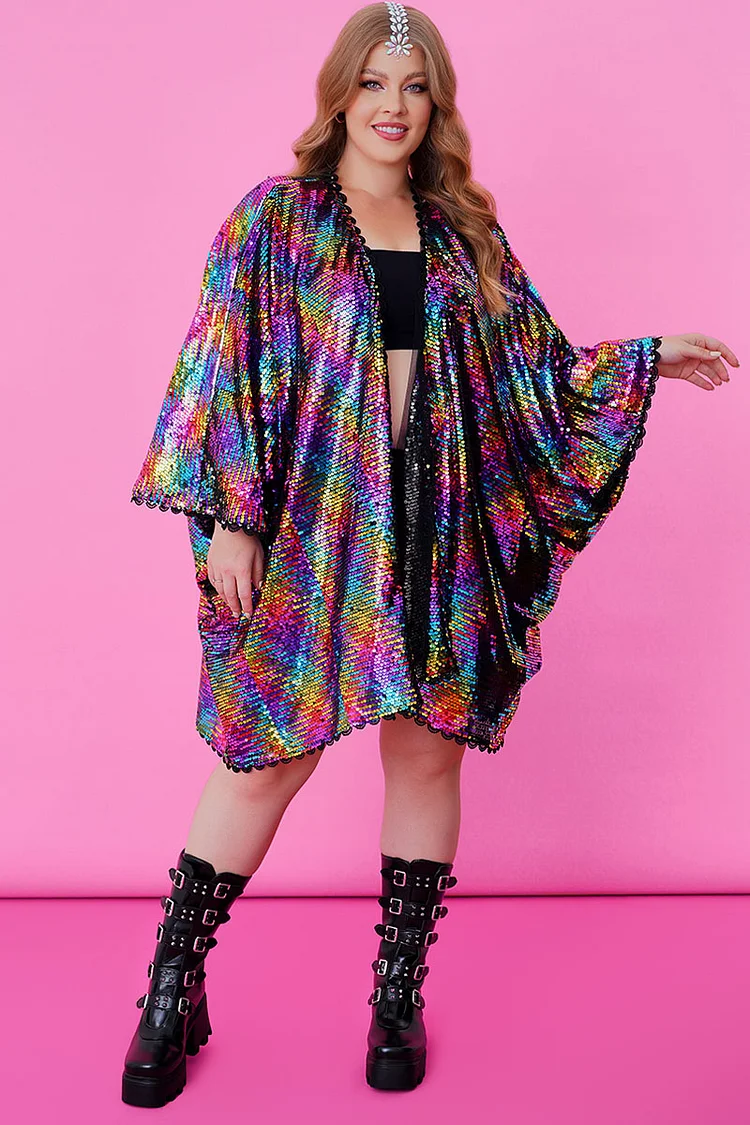
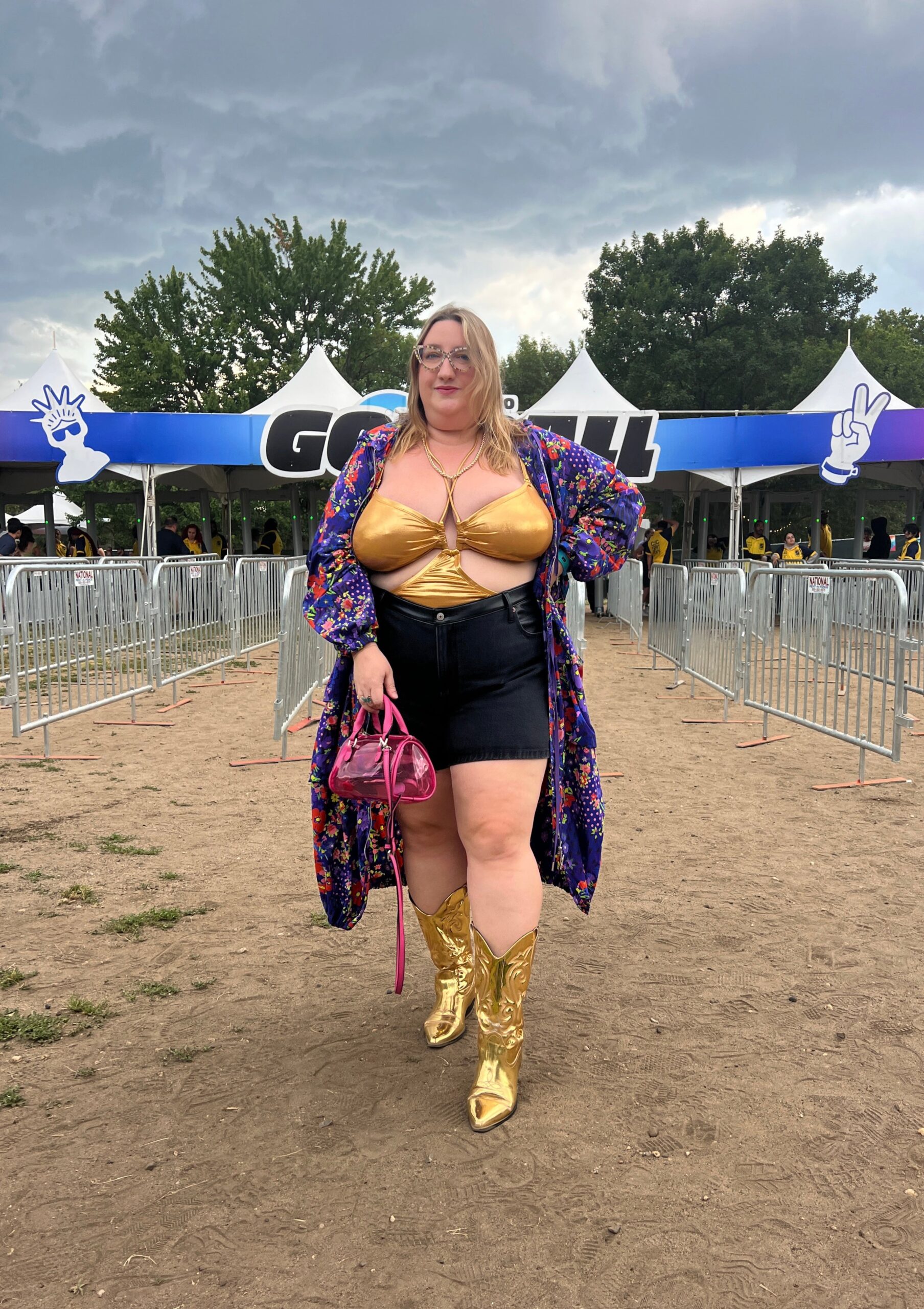
    A pop concert – your Beyonce, your Sabrina Carpenter, your Dua Lipa arena night – rewards sparkle and a little theater. Sequins, metallics, a bodysuit layered under a mesh skirt, or a slip dress with a denim jacket all read perfectly. Pop crowds dress to be seen, so a curvy frame in a column of liquid sequins is not hiding anything, it is the whole point. If a full sequin look feels like a lot, a single statement piece – rhinestone-fringed boots, a sparkly bralette under an open shirt, a metallic midi skirt with a plain fitted tee – carries the same energy with less commitment.

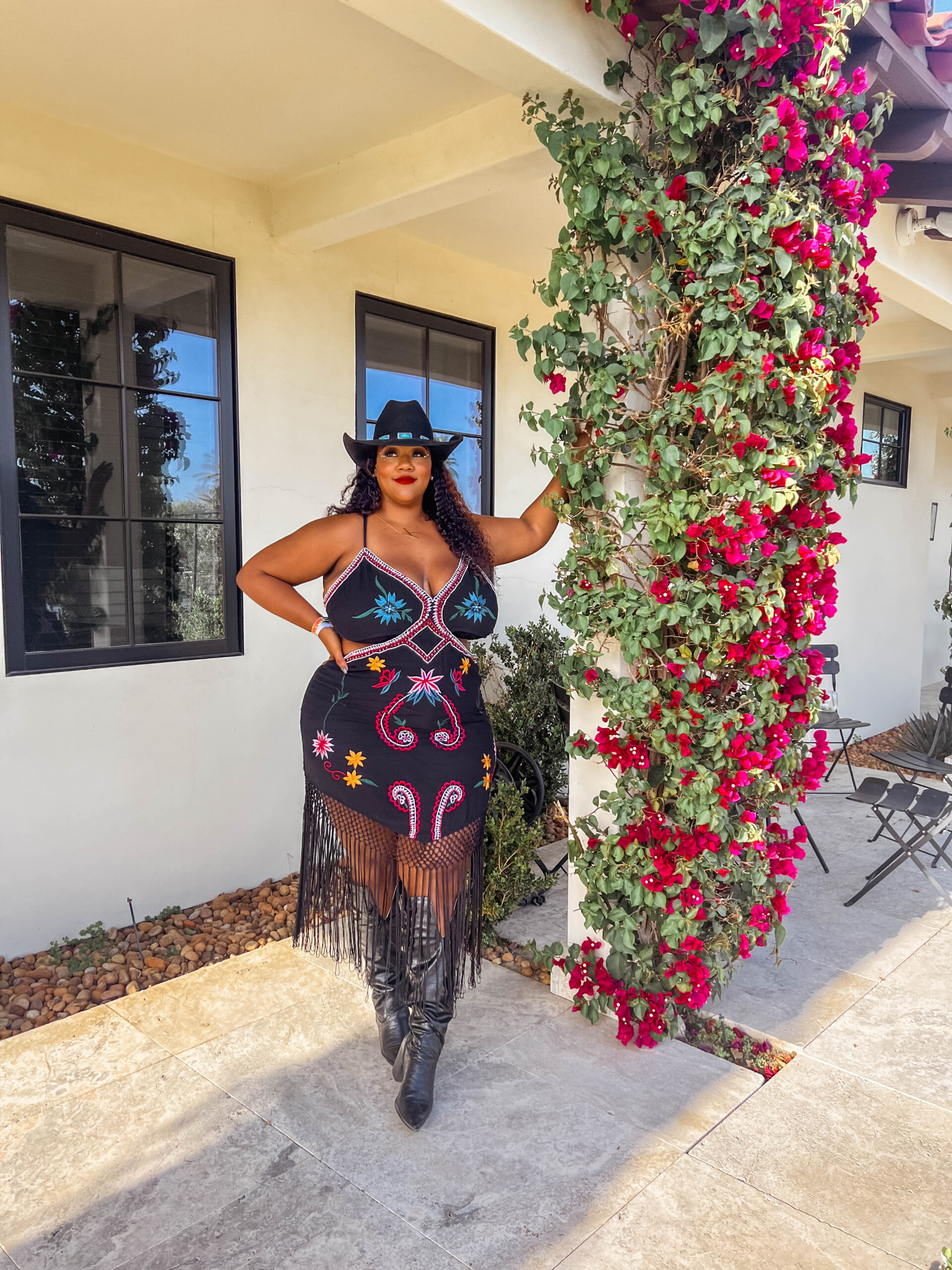
    Country shows are having an enormous moment, and the uniform is joyfully easy to wear on a fuller figure. Think a flowy floral or gingham dress with cowboy boots, high-rise denim shorts with a knotted Western shirt, or a slip skirt and a fringed jacket. Country style leans on movement and softness, which is forgiving for long days and flattering in the truest sense – it lets the fabric skim rather than cling. A wide belt at the natural waist defines a curvy silhouette beautifully here if you want shape.

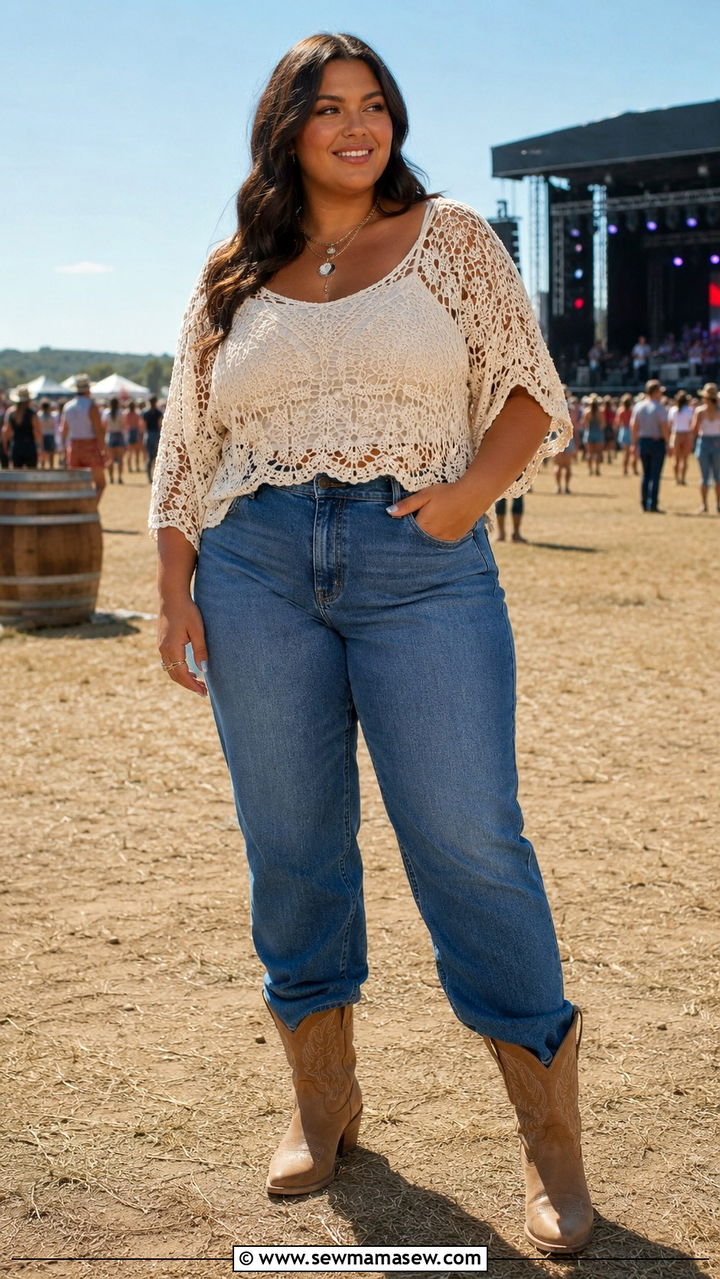
    Festivals are their own animal, and we will come back to them, but the festival “vibe” – boho, free, a little undone – travels well to any outdoor or general-admission show. Crochet tops, tiered skirts, breezy co-ord sets, bold prints, and a crossbody bag you can dance with all belong.

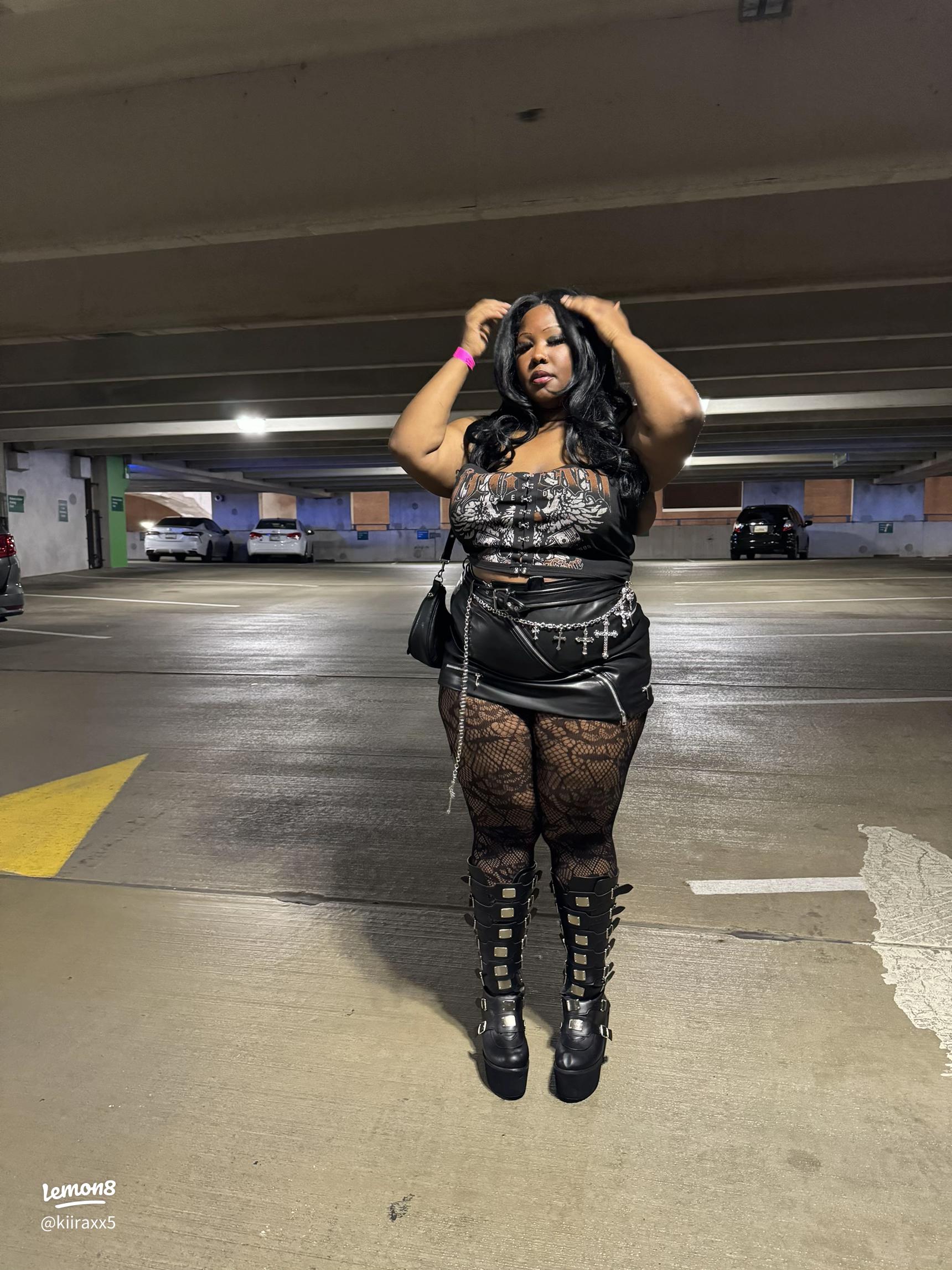
    Rock and alternative shows skew darker and tougher, which is a gift to anyone who loves a bit of edge. A graphic band tee knotted at the hip over leggings or wide-leg trousers, a faux-leather skirt with chunky boots, fishnets under distressed denim, a slip dress with a moto jacket. Black does a lot of quiet work at a rock show, but so does a red lip and a confident stance.

    R&B and soul nights invite softness and shine – a satin slip, a wrap dress that moves with you, a bodycon with a long duster coat, gold hoops, a sleek bun. The mood is grown, sensual, unhurried. Curvy bodies were made for the drape of good satin, and an R&B show is the place to prove it.

    Comfort That Does Not Kill the Look

    Here is the truth no styling video tells you – you will be on your feet for three to six hours, possibly in heat, possibly in a crowd that does not care about your personal space. The outfit has to survive that, or the photos will be the only good part.

    Start from the feet, because nothing ends a night faster than ruined shoes. Footwear pros and podiatry-minded brands agree on the basics: cushioned insoles, real arch support, breathable uppers, and – this is non-negotiable – shoes you have already broken in. A concert is the worst possible debut for a new pair. Supportive sneakers are the gold standard for standing all day; models like the Brooks Ghost, HOKA Clifton, and roomy New Balance trainers are repeatedly named as crowd-pleasers for marathon festival schedules because of plush cushioning and a generous toe box. If sneakers feel too casual for your look, a sturdy block-heel ankle boot or a cushioned ballet flat (Tieks built a following on exactly this use case) splits the difference. Skip stilettos and brand-new sandals for any general-admission show, where you will stand the whole time and the floor is sticky.

    Fabric is the next quiet hero. For long, warm shows, breathable and forgiving wins: cotton, linen, modal, jersey, and lightweight knits move air and stretch with you. Avoid anything stiff or heavily synthetic that traps heat against the skin. A loose, flowing silhouette over a clingy one keeps you cooler and lets you actually breathe when the floor packs in – and it photographs as effortless, not as effort.

    Then there is the unglamorous, completely essential matter of anti-chafe. For curvy women, inner-thigh friction over a six-hour day is a real thing, and the fix is simple and well established. Anti-chafing thigh bands – Bandelettes is the best-known name, with Thigh Society and others making slip shorts in the same vein – work by replacing skin-on-skin rubbing with a smooth, lightly compressive layer. Measure the thickest part of your bare thigh while standing and size accordingly so the band covers the full friction zone and grips without sliding. For very hot or very long days, full-coverage slip shorts under a dress or skirt are the more complete solution, and they double as a smoothing layer if you want one. A small balm or a backup pair tucked in your bag is cheap insurance.

    Layers solve the weather problem before it starts. Indoor arenas swing from sweltering at floor level to chilly near the doors; outdoor shows can drop fifteen degrees after sunset. A packable jacket, an oversized shirt you can tie around your waist, or a light cardigan means you adjust instead of suffer. And give a thought to where your phone goes – a crossbody bag worn across the body (not a tote that slides off your shoulder when your arms go up) or a fanny pack keeps your phone, ID, card, and lip product secure and hands-free for dancing. Many general-admission venues now require clear or small bags, so check the venue policy before you pack.

    Statement Pieces and the Power of an Accessory

    Statement Pieces and the Power of an Accessory

    Once the practical layer is handled, this is where the joy lives. Accessories let you turn a simple, comfortable base into something that feels like a moment, and they do the loudest talking for the least effort.

    Build around a hero. Pick one piece to be the star – a metallic skirt, a fringed jacket, a bold bodysuit, cowboy boots, oversized hoops – and keep the rest of the outfit calm so it has room to shine. A plain black tank and good jeans become a whole look the second you add a sequin blazer and a stack of gold bangles.

    Jewelry reads beautifully from a distance and survives the whole night. Statement earrings, layered chains, a cuff, stacked rings – none of it chafes, overheats, or needs adjusting. Belts pull double duty for curvy frames, defining the waist and breaking up a column of fabric while staying comfortable. A bold lip is the single most efficient confidence move in the building; it shows up in every photo and asks nothing of your feet.

    A few small touches earn their place in your bag too: blue-light-friendly sunglasses for daytime outdoor sets, a hair tie and a couple of pins for when the dancing wins, a tiny powder or blotting sheets, and a portable charger so the night does not end when your battery does. None of this is about covering anything up. It is about giving yourself everything you need to stay out there, fully in it, until the lights come up.

    The Festival Versus Arena Difference

    The Festival Versus Arena Difference

    Where the show happens changes the brief entirely, and dressing for the wrong one is a long, uncomfortable mistake.

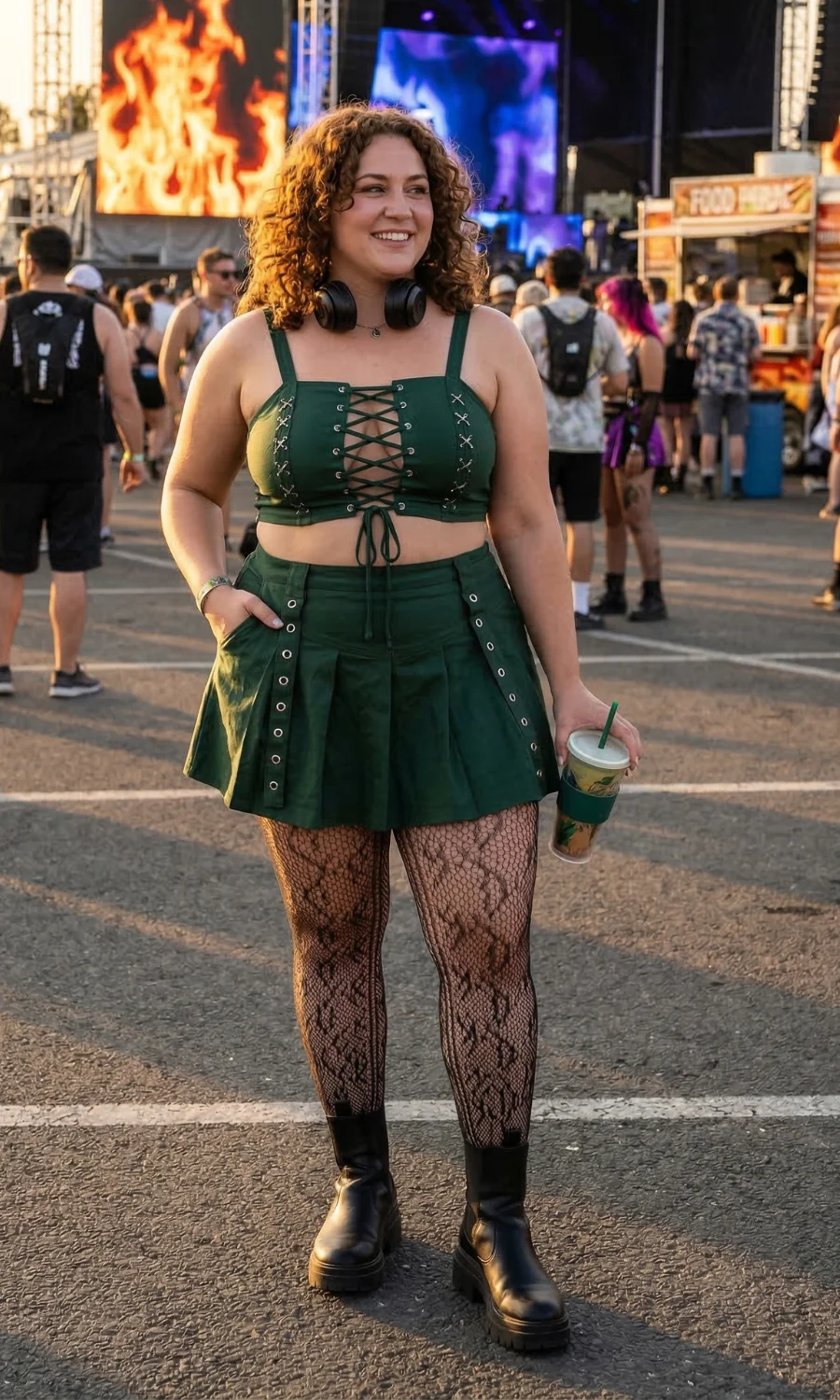
    A festival is an endurance event. You are outdoors for eight to twelve hours, often across multiple days, walking miles between stages, exposed to sun, dust, possible rain, and temperatures that swing hard from afternoon to night. The festival wardrobe is built for that reality: breathable fabrics, a hat and sunscreen, closed or sturdy shoes that handle uneven ground (chunky sneakers, lace-up boots, sport sandals with a real footbed – never brand-new anything), a crossbody or fanny pack, and layers for the temperature drop. This is the home of the boho and rave aesthetics – crochet, fringe, bold prints, bodysuits, co-ord sets, and statement sunglasses – precisely because those looks are designed to move and breathe through a marathon day. Comfort is not the enemy of the festival look, it is the foundation of it.

    An arena or theater show is a sprint by comparison. You are indoors, climate-controlled, on your feet for a couple of hours at most, and you arrived by car or transit rather than hiking in. That frees you up to dress with more polish and less armor: the sequin look, the satin slip, the heeled boot, the dressier bag. You still want broken-in shoes and a layer for the AC, but you can let glamour take the lead. The mental shortcut is simple – festival rewards stamina, arena rewards shine. Pack for the one you are actually attending.

    Where to Shop Plus-Size Show Outfits

    Where to Shop Plus-Size Show Outfits

    The genuinely good news is that real retailers now cut for real bodies, with extended ranges that go well beyond a token size or two.

    For festival and concert specifics, Torrid is a go-to, running a dedicated “Festi” collection each season with bodysuits, sets, and dresses cut for curves across roughly sizes 10 through 30. Yours Clothing carries a full festival edit spanning roughly US sizes 8 to 36, heavy on crochet, boho, and bright prints. For rave-leaning and bold festival pieces with extended sizing built in, Freedom Rave Wear and Xpluswear both specialize in the genre.

    For the broader closet – the slip dresses, satin, denim, and tailored pieces that carry an arena or R&B night – Universal Standard is the standout, offering essentially every style from a US 00 to 40 (their 4XS to 4XL range) with the same price and fit-testing across the whole spectrum. Eloquii cuts contemporary, trend-forward pieces in sizes 14 to 28 and beyond, and is reliably strong on dresses, jumpsuits, and going-out looks. Lane Bryant and Torrid both anchor the mall-brand middle with denim, tops, and event dresses in deep size ranges, and Old Navy’s extended sizing makes it an easy, affordable source for the basics – tanks, tees, and high-rise shorts – that form the base of so many looks.

    Fast-fashion players like PrettyLittleThing and ASOS carry large plus ranges with on-trend festival and concert pieces at low prices, useful when you want something disposable for one specific night. Expect to spend roughly $25 to $60 for a fast-fashion festival piece, $40 to $90 for a Torrid or Eloquii dress or set, and $100 and up for Universal Standard’s investment-quality basics. Whatever the source, check the brand’s own size chart and measure yourself rather than trusting a label number, since plus sizing still varies wildly between retailers.

    Confidence and the Day-of Plan

    Confidence and the Day-of Plan

    The best-dressed person at any show is not the one in the most expensive outfit. It is the one who clearly forgot to worry about how she looks because she is too busy having the time of her life. Confidence is the accessory that makes everything else work, and it is built before you leave the house.

    Do a real trial run. Put the full outfit on a few days early, shoes and bag and all, and move in it – sit, reach overhead, walk the block. Anything that pinches, slides, or rides up now will be unbearable in hour four, so swap it before the day instead of suffering on the night. Pack a small kit you can carry hands-free: anti-chafe band or balm, a couple of bandages for surprise blisters, hair ties, charged phone and charger, ID, card, and a refillable water bottle if the venue allows one. Eat before you go and keep hydrating through the show; comfort is as much about your body as your clothes.

    Then, when you get there, give yourself permission to take up space. You bought the ticket. You are allowed to dance with your whole body, sing every word badly, throw your arms up, and let the photos be blurry because you were too busy living to pose. The outfit was only ever there to make that easier.

    The Encore

    So here is the picture: comfortable shoes already broken in, a fabric that breathes, a thigh band doing its quiet job, a crossbody holding your phone, and one bold piece – the sequins, the boots, the red lip – that makes you feel like the night is partly yours. You walk into the venue, the lights go down, the first chord lands, and your only thought is the music. That is the whole job done. Grab the ticket, build the look around how you want to feel, and go be loud.

  • State Fair Season Style Guide – Cute, Comfortable Outfits for Curvy Women That Survive a Full Day on Your Feet

    State Fair Season Style Guide – Cute, Comfortable Outfits for Curvy Women That Survive a Full Day on Your Feet

    Funnel cake at noon, a tilt-a-whirl by three, fireworks after dark, and somewhere in between, roughly twelve thousand steps across gravel, grass, and sticky midway asphalt. That is a real state fair day, and the outfit you choose at 9 a.m. has to still feel good when your feet hit the parking lot at 10 p.m. The good news for curvy women in 2026 is that the brands worth shopping have finally caught up, the cute options run all the way through extended sizes, and dressing for a long day on your feet no longer means choosing between looking good and feeling human.

    The trick is building outfits backward from comfort instead of forward from a Pinterest photo. Comfort is the foundation, and style sits on top of it, not the other way around. Get the fabric, the fit, the shoes, and the anti-chafe layer right, and almost any cute formula will hold up from the first corn dog to the last roller coaster.

    Why Your Feet and Your Fabric Decide the Whole Day

    Why Your Feet and Your Fabric Decide the Whole Day

    A full fair day is an endurance event dressed up as a fun one. You will stand in lines, walk fairgrounds the size of small towns, and sweat through afternoon heat that often climbs past 90 degrees. The body that carries you through all of that deserves clothing that works with it, not against it. That starts with fabric, and the rule is simple: choose anything that breathes and moves.

    Cotton, linen blends, modal, viscose, and lightweight rayon let air circulate and pull moisture off your skin. They drape softly over curves without clinging when you sweat. Skip anything heavy, stiff, or fully synthetic with no stretch, because polyester that traps heat turns a fun afternoon into a sticky ordeal by hour four. If a piece has a touch of spandex woven in, even better, because that little bit of give means the waistband and seams move when you bend, reach, and climb into a Ferris wheel car.

    Fit matters just as much as fabric. Pieces that skim the body let air flow and prevent the bunching that leads to chafing. That does not mean baggy or shapeless. A skimming fit follows your shape with a hair of breathing room, so a flowy top still shows your waist and an easy dress still nods to your curves. The point is movement. You want to lift your arms for a photo, sit down on a hay bale, and chase a kid toward the petting zoo without a single seam digging in.

    One more thing worth saying plainly: this is your day, and your body is built for fun, not for sucking in. Skip the shapewear that squeezes the breath out of you by the second hour, skip the waistband you have to unbutton to eat, and skip any voice in your head that says comfort and cute cannot share an outfit. They can, and the whole point of dressing well for a fair is that you forget what you are wearing and remember the day instead. A curvy body that gets to move freely, eat the funnel cake, and ride the Ferris wheel without flinching is the entire goal here. Everything below is just the toolkit that gets you there.

    The Cute-But-Comfortable Outfit Formulas

    The Cute-But-Comfortable Outfit Formulas

    The easiest way to get dressed for a fair is to lean on formulas that have been stress-tested by real bodies on real long days. Each one balances looking put-together with surviving the heat and the steps.

    Denim shorts plus a flowy top is the classic for a reason. A pair of mid-rise or high-rise denim shorts with a touch of stretch holds everything in place without a tight waistband, and a billowy, breathable top floats over the midsection while keeping you cool. Look for shorts with at least a four or five inch inseam so the legs do not ride up while you walk, which is exactly the kind of small detail that prevents thigh friction later. Old Navy carries plus denim shorts in soft, stretchy washes for around 30 to 40 dollars, and Torrid does roomier, longer-inseam cuts if you want more coverage.

    The easy dress is the lowest-effort win on the list. One piece, zero coordinating, instant outfit. A tiered cotton midi, a soft T-shirt dress, or a swingy sundress in a forgiving knit lets air move freely and never pinches. A dress that skims rather than clings reads cute in every photo and feels like wearing almost nothing in the heat. Pair it with bike shorts or anti-chafe shorts underneath, and you have full freedom to climb onto rides without a second thought. Universal Standard makes beautifully simple knit dresses in sizes from 4XS to 4XL, often in the 80 to 120 dollar range, and Old Navy has playful printed sundresses for far less.

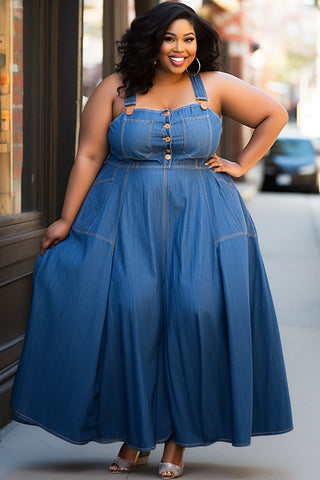
    Overalls are the underrated MVP of fair style. They are roomy, adjustable at the straps, endlessly cute, and they free your hands and waist from any pinching. Wear them over a fitted tank or a cropped tee, roll the cuffs, and you look effortlessly styled while feeling like you are in your comfiest clothes. The bib doubles as a casual phone pocket in a pinch. Plenty of plus retailers carry denim and twill overalls, and they photograph as charming as they feel.

    Athleisure-meets-cute is for the woman who refuses to suffer for fashion and should not have to. Think a pair of wide-leg or straight-leg knit pants or premium leggings with a cute, slightly oversized graphic tee or a soft button-down knotted at the waist. Add gold hoops and a structured crossbody bag and the whole look reads intentional rather than gym-bound. This formula breathes, stretches, and moves through a full day better than almost anything else, and it transitions straight into the cooler evening hours.

    Whatever formula you pick, the move is to build in a layer for the temperature swing. Fairs are hot at 2 p.m. and breezy at 9 p.m., so a packable denim jacket, a light cardigan, or an oversized flannel tied at your waist earns its keep when the sun goes down.

    Shoes That Actually Survive the Fair

    Shoes That Actually Survive the Fair

    Footwear is where most fair outfits quietly fall apart, and where curvy women carrying a little more deserve genuine support rather than a flat, flimsy sole. This is the single most important decision of the day. Cute sandals with no cushioning will betray you by hour two, and you will spend the fireworks wishing you were barefoot.

    Reach for cushioned, broken-in shoes you have already walked miles in. A clean pair of white leather sneakers goes with every formula above and gives your arches real support across hours of standing. Chunky retro trainers are having a moment and they hide a surprising amount of comfort tech. If you want a sandal, choose a supportive footbed brand built for walking, with a contoured arch and a secure strap across the foot rather than a single thin band. Sporty slides with molded cushioning have come a long way and look genuinely cute with a sundress.

    There is a quiet reason supportive shoes matter even more when you carry more curves: every step asks a little extra of your feet, knees, and lower back, and a cushioned, well-built shoe spreads that load instead of letting it land hard on your heels and arches. That is not a knock on your body, it is just physics, and it is the difference between dancing to the cover band at nine and limping to the car at ten. If you have wider feet, look for brands that offer a true wide width rather than a snug shoe you hope will stretch, because cramped toes turn into hot spots fast. A removable cushioned insole is the cheapest upgrade going, and you can slip a fresh gel insert into almost any sneaker for a few dollars and feel the difference by the end of the night.

    Two rules make or break the day. First, never wear a brand-new shoe to a fair, because fresh shoes and 10 p.m. blisters are an unbreakable pair. Break them in for a week of normal errands first. Second, wear real socks with closed shoes, ideally moisture-wicking ones, because damp cotton socks are how hot spots become blisters. Toss a pair of blister-prevention bandages or a small anti-friction balm stick in your bag, and slick it on your heels before you leave the house, not after the rubbing starts.

    Anti-Chafe and the Practical Must-Haves

    Anti-Chafe and the Practical Must-Haves

    Thigh chafe is the great unspoken saboteur of summer, and there is zero reason to white-knuckle through it in 2026. Curvy thighs that touch are completely normal, and the fix is simple, cheap, and effective. Handle this layer before you leave and the whole day gets easier.

    A pair of anti-chafe shorts under a dress or skirt is the gold standard. Thigh Society makes slip shorts specifically designed and fit-tested on plus-size bodies, with styles running through 3XL and 4XL and roughly 14 to 26 in numeric sizing, priced around 30 to 40 dollars a pair. Their Cooling style is built for exactly this kind of hot, high-movement day. If you prefer something less full-coverage, Bandelettes are lace thigh bands that stay put through XL and XXL thigh measurements and tuck invisibly under any hem, usually around 20 dollars. Either way, a swipe of anti-chafe balm along the inner thigh is a smart backup. The goal is to move freely all day and never think about it again.

    Then there is the eternal question of where to stash your phone, your cash, and your keys. A crossbody bag worn snug to the body is the answer, hands-free and harder to lose on a ride than anything that dangles. Choose one with a zip top so nothing flies out on the swings, and keep it small so you are not lugging weight around all day. If your outfit has real pockets, treasure them, but still bring the crossbody for the essentials you cannot afford to drop into the cotton-candy crowd.

    Sun, Weather, and What to Actually Carry

    Sun, Weather, and What to Actually Carry

    Fairgrounds are famously short on shade. You are exposed for hours, so sun protection is not a nice-to-have, it is part of the outfit. Apply a broad-spectrum SPF 30 or higher before you dress, and tuck a travel-size tube in your bag for reapplying after you sweat. A wide-brim hat or a cute bucket hat shields your face and doubles as a styling piece, and sunglasses save your eyes from squinting through the whole midway.

    Weather can pivot fast in summer, so glance at the forecast and plan for the swing. Pack that light layer for the evening chill and a compact, packable rain poncho or a small umbrella if there is any chance of a pop-up storm, because nothing ends a fair day faster than a soaked outfit and no backup. Heat is the bigger daily threat for most fairs, which makes a refillable water bottle one of the smartest things you can carry. Staying hydrated keeps your energy up across all those steps, and many fairgrounds have free refill stations.

    Keep the carry list short and intentional. Phone, ID, a card and a little cash, sunscreen, balm, a couple of bandages, a hair tie, and water. Everything else is optional weight you will resent by the funnel-cake stand. The lighter your bag, the lighter your whole day feels.

    Where to Shop Plus Sizes With Confidence

    The era of digging through a sad back corner for anything above a 14 is over, and these names deliver genuinely cute fair-ready pieces in real extended ranges.

    Torrid is the dedicated plus specialist, running sizes 10 through 30, and it is the place for denim shorts, easy dresses, and tops cut for curves from the start rather than scaled up as an afterthought. Expect tops and shorts in the 30 to 50 dollar range and dresses a bit higher.

    Old Navy is the budget hero for fair season. The plus line covers the formulas above, sundresses, denim shorts, soft tees, and easy knit pants, at prices that make it painless to grab a few options, often 20 to 40 dollars a piece.

    Universal Standard is the splurge-worthy pick for elevated basics, with one of the widest size ranges in fashion, 4XS to 4XL, and knit dresses and pants that look polished while feeling like loungewear. Pieces generally run 80 to 130 dollars and last for years.

    Madewell Plus brings the elevated-denim energy, with jeans and shorts running through size 28W, including dedicated Curvy fits designed and tested on plus bodies so the waistband actually holds. Denim typically lands in the 90 to 130 dollar range.

    For the anti-chafe layer, Thigh Society and Bandelettes both carry true plus sizing and solve the exact problem a long fair day creates. Between these names, every formula in this guide is buildable in your size, in fabrics that breathe, at a price point that fits the budget.

    Get Dressed and Go

    Lay it all out the night before: the breathable dress or the denim-shorts combo, the anti-chafe shorts folded on top, the broken-in sneakers with real socks tucked inside, the zip crossbody loaded with sunscreen and a couple of bandages, the light layer for when the sun drops. Set the refillable water bottle by the door so you cannot forget it. Slick the balm on your heels and inner thighs while your coffee brews, clip the crossbody snug, and pull the bucket hat on at a slight tilt because it looks better that way.

    Then walk out the door and order the funnel cake first, because you earned it before you even arrived, and your outfit is built to carry you straight through to the last firework.

  • The Best Swimsuits for Curvy Women in 2026 – Styles That Actually Fit and Flatter

    The Best Swimsuits for Curvy Women in 2026 – Styles That Actually Fit and Flatter

    Standing in front of a poorly lit dressing room mirror, tugging at a suit that gaps at the bust and digs into the hips, is a rite of passage almost every curvy woman knows too well. The good news for 2026 is that the swimwear world has finally caught up. Brands that once stopped at a size 14 now cut suits through a size 30 and beyond, with real underwire support, longer torsos, and fabric that holds you without flattening you into something you are not. A swimsuit that fits well does not hide anything. It simply moves with you, stays put when you dive, and lets you think about the water instead of your waistband.

    So let’s talk honestly about the word in that title. “Flatter” gets thrown around in swim marketing as code for “make you look smaller,” and that framing deserves to go in the bin. Here, flatter means a suit that fits your actual proportions, supports the parts of you that want support, and feels good enough that you forget you are wearing it. A great suit is not about correction. It is about fit, comfort, and the kind of quiet confidence that comes from clothing that was built for your body in the first place.

    How to shop swim for your body, not against it

    How to shop swim for your body, not against it

    The single biggest upgrade you can make is to stop shopping by dress size alone and start shopping by your three real measurements: bust, waist, and torso length. Plus-size bodies vary enormously, and two women who both wear a size 22 in jeans can need completely different swimsuits. Pull out a soft tape measure, write your numbers down, and check them against each brand’s size chart rather than guessing. Lands’ End, Andie, Cupshe, and Hanna Nikole all publish detailed charts with bust, waist, and hip measurements, and using them saves you the return-shipping shuffle.

    Support is where the right suit earns its keep. If you carry a fuller bust, look for genuine underwire, molded cups, adjustable and wide-set straps, and a band that anchors under the bust rather than relying on the neck to hold everything up. A thin string halter will leave you sore by mid-afternoon. Brands like Swimsuits For All and its GabiFresh collaborations build underwire suits in cup sizes running from D/DD up through G/H, which is a different universe from the one-size-fits-most padding you find in cheaper suits.

    Torso length is the quietly important measurement nobody mentions. If you are tall or long-waisted, a standard one-piece will ride up and pull down on your shoulders all day, and no amount of strap adjustment fixes it. Lands’ End makes a dedicated long-torso plus range, and Andie cuts several styles with added length for exactly this reason. If you are petite or short-waisted, the opposite applies, and you want a suit that does not bag at the middle. Coverage is a personal call, not a rule. Some days you want a high neck and full back, other days a plunge and a cheeky cut feel right, and both are completely valid.

    The best one-pieces for curves

    The best one-pieces for curves

    The one-piece is the workhorse of a curvy swim wardrobe, and the category has grown up. A well-built maillot gives you a smooth line, often a hidden shelf bra or underwire, and the freedom to actually swim rather than constantly readjust. Lands’ End is the reliable anchor here. Its plus one-pieces run from roughly a 16W up through a 26W, with soft-cup or underwire support, adjustable straps, and optional tummy-control panels for anyone who wants a firmer hold around the middle. Prices generally sit in the $70 to $100 range, and the construction earns it.

    Andie Swim has become a favorite for women who want a modern, minimalist suit that still holds up. Its plus range reaches up to a 3X, with styles like the Mykonos built to support a fuller bust and a longer body. Expect to pay somewhere around $100 to $130, and expect a suit that lasts more than one season. For a livelier, color-forward one-piece, Swimsuits For All offers a deep bench of underwire maillots, often in the $50 to $90 range, frequently discounted. If you swim laps or chase kids in the pool, Speedo and Nike both run dedicated plus one-pieces built for athletic use, with compressive, chlorine-resistant fabric and racer or wide-strap backs that stay put through real movement.

    Tankinis and separates that let you mix sizes

    Tankinis and separates that let you mix sizes

    Separates are the unsung heroes of plus-size swim, and the reason is simple: your top and bottom rarely wear the same number. Buying a tankini or a two-piece set as separate pieces means you can size your top for your bust and your bottom for your hips without compromise. Torrid built much of its swim reputation on this, sizing tops and bottoms individually from a 14 up to a 30, with side boning, wire-free and underwire options, and bottoms in everything from briefs to high-waisted to skirted. Most pieces land in the $40 to $60 range.

    Tankinis themselves get an unfair reputation as the “safe” option, but a good one is genuinely practical. It gives you the coverage and support of a one-piece with the bathroom convenience of a two-piece, and a longer tankini top paired with a high-waisted bottom covers the midsection without a hint of compromise on comfort. Lands’ End and Hanna Nikole both make strong tankinis with built-in bust support and adjustable lengths. Cupshe, which sizes its plus range from roughly a 0X to a 4X, offers budget-friendly sets and separates in the $30 to $45 range, which makes it an easy place to experiment with a print or a silhouette before committing more money elsewhere.

    High-waisted and bikini options for curvy bodies

    High-waisted and bikini options for curvy bodies

    Anyone who still believes curvy women cannot wear bikinis has not been paying attention. The high-waisted bikini is, for many, the perfect bridge: it sits at the natural waist, gives genuine core comfort and coverage, and pairs beautifully with an underwire top that actually supports a fuller chest. Swimsuits For All and the GabiFresh collaborations practically pioneered this look for the plus market, building bold, cut-out and color-blocked sets with underwire tops in cup sizes through G/H and bottoms that hold their shape. Sets typically run $60 to $100.

    If you want a more classic bikini, the key is buying the top and bottom as separates, which most plus-focused brands now allow. Torrid and Cupshe both shine here. Look for tops with underwire or thick supportive bands, wide adjustable straps, and back closures rather than tie-only necks if you carry weight up top. For bottoms, high-waisted and mid-rise cuts give the most all-day comfort, while a classic brief or a cheeky cut works well when you want less coverage. The fabric matters as much as the cut: a thicker, double-lined fabric with good spandex content keeps its shape in and out of the water, and it is worth paying a little more for. Aerie carries a fun, youthful bikini selection with mix-and-match separates, with extended swim running up to roughly a size 20 on most one-pieces and a 22 on some separates, at friendly prices around $30 to $50 per piece.

    Swimdresses and extra coverage that feel good

    Swimdresses and extra coverage that feel good

    A swimdress is not a consolation prize. It is a genuinely comfortable, breezy option that gives you a soft skirted layer over the hips and thighs while keeping the built-in support of a one-piece underneath. On a long beach day, or for anyone who simply prefers more coverage, a good swimdress feels closer to wearing a favorite sundress than a swimsuit. Hanna Nikole specializes in exactly this, with one-piece swimdresses, skirted suits, and keyhole styles sized through the plus range, typically in the $35 to $55 band and widely available, which makes it a low-risk place to start.

    Lands’ End makes some of the most durable swimdresses on the market, with real bust support, longer skirts, and the same tummy-control fabric option found across its line, usually around $80 to $110. For more coverage without going full swimdress, look at high-neck one-pieces, longer-line tankinis, rash guards and swim leggings, and board shorts. Brands like Speedo and Lands’ End both offer swim tops with sleeves and longer bottoms for anyone who wants more sun protection or simply prefers their shoulders and legs covered. Coverage is a comfort preference, full stop, and there is no version of it that needs justifying.

    The brands that genuinely size-include

    A quick honest map of who actually serves curvy bodies in 2026, because not every brand that says “inclusive” means it. Torrid is the plus-size specialist, sizing swim from a 14 to a 30 with separates you can mix. Swimsuits For All, and its GabiFresh collaborations, runs roughly a size 10 to 26 with serious underwire support up to G/H cups. Hanna Nikole focuses on affordable plus swimdresses and one-pieces, widely available online. Cupshe sizes its plus collection from about 0X to 4X at budget prices. Lands’ End is the quality classic, with plus running into the mid-20W range plus dedicated long-torso and tummy-control lines. Andie offers modern minimalist suits up to a 3X.

    Aerie brings a younger, body-positive sensibility with swim extending to around a size 20 to 22, though its very largest sizes are less consistent across the catalog, so check the specific piece. Speedo and Nike both run dedicated plus ranges for swimmers who want athletic, chlorine-ready performance suits rather than fashion pieces. The pattern worth noticing: the brands built around curves from the start, like Torrid, Swimsuits For All, and Hanna Nikole, tend to offer the most consistent fit and the widest true size range, while mainstream brands like Aerie and Nike are expanding but still cap out lower. When in doubt, the brand’s own size chart is the only source that matters.

    Confidence and the ‘beach body’ myth

    Here is the truth the magazines spent decades hiding: a beach body is a body that is at the beach. There is no qualifying round, no before photo, no waiting until some future version of yourself earns the right to wear a swimsuit in public. The pool does not check your dress size at the gate. The ocean has never once asked anyone to suck it in. The entire concept of getting a body “ready” for summer was invented to sell things, and you are allowed to opt out of it completely.

    What actually changes how you feel in a suit is not shrinking yourself. It is wearing something that fits, that supports you where you want support, and that you genuinely like the look of. Confidence at the beach is far more about the right straps and a band that stays put than it is about any number on a tag. The women who look most at ease in the water are rarely the smallest ones. They are the ones who stopped performing for the shoreline and started enjoying it. Buy the bright print. Wear the cut-out if it makes you grin. Your job at the beach is to have a good time, not to apologize for taking up space in a chair.

    Where to start this week

    Pull out a tape measure and write down your bust, waist, and torso length, because every smart swim decision flows from those three numbers. Then pick one brand that matches your priority. If support for a fuller bust is the goal, start with Swimsuits For All or the GabiFresh underwire styles. If you want to mix a top and bottom in different sizes, go straight to Torrid. If you are long-waisted, Lands’ End and Andie are built for you. If you want to test a swimdress without spending much, Hanna Nikole and Cupshe make that easy and cheap.

    Order two sizes of the style that catches your eye, try them on at home in good light with the door closed and nobody rushing you, and keep the one that lets you raise your arms, twist, and sit without a single adjustment. Send the other one back. That is the whole method. A suit that passes that test is the one that will be balled up in your beach bag all summer, and the moment you stop noticing what you are wearing in the water is the moment the right suit has done its job.

  • What Happened When 5 Women Tried the Same Viral Outfit Trend at 5 Different Sizes

    What Happened When 5 Women Tried the Same Viral Outfit Trend at 5 Different Sizes

    On a Tuesday afternoon in early March 2026, I stood in my Brooklyn studio with five hangers lined along the steam pipe and a stack of saved Instagram screenshots taped to the wall. The reference was the quiet-luxury tonal beige column that has been working its way out of editorial captions and into the For You Page for two years now – bone slip skirt, oat cashmere shell, sand silk overshirt, all within a six-shade range of beige, hipbone to clavicle one unbroken column. The pattern has crystallized through a handful of celebrity carousels, a wave of TikTok creator breakdowns, and a comments section that keeps repeating the same phrase: a tonal column is universally flattering. By the time my five fit models walked into the studio, the trend had a name, a shape, and a body-shaped assumption tucked underneath it that nobody on the FYP was naming out loud.

    The assumption was this: that a tonal column reads as elongating and elegant on every body. That was the line in the captions, and the comments under Mikayla’s video said it back to her. Looking at my five hangers and my five very different fit models, it was marketing copy. Not garment reality. What I wanted to find out, with Naia and Hannah and Reni and Devyn and Marquita over the next eight days, was what the actual cut does when the body changes underneath it – where the side seam falls, where the dart lands, where the rise hits, and whether the column reads as a column or as five fighting pieces.

    Tonal beige column outfit on a dress form in a Brooklyn fashion studio with steam pipe and natural light

    The viral trend and the body-shaped assumption underneath it

    The viral trend and the body-shaped assumption underneath it

    The quiet luxury tonal column did not start with one celebrity. It started, depending on whose runway notes you trust, with The Row’s pre-fall lookbooks and got a second wind through Khaite’s resort campaigns. The translation into clothes a non-stylist could name and buy followed: a slip skirt, a fine-gauge shell, an overshirt, all bone-to-sand, no contrast, no waist break, no print. The civilian vocabulary that took it to the For You Page came from creators who broke down the silhouette piece by piece.

    The useful frame, the one nobody puts in a TikTok caption, is this. The tonal column is a silhouette before it is a color story, and the silhouette is a slim rectangle. That is the actual brief. The slim rectangle reads differently on a size 4 frame, where the rectangle is the body, than on a curved body, where the rectangle has to be built out of garments that hold their own shape independently of the wearer. That distinction is the part that does not make it into the trend captions.

    The five women in the studio were chosen by size and by willingness to be photographed and to talk on the record. I will use first names. What you are reading is the public version.

    Size 10 (Naia, in Lagos): the original-photo version

    Naia is a 5’7″ architect based in Lagos, US 10, 34-inch bust, 28-inch waist, 39-inch hip. She came in on day one with a bone slip skirt from Anthropologie’s straight-size range ($148, viscose-silk blend, true bias cut, 30-inch length), a fine-gauge cashmere shell in oat from Quince ($69, size M), and a sand silk-cotton overshirt from Madewell in size 10 ($168).

    What worked: almost everything, which is the whole problem with how the trend gets photographed. The bias-cut slip skirt skimmed her hip without pull lines because there were no curve transitions for the bias to fight against. The shell sat flat under the overshirt with no bust strain on the front placket. The shoulder seam landed at her actual shoulder point. The tonal range read as a column from the front because there was no waist indentation breaking the visual line in the first place.

    What failed: nothing structural. What failed conceptually was the implicit promise the trend made to the For You Page. Naia’s column worked because the body underneath it was already a slim rectangle. The clothes were not doing the elongating work; the proportions were doing it, and the clothes were getting the credit. This is the version of the trend that goes viral, and it is the version that does the most damage to everyone shopping it at a different body shape, because it sells the garment as the cause of the effect.

    Slim woman in head to toe beige tonal outfit slip skirt cashmere shell silk overshirt full length mirror

    Size 14 (Hannah, in Toronto): the closest fit

    Size 14 (Hannah, in Toronto): the closest fit

    Hannah is a 5’5″ PR director in Toronto, US 14, 38-inch bust, 32-inch waist, 43-inch hip. She tried a modified Naia stack: the Anthropologie bone slip skirt at the top of the straight-size range (14), the Quince oat shell in L, and a sand silk-cotton overshirt from Anthropologie Plus in 14W ($178, near-identical cut to the Madewell straight-size version but with a longer back hem and a re-graded shoulder seam).

    What worked: the Anthropologie Plus overshirt. The brand re-grades its plus block at the shoulder rather than just scaling the straight-size pattern up, which means the shoulder seam landed within a quarter inch of her actual shoulder point instead of dropping two inches down her upper arm. The back hem hit one inch below her hip, giving the column its top section without breaking line. The Quince shell in L sat clean across her bust with no strain at the front placket or side seam.

    What failed: the slip skirt. The Anthropologie straight-size grade tops out at 14 and grades the bias cut by adding fabric at the side seam without re-cutting the bias panel. The result was a pull line that ran from her left high hip across the front of the thigh on every step. The fix was to swap in an Eloquii bias-cut midi in bone ($120, size 14, 31-inch length, cut on a true bias panel graded across the plus range from 14 to 28 instead of bolted onto the end of a straight-size pattern). The pull line disappeared. The column reconstituted itself.

    Hannah, on the record: “The trend works at my size. The straight-size brands that pretend their pattern goes to a 14 do not.”

    Size 18 (Reni, in Atlanta): where the cut starts to argue back

    Reni is a 5’8″ nurse practitioner in Atlanta, US 18, 42-inch bust, 36-inch waist, 48-inch hip. By size 18, the column-as-rectangle assumption stops being a styling preference and becomes a construction problem. The brief has to be re-cut, not re-graded.

    Reni tried a Universal Standard tonal stack first: a princess-seamed midi skirt in bone, the Tee Rex tee in oat, and an oversized button-down in sand, all from the brand’s current rotation. Universal Standard cuts every garment on the same body block from XS to 4XL, so the proportions hold across the range instead of stretching at the upper sizes.

    Plus size woman size 18 in tonal beige column outfit princess seamed skirt oversized shirt natural light

    What worked: the princess seaming on the Geneva. A princess seam runs from the armhole down through the bust and into the waist, which lets the pattern carve curve into the garment instead of relying on the wearer to provide it. On Reni’s frame, the seam pulled the column in slightly at the natural waist without breaking the tonal line. The Carter overshirt in size 18 dropped to mid-thigh and gave the stack its top section. The whole column read as a column from ten feet back.

    What failed: the Tee Rex shell in the oat colorway specifically. The cotton-modal blend at this dye lot was thin enough that the underbust of Reni’s bra ghosted through the front. Solvable with a different colorway, but worth naming because the For You Page version of this trend assumes the shell layer is invisible underneath the overshirt, and at size 18 with a structured bra the shell becomes load-bearing on its own.

    The other thing that argued back was the slip-skirt rise. The Geneva sits at a 12-inch front rise and a 14-inch back rise. At size 18 with a 48-inch hip, the back rise was a half-inch too short, which meant the waistband rolled forward when Reni sat down. Her solution on day three was to size up to a 20 in the skirt and take it in a half inch at the side seam. A 20 graded down beats an 18 stretched up at this body, and that is a pattern I have seen repeated across plus brands for ten years.

    Size 22 (Devyn, in Houston): the structural rebuild

    Size 22 (Devyn, in Houston): the structural rebuild

    Devyn is a 5’6″ college instructor in Houston, US 22, 46-inch bust, 40-inch waist, 52-inch hip. At size 22, the trend stops being something you participate in by buying the trend’s exact pieces. It becomes a silhouette you reconstruct from the ground up using garments built on a plus block.

    The Universal Standard stack that worked on Reni did not hold for Devyn at the same pattern. The Carter overshirt in 22 had a sleeve that read proportionally too short for her arm length, and the Geneva slip skirt’s princess seam was hitting at a waist point the shell underneath could not cover smoothly. Devyn rebuilt the column from Marina Rinaldi and Eloquii pieces instead.

    Marina Rinaldi is the Italian plus label owned by the Max Mara group, with its younger Persona by Marina Rinaldi line carrying the same construction logic at a lower price tier. A heavier silk-blend trouser in bone replaced the slip skirt entirely. The brand cuts its plus pattern from the original Max Mara editorial block, then re-engineers it for a plus body rather than grading up. The front-waist dart placement is shifted closer to center front, which gives the trouser a flat front instead of a strained front at the high-hip curve. The fabric weight (heavier than most US plus brands stock) holds its own line independent of the body underneath. The column is not the body. The column is the garment.

    Over the trouser, Devyn wore an Eloquii oversized boyfriend-style shirt in sand. Under both, an Eloquii fine-gauge knit shell in oat sat clean. The column held.

    What failed: any version of this in the Anthropologie Plus or Old Navy Plus range at size 22. The Anthropologie Plus overshirt that worked on Hannah at 14 stops being re-graded above 20W and just gets scaled up: the shoulder seam drops two inches, the back hem flares, the column line breaks. Devyn tried four Old Navy Plus pieces in the lead-up. None held the column line longer than the photograph it took to document them.

    Devyn, day five: “The trend is not the problem. The pattern grading at mid-tier prices above size 20 is the problem. The pieces that work cost three times what the For You Page tells you the look costs.”

    Size 26 (Marquita, in Brooklyn): the alternate-route version

    Marquita is a 5’4″ middle school principal in Brooklyn, US 26, 52-inch bust, 46-inch waist, 58-inch hip. By size 26, two things change at once: the pool of brands that cut a true 26 narrows to roughly seven labels in the US market, and the column silhouette, executed as a literal slim rectangle, fights the body it sits on harder than it needs to. The alternate-route version is what gets the tonal-column effect without forcing the rectangle.

    Size 26 plus woman in tonal beige outfit Eloquii column dress Universal Standard overshirt Brooklyn brownstone steps

    Marquita’s first attempt was a literal column: Universal Standard’s Geneva slip in bone at size 26 plus the Carter overshirt at 26. The slip skirt worked on its own. The overshirt fought her shoulders. The cut is designed to drop off the shoulder by a controlled amount, and at size 26 the drop became uncontrolled, with the shoulder seam landing four inches down her upper arm and the back of the shirt billowing.

    The rebuild was to replace the overshirt with a structured open-front piece. An Eloquii princess-seamed column-style dress in bone became the base layer. Over it, a Marina Rinaldi cashmere-blend long cardigan in oat replaced the overshirt. The tonal range read across all three depth levels of beige. The column read as a column because the dress underneath was already shaping the line, and the cardigan added the top tonal layer without imposing its own rectangle.

    What worked: the princess-seamed bodice on the dress. The seams run from a high armhole down through the bust apex into the waist seam, which carves the front shape of the dress into the pattern instead of asking the body to fill the rectangle. The skirt portion drops from the waist seam in a soft A-line, not a column, but reads as a column inside the cardigan layer because the cardigan is straight-cut and gives the eye the vertical line.

    What failed: any attempt to make the slip-skirt-plus-shell version of the trend work at 26 with brands outside the Eloquii / Universal Standard / Marina Rinaldi / 11 Honore band. The mid-tier brands stop grading and start scaling around 22. The trend, executed at 26 in mid-tier pieces, becomes five fighting garments instead of one column.

    Marquita, day eight: “I am not getting the For You Page version. I am getting my version. They look similar from across a room and they read entirely differently when I move.”

    What “universally flattering” actually means in industry copy

    What

    “Universally flattering” is a phrase that gets used in three places. In brand marketing copy, it means “the sample size sells through fast.” In editorial captions, it means “this looked good on the model in the lighting we had.” On the For You Page, it means “you should feel bad if this didn’t work on you.” None of those three usages is about the garment doing universally flattering work across bodies, because no single garment cut on one block does that.

    What it actually means, in the industry, is “we tested this on one body type and it worked.” The viral reference images that started the column conversation were photographed on a single body. The garments were chosen for the body in the photographs. The trend that came out of them does not contain a clause about which pattern blocks to ask for at your size, and that absence is the marketing.

    The honest version of the trend, at five different sizes, is what was on the steam pipe for eight days. At 10, the body does the work and the clothes get the credit. At 14, the trend works if you swap one or two straight-size pieces for plus-graded equivalents. At 18, the cut starts arguing back, and the fix is a princess seam and a sized-up rise. At 22, the trend has to be rebuilt from plus-pattern brands that engineer the curve into the pattern. At 26, the column has to be reconstructed inside a dress that is doing its own structural work. All five looked tonal. All five looked beige. None of them was the same garment build, and the difference is the part the captions skip.

    The honest version of the rule is simpler. The garment that flatters one body is engineered for that body. Anything else is a marketing claim.

    Back on the steam pipe, on the last afternoon of the shoot, I un-taped the reference screenshots and stood in front of the five outfits in a row. Bone slip, oat shell, sand silk-cotton overshirt at size 10. The same stack with the Anthropologie Plus overshirt swapped in at size 14. The Universal Standard princess-seamed bone skirt with Tee Rex and an oversized sand shirt at size 18. A Marina Rinaldi heavier-weight trouser with Eloquii shell and an oversized Eloquii boyfriend shirt at size 22. An Eloquii princess-seamed column dress under a Marina Rinaldi cashmere cardigan at size 26. From across the studio they looked like a single trend at five sizes, exactly as the captions promised. From three feet away they were five different construction problems with five different answers. Both versions of that statement are true at the same time. The For You Page only shows you one of them.

  • The Nap Dress Trend Is Not Going Away

    The Nap Dress Trend Is Not Going Away

    Sunday brunch in Brooklyn, late April 2026, a café off Bedford that does the cardamom buns everyone has been arguing about online. I sat down with a coffee at 11:30 and within ten minutes I had counted four nap dresses at four different tables. One was the original Hill House Ellie in the cream-and-blue floral that has been in production since 2019. One was a Doen knockoff with the wrong shade of sage, the kind that looked right from across the room and wrong from two feet away. One was a Mango Sky Dress in dusty pink, $89.99 retail, photographed to death on TikTok last summer. The fourth, the one that surprised me, was the Target Universal Thread version in white eyelet. Forty-two dollars. The woman wearing it had paired it with cowboy boots and a vintage Coach saddle bag and looked, frankly, better than the woman two tables over in the $375 original.

    Four iterations of the same silhouette, four price tiers, one café, one morning. When that happens, the trend is no longer a trend. It has become an item of clothing.

    I have been a skeptic about most things this decade has tried to sell women. Cottagecore felt like a Pinterest board pretending to be a movement. Coastal grandmother was a marketing department’s idea of a personality. Quiet luxury was just expensive beige. But the nap dress, against my own initial verdict in 2020, has done something none of those other moments managed to do. It has survived two recessions, a pandemic, a TikTok backlash, the rise and fall of three or four competing aesthetics, and the arrival of dupes at every price point under $50. That is not a trend cycle. That is a garment finding its place in the lexicon.

    The Timeline: From May 2019 to Everywhere

    Hill House Home Ellie nap dress original cream blue floral 2019

    Hill House Home launched the Ellie nap dress in June 2019. The brand was founded by Nell Diamond, a former hedge fund analyst who had started Hill House in 2016 selling monogrammed bedding to women her age who wanted their grown-up apartments to look intentional. The dress was, in her own telling, almost an accidental product. She wanted something she could wear around the house that was comfortable enough to nap in but presentable enough to answer the door in. Smocked bodice, puff sleeves, tiered skirt that hit mid-calf, a print called Ellie that referenced English bedding florals. It retailed for $125.

    The first batch sold out in days. The waitlist hit five figures within a year. By the time the pandemic arrived in March 2020, the nap dress had already become the unofficial uniform of a certain kind of woman in her late twenties and thirties living in Brooklyn or Los Angeles or Austin, and within six weeks of lockdown it was the unofficial uniform of every woman trying to feel human while working from her kitchen table. Hill House raised over $20 million in a Series B in September 2022, per WWD’s reporting that fall. The brand’s sizing on the Ellie still tops out at XXL, which industry reviewers note fits up to roughly a US 22; plus-size shoppers above that range are pushed to the dupe market or to size-extended competitors.

    The dupes started arriving in earnest in 2021. Pink Lily, Amazon’s racks of identical smocked-bodice tiered-skirt knockoffs, the ASOS in-house version that became one of their best sellers two years running. Old Navy launched a $39.99 cotton version in spring 2022 that has been on rotation ever since. Mango introduced the Sky Dress in 2025, $89.99, and it is now in its third color way. Target’s Universal Thread line started doing recognizable nap dress dupes in spring 2024 at $39.99 to $44.99 depending on the fabric. By 2026, the nap dress is not a Hill House product. It is a silhouette. It is in every fast-fashion catalogue I can think of, sold in cuts and fabrics that didn’t exist five years ago, in colors Hill House has never made.

    That is the timeline of an item, not the timeline of a trend. Trends do not get knocked off at five price points and keep selling at the original price point. They get knocked off, the originator loses pricing power, and the silhouette either disappears or becomes a permanent cheap thing on Shein. The nap dress is one of the very few garments in the last decade that has been democratized down the price ladder without losing its position at the top of it. Hill House still sells out Ellie restocks. The drops still get camped. The brand is reportedly profitable.

    Why It Spread: The Four-Quadrant Fit

    nap dress brunch postpartum bride wedding guest collage

    I have a theory about why the nap dress survived when so many of its contemporaries didn’t, and it has nothing to do with cottagecore or pandemic loungewear or the Reformation-adjacent aesthetic that fashion press kept trying to attach to it. The nap dress survived because it fits into four life moments that women have historically had to buy four different dresses for.

    Quadrant one: bridal. Specifically, the bridesmaid market and the bridal shower / rehearsal dinner market. Hill House started doing all-white nap dresses around 2021, and they’ve become a default for the kind of bride who wants to look pretty but not “bridal” at her own pre-wedding events. The smocked bodice photographs well, the tiered skirt moves well, the cotton breathes well in August. There’s now a bridal section on the Hill House site, and Doen and Christy Dawn have followed with white pieces of their own.

    Quadrant two: brunch. The obvious one. The silhouette reads as effort without requiring effort. You can wear it with sneakers, with sandals, with cowboy boots. It survived the brunch dress wars of 2020 to 2023 and emerged as the default.

    Quadrant three: postpartum. This is the quadrant the fashion press has consistently underweighted because most of the people writing about the nap dress have not been postpartum. The smocked bodice expands. The empire waist sits above the part of the body that is doing the most changing in the first six months after birth. The fabric is washable. It accommodates a nursing bra. There is a reason the nap dress shows up in baby shower photos and in the photos women post of themselves at six weeks postpartum, looking presentable for the first time, and it is not that those women all happen to have the same taste. It is that the dress works for that body, in that moment, in a way that almost no other dress on the market does.

    Quadrant four: hot girl summer. This is the one that surprised me. The nap dress is, by any reasonable measure, the opposite of hot girl summer. It covers. It is not tight. It does not show cleavage in the conventional sense. And yet by 2022 it had become a hot girl summer staple, worn unbuttoned a little further than its makers intended, paired with gold hoops and a high ponytail and a bare leg, and it worked. Because the silhouette is flattering, and because the puff sleeves do something interesting to the shoulder line, and because a tiered skirt over a long bare leg is, it turns out, a look.

    Four life moments. One dress. That is the math, and the math is the reason it survived.

    The Plus-Size Question

    plus-size woman wearing Hill House nap dress 4X smiling outdoors

    Hill House’s own sizing on the Ellie still runs XXS to XXL, which most reviewers translate to roughly a US 22 ceiling. That sizing has been a recurring complaint from the plus-size readership the dress has otherwise won over. The brand has flirted with extended cuts on a handful of capsule pieces, but the core Ellie is not the inclusive object the marketing language implies. The bigger story has been Selkie at the wider end (0 through 6X across some styles) and Christy Dawn’s extended line capping at 3X, both of which have moved into the silhouette territory Hill House did not stretch to fill.

    The plus-size verdict on the nap dress, from someone who has put a lot of bodies into a lot of nap dresses for editorial pulls over the past four years, is this. The smocked bodice plus tiered skirt combination is one of the most forgiving silhouette structures available for hourglass and pear shapes. The smocking holds the bust without compressing it. The empire waist marks the narrowest part of the torso. The tiered skirt skims the hip without clinging. For an apple shape, the verdict is more complicated. The empire waist can ride up when there is more torso volume than bust volume, which makes the dress look like it is sitting wrong. A drop-waist tiered dress, or a fit-and-flare with the waist at the natural waist, will often work better on an apple shape than a true empire-waist nap dress.

    The cup-size note matters more than the size-on-the-tag note. Most nap dresses, including Hill House’s, have no built-in support. The smocked bodice is stretchy cotton, not structured cup-supportive fabric. For 36DD and up, a bralette layered underneath – the kind with wide bands and a little structure but no underwire – is the difference between the dress looking good and looking like it is being held up by hope. Bare Necessities and Cosabella both make cotton bralettes that work under the smocking without showing through. This is not a flaw in the dress; it is the trade-off of a dress that fits across four sizes of the same garment. The trade-off is that you bring the support yourself.

    The Under-$80 Alternatives

    The Under-$80 Alternatives

    You do not need to spend $125 to $195 on the original Hill House to get the silhouette. You probably know that already. But the under-$80 market is wide enough now that it is worth being specific about what is actually good.

    Pink Lily has the largest catalogue of nap-dress-adjacent options at the $50 to $70 range, and the quality has improved noticeably since 2023. The fabric is lighter than Hill House, so it reads more “vacation dress” than “everyday dress,” but for the price the construction is consistent. Old Navy’s smocked tiered dresses at $39.99 to $49.99 are the workhorse pick. They wash well, they hold their shape, they come in real cottons rather than the slippery polyester that defines the cheaper end of the dupe market.

    The Mango Sky Dress at $89.99 is the closest dupe to Hill House in fit and fabric weight. The silhouette is genuinely identical from across a room and not far off up close, and the dress comes in colors Hill House has never released. Target Universal Thread at $39.99 is the surprise of the category. The 2024 launch was, by my eye, too thin in the fabric. The 2025 reformulation is significantly better, and the white eyelet version is the one I keep recommending to women who want to test the silhouette before committing to a $175 version. ASOS Design’s smocked midi at around $65 rotates in and out of stock but is consistently one of the best-fitting dupes in the under-$80 range, particularly for taller bodies because the length runs longer than most.

    The Over-$200 Originals

    The Over-$200 Originals

    If you are going to spend over $200 on a dress in this silhouette, you should know what you are buying. The over-$200 market is not really competing with Hill House on the same product. They are competing on a different version of the same idea.

    Doen’s catalogue, which includes the Adrienne and Solena, runs in the “vintage prairie” silhouette that pre-dates the nap-dress label by several years. The brand has been quietly producing variations on this cut since its 2016 launch. The fabric is heavier than Hill House, the construction is more substantial, and the cut runs more European than American – longer, leaner, less smocking, more drape. Most Doen maxis retail between $278 and $428 depending on fabric, and the dresses are made in smaller batches and sell out quickly when they restock.

    Christy Dawn is the other serious option in the over-$200 category. The brand makes its dresses from deadstock and regenerative cotton, the price reflects the supply chain, and the silhouettes are closer in spirit to 1970s Laura Ashley than to a smocked Hill House. The Dawn dress, the brand’s signature, runs around $258, and the extended-sizing line caps at 3X. Saloni, the British label, makes nap-dress-adjacent silhouettes in printed silks and embroidered cottons at the $400 to $700 range. That’s wedding-guest territory rather than brunch territory, and the dresses are constructed to hold up at events rather than to nap in.

    The honest comparison is this. Hill House at $125 to $195 is the everyday version. Doen and Christy Dawn at $250 to $328 are the heirloom version. The over-$200 dresses will last longer, photograph better, and look noticeably more expensive in person. Whether that is worth the gap is a function of how often you will wear the dress and whether you care about the difference between a cotton that looks cheap-good and a cotton that looks expensive-good. Both are valid answers.

    How To Style It Past Brunch

    nap dress styled leather jacket boots structured bag city autumn

    The reason I keep coming back to the nap dress as an item rather than a trend is that I have, over the past four years, worn one to a work meeting, a flight, a wedding, a funeral, a baby shower, a first date, and a Tuesday at the grocery store. The styling does the work.

    For a work meeting, the formula is jacket plus boots. A structured blazer in navy, camel, or black, the kind with a real lapel and a real shoulder, transforms the nap dress from soft to deliberate. Ankle boots in leather, not suede, finish the silhouette. A slim belt over the blazer, optional, pulls the waist in further. This is the styling I have used for editorial meetings and pitch meetings, and nobody has ever read the dress as casual.

    For travel, loafers plus a structured bag. The nap dress is the closest thing to pajamas you can wear on a plane without looking like you wore pajamas on a plane. Penny loafers, oxblood or black, with a real leather tote that holds its shape, and the dress reads as European rather than rumpled. Add a cashmere cardigan and you have an outfit that survives a six-hour flight and a hotel check-in without changing.

    For a wedding as a guest, sandals plus heirloom jewelry. The dress already does the romantic work, so the jewelry should do the gravitas. Pearl studs, a thin gold chain that belonged to someone, a vintage cocktail ring. Strappy sandals in a metallic or a nude. The nap dress in a printed silk or a white eyelet is one of the few garments that works at a wedding without competing with the bride or looking like you tried too hard.

    What The Dress Actually Says

    What The Dress Actually Says

    The thing I keep coming back to, the reason I think this silhouette earned its closet space rather than rented it, is that the nap dress solved a problem the industry didn’t acknowledge. It is a dress that requires nothing of the body underneath it. No shapewear. No Spanx. No constructed bra. No thigh-gap calculation. No sucking in. The smocked bodice expands and contracts with breath and food and the slow weekly fluctuations of a body that is not, and has never been, a static object.

    Womenswear spent most of the 2010s building dresses that needed infrastructure underneath them to function. Bodycon needed Spanx. Slip dresses needed bralettes that disappeared and breasts that defied gravity unaided. Cocktail dresses needed strapless bras that worked. The implicit deal was that the dress would look good if the body underneath did the engineering. The nap dress reversed that deal. It said, the dress will do the engineering. You bring the body, in whatever state it happens to be in this week, and the dress will accommodate it.

    That is a small thing and a large thing at the same time. It is small in the sense that it is one silhouette, one cotton, one set of design choices made by one woman at one brand in 2019. It is large in the sense that it told the rest of the industry something the industry had refused to hear. Which is that there is a substantial market for clothing that does not punish the body wearing it. That women will pay $125, or $195, or $325, for a dress that lets them eat lunch without thinking about it. That comfort is not the opposite of style; it is, for a meaningful percentage of the buying public, a precondition for it.

    The dress is not going away because the problem it solved is not going away. The body keeps changing. The week keeps having Sundays. The wedding invitations keep arriving and the babies keep being born and the brunch keeps happening at 11:30 in cafés in Brooklyn and Austin and Lagos and London, and women keep needing one dress they can put on without thinking. The nap dress is the one. It earned that position over seven years, against considerable skepticism including mine, and the four-tables-four-dresses morning is the proof.

    Where womenswear goes next is, I think, the question of whether the rest of the category will learn from what this dress figured out. Whether pants, blazers, jeans, and structured workwear will start designing for the body that exists rather than the body that has been edited into shape underneath. The early signs are there. Elastic-waist trousers at Toteme. Soft tailoring at The Row. Bras with no underwire from CUUP. The nap dress was not the cause of any of that, but it was the loudest early signal that the deal had changed. That women had stopped agreeing to be the structure their clothes refused to provide. Seven years in, the deal looks like it is sticking.

  • The Dress Code Decoder: What Every Wedding Invitation Term Actually Means in 2026

    The Dress Code Decoder: What Every Wedding Invitation Term Actually Means in 2026

    The wedding was at Mountain Top Inn in Pine Mountain, Georgia, on a Saturday in October 2024. The invitation, which had arrived in a thick cream envelope six weeks earlier, said “Garden Black Tie.” That is the line. Two words pressed onto the bottom of the invitation in a small gold serif, with no clarifying footnote, no link to a Pinterest board, no follow-up text from the bride. I drove up from Atlanta on Friday night and pulled into the parking lot Saturday afternoon expecting some interpretive range. What I got was a costume party.

    Three women in floor-length sequined gowns, the kind you wear to the Met. Three in midi cocktail dresses with bare arms and stiletto sandals. Three in head-to-toe black suiting, structured shoulders, no shirt underneath. Three in white linen, which is its own separate crime. The bride’s mother walked in wearing church separates, a teal skirt and a matching jacket with shoulder pads from a particular era. Nobody was correct because the dress code did not actually instruct anyone. “Garden Black Tie” was a vibe board. It was not a dress code.

    The chaos of a vague dress code is the problem this article exists to fix. Wedding invitations in 2026 are inflating language faster than guests can decode it. Below is the decoder, written by someone who has watched the lexicon mutate from “Black Tie” and “Cocktail” into “Creative Formal” and “Festive Elegant” and “Garden Cocktail Formal,” which is three words doing four jobs.

    A wedding invitation with a vague dress code line on a cream cardstock
    The cream invitation that started the costume party at Mountain Top Inn.

    White Tie: The Only Formal Dress Code Left

    white tie wedding floor length gown opera gloves elegant

    White tie is the apex of the pyramid and the only term on a modern invitation that means exactly one thing. Floor-length gown. Not midi, not tea-length, not ankle-grazing. The hem touches the floor. Fabric should hold structure: silk gazar, mikado, duchess satin, or a heavier crepe. The 1955 rulebook called for opera-length gloves above the elbow, and a small subset of weddings still want that read. The modern alternative is a wrist-cuffed glove in matte satin or kid leather, which photographs cleaner and lets you actually hold a coupe.

    Jewelry on white tie should be heirloom or rented. Costume reads wrong on camera. If you don’t own the diamond drops, rent from Switch or Borrowed by Design. The brands worth pulling from on the floor-length search: Eloquii Studio for sizes 14 to 28, ASOS Edition for structured columns at a lower price point, and Reformation Extended Sizes for a slip silhouette. Law Roach, who announced his retirement from celebrity styling in 2023 in a Vogue interview that clarified the move was about exiting the celebrity-styling grind rather than fashion entirely, has long held that white tie is the dress code with the fewest moves available to a guest. The math is simple: floor-length, structured fabric, heirloom or rented jewelry, no costume.

    Black Tie: The Most Misread Code on the List

    black tie wedding plus-size satin slip dress sequin

    Black tie is where the costume party at Mountain Top Inn started to go wrong. The rule: floor-length, or a very dressy midi if the fabric is sequined, satin, or a structured brocade. A jumpsuit works if the crepe is heavy and the shoulder is engineered, not a slouchy viscose number that reads like office wear. What doesn’t work, and what three of the women at Mountain Top wore, is a cocktail dress. Cocktail is a different dress code. Putting it under a black-tie invitation reads like you misunderstood the assignment.

    The failure mode is almost always the same. A midi cocktail reads short on a dance floor full of gowns, and the photographs flatten the difference between guests who got the brief and guests who improvised. The brands doing the work in the floor-length and dressy-midi range: BHLDN’s guest collection; Eloquii Studio for structured satin and sequin in sizes 14 to 32; Lulus for a floor-length under $200 that photographs better than it has any right to; and ML Monique Lhuillier on Rent the Runway, the rental closet most reliable for true black tie.

    A black-tie wedding reception with floor-length gowns on the dance floor
    Black tie is floor-length or a sequined midi. Cocktail dresses do not translate.

    Black Tie Optional: The Permission Slip

    Black tie optional is the code couples write when they want gowns at the ceremony but can’t bring themselves to require tuxedos. The translation: anywhere from knee-length to floor-length is correct, and the fabric or color does the talking. Embellishment works. Rich saturated color works. A satin slip dress in a deep oxblood or a forest green reads exactly right on a plus-size body where the bias-cut sits at the right place across the hip and the slip-strap construction supports a proper bra rather than a stick-on cup.

    Karla Welch, the stylist whose work with Tracee Ellis Ross and Justin Bieber has shaped a decade of red-carpet looks, has talked publicly about color as the lever guests underuse. Black tie wants you in black or jewel tone. Black tie optional lets you wear scarlet, or a deep teal, or a chocolate brown nobody else thought to wear. That’s where the optional half earns its keep.

    Cocktail Attire: The Mid-Tier Workhorse

    cocktail dress midi jewel tone plus-size guest wedding

    Cocktail is knee-length to midi, in a structured fabric, with a sleeve length determined by season and venue. Crepe holds. Mikado holds. A stretch satin in a heavier weight holds. A flowy chiffon doesn’t, and a polyester suiting fabric reads cheaper than the photos will let you forget. The color rule for cocktail follows the season: jewel tones in fall and winter (emerald, garnet, sapphire, oxblood), lighter florals or soft saturated solids in spring and summer (terracotta, butter yellow, a clear cobalt).

    The hem length that photographs cleanest at a cocktail wedding sits between the kneecap and mid-calf, roughly 39 to 42 inches at the hem on a 5’6″ body. Anything shorter reads casual. Anything longer pushes into semi-formal and competes with the floor-length gowns at black-tie events.

    Dressy Casual and Semi-Formal: The New Beach Casual

    Dressy casual is the dress code that has eaten “Beach Casual” alive. In 2026 you see it on backyard weddings, restaurant rehearsal dinners, and afternoon ceremonies at venues that don’t have the word “estate” or “manor” in the name. The translation: midi sundress with a heeled sandal for outdoor; little black dress with a statement earring for indoor. The fabric shouldn’t be a sweatshirt fleece or a t-shirt jersey. The fabric should be a structured cotton, a linen blend with some weight, or a viscose crepe that doesn’t wrinkle on a folding chair.

    The mistake people make is reading the “casual” half and arriving in jeans, or reading the “dressy” half and arriving in a cocktail dress. Both reads are wrong. Dressy casual is the dress code that’s really about whether a guest understands their host. The couple chose this code because they wanted the room relaxed but intentional. Jeans break the second half. Sequins break the first.

    Garden Party Attire: Florals, Yes; Nude, Never

    garden party wedding midi floral linen plus-size guest

    Garden party attire wants florals. It also wants tea-length or midi hems in a fabric that breathes (linen, cotton voile, silk crepe), and a flat sandal or a block heel because grass doesn’t negotiate with stilettos. What it doesn’t want is anything in the nude family. Champagne, beige, sand, blush, ivory, taupe, oat: all of those read bridal in outdoor photography. The light at a 4pm garden ceremony is warm, and warm light pulls nude tones toward white. From across the lawn, you photograph as the bride. That’s the crime.

    Misa Hylton, the New York-based stylist and creative director who built the visual language of 90s hip-hop for Mary J. Blige and Lil’ Kim and now runs the Misa Hylton Fashion Academy, has long taught a rule that translates cleanly to garden weddings: pick a color that lives in nature but isn’t the color of the bridal party. If the bridesmaids are sage, wear marigold. If they’re dusty rose, wear terracotta. If they’re lavender, wear butter yellow or clean cobalt. Belong in the garden without competing with the wedding party.

    A garden wedding with guests in florals and tea-length dresses
    Garden attire wants florals in the right hem and a heel that respects the grass.

    Creative Black Tie and Creative Formal: The Pinterest Decode

    Creative black tie is the most overused dress code on a 2026 invitation. It is also the most underexplained. What it actually means: follow the aesthetic of the invitation’s Pinterest board. If the invitation is moody navy and gold with a serif type and a watercolor crest, wear in that direction (a navy column, a deep wine, a black with gold embellishment). If the invitation is Italian Riviera with a pencil sketch of a lemon tree and a sans-serif type, wear a yellow midi, a printed silk, or a wide-leg trouser in a sandy linen. Creative black tie is not freelance. It is the couple asking you to read the room the invitation already telegraphed.

    The reason this code gets misread: most guests do not actually study the invitation. They scan it for date, time, and venue, and they ignore the typography and the palette. If the couple put a Pinterest board link in the lower corner, click it. If they did not, look at the invitation itself as the board. The colors are the brief. The fonts are the brief. The illustration style is the brief. You are not inventing. You are matching.

    Destination Wedding and Festive: The Chaos Category

    “Festive” is the dress code that means nothing and everything. Destination weddings in 2026 are leaning on it because the couple wants the room to feel like a vacation, not a gala. The default read: dressy but comfortable, in hot weather, with sleeves preferred for sun. A cap sleeve or a flutter sleeve covers the shoulder without sweating you out of the dress. A linen-blend midi works. A wide-leg silk trouser with a silk camisole works. A printed maxi in a structured cotton works.

    The brands worth pulling from: Eloquii Resort, which dropped its first sized-to-32 resort line in 2024 and made it the strongest plus-size destination collection on the market; Universal Standard, for the bias-cut cotton poplin slip that survives a humidity index of 90; and Anthropologie’s Resort capsule, which leans coastal Italian. The mistake guests make is overcorrecting toward swimwear-adjacent. Festive is not flip-flops.

    The White Rule

    Do not wear white. Do not wear off-white, champagne, ivory, blush, cream, or oat. The only exception is when the invitation specifically requests white attire as the dress code, which happens at a small number of weddings, mostly destination ceremonies or second-marriage celebrations where the couple wants the entire room in white. If the invitation does not say “white attire,” any shade in that family reads as a violation. The photographer will capture you next to the bride and the photo will look like you tried.

    The Black Rule

    Black has been acceptable at weddings for at least a decade. The old rule (no black, it reads funereal) has not applied since around 2014. The only contexts where black still gets side-eye are very religious weddings (some traditional Catholic, Orthodox Jewish, or Southern Baptist services), older-Southern weddings where the grandmother generation still holds opinions, and certain cultural weddings where black is read as inauspicious (some Hindu and Chinese ceremonies). At everything else, black is correct. A black floor-length at a black-tie wedding is the safest choice in the room. A black cocktail at a cocktail wedding is a workhorse. The “no black” rule is dead. Read the room and ignore it.

    The Plus-Size Math Has Changed

    The rental market for plus-size wedding-guest dressing was effectively broken until 2023. Rent the Runway’s selection was thin and Nuuly capped at 24. Both expanded in 2023 and 2024. Nuuly now carries through size 32 across most dress categories. Rent the Runway expanded its 14-to-28 closet by roughly 40 percent and added a 30-to-32 section in 2024. The 26-to-32 range, locked out of the rental economy for a decade, now has actual selection.

    The construction note that matters: bra-strap shoulder is a function of structured strap, not “shapewear.” A dress that supports a real bra has internal channels for the strap, a wider strap that distributes weight, and a neckline cut that holds the bust without stick-on cups or compression underwear. Eloquii Studio, BHLDN, and the Universal Standard formal capsule all build to this standard. If a dress requires three pieces of shapewear to make the structure work, the dress is wrong.

    A plus-size guest in a structured floor-length gown at a black-tie wedding
    Construction does the work. Shapewear does not have to.

    The Underdress Rule

    The single most reliable instruction for guests reading any dress code: dress one level up from the venue tier. If the invitation says “casual barn,” you are not in jeans. You are in a midi sundress with a heel. If the invitation says “elegant garden,” you are not in cocktail. You are in floor-length or a tea-length silk. If the invitation says “black tie at the Plaza,” you are not in a midi sequin. You are in a column gown with proper jewelry. The venue tier tells you the floor. The dress code tells you to go one notch above that floor. The math is simple. The guests who get it wrong almost always under-dressed.

    What to Do When the Invitation Gives No Dress Code at All

    This is the closing observation, and it covers the situation that ate most of the chaos at Mountain Top Inn. Wedding invitations in 2026 are inflating language. Couples are inventing permutations (“garden cocktail formal,” “creative black tie,” “festive elegant”) to signal aesthetic without actually telling guests what to wear. The decoder above cuts through the inflation. But the most common modern problem is the opposite: the invitation gives no dress code at all. No line at the bottom. No clarifying note. Just the venue, the date, and the RSVP card.

    When the invitation is silent, the answer is to ask the couple. Text the bride. Text the groom. Text whichever member of the wedding party is closest to you. The question is one sentence: “What are you imagining for guest dress?” That is the move. It is not rude. It is the opposite of rude. It signals that you took the wedding seriously enough to want to read the room they are building. If you genuinely cannot ask (estranged family member’s wedding, plus-one to someone you barely know, a destination invitation from a former coworker), the default is one level dressier than the venue tier suggests. A backyard becomes midi. A barn becomes a tea-length silk. A hotel ballroom becomes floor-length. A vineyard becomes a structured midi in a saturated color. The decoder above gives you the floor. The underdress rule gives you the ceiling. The math, after fifteen years on the wedding-guest beat, comes out clean.